Adding a fast external enclosure can turn spare SATA drives or NVMe SSDs into a flexible workstation, backup, or media-storage system. The best options balance connection speed, drive compatibility, cooling, expansion, and RAID support.
This roundup compares 10 multi-bay enclosures suited to photographers, video editors, creators, and power users who need more capacity without replacing their entire computer.
Best 10 Hard Drive Enclosure with Thunderbolt 4 Picks for 2026
Flexible RAID Workhorse
OWC ThunderBay 4 Four-Bay Enclosure

- Four SATA bays for 3.5-inch or 2.5-inch drives
- RAID 0/1/4/5/10 support
- Up to 1527MB/s sustained performance
Best For: Flexible multi-drive storage arrays
High-Capacity Hybrid Hub

- Four SATA bays plus four M.2 NVMe slots
- Supports up to 152TB of stated capacity
- 10Gbps USB-C with Thunderbolt 4 compatibility
Best For: Mixed HDD and NVMe expansion
RAID-Ready Creator Array
OWC ThunderBay 4 with SoftRAID
- Four SATA bays with no adapter needed
- SoftRAID Premium included for three years
- Up to 1527MB/s with multiple RAID modes
Best For: Managed RAID storage for creative workflows
Portable NVMe Speed Dock

- Four M.2 NVMe bays with up to 32TB capacity
- USB 4.0 bandwidth up to 40Gbps
- Compact aluminum design with active cooling
Best For: Portable multi-SSD video and media workflows
Best RAID-Ready Enclosure
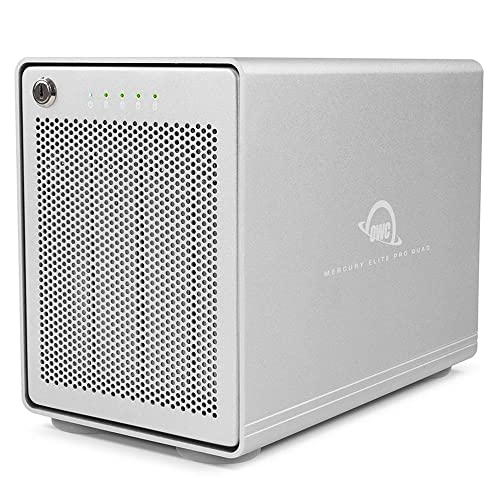
- Four bays for 2.5-inch or 3.5-inch SATA drives
- USB 3.2 10Gb/s with up to 947MB/s performance
- Supports software RAID configurations
Best For: Four-drive desktop storage and RAID expansion
Best Plug-and-Play DAS

- Four-bay diskless enclosure with independent disks
- USB 3.2 Gen 2 Type-C works with Thunderbolt 4
- Tool-free trays and hot-swappable drive support
Best For: Simple multi-drive storage without RAID
Best NVMe Performance
OWC Express 4M2 USB4 Enclosure

- Four slots for 2230, 2242, or 2280 NVMe SSDs
- USB4 40Gb/s with up to 3,200MB/s claimed performance
- Aluminum body with adaptive cooling fans
Best For: High-speed NVMe storage and creative workloads
Best High-Capacity Pick

- Eight SATA bays for up to 192TB total listed capacity
- 40Gbps USB4 with Thunderbolt 3/4/5 compatibility
- Removable trays, individual switches, and smart fan cooling
Best For: High-capacity non-RAID home or office storage
Best Thunderbolt-Certified Option
OWC ThunderBay 8 Storage Enclosure

- Eight universal bays for 2.5-inch or 3.5-inch SATA drives
- Dual Thunderbolt ports enable daisy-chaining
- Plug-and-play Mac and Windows support with cable included
Best For: Expandable Thunderbolt storage systems
Best Hybrid RAID Pick

- Two SATA bays plus two NVMe bays in one enclosure
- RAID 1, RAID 0, and LARGE storage modes
- 40Gbps USB4, Thunderbolt compatibility, and 8K output
Best For: Creative workflows mixing archive drives and fast NVMe storage
Flexible RAID Workhorse – OWC ThunderBay 4 Four-Bay Enclosure
If you need a hard drive enclosure with thunderbolt 4 for a multi-drive desktop setup, the OWC ThunderBay 4 offers four SATA bays and dual Thunderbolt ports. It supports both 3.5-inch and 2.5-inch drives, delivers up to 1527MB/s sustained performance, and works with Mac and Windows systems equipped with Thunderbolt over USB-C.
Best For: Users building a flexible four-drive storage array with software RAID options.
Pros:
- Holds up to four 3.5-inch or 2.5-inch SATA drives without adapters.
- Supports RAID 0, 1, 4, 5, and 1+0 (10) configurations.
- Aluminum chassis is designed for heat dissipation and quiet operation.
- Includes dual Thunderbolt 3 ports and a three-year limited warranty.
Cons:
- Uses Thunderbolt 3 rather than Thunderbolt 4.
- Drives are not included in the listed 0TB configuration.
- Its four-bay desktop design is relatively heavy and bulky.
The ThunderBay 4 is a strong choice when expandability and RAID flexibility matter more than portability. Just confirm that your computer has a compatible Thunderbolt connection before buying.
High-Capacity Hybrid Hub – TerraMaster D8 Hybrid 2
The TerraMaster D8 Hybrid 2 is a versatile alternative for shoppers comparing a hard drive enclosure with thunderbolt 4. It connects over USB-C at up to 10Gbps, supports four SATA drives plus four M.2 2280 NVMe SSDs, and is compatible with Thunderbolt 4 systems as well as Windows, macOS, Linux, and NAS operating systems.
Best For: Users who want high-capacity, independently managed HDD and NVMe expansion in one enclosure.
Pros:
- Supports eight independent drives: four SATA and four M.2 NVMe.
- Offers up to 152TB of combined stated capacity.
- Includes power-management modes and TPC Backupper software.
- Plug-and-play compatibility with USB 4, USB 3.x, and Thunderbolt systems.
Cons:
- Uses USB 3.2 Gen 2 at up to 10Gbps, not a 40Gbps Thunderbolt connection.
- Does not include built-in RAID.
- Drives are not included.
This enclosure prioritizes capacity and configuration freedom over Thunderbolt-native speed. It is a practical fit for mixed-drive storage, but buyers needing hardware RAID or 40Gbps transfers should look elsewhere.
RAID-Ready Creator Array – OWC ThunderBay 4 with SoftRAID
For a hard drive enclosure with thunderbolt 4-style high-speed workflow needs, the OWC ThunderBay 4 with SoftRAID provides four SATA bays and Thunderbolt connectivity for Mac and PC systems. It supports 3.5-inch or 2.5-inch drives, reaches up to 1527MB/s, and includes SoftRAID Premium for creating and monitoring storage arrays.
Best For: Creative professionals who want managed RAID features for a four-drive Thunderbolt storage system.
Pros:
- Accepts four 3.5-inch or 2.5-inch SATA drives without adapters.
- Supports RAID 0, 1, 4, 5, 10, and JBOD configurations.
- Includes a three-year SoftRAID Premium subscription.
- Provides dual Thunderbolt 3 ports and up to 1527MB/s performance.
Cons:
- Uses Thunderbolt 3 rather than Thunderbolt 4.
- Requires separate drives; the enclosure is listed with 4TB capacity but is drive-dependent.
- Large 4-bay chassis is intended for desktop use.
The included SoftRAID software makes this model especially appealing for users who need clearer RAID setup and monitoring. It remains a Thunderbolt 3 enclosure, so check host compatibility and expected workflow speeds before purchase.
Portable NVMe Speed Dock – ORICO 40Gbps M.2 Enclosure
The ORICO 8848U4 is a compact hard drive enclosure with thunderbolt 4 compatibility for users who prefer all-flash storage. Its USB 4.0 interface provides up to 40Gbps bandwidth, while four M.2 NVMe bays support up to 32TB total and single-disk speeds of up to 10Gbps.
Best For: Video editors, music producers, and mobile professionals using multiple NVMe SSDs.
Pros:
- Four M.2 NVMe bays support 2230, 2242, 2260, and 2280 drives.
- Supports up to 32TB total capacity with up to 8TB per drive.
- Compact, fan-cooled aluminum design is suited to portable workflows.
- Provides USB 4.0 bandwidth up to 40Gbps.
Cons:
- SSD modules are not included.
- Listed single-disk read and write speed is up to 10Gbps, not 40Gbps.
- Has a one-year warranty and is listed for PC compatibility.
This model is a compelling choice for a quiet, portable all-SSD setup, especially when handling large media files. Confirm your computer supports the required USB 4.0 connection and that your NVMe drives match the supported formats.
Best RAID-Ready Enclosure – OWC Mercury Elite Pro Quad
If you need a hard drive enclosure with Thunderbolt 4 compatibility for a multi-drive desktop setup, the OWC Mercury Elite Pro Quad provides four universal bays and up to 947MB/s performance over USB-C. It supports 2.5-inch and 3.5-inch SATA drives and works with USB-C or Thunderbolt 3-equipped Mac and Windows computers.
Best For: Users building a four-drive external storage enclosure with software RAID support.
Pros:
- Four bays support both 2.5-inch and 3.5-inch drives
- USB 3.2 10Gb/s interface can deliver up to 947MB/s
- Supports software RAID configurations
Cons:
- Drives are not included
- SoftRAID software is not included
- Listed compatibility specifically mentions Thunderbolt 3 rather than Thunderbolt 4
This is a practical choice when drive flexibility and RAID expandability matter more than a native Thunderbolt 4 connection. Its four-bay design makes it better suited to desktop storage projects than simple single-drive expansion.
Best Plug-and-Play DAS – TerraMaster D4-320
The TerraMaster D4-320 is a diskless four-bay DAS for shoppers seeking a hard drive enclosure with Thunderbolt 4 compatibility. Its USB 3.2 Gen 2 Type-C interface reaches up to 10Gbps, supports Windows, Mac, and Linux, and can connect to USB 3.0 through Thunderbolt 4 systems.
Best For: Users who want simple, tool-free access to four independent SATA drives without RAID.
Pros:
- Supports four 3.5-inch HDDs, 2.5-inch HDDs, or 2.5-inch SATA SSDs
- Hot-swappable, tool-free drive trays simplify maintenance
- Temperature-controlled cooling and noise-reduction features support quieter operation
Cons:
- Does not provide a RAID function
- Diskless design requires separately purchased drives
- USB 3.2 Gen 2 is limited to 10Gbps
The D4-320 emphasizes convenience rather than RAID management. Hot swapping, plug-and-play setup, and broad operating-system support make it a straightforward option for independent external disks and routine storage expansion.
Best NVMe Performance – OWC Express 4M2 USB4 Enclosure
For high-speed solid-state storage, the OWC Express 4M2 is a strong hard drive enclosure with Thunderbolt 4 compatibility, using USB4 40Gb/s connectivity and four NVMe M.2 slots. It supports USB4, Thunderbolt, and USB-C Macs and PCs, with claimed real-world performance up to 3,200MB/s.
Best For: Creative and performance-focused users assembling a fast four-drive NVMe enclosure.
Pros:
- Four slots accept NVMe M.2 2230, 2242, or 2280 SSDs
- USB4 40Gb/s connectivity supports up to 3,200MB/s real-world performance
- Aluminum construction helps protect drives and dissipate heat
Cons:
- NVMe SSDs are not included
- Performance depends on the installed drives and host connection
- Its four-slot NVMe design is more specialized than a conventional SATA enclosure
The Express 4M2 is the performance-oriented choice in this group. Its USB4 and Thunderbolt compatibility, adaptable M.2 support, and SoftRAID capabilities make it appropriate for demanding storage workflows when you are prepared to supply your own NVMe drives.
Best High-Capacity Pick – IO CREST 8-Bay USB4 Enclosure
If you need a hard drive enclosure with Thunderbolt 4 support for a large home or office storage setup, this eight-bay IO CREST model offers substantial capacity and straightforward drive management. Its USB4 interface supports transfers up to 40Gbps, while compatibility with Thunderbolt 3, 4, and 5 makes it flexible across newer systems.
Best For: Users building a high-capacity, non-RAID SATA storage center for a home office or business workspace.
Pros:
- Supports up to eight 2.5-inch or 3.5-inch SATA drives, with up to 24TB per drive.
- USB4 40Gbps connectivity and compatibility with Thunderbolt 3/4/5.
- Removable trays and individual power switches simplify drive organization.
- Built-in thermal-sensor fan offers automatic or manual three-level cooling.
Cons:
- Does not support RAID or NAS functionality.
- Its seven-pound aluminum enclosure is relatively large for a desktop accessory.
- Drive capacity and performance depend on the installed SATA drives.
This is a practical choice when maximum bay count matters more than RAID features. The individual switches, removable trays, and active cooling make it well suited to centralized storage, but buyers seeking redundancy or network access should look elsewhere.
Best Thunderbolt-Certified Option – OWC ThunderBay 8 Storage Enclosure
The OWC ThunderBay 8 is a strong contender if you want a hard drive enclosure with Thunderbolt 4 support through backward-compatible Thunderbolt connectivity. It provides eight universal bays for 2.5-inch or 3.5-inch SATA drives and is designed for plug-and-play use with Mac and Windows systems.
Best For: Mac and Windows users who want an eight-bay Thunderbolt storage enclosure with daisy-chain expansion.
Pros:
- Eight bays accept both 2.5-inch and 3.5-inch SSDs or HDDs.
- Dual Thunderbolt 3 ports support daisy-chaining up to six units or additional Thunderbolt devices.
- Thunderbolt-certified for Mac and Windows, with no drivers required.
- Includes thumb-screw release trays and a Thunderbolt cable.
Cons:
- The supplied specifications identify Thunderbolt 3 rather than a native Thunderbolt 4 interface.
- No RAID capability is stated in the supplied product details.
- It is a substantial enclosure at approximately 7.3 kg.
Choose the ThunderBay 8 when Thunderbolt workflow integration and expansion are priorities. Its dual ports and universal bays are useful for growing storage setups, though buyers should verify the exact Thunderbolt compatibility and warranty terms before purchase.
Best Hybrid RAID Pick – ACASIS 4-Bay USB4 Enclosure
For buyers who want a hard drive enclosure with Thunderbolt 4 support plus faster SSD storage, the ACASIS hybrid enclosure combines SATA and NVMe bays in one aluminum chassis. Its USB4 40Gbps host connection works with USB4 and Thunderbolt 3/4/5 systems, while RAID modes and video output add flexibility for demanding workflows.
Best For: Creative users who need a mix of high-capacity SATA storage, NVMe performance, RAID options, and 8K display support.
Pros:
- Combines two SATA bays for 2.5-inch or 3.5-inch drives with two NVMe bays supporting 2230–2280 SSDs.
- Offers hardware RAID 1 for HDDs, software RAID 0 for NVMe drives, and a LARGE mode for unified capacity.
- USB4 40Gbps connectivity is compatible with Thunderbolt 3/4/5 and supports 8K at 60Hz video output.
- Active cooling and a 96W power supply help support sustained workloads.
Cons:
- Full 40Gbps performance requires NVMe RAID mode and a compatible USB4 or Thunderbolt port.
- The SATA bays are listed at 5Gbps, below the NVMe section’s maximum speed.
- RAID setup, drive compatibility, and final capacity depend on the installed drives.
This is the most versatile option of the three for mixed storage needs, especially when active projects benefit from NVMe speed while archives remain on larger SATA drives. Its additional RAID and display features add capability, but they also make setup more involved than a basic multi-bay enclosure.
How We Picked the Best Hard Drive Enclosure with Thunderbolt 4
We focused on enclosure design, drive compatibility, connectivity, expansion potential, and practical storage features. The lineup includes Thunderbolt and USB4-class models, SATA-only systems, NVMe enclosures, hybrid designs, and larger multi-bay units. We also considered whether each enclosure supports RAID, hardware or software management, active cooling, diskless installation, and the workflow demands of large photo, video, and backup libraries.
Because drive capacity, RAID configuration, and host-computer support vary, advertised interface speeds should be treated as maximum link rates rather than guaranteed file-transfer performance.
Quick Comparison
- Best for Thunderbolt expansion: OWC ThunderBay models offer fast connectivity and multiple bays for demanding desktop workflows.
- Best for NVMe performance: OWC Express 4M2 and the ORICO all-flash enclosure target users working with several M.2 SSDs.
- Best for mixed media: TERRAMASTER D8 Hybrid and the ACASIS hybrid design combine SATA and NVMe storage options.
- Best for high drive counts: The OWC ThunderBay 8 and eight-bay USB4 enclosure provide room for larger arrays.
- Best for straightforward SATA expansion: TERRAMASTER D4-320 offers a simpler four-bay approach for compatible hard drives and SSDs.
Key Buying Factors for a Hard Drive Enclosure with Thunderbolt 4
Host and Cable Compatibility
Confirm that your computer has a genuine Thunderbolt 4 port if you need Thunderbolt features such as high sustained bandwidth, daisy-chaining, or broad peripheral compatibility. USB4 and USB-C connectors can look identical but may offer different capabilities. Use a properly rated cable, especially for 40Gbps operation.
Drive Type and Bay Layout
Check whether the enclosure accepts 2.5-inch drives, 3.5-inch drives, M.2 NVMe SSDs, or a combination. A SATA enclosure is generally easier to populate with inexpensive high-capacity hard drives, while an NVMe model is better suited to low-latency scratch disks and active editing. Hybrid units provide flexibility but may involve more complicated software and thermal requirements.
RAID, Redundancy, and Backup
RAID 0 can increase throughput but sacrifices fault tolerance. RAID 1 protects against a single drive failure at the cost of usable capacity, while RAID 5 or similar options can balance capacity and redundancy when supported. RAID is not a substitute for an independent backup, so keep important files on another device or cloud service.
Cooling, Noise, and Sustained Performance
Large drives and NVMe SSDs generate heat during long transfers. Look for active fans, ventilation, replaceable or adjustable cooling, and a design suitable for your workspace. A quieter enclosure may be preferable in an office or studio, while editors handling sustained 4K or 8K footage should prioritize thermal stability.
Who Should Buy Which Hard Drive Enclosure with Thunderbolt 4?
Choose a Thunderbolt-focused enclosure if you use a compatible Mac or Windows workstation and regularly move large project files. Choose an NVMe enclosure for the fastest scratch storage and responsive editing. A multi-bay SATA model is usually the better value for backups, archives, and high-capacity media libraries. Hybrid enclosures suit users who want both affordable hard-drive capacity and faster SSD tiers. Finally, select an eight-bay system if you expect your storage needs to grow or want more flexibility for a larger RAID pool.