The right amplifier can turn passive speakers into a more capable, better-matched audio system without forcing you to replace the speakers you already own. The best choice depends on power demands, room size, connectivity, and whether you need a compact desktop amp or a full-size component.
We compared 10 standout models across those priorities, including Class D mini amplifiers, integrated stereo amps, Bluetooth options, and professional rack-mount designs. Use the guide below to narrow the list by performance, features, and installation needs.
Best 10 Power Amplifiers for Passive Speakers Picks for 2026
Compact High-Power Pick
Fosi Audio V3 Stereo Amplifier

- Up to 600W total output
- TPA3255 Class D design
- Compact, cool-running chassis
Best For: Desktop, bookshelf, and compact home-theater systems
Versatile Integrated Choice
Yamaha A-S301BL Stereo Amplifier

- Optical and coaxial digital inputs
- Phono and analog connectivity
- Speaker A/B and subwoofer output
Best For: Flexible home stereo systems with multiple sources
Professional Venue Power
Rockville RPA9 Rackmount Amplifier
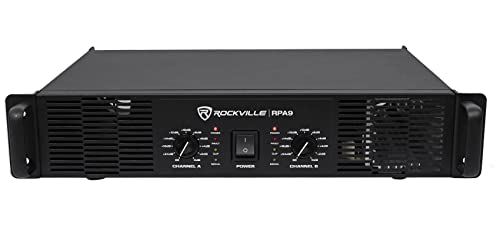
- 800W RMS and 3000W peak output
- Stereo and bridged modes
- Pro inputs and speakON outputs
Best For: DJs, live events, and rack-mounted audio systems
Modern Hi-Fi Upgrade

- Up to 100W per channel at 8Ω
- High-resolution optical and coaxial playback
- Direct analog input and WiiM integration
Best For: High-resolution systems using WiiM streamers or digital sources
Reliable Analog Power

- Two-channel Class A/B design
- Quiet operation for near-field use
- Adjustable 50–150 Hz low-pass crossover
Best For: Stereo passive speakers and acoustic-measuring setups
Wireless High-Output Value
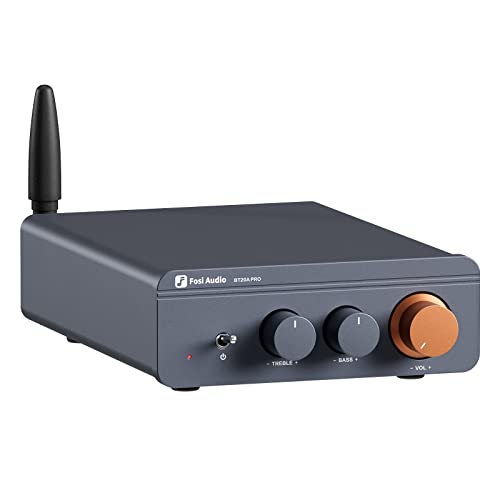
- Bluetooth 5.0 wireless playback
- Up to 300 watts x 2 claimed output
- Swappable op-amps and tone controls
Best For: Compact wireless passive-speaker systems
Flexible Balanced Amplification

- Stereo or mono operating modes
- Balanced XLR/1/4-inch TRS input
- 12V trigger and 48V power supply included
Best For: Expandable home-audio and balanced-source systems
High-Power Compact Choice

- Up to 300W per channel
- RCA input with tone controls
- Protection circuits and compact design
Best For: High-output home stereo and gaming setups
Simple Wireless Pick
BT20A Bluetooth Stereo Amplifier
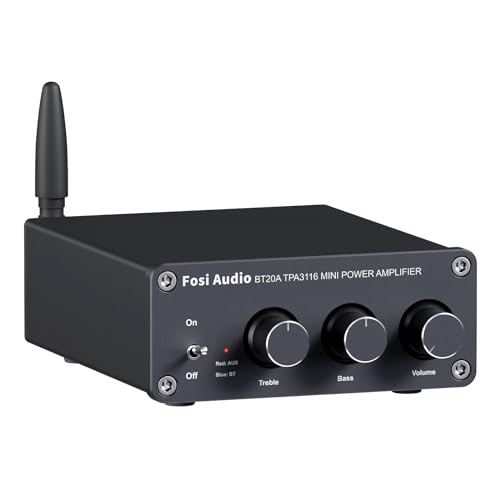
- Bluetooth and RCA inputs
- Up to 100W per channel
- Compact with bass and treble controls
Best For: Easy home, garage, patio, and bookshelf audio
Compact High-Power Pick – Fosi Audio V3 Stereo Amplifier
For listeners seeking power amplifiers for passive speakers in a compact format, the Fosi Audio V3 offers up to 600W total output for 2–8Ω speakers. Its Class D design, adjustable pre-out, and desktop-friendly size suit bookshelf, tower, and home-theater setups.
Best For: Desktop systems, bookshelf speakers, and compact home theaters that need substantial power.
Pros:
- Up to 600W total output for compatible 2–8Ω speakers.
- TPA3255 Class D circuitry and premium capacitors support clear, low-distortion sound.
- Top-and-bottom vents and a full-body heatsink aid cooling.
- Swappable op-amps and volume-controlled pre-out add flexibility.
Cons:
- Its compact design provides fewer connection and control options than larger integrated amplifiers.
- Op-amp upgrades require separately sourced components and user installation.
The V3 is a strong choice when you want high output in a small enclosure and appreciate the option to customize the sound. The included 48V power supply helps it deliver its rated performance.
Versatile Integrated Choice – Yamaha A-S301BL Stereo Amplifier
The Yamaha A-S301BL is a practical option among power amplifiers for passive speakers when you want an integrated stereo amplifier with both digital and analog connectivity. It includes coaxial and optical inputs, phono support, speaker A/B or A+B selection, and a subwoofer output.
Best For: Traditional stereo systems using multiple sources, two speaker pairs, or a powered subwoofer.
Pros:
- Includes digital coaxial and optical inputs.
- Supports analog sources, including phono.
- Offers Speaker A, B, and A+B output options.
- Provides a dedicated subwoofer output.
Cons:
- At 19.8 pounds, it is less suited to portable or space-constrained installations.
- The supplied notes do not specify its power rating or detailed connectivity beyond the listed inputs and outputs.
Choose the A-S301BL if system flexibility matters more than an ultra-small footprint. Its combination of digital inputs, phono connectivity, speaker switching, and subwoofer support makes it adaptable for everyday stereo listening.
Professional Venue Power – Rockville RPA9 Rackmount Amplifier
For larger systems needing power amplifiers for passive speakers, the Rockville RPA9 is built around professional and DJ use. It delivers 800W RMS and 3000W peak output, supports stereo or bridged operation, and provides XLR, 1/4-inch, and RCA inputs with speakON and banana outputs.
Best For: DJs, live events, touring setups, and rack-mounted professional audio systems.
Pros:
- Rated for 800W RMS and 3000W peak output.
- Stereo and bridged modes provide installation flexibility.
- Supports XLR, 1/4-inch, and RCA inputs.
- Dual fans, heatsinks, and a rugged metal 2U chassis suit extended use.
Cons:
- The 2U rackmount form factor is excessive for most desktop or casual home systems.
- Fan-based cooling may be less suitable for quiet listening rooms.
- Its professional connectors and controls may require additional system equipment.
The RPA9 makes the most sense when you need substantial output, durable construction, and pro-audio connectivity. For a home bookshelf setup, its size and venue-oriented features are likely more than necessary.
Modern Hi-Fi Upgrade – WiiM Vibelink Amp
The WiiM Vibelink Amp is a streamlined choice among power amplifiers for passive speakers, pairing digital high-resolution inputs with a direct analog path. It delivers 100W per channel at 8Ω through digital inputs, 200W per channel at 4Ω, and 60W when using RCA input; it does not provide built-in streaming.
Best For: Passive-speaker systems using WiiM streamers or high-resolution optical and coaxial sources.
Pros:
- Supports up to 100W per channel at 8Ω and 200W at 4Ω with digital input.
- Optical and coaxial inputs support bit-perfect 192kHz/24-bit playback.
- Pure analog input bypasses ADC conversion.
- Aluminum construction, copper heat pipe, and graphene heatsink support thermal management.
Cons:
- It is a pure power amplifier and does not include streaming functions.
- RCA input output is limited to 60W per channel.
- Its strongest integration features are geared toward WiiM streamer owners.
The Vibelink Amp is a good fit for listeners building a modern, separate-component system around passive speakers. Verify your desired input type before buying, since output differs between analog and digital sources and streaming requires a separate device.
Reliable Analog Power – Dayton Audio APA150
The Dayton Audio APA150 is a straightforward choice among power amplifiers for passive speakers when you want a two-channel Class A/B design with a generous 10 Hz–40 kHz frequency response. Its quiet operation, cool-running output transistors, and adjustable low-pass crossover make it practical for home audio and near-field setups.
Best For: Stereo passive speakers, high-resolution playback, and acoustic-measuring applications.
Pros:
- Class A/B topology is designed for low distortion and reliability.
- Quiet fan operation suits near-field listening.
- Adjustable 50–150 Hz low-pass crossover adds setup flexibility.
- Wide 10 Hz–40 kHz frequency response.
Cons:
- Does not include Bluetooth or other wireless connectivity.
- Its 150-watt output is lower than the higher-output Fosi options in this roundup.
The APA150 favors dependable, conventional amplification over extra features. Choose it when quiet analog operation and a useful crossover matter more than wireless streaming or compact Class D efficiency.
Wireless High-Output Value – Fosi Audio BT20A Pro
The Fosi Audio BT20A Pro combines Bluetooth 5.0 with a compact two-channel Class D amplifier, making it one of the more flexible power amplifiers for passive speakers. Its TPA3255 platform is rated at up to 300 watts per channel, while bass and treble controls and replaceable op-amps allow further sound customization.
Best For: Passive-speaker systems that need wireless playback, tone controls, and a small footprint.
Pros:
- Bluetooth 5.0 provides convenient wireless connectivity and pairing memory.
- Rated output reaches 300 watts x 2.
- Replaceable op-amps support experimentation with different compatible models.
- Bass and treble controls allow simple tonal adjustment.
Cons:
- It requires the included 32V/5A power adapter.
- Bluetooth and tone controls may be unnecessary in a purely wired system.
The BT20A Pro is a strong fit for buyers who want substantial claimed output in a mini amplifier without giving up wireless convenience. Its upgradeable op-amp design also makes it more adaptable than a basic plug-and-play receiver.
Flexible Balanced Amplification – Fosi Audio ZA3
The Fosi Audio ZA3 is a versatile option among power amplifiers for passive speakers, offering stereo and mono modes in a compact two-channel chassis. It supports balanced XLR or 1/4-inch TRS input, a 12V trigger, and up to 180 watts in stereo or 235 watts in mono with the included 48V power supply.
Best For: Desktop, home-theater, or expandable systems using balanced sources or mono amplifier configurations.
Pros:
- Switches between stereo and mono operation for flexible system planning.
- Balanced combo input can help minimize interference and noise.
- 12V trigger input supports synchronized power control.
- Improved ventilation and dust covers support sustained operation.
Cons:
- Its advanced connections and modes may be more than a simple stereo setup needs.
- Mono operation at the stated maximum requires suitable system configuration; two units can be paired for a larger system.
The ZA3 is the most system-oriented choice here. Its balanced input, trigger connection, selectable operating modes, and op-amp rolling make it particularly appealing when you expect to refine or expand a passive-speaker setup.
High-Power Compact Choice – TB10D 600W Stereo Amplifier
The Fosi Audio TB10D is a strong option among power amplifiers for passive speakers when you want substantial two-channel output in a compact enclosure. Its TPA3255 design delivers up to 300 watts per channel and includes RCA connectivity, passive-speaker outputs, and adjustable bass and treble controls.
Best For: Home audio, gaming setups, studios, and listeners who want high output with simple tone adjustment.
Pros:
- Up to 300 watts per channel from the TPA3255 chip
- Supports 2–8 ohm bookshelf speakers
- RCA input, passive-speaker output, and bass/treble controls
- Built-in protection circuits and compact 2.4-pound design
Cons:
- Connectivity is centered on RCA rather than a broad range of inputs
- Its high power output may exceed the needs of smaller casual listening setups
The TB10D is a practical pick if power and flexibility matter more than extra features. It can anchor a home stereo or entertainment setup while remaining small enough for a desk, shelf, or studio.
Simple Wireless Pick – BT20A Bluetooth Stereo Amplifier
The Fosi Audio BT20A is a straightforward choice among power amplifiers for passive speakers, combining Bluetooth streaming with RCA input in a small Class D enclosure. Rated at up to 100 watts per channel, it is designed for convenient home, office, garage, patio, and bookshelf-speaker use.
Best For: Buyers who want easy wireless music playback and basic amplification for indoor or outdoor passive-speaker systems.
Pros:
- Bluetooth and RCA inputs support flexible source connections
- Up to 100 watts per channel
- Compact design fits offices, bedrooms, garages, and shelves
- Bass and treble controls allow simple sound adjustment
Cons:
- Provides fewer connection and customization options than more advanced amplifiers
- Maximum output is lower than the other listed high-power models
The BT20A focuses on uncomplicated operation rather than extensive features. Its Bluetooth support and one-touch power switch make it especially convenient for everyday listening with compatible passive speakers.
Tunable Hi-Fi Upgrade – Douk Audio A5 TPA3255 Power Amp
The Douk Audio A5 is a feature-focused option among power amplifiers for passive speakers, offering up to 300 watts per channel alongside an adjustable 30–200Hz high-pass filter. Its TPA3255 platform, PFFB circuitry, and accessible op-amp design make it suited to listeners who want to refine a two-channel home audio system.
Best For: Hi-fi listeners, home theater users, and audiophiles who want high output and hands-on sound customization.
Pros:
- Up to 300 watts per channel with the TPA3255 chip
- Adjustable high-pass filter helps limit low-frequency interference
- Accessible op-amps support plug-and-play sound experimentation
- Compact aluminum chassis with PFFB technology and a 32V/5A adapter
Cons:
- The enthusiast-oriented controls and op-amp access may be unnecessary for simple systems
- Its supplied specifications emphasize a 32V power setup, so system matching still matters
The A5 stands out for combining substantial output with adjustment options uncommon in compact amplifiers. It is a compelling choice when speaker integration and future sound tuning are more important than minimalist operation.
How We Picked the Best Power Amplifiers for Passive Speakers
We evaluated each amplifier by its intended use, rated output, connectivity, size, and practical flexibility. The selection includes compact Class D models for desks and small rooms, integrated amplifiers for traditional stereo systems, Bluetooth-equipped options for convenient streaming, and higher-output designs for demanding speakers or larger spaces.
Because published wattage is not the only measure of performance, we also considered channel configuration, speaker compatibility, controls, expansion options, and whether the amplifier suits casual listening, home theater, outdoor audio, or professional-style installations.
Quick Comparison
| Best For | Look For |
|---|---|
| Desktop or small-room listening | Compact Class D design, simple inputs, moderate output |
| Traditional home stereo | Integrated inputs, dependable controls, clean analog connectivity |
| Wireless streaming | Built-in Bluetooth or network streaming support |
| Large rooms or demanding speakers | Higher continuous power, stronger cooling, suitable impedance support |
| Rack or DJ installations | Rack-mount hardware, robust connections, front-panel monitoring |
Key Buying Factors for Power Amplifiers for Passive Speakers
Power and Speaker Matching
Check both the amplifier’s power rating and your speakers’ recommended range. More watts can provide useful headroom, but excessive volume, clipping, or an impedance mismatch can damage equipment. Confirm that the amplifier supports your speakers’ nominal impedance and use gain responsibly.
Inputs and Streaming
Decide whether you need RCA, optical, AUX, balanced connections, Bluetooth, or network streaming. Bluetooth is convenient for phones and tablets, while wired inputs are often preferable for fixed sources such as CD players, turntables with a phono stage, or televisions.
Size, Cooling, and Controls
Mini amplifiers fit neatly on desks and shelves, but larger systems may benefit from better ventilation, substantial power supplies, and accessible volume controls. Leave adequate airflow around any amplifier, particularly when it will run at high volume for extended periods.
Mono, Stereo, and Expansion Options
Most home systems need two stereo channels. Some models can be bridged or configured for mono operation, which may help with a subwoofer or specialized installation. Verify the manufacturer’s supported configuration before connecting speakers this way.
Who Should Buy Which Power Amplifiers for Passive Speakers?
Choose a compact Class D amplifier if you want an affordable, space-saving solution for bookshelf speakers, a desktop, bedroom, or small living room. Choose an integrated stereo amplifier if you prefer traditional source connections and hands-on control in a more conventional hi-fi setup.
Choose a Bluetooth model if wireless playback is your priority and you want quick access to music from mobile devices. Choose a higher-output or rack-mount amplifier for larger rooms, louder listening, DJ use, or installations where durability and sustained output matter more than minimal size.
Before ordering, confirm the speaker impedance, available source connections, amplifier dimensions, and required power level. Those checks will usually matter more than the largest headline wattage.