A 12V trigger can make a power amplifier easier to live with by letting a compatible preamp, DAC, streamer, or home-theater receiver control its power state automatically.
Our roundup covers 10 options ranging from compact desktop amplifiers to high-output monoblocks and bridgeable rack-style models. The right choice depends on speaker demands, system connections, available space, and whether trigger control is built in or added through an accessory.
Best 10 Power Amplifiers with 12v Trigger Picks for 2026
High-Power Mono Choice
Topping B200 Mono 200W Power Amplifier

- 200W mono output with selectable gain
- Balanced XLR/TRS inputs
- 12V trigger for linked power control
Best For: Balanced high-power audio systems
Connected Stereo Hub
AIYIMA A80 Bluetooth DAC Stereo Amplifier

- Integrated DAC and Bluetooth
- Up to 300W*2 Class D output
- 12V trigger plus stereo/2.1 support
Best For: Flexible home audio and digital sources
Budget Installation Amp
Monoprice Unity 100-Watt Power Amp
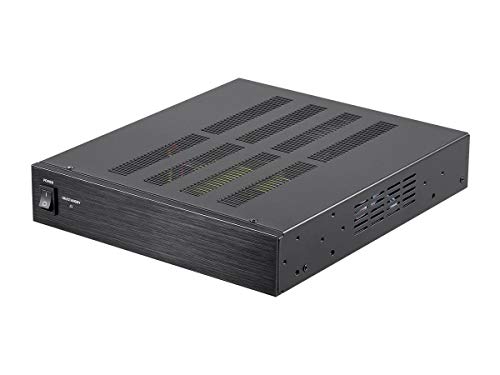
- Two channels with bridgeable operation
- 12V input and output triggers
- Euroblock connectors for installations
Best For: Affordable integrated audio installations
Balanced 2.1 Specialist
AIYIMA A20 Fully Balanced Stereo Amplifier

- 300W*2 PFFB Class D design
- Adjustable high-pass filter and sub out
- 12V trigger with bypass mode
Best For: Balanced 2.1 audiophile systems
Best Trigger Add-On
BobWire DAT1 Digital Audio Trigger
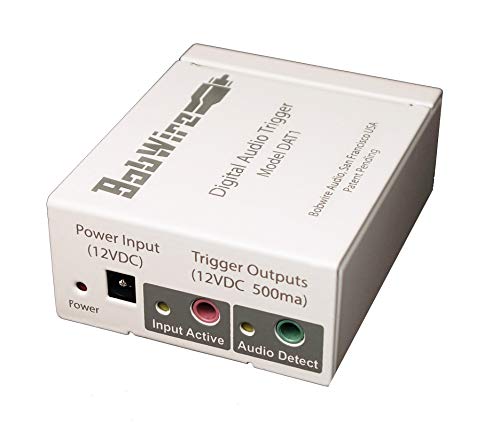
- Adds two 12V trigger outputs
- Supports optical PCM sources
- Not compatible with AVR power control
Best For: Stand-alone amplifiers and optical-source systems
Best Compact Monoblock
GaN 300W Mini Class D Amplifier

- Up to 300W into 4 ohms
- Includes 12V trigger control
- One channel per amplifier
Best For: Compact desktop and home HiFi systems
Best Rack-Mountable Option
Monoprice Unity 200W Bridgeable Amp

- Stereo or bridged operation
- 12V trigger input and output
- Includes rack-mount ears
Best For: Installed and multi-amplifier audio systems
High-Output Mono Choice
TOPPING B200 Mono Power Amplifier
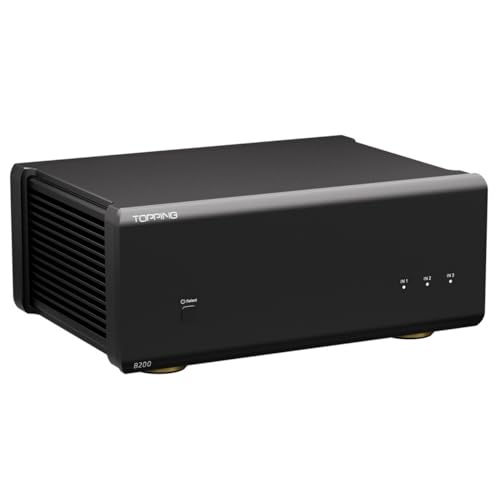
- 200W mono output for demanding speakers
- NFCA design with very low distortion
- Balanced inputs and 12V trigger
Best For: Audiophile stereo systems built with two mono amplifiers
Compact Balanced Performer
Topping Mini 300 Stereo Power Amp

- Up to 140W x 2 into 4 ohms
- Balanced TRS and RCA inputs
- 12V trigger with protection features
Best For: Compact desktop Hi-Fi and professional monitoring
Adjustable Stereo Value
SMSL AO10 2-Channel Class D Amplifier

- Up to 100W x 2 output
- 12V trigger for synchronized power
- Seven EQ modes plus bass and treble controls
Best For: Desktop and home audio systems needing flexible sound tuning
High-Power Mono Choice – Topping B200 Mono 200W Power Amplifier
The Topping B200 is a strong option when shopping for power amplifiers with 12v trigger support and a high-output mono design. Its 200W output, selectable gain, balanced XLR/TRS inputs, and NFCA discrete amplification suit demanding speaker systems.
Best For: Audiophiles building a balanced system with one amplifier per channel.
Pros:
- 200W mono output with high- and low-gain options
- Three balanced XLR/TRS inputs
- 12V trigger input enables linked power control
- Designed for detailed music reproduction
Cons:
- Mono design requires two units for a balanced stereo setup
- Specified for 220V power
The B200 is best suited to listeners prioritizing output and balanced connectivity over all-in-one convenience. Its 12V trigger adds useful system automation for compatible equipment.
Connected Stereo Hub – AIYIMA A80 Bluetooth DAC Stereo Amplifier
The AIYIMA A80 combines a DAC, Bluetooth, and stereo Class D amplification in one component, making it a versatile choice among power amplifiers with 12v trigger support. It offers up to 300W per channel, balanced TRS input, and broad digital connectivity.
Best For: Home listeners who want one amplifier for streaming, digital sources, and stereo or 2.1 setups.
Pros:
- Integrated ESS9038Q2M DAC and TPA3255 amplifier
- Bluetooth, USB, optical, coaxial, and balanced TRS inputs
- Supports 12V trigger integration
- Subwoofer pre-out and tone controls add setup flexibility
Cons:
- More feature-rich than a dedicated power amplifier
- Product notes describe the output as up to 300W*2 without further system qualification
The A80 is a practical fit when connectivity matters as much as amplification. Its remote, digital VU display, and 12V trigger make it convenient for modern home audio systems.
Budget Installation Amp – Monoprice Unity 100-Watt Power Amp
The Monoprice Unity is a straightforward two-channel option for shoppers comparing power amplifiers with 12v trigger connections. It provides 120W of listed output, bridgeable operation, Euroblock connectors, and both 12V input and output triggers for system control.
Best For: Cost-conscious installations needing bridgeable amplification and trigger pass-through.
Pros:
- Two-channel design with bridgeable operation
- 12V input and output triggers
- Euroblock connectors suit installation-oriented wiring
- Listed 120W output
Cons:
- Supplied details provide limited information about audio performance
- Listed with no warranty
The Unity focuses on practical system integration rather than extensive feature sets. Its trigger input and output can simplify coordinated power control in compatible setups.
Balanced 2.1 Specialist – AIYIMA A20 Fully Balanced Stereo Amplifier
The AIYIMA A20 is aimed at enthusiasts who want power amplifiers with 12v trigger support and more control over a 2.1 system. Its fully balanced inputs, adjustable high-pass filter, subwoofer output, bypass mode, and stated 300W*2 PFFB design support flexible system matching.
Best For: Audiophiles building a balanced stereo system with a subwoofer and automated power control.
Pros:
- Fully balanced XLR/RCA input configuration
- Adjustable 60–200Hz high-pass filter and subwoofer output
- 12V trigger and bypass mode support system integration
- Stated 116dB SNR and 0.002% THD+N
Cons:
- Designed around enthusiast-oriented setup features
- Power adapter is an external 48V, 5A unit
The A20 stands out for adding crossover and preamp-integration tools that many compact amplifiers omit. It is particularly compelling when speaker protection and subwoofer blending are priorities.
Best Trigger Add-On – BobWire DAT1 Digital Audio Trigger
The BobWire DAT1 is a practical way to add 12V trigger control to compatible audio equipment. It accepts a digital/optical audio source and provides two 12V trigger outputs for switching stand-alone amplifiers and other accessories. Note that it is not intended to turn on an AVR.
Best For: Adding trigger-based power control to stand-alone amplifiers, TV lifts, speaker selectors, and similar accessories in systems using optical audio.
Pros:
- Provides two 12V trigger outputs with different source/action options.
- Works with compatible TVs, streamers, DACs, and optical-output devices.
- Includes a 192kHz/24-bit Cirrus Logic DAC for PCM analog output.
Cons:
- Does not turn on surround receivers or AVRs.
- Requires a 12V supply and a digital/optical source.
Choose the DAT1 when your amplifier lacks a trigger source but your system has optical audio. Verify that the amplifier has a 12V trigger input before buying.
Best Compact Monoblock – GaN 300W Mini Class D Amplifier
This compact GaN Class D monoblock is a strong option for listeners seeking power amplifiers with 12V trigger control in a desktop or compact HiFi setup. It drives one passive speaker, so a standard stereo system requires two units, and it accepts balanced or unbalanced inputs.
Best For: Desktop HiFi systems using passive bookshelf speakers, a DAC, streamer, preamplifier, or audio interface.
Pros:
- Delivers up to 300W into 4 ohms or 150W into 8 ohms with 48V DC power.
- Offers selectable 12V trigger, signal-sensing standby, or manual control.
- Compact, lightweight, fanless design with XLR/TRS and RCA inputs.
Cons:
- It is a single-channel monoblock; two amplifiers are needed for stereo.
- Requires a 48V DC power source for the stated output ratings.
The GaN Mono suits systems where space, efficient operation, and flexible control matter. Its monoblock format is convenient for focused speaker-by-speaker upgrades but increases the cost of building a stereo pair.
Best Rack-Mountable Option – Monoprice Unity 200W Bridgeable Amp
The Monoprice Unity is a versatile choice among power amplifiers with 12V trigger control, combining two-channel operation, bridgeable output, and rack-mount hardware. Its trigger input handles power control, while the trigger output can pass control to another device.
Best For: Rack-mounted installations, multi-amplifier systems, and setups needing flexible stereo or bridged operation.
Pros:
- Provides 50W per channel into 8 ohms or 65W per channel into 4 ohms.
- Can bridge to deliver 120W into a single 8-ohm load.
- Includes both 12V trigger input and output, plus a buffered loop output.
- Rack-mount ears support single- or side-by-side dual-amp installations.
Cons:
- Bridged operation is limited to a single 8-ohm load.
- Uses detachable Phoenix speaker connectors rather than standard binding posts.
For custom installations, the Unity offers useful expansion and mounting options in addition to trigger automation. Its bridgeable design also lets you choose between two-channel coverage and higher single-channel output.
High-Output Mono Choice – TOPPING B200 Mono Power Amplifier
For listeners building a serious system around power amplifiers with 12v trigger, the TOPPING B200 stands out as a high-output mono design. It delivers 200W, uses NFCA discrete technology, and includes three balanced XLR/TRS inputs for flexible system integration.
Best For: Audiophiles who want powerful mono amplification for passive speakers and may use two units in a stereo system.
Pros:
- 200W output suits demanding high-fidelity speaker setups.
- Very low reported distortion and high 145dB SNR/DNR support clean reproduction.
- Three XLR/TRS balanced inputs and selectable high/low gain provide setup flexibility.
- 12V trigger enables coordinated power control with compatible equipment.
Cons:
- It is a mono amplifier, so a stereo system requires two units.
- Its balanced-input-focused design may be more than a simple desktop setup needs.
The B200 is a strong fit when output, low noise, and balanced connectivity matter most. Its mono format and gain options make it especially appealing for a carefully assembled Hi-Fi system.
Compact Balanced Performer – Topping Mini 300 Stereo Power Amp
The Topping Mini 300 is a practical pick among power amplifiers with 12v trigger for desktop and monitoring systems. Its fully balanced Class-D design provides up to 140W per channel into 4 ohms, while TRS and RCA inputs support both balanced and everyday source connections.
Best For: Desktop listeners and monitoring setups that need compact stereo power, flexible inputs, and automatic system power synchronization.
Pros:
- Up to 140W x 2 into 4 ohms offers substantial stereo output.
- Fully balanced architecture delivers a 124dB SNR and low reported noise.
- TRS and RCA inputs accommodate balanced and unbalanced sources.
- 12V trigger, silent switching, and protection features add convenience and safety.
Cons:
- The supplied specifications indicate a 38V DC supply, so power requirements should be checked for the intended installation.
- Its compact desktop format may not suit buyers seeking a traditional full-size amplifier.
With strong stereo output in a freestanding compact design, the Mini 300 balances convenience and fidelity. The trigger input is particularly useful when it needs to follow a DAC or preamp automatically.
Adjustable Stereo Value – SMSL AO10 2-Channel Class D Amplifier
The SMSL AO10 adds useful sound-shaping controls to the power amplifiers with 12v trigger category. This two-channel Class-D amplifier provides up to 100W x 2 at 2 ohms, includes seven EQ presets, and offers independent treble and bass adjustment for desktop or home audio use.
Best For: Home audio and desktop listeners who want straightforward stereo power with customizable tonal controls.
Pros:
- 100W x 2 maximum output can drive many bookshelf and passive speaker setups.
- Built-in 12V trigger supports synchronized power on/off with compatible equipment.
- Seven EQ presets plus independent treble and bass controls allow convenient tuning.
- Compact body fits desktops, racks, and spaces near bookshelf speakers.
Cons:
- The supplied notes do not specify balanced inputs or advanced noise-performance figures.
- Its maximum output ratings vary by speaker impedance, so speaker compatibility should be checked.
The AO10 is a versatile choice for listeners who value adjustment more than a minimalist signal path. Its compact design, remote control, and trigger connection make it easy to include in a flexible everyday system.
How We Picked the Best Power Amplifiers with 12v Trigger
We selected these models for their combination of amplifier performance, connection flexibility, power-control features, and practical system compatibility. The list includes stereo and mono designs, Class-D architectures, balanced and unbalanced inputs, compact desktop units, and bridgeable amplifiers for more demanding installations.
We also considered how clearly each product supports 12V trigger integration. Some amplifiers provide both trigger inputs and outputs, while others include a 12V input only. A dedicated trigger device, such as the BobWire DAT1, can be useful when a source component does not offer a trigger output.
Quick Comparison
| Best For | Recommended Type | What to Look For |
|---|---|---|
| Desktop listening | Compact stereo amplifier | Small footprint, low noise, RCA or TRS input |
| High-power stereo systems | Bridgeable power amplifier | Higher output, cooling, trigger input and output |
| Separate left/right channels | Mono monoblocks | Balanced inputs, matching gain, pair availability |
| Automated source systems | Amplifier with 12V trigger | Reliable standby behavior and compatible voltage range |
| Triggerless equipment | External trigger controller | Automatic sensing and appropriate 12V outputs |
Key Buying Factors for Power Amplifiers with 12v Trigger
Power and Speaker Compatibility
Match continuous amplifier power to your speakers and listening space rather than choosing by wattage alone. Check the speaker’s impedance range, sensitivity, and recommended amplifier power. A bridgeable model may deliver more power, but bridging can limit impedance compatibility and removes normal stereo operation.
Trigger Connections
Confirm whether the amplifier has a 12V trigger input, output, or both. An input lets another component turn the amp on; an output can pass control to additional equipment. Check the connector type, trigger voltage range, and whether the unit returns to standby reliably when the signal disappears.
Inputs and System Matching
Balanced XLR or TRS inputs can help reduce noise with longer cable runs, while RCA is convenient for typical home systems. If using a DAC, preamp, or streamer as the source, verify output level, gain, and connector compatibility. Some compact amplifiers also include volume controls or DAC features, while pure power amplifiers generally require a separate preamp.
Size, Cooling, and Noise
Desktop models suit nearfield systems, but larger rooms and low-sensitivity speakers may benefit from a heavier chassis and stronger cooling. Class-D designs are often compact and efficient, though ventilation is still important. For quiet listening spaces, prioritize low idle noise and reviews that address fan or transformer behavior.
Who Should Buy Which Power Amplifiers with 12v Trigger?
Choose a compact stereo amplifier if you are building a desktop or small-room system and value simple installation. Select a mono amplifier pair when you want separate channel placement, balanced connectivity, or a modular upgrade path. Bridgeable Monoprice-style units are better suited to installations that need additional output and rack-friendly control connections.
If your existing source lacks a trigger output, an external trigger accessory can automate power control without replacing the source component. For the most seamless setup, choose an amplifier with a built-in 12V trigger input and confirm that its power rating, impedance requirements, and connectors match the rest of your system.