A NAS enclosure with 10GbE can make large file transfers, media workflows, backups, and collaborative storage noticeably faster than standard gigabit networking. The right model depends on more than port speed, though: drive bays, expansion options, software, memory, and workload all matter.
We selected 10 current NAS options spanning compact four-bay systems, high-capacity eight-bay units, SSD-focused designs, and business-ready platforms. Use the guide below to match capacity, connectivity, and management features to the way you plan to work.
Best 10 Nas Enclosure with 10gbe Picks for 2026
Best Creator-Friendly Pick

- Dual 10GbE supports fast transfers and link aggregation
- Four bays plus M.2 and U.2 expansion
- SD, USB, HDMI, Docker, and surveillance features
Best For: Creators and small teams needing fast, flexible local storage
Best Compact All-SSD Option

- Eight NVMe bays in a compact enclosure
- 16GB DDR5 and Core i3-N305 performance
- Quiet SSD-based design with 10GbE
Best For: Compact, quiet storage for homes and small businesses
Best for VMs and Docker

- Intel Core i3-1315U with expandable DDR5 memory
- 10GbE plus 2.5GbE networking
- Docker, VMs, RAID, and up to 144TB capacity
Best For: Developers and power users running demanding services
Best Enterprise Video Workflow

- Eight bays with expansion to 360TB
- Optional 10GbE or 25GbE networking
- Designed for multi-user 4K/8K production
Best For: Professional media teams and business-critical storage
Best Overall

- 10GbE and 2.5GbE networking
- Up to 144TB with RAID support
- Docker, VMs, and AI photo tools
Best For: Families, creators, and small teams needing fast shared storage
Best High-Capacity Value

- Eight SATA drive bays
- Two 10GbE and two 2.5GbE ports
- 4GB DDR4 memory, expandable to 16GB
Best For: Users prioritizing drive expansion and network flexibility
Best for Teams
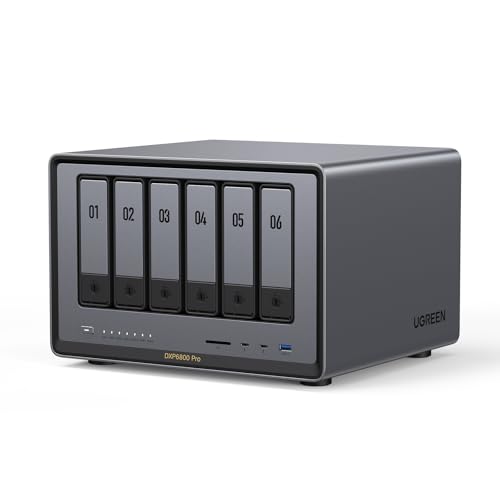
- Dual 10GbE with link aggregation
- 10-core Intel Core i5 processor
- Six SATA and two M.2 NVMe bays
Best For: Small businesses and creative teams with demanding file workflows
Balanced 4-Bay Pick

- Ryzen V1500B CPU with expandable 8GB RAM
- Dual 2.5GbE and two NVMe slots
- Four-bay diskless desktop design
Best For: Small teams and home users needing flexible storage
High-Capacity 10GbE Powerhouse

- Dual 10GbE ports with link aggregation
- Eight SATA bays plus two M.2 slots
- 12th Gen 10-core Intel Core i5 CPU
Best For: Businesses and studios handling large project files
Midrange 10GbE Workhorse

- 10GbE plus 2.5GbE network ports
- Six SATA bays and two M.2 slots
- Intel Core i3 with 8GB DDR5 RAM
Best For: Users wanting six-bay storage with 10GbE
Best Creator-Friendly Pick – UGREEN DXP4800 GT
If you need a nas enclosure with 10gbe for media work, backups, and shared files, the UGREEN DXP4800 GT combines four drive bays with dual 10GbE networking. Its Ryzen processor, expandable memory, SSD support, and creator-focused connections make it a flexible choice for fast local workflows.
Best For: Creators, tech enthusiasts, and small office teams that need fast transfers, media handling, and flexible storage.
Pros:
- Dual 10GbE ports can provide up to 20Gbps aggregate bandwidth with compatible link aggregation equipment.
- Ryzen R2514 processor, 8GB RAM, and support for up to 64GB handle multitasking, Docker, virtual machines, and media processing.
- SD card, USB 10Gbps, USB-C 10Gbps, and 4K HDMI connections simplify media imports and local playback.
- Supports up to 144TB across four SATA bays, U.2 NVMe support, and two M.2 SSDs.
Cons:
- Drives and SSDs are not included.
- Full dual-port throughput requires compatible network equipment and link aggregation.
- Surveillance support is limited to compatible ONVIF/RTSP cameras.
The DXP4800 GT is a strong all-rounder when fast networking matters but you also want creator conveniences such as direct SD-card backup. Its four-bay design and expandable storage leave room to grow, while UGOS Pro supports broader self-hosted and surveillance uses.
Best Compact All-SSD Option – TerraMaster F8 SSD Plus
The TerraMaster F8 SSD Plus is a compact nas enclosure with 10gbe built around eight NVMe SSD bays rather than traditional hard drives. With a Core i3-N305 processor, 16GB of DDR5 memory, and a small footprint, it targets users who value quiet operation and responsive storage in tight spaces.
Best For: Home users and small businesses wanting compact, quiet, all-SSD storage for virtualization, databases, media servers, or post-production.
Pros:
- Eight M.2 2280 NVMe bays support up to 64TB total capacity.
- Core i3-N305 processor, 16GB DDR5 memory, and UHD Graphics support demanding workloads.
- 10Gbps Ethernet offers transfer speeds of up to 1024MB/s.
- SSD-based storage, heat sinks, convection cooling, and quiet fans help keep operation unobtrusive.
Cons:
- It is diskless, so the eight NVMe SSDs must be purchased separately.
- Its 64TB maximum is lower than some larger HDD-based NAS options.
- The single 10GbE port does not provide the dual-port aggregation option found on some competitors.
This model stands out for its paperback-sized design and low-noise SSD platform. It makes the most sense when compactness and quick access are more important than maximum bulk capacity, and its included Business Backup Suite adds useful protection tools for smaller organizations.
Best for VMs and Docker – UGREEN DXP4800 Pro
For developers and power users, the UGREEN DXP4800 Pro is a nas enclosure with 10gbe designed for heavier computing workloads. Its Intel Core i3-1315U, expandable DDR5 memory, Docker and virtual-machine support, and combination of 10GbE and 2.5GbE networking make it more than a basic file server.
Best For: IT professionals, developers, video editors, and power users running containers, virtual machines, or demanding shared storage.
Pros:
- Six-core Intel processor with up to 4.5GHz turbo speed supports demanding multitasking.
- 8GB DDR5 RAM can be expanded to 96GB for larger virtualized and containerized workloads.
- 10GbE plus 2.5GbE networking enables transfers of up to 1.25GB/s.
- Four drive bays, two PCIe 4.0 M.2 slots, RAID options, and support for up to 144TB provide flexibility.
Cons:
- Drives are not included.
- Only one of the listed network ports is 10GbE; the second is 2.5GbE.
- Its advanced features may be more than casual file-storage users need.
The DXP4800 Pro is the better fit when processing power and expandability are central to the buying decision. It combines fast networking with substantial memory headroom, virtualization features, local AI photo processing, and business-oriented security controls in a tool-free four-bay chassis.
Best Enterprise Video Workflow – Synology DS1825+
The Synology DS1825+ is an eight-bay nas enclosure with 10gbe aimed at professional media teams and business-critical storage. It supports 10GbE or 25GbE upgrade cards, concurrent 4K/8K editing workloads, expansion to 360TB, and enterprise-focused reliability features.
Best For: Video production teams, post-production environments, and businesses that need scalable storage, high-speed networking, and stronger continuity measures.
Pros:
- Supports 50-plus concurrent users editing 4K/8K projects, with stated speeds up to 2,239MB/s.
- Eight bays can scale from 160TB to 360TB with expansion units.
- Optional networking upgrades support either 10GbE or 25GbE.
- High-availability clustering, automated failover, backup capabilities, and a three-year warranty support business-critical use.
Cons:
- Networking upgrades are optional rather than necessarily included.
- It is diskless, so storage drives and any required network card add to the total cost.
- Its enterprise-oriented capabilities may be excessive for simple home backups.
The DS1825+ is the most production-focused option in this group. Its expansion path, multi-user performance, upgradeable networking, and availability features make it suitable for teams planning a long-term storage platform rather than a basic desktop NAS.
Best Overall – UGREEN DXP4800 Plus 4-Bay NAS
The UGREEN DXP4800 Plus is a versatile nas enclosure with 10gbe for families, creators, and small teams. Its four drive bays, 10GbE port, 2.5GbE port, and 8GB DDR5 RAM support fast file transfers, backups, collaboration, Docker, and virtual machines.
Best For: Users who want a fast, flexible four-bay NAS for shared storage, backups, media, and private-cloud access.
Pros:
- 10GbE networking and 10Gbps USB ports support fast transfers.
- Supports up to 144TB with compatible drives, plus multiple RAID options.
- Includes 128GB SSD, 4K HDMI, SD 3.0, Docker, and virtual-machine support.
- AI-powered photo organization and cross-platform access add everyday convenience.
Cons:
- Hard drives or SSDs are not included.
- Actual speeds depend on the network, processor, drives, and file sizes.
- Ethernet is wired; Wi-Fi is not supported.
With a strong feature set and a manageable four-bay design, the DXP4800 Plus is a well-rounded choice when you need 10GbE performance without moving to a larger enclosure.
Best High-Capacity Value – QNAP TS-832PX-4G 8-Bay NAS
The QNAP TS-832PX-4G is a practical nas enclosure with 10gbe for buyers who prioritize expansion room. Its eight diskless SATA bays, two 10GbE ports, and two 2.5GbE ports provide substantial capacity and flexible high-speed networking.
Best For: Home offices and small businesses that need an eight-bay enclosure with multiple 10GbE and 2.5GbE connections.
Pros:
- Eight 3.5-inch SATA bays provide more expansion room than four-bay models.
- Includes two 10GbE ports and two 2.5GbE ports.
- Quad-core ARM processor and 4GB DDR4 memory support NAS workloads.
- Metal tabletop enclosure and a two-year warranty are practical additions.
Cons:
- Drives are not included.
- Processor and base memory are more modest than higher-performance NAS platforms.
This QNAP is best viewed as a capacity-focused enclosure: it offers extensive drive expansion and abundant network connectivity, while its ARM-based hardware is suited to buyers who do not need workstation-class processing.
Best for Teams – UGREEN DXP6800 Pro 6-Bay NAS
The UGREEN DXP6800 Pro is a powerful nas enclosure with 10gbe designed for demanding teams and small businesses. It combines dual 10GbE ports, a 12th Gen 10-core Intel Core i5 processor, six SATA bays, and two M.2 NVMe bays for fast file workflows and substantial storage.
Best For: Businesses and creative teams handling large files, collaborative projects, virtualization, or demanding multimedia libraries.
Pros:
- Two 10GbE ports can be aggregated for up to 20G bandwidth.
- Intel Core i5 processing supports demanding workloads, Docker, and virtual machines.
- Six SATA bays and two M.2 NVMe bays support up to 208TB and several RAID levels.
- Encryption and multi-factor authentication help protect local data.
Cons:
- Hard drives and SSDs are not included.
- Actual transfer speeds depend on the network, CPU, drives, and file sizes.
- Its business-focused hardware may be more than casual users need.
The DXP6800 Pro is the strongest performance-oriented option here, especially for teams that can take advantage of dual 10GbE, NVMe caching or storage, and its higher-end Intel processor.
Balanced 4-Bay Pick – QNAP TS-473A-8G-US
The QNAP TS-473A-8G-US is a practical choice if you want a capable NAS enclosure with 10GbE potential through expansion while keeping a compact four-bay desktop format. Its Ryzen processor, expandable memory, NVMe slots, and dual 2.5GbE ports suit file sharing, media storage, and team workflows.
Best For: Small teams and home users who need flexible storage expansion, fast 2.5GbE networking, and cache acceleration.
Pros:
- Quad-core AMD Ryzen V1500B processor with 8GB DDR4 RAM, expandable to 64GB
- Two M.2 PCIe Gen 3 NVMe slots support cache acceleration or SSD storage pools
- Dual 2.5GbE ports and USB 3.2 Gen 2 connectivity support faster transfers
- Boxafe supports backups for Google Workspace and Microsoft 365 accounts
Cons:
- It has 2.5GbE ports rather than built-in 10GbE connectivity
- Drives are not included
This QNAP is a well-rounded four-bay platform, but buyers specifically seeking native 10GbE should consider a different model or verify expansion compatibility before purchasing.
High-Capacity 10GbE Powerhouse – UGREEN NAS DXP8800 Plus
The UGREEN NAS DXP8800 Plus is built for demanding users who need a high-capacity NAS enclosure with 10GbE networking. Its dual 10GbE ports can be aggregated for up to 20G bandwidth, while eight SATA bays and two M.2 NVMe slots provide substantial storage and performance flexibility.
Best For: Businesses, IT teams, and large studios moving large project files across a fast wired network.
Pros:
- Dual 10GbE ports support link aggregation and claimed download speeds up to 2500MB/s
- Eight SATA bays plus two M.2 NVMe slots offer up to 272TB of advertised capacity
- 12th Gen 10-core, 12-thread Intel Core i5 processor supports demanding workloads
- Supports multiple RAID levels, Docker, and virtual machines
Cons:
- Hard drives and SSDs are not included
- Actual transfer speeds depend on the network, drives, CPU, and file sizes
- Wired Ethernet is required; Wi-Fi is not supported
With two 10GbE ports and eight drive bays, this is the strongest fit in the group for capacity-focused professional storage, provided your network and drives can support its performance potential.
Midrange 10GbE Workhorse – UGREEN NAS DXP6800 Plus
The UGREEN NAS DXP6800 Plus delivers a strong middle ground for anyone shopping for a NAS enclosure with 10GbE. It combines six SATA bays, two M.2 NVMe slots, a 12th Gen Intel Core i3 processor, and both 10GbE and 2.5GbE networking for high-speed file transfers without moving up to an eight-bay chassis.
Best For: Small businesses, creative users, and enthusiasts who need 10GbE performance with six bays and flexible local storage.
Pros:
- One 10GbE and one 2.5GbE port support fast wired networking and aggregation
- Six SATA bays and two M.2 NVMe slots provide up to 208TB of advertised capacity
- 12th Gen six-core, eight-thread Intel Core i3 processor with 8GB DDR5 RAM
- Includes a built-in 128GB SSD, 4K HDMI, Docker, and virtual machine support
Cons:
- Drives are not included
- It has only one 10GbE port, unlike the DXP8800 Plus
- Actual speeds vary with the network, storage drives, CPU, and file sizes
This model is a sensible compromise when six bays are enough but 10GbE is still a priority. Its mixed-speed ports also make it easier to connect to varied network equipment.
How We Picked the Best Nas Enclosure with 10gbe
We focused on NAS systems suited to high-speed local storage, prioritizing models with 10GbE connectivity or a credible high-speed networking path through built-in ports, expansion, or supported adapters. We also considered bay count, processor performance, memory, upgrade flexibility, RAID support, operating-system maturity, and the needs of creators, families, offices, and IT teams.
Because a fast network cannot compensate for slow disks or poor configuration, we also weighed storage flexibility. SSD-focused systems favor low latency and quiet operation, while larger multi-bay models provide more capacity and redundancy for shared files, surveillance, virtualization, and production archives.
Quick Comparison
| Best For | Recommended Type | Why It Stands Out |
|---|---|---|
| Home users and families | Four-bay desktop NAS | Balanced capacity, simpler setup, and manageable cost |
| Creators and media teams | 10GbE four- or six-bay NAS | Faster editing, project transfers, and centralized media storage |
| Small businesses | Six- or eight-bay NAS | More usable capacity, redundancy, and room for growth |
| Large studios and IT teams | Eight-bay enterprise-class NAS | Higher scalability, advanced networking, and stronger management features |
| Quiet, high-performance storage | All-SSD NAS | Low latency and consistent performance for demanding workflows |
Key Buying Factors for a Nas Enclosure with 10gbe
Network Hardware and Real-World Throughput
Check whether 10GbE is built in, supplied through an expansion card, or available only with a separate adapter. Your switch, cabling, client computer, and storage drives must also support the target speed. Hard-drive arrays may not saturate 10GbE in every workload, while SSD arrays are more likely to benefit fully.
Drive Bays, RAID, and Expansion
Four bays can be enough for a home or small office, but six- and eight-bay enclosures offer more capacity and better options for RAID protection, hot spares, and future upgrades. Confirm supported drive types and whether mixing disk sizes or adding expansion shelves is practical.
CPU, Memory, and Applications
Choose a stronger processor and more RAM if you expect virtualization, containers, multiple users, 4K media services, database work, or surveillance recording. Basic backups and file sharing need far less power. Also compare the NAS operating system, app catalog, snapshot tools, user permissions, and backup integrations.
Noise, Power, and Security
Desktop NAS devices vary widely in fan noise and energy use. SSD models are often quieter, while large hard-drive arrays provide cheaper capacity. Look for encryption, two-factor authentication, automatic updates, immutable or offline backup options, and clear alerting for drive failures.
Who Should Buy Which Nas Enclosure with 10gbe?
Choose a four-bay model if you need a manageable family, home-office, or creator NAS with room for redundancy. Choose six bays when your team shares larger projects or you want more capacity without moving to a rack-oriented system. Choose an eight-bay enclosure for business file serving, large media libraries, surveillance, or longer-term expansion.
Choose an SSD-focused NAS for quiet, responsive project storage and low-latency workloads. Choose a business or enterprise-oriented platform when centralized administration, advanced backup, virtualization, stronger access controls, and scale matter more than the lowest purchase price. Finally, verify the complete network path before buying: a 10GbE NAS delivers its best value when the switch, clients, cables, and storage array are ready to use it.