Upgrading or duplicating a drive is much easier with the right enclosure—especially when you can clone disks without installing software or connecting them to a computer.
This roundup compares 10 hard drive enclosures with offline cloning, including dual-bay SATA docks, multi-drive stations, and high-speed NVMe cloners, so you can choose the right fit for your drives, workflow, and budget.
Best 10 Hard Drive Enclosure with Offline Cloning Picks for 2026
Best Overall SATA Cloner

- Supports 2.5-inch and 3.5-inch SATA drives
- Offline cloning with no computer required
- USB 3.0 and up to 20TB listed capacity
Best For: Everyday SATA drive cloning and access
Fastest NVMe Option
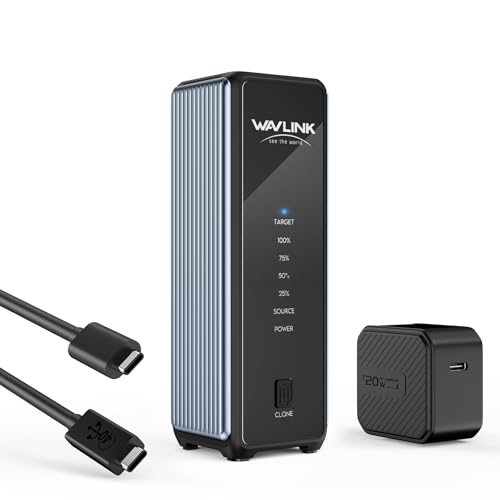
- USB4 transfer rates up to 40Gbps
- Supports multiple M.2 NVMe sizes
- Active cooling for sustained workloads
Best For: Fast NVMe SSD upgrades and cloning
Best for Multi-Drive Workflows

- Four bays for 2.5-inch and 3.5-inch SATA drives
- Trayless, tool-free drive insertion
- Offline cloning with USB 3.0 access
Best For: Managing several SATA drives at once
Best Value NVMe Cloner

- One-button offline cloning for two NVMe SSDs
- Supports 2230 through 2280 M.2 sizes
- Up to 16TB total across two drives
Best For: Straightforward NVMe SSD upgrades and duplication
Best SATA Offline Cloner

- One-button offline SATA cloning
- Fits 2.5-inch and 3.5-inch drives
- Dual-drive USB-C access
Best For: Bare SATA HDD and SSD cloning
Best NVMe Offline Cloner

- One-button offline NVMe cloning
- Supports M Key and B+M Key SSDs
- 20Gbps USB 3.2 Gen 2x2
Best For: Fast M.2 NVMe duplication and access
Best Value SATA Dock

- Offline cloning up to 60Mbps
- Supports 2.5-inch and 3.5-inch SATA drives
- UASP and hot-swapping support
Best For: Simple SATA cloning across multiple operating systems
Most Versatile
Triple-Bay NVMe and SATA Offline Cloner

- One-touch offline cloning
- Supports NVMe and SATA drives
- Three bays with 10 Gbps USB 3.2 Gen 2
Best For: Mixed-drive data migration and multi-drive workflows
Best for SATA Cloning
Dual-Bay SATA Offline Duplicator

- Direct offline cloning between two drives
- Supports 2.5-inch and 3.5-inch SATA HDDs and SSDs
- UASP-enabled USB 3.0 connectivity
Best For: Simple SATA backups, upgrades, and drive duplication
Best for Large-Capacity Storage

- Offline cloning for SATA drives
- Tool-free support for 2.5-inch and 3.5-inch drives
- Designed for large-capacity HDDs and SSDs
Best For: Large SATA backups, media libraries, and data recovery
Best Overall SATA Cloner – Dual-Bay Hard Drive Dock
If you need a practical hard drive enclosure with offline cloning for standard SATA drives, the SABRENT EC-HD2B is a straightforward choice. Its two bays accept 2.5-inch and 3.5-inch SATA HDDs or SSDs, while USB 3.0 provides computer-connected transfer speeds up to 5Gbps.
Best For: Users cloning or accessing standard SATA hard drives and SSDs at home or in a small office.
Pros:
- Supports both 2.5-inch and 3.5-inch SATA HDDs and SSDs.
- Provides offline cloning without requiring a computer.
- Supports drives up to 10TB and total storage capacity listed at 20TB.
- Plug-and-play setup requires no drivers.
Cons:
- Limited to SATA drives rather than M.2 NVMe SSDs.
- Offline cloning speed is listed at up to 60Mbps.
The EC-HD2B is a sensible all-purpose SATA dock when compatibility with both desktop and laptop-sized drives matters more than newer NVMe performance.
Fastest NVMe Option – 40Gbps Dual NVMe Cloner
For a high-speed hard drive enclosure with offline cloning, the WAVLINK 40Gbps model targets M.2 NVMe users who want fast transfers and tool-free drive access. Its dual slots support several M.2 sizes, and active cooling helps manage heat during demanding workloads.
Best For: NVMe users performing fast SSD upgrades, backups, or drive-to-drive migrations.
Pros:
- USB4 connectivity supports data rates up to 40Gbps.
- Compatible with M-key and B+M-key NVMe SSDs in 2230, 2242, 2260, and 2280 sizes.
- One-click offline cloning supports drives up to 8TB per slot.
- Active cooling fan, aluminum housing, and vents support heat dissipation.
Cons:
- Designed for M.2 NVMe SSDs, not standard 2.5-inch or 3.5-inch SATA drives.
- The target SSD must be at least as large as the source and is formatted during cloning.
This is the performance-focused pick in the group, especially for compatible USB4 or Thunderbolt systems. Back up important data before using its offline clone function.
Best for Multi-Drive Workflows – 4-Bay SATA Dock
The SABRENT DS-U3B4 is a hard drive enclosure with offline cloning built for users who need to manage several SATA drives at once. Its four trayless bays accept 2.5-inch and 3.5-inch HDDs or SSDs, making it useful for backups, drive access, and multi-drive organization.
Best For: Home offices, technicians, and storage users who regularly work with multiple SATA drives.
Pros:
- Holds up to four 2.5-inch or 3.5-inch SATA HDDs and SSDs.
- Trayless design allows direct drive insertion without tools.
- Offline cloning works directly between drives without a computer.
- USB 3.0 connection supports transfers up to 5Gbps.
Cons:
- Supports SATA drives rather than M.2 NVMe SSDs.
- Its larger four-bay design may be more than needed for occasional single-drive use.
Choose the DS-U3B4 when capacity and simultaneous drive access are priorities. It offers more bays than a typical dual-bay dock while retaining plug-and-play operation.
Best Value NVMe Cloner – 20Gbps Dual-Bay Enclosure
The WAVLINK 20Gbps model is a compact hard drive enclosure with offline cloning for dual M.2 NVMe SSDs. It supports common 2230, 2242, 2260, and 2280 sizes, with one-button cloning and status indicators that show progress during the operation.
Best For: Users upgrading or duplicating compatible NVMe SSDs without needing USB4-level performance.
Pros:
- Supports offline one-click cloning between two NVMe SSDs.
- Accepts M-key and B+M-key drives in four common M.2 sizes.
- Supports up to 8TB per drive, or 16TB across two drives.
- Includes USB-C connectivity, USB-A adapter support, and OTG support.
Cons:
- Not compatible with M.2 SATA SSDs.
- The source and target drive positions must be used correctly for cloning to start.
- The target drive should be disconnected from the computer before offline cloning.
This enclosure balances broad M.2 size support with a simpler 20Gbps connection. Its clearly marked indicators and dedicated cloning button are useful for straightforward SSD migrations.
Best SATA Offline Cloner – SABRENT Dual-Bay USB-C Dock
If you need a hard drive enclosure with offline cloning for standard SATA drives, the SABRENT EC-CH2B offers a straightforward two-bay setup. Press the clone button to copy one drive to another without connecting the dock to a computer, or use both bays as separate drives over USB-C.
Best For: Users cloning bare 2.5-inch or 3.5-inch SATA HDDs and SSDs without a computer.
Pros:
- Offline, one-button cloning without a computer
- Supports both 2.5-inch and 3.5-inch SATA drives
- Both bays can be read and written simultaneously when connected to a computer
- Tool-free, hot-swappable design with USB-C connectivity
Cons:
- Does not support IDE/PATA, M.2, or NVMe drives
- The target drive must be the same size as or larger than the source
- The included cable is USB-C to USB-C, so a USB-A adapter or cable may be needed
This is a practical choice for SATA-based upgrades and drive-to-drive copies. Its main limitation is compatibility: it is a dock for bare SATA media, not a universal enclosure for newer NVMe or M.2 SSDs.
Best NVMe Offline Cloner – Rosewill Dual-Bay M.2 Dock
For M.2 storage, the Rosewill RS-N2-CL is a hard drive enclosure with offline cloning designed around dual NVMe bays. It supports M Key and B+M Key NVMe SSDs, with one-button standalone cloning and a USB 3.2 Gen 2×2 connection rated for up to 20Gbps.
Best For: Users who need offline cloning and fast computer access for compatible NVMe M.2 SSDs.
Pros:
- Standalone, one-button NVMe cloning
- Supports M Key and B+M Key NVMe SSDs
- 20Gbps USB 3.2 Gen 2×2 interface
- Includes USB-C, USB-A, and power cables
Cons:
- Designed for NVMe M.2 drives rather than SATA or traditional hard drives
- Actual transfer speeds depend on the connected drives and host system
- Offline cloning requires compatible drives in both bays
The Rosewill stands out when speed and NVMe compatibility matter more than broad drive-format support. Its S.M.A.R.T. monitoring and TRIM support add useful drive-management features, while the dual-bay layout keeps cloning simple.
Best Value SATA Dock – WAVLINK Dual-Bay Drive Dock
The WAVLINK WL-ST334UA is a practical hard drive enclosure with offline cloning for users working with 2.5-inch and 3.5-inch SATA HDDs or SSDs. It supports computer-based dual-drive access over USB 3.0 or USB-C and can duplicate a source disk to a target disk without a computer.
Best For: Home users who want a simple dual-bay SATA dock with offline cloning and broad operating-system support.
Pros:
- Offline cloning at up to 60Mbps
- Supports 2.5-inch and 3.5-inch SATA drives
- UASP support with USB 3.0 connectivity
- Tool-free setup, hot-swapping, and automatic sleep mode
Cons:
- Does not support online cloning
- The target drive must be the same capacity as or larger than the source
- Not compatible with M1/M2-based Macs according to the supplied notes
With support for Windows, older Mac OS X systems, and Linux or Unix, this WAVLINK dock is a flexible option for conventional SATA media. It is best suited to straightforward cloning and file access rather than newer M.2 or NVMe storage.
Most Versatile – Triple-Bay NVMe and SATA Offline Cloner
If you need a hard drive enclosure with offline cloning that handles more than standard SATA drives, the ICY BOX TripleBay is a flexible choice. Its three tool-free bays support M.2 PCIe NVMe, 2.5-inch SATA, and 3.5-inch SATA drives, while USB 3.2 Gen 2 provides up to 10 Gbps for connected-device transfers.
Best For: Users migrating data between mixed NVMe and SATA storage types or managing several drives at once.
Pros:
- One-touch offline cloning without software or a computer setup.
- Supports NVMe-to-NVMe and SATA-to-NVMe cloning, plus 2.5-inch and 3.5-inch drives.
- Three independent bays and USB-C/USB-A connectivity add practical flexibility.
- Works with Windows and macOS and includes a 24-month warranty.
Cons:
- The plastic enclosure may be less substantial than a metal dock.
- Its broader feature set may be unnecessary for users who only clone SATA drives.
This is the strongest all-around option for mixed storage environments. Choose it when NVMe support, three-bay access, and faster USB connectivity matter more than a simpler two-bay design.
Best for SATA Cloning – Dual-Bay SATA Offline Duplicator
The WAVLINK dual-bay dock is a straightforward hard drive enclosure with offline cloning for 2.5-inch and 3.5-inch SATA HDDs and SSDs. It copies directly between two drives without a computer, and its fixed bezels help keep inserted drives stable during use.
Best For: Home and office users who want an uncomplicated SATA-to-SATA cloning and backup station.
Pros:
- Offline clone function works without a computer or installed drivers.
- Supports two 2.5-inch or 3.5-inch SATA drives, with capacities up to 20TB each.
- Tool-free, hot-swappable design is convenient for regular drive access.
- UASP-enabled USB 3.0 supports transfer rates up to 5 Gbps.
Cons:
- Offline cloning requires the target drive to be at least as large as the source.
- It supports SATA drives but not M.2 NVMe storage.
- USB 3.0 is slower than the 10 Gbps interface on the ICY BOX TripleBay.
For SATA-only users, this dock keeps the process simple and practical. Its two-bay layout, fixed bezels, and direct cloning function make it a sensible choice for routine backups and drive upgrades.
Best for Large-Capacity Storage – 60TB-Class Dual-Bay SATA Dock
The ICY BOX dual-bay station is a practical hard drive enclosure with offline cloning for users who work with large SATA storage devices. It accepts both 2.5-inch and 3.5-inch HDDs and SSDs without tools, supports USB 3.0 with UASP, and is designed for plug-and-play use across major desktop operating systems.
Best For: Users handling large-capacity SATA drives for media storage, backups, and data recovery.
Pros:
- Offline clone and duplicator function works without a computer.
- Tool-free dual-bay design supports both 2.5-inch and 3.5-inch SATA drives.
- Supports large-capacity HDDs up to approximately 30TB per drive.
- Works with Windows, macOS, and Linux without driver installation.
Cons:
- USB 3.0 limits transfers to up to 5 Gbps.
- It is intended for SATA drives and does not support M.2 NVMe storage.
- The supplied listing gives different capacity references, so confirm the current supported limit before purchase.
This model is appealing when capacity and broad operating-system compatibility are priorities. It offers a simpler two-bay workflow than the TripleBay while remaining suitable for large SATA HDD and SSD collections.
How We Picked the Best Hard Drive Enclosure with Offline Cloning
We focused on docks and enclosures that support true offline cloning, meaning a source drive can be copied directly to a destination drive using a physical button or dedicated control. We also considered drive compatibility, bay layout, interface speed, installation convenience, capacity support, and whether each model handles 2.5-inch drives, 3.5-inch drives, SATA SSDs, or M.2 NVMe SSDs.
Because cloning hardware varies widely, the products are not interchangeable. A SATA dock cannot clone an NVMe drive unless it specifically includes NVMe support, and a destination drive generally needs to be equal to or larger than the source drive’s usable capacity.
Quick Comparison
- Best for standard SATA drives: Dual-bay SATA docks from SABRENT, WAVLINK, and ICY BOX.
- Best for multiple drives: Four-bay and triple-bay docking stations.
- Best for M.2 NVMe SSDs: WAVLINK and Rosewill dual-bay M.2 cloners.
- Best for newer computers: USB-C models with USB 3.2 or 40Gbps connectivity.
- Best for mixed workflows: Stations that combine SATA and NVMe support.
Key Buying Factors for a Hard Drive Enclosure with Offline Cloning
Drive Type and Physical Size
Check whether your drives use SATA or NVMe and verify the supported form factor. SATA docks typically accept 2.5-inch laptop drives and 3.5-inch desktop drives. M.2 models must match the SSD’s keying, protocol, and length, such as 2230, 2242, 2260, or 2280. M.2 SATA and M.2 NVMe are different standards, so confirm compatibility before buying.
Cloning Method and Capacity
Offline cloning is useful for system migrations, backups, and drive replacement because it does not depend on operating-system software. Look for clear source and destination labeling, progress indicators, and a physical clone button. The target drive should normally be at least as large as the source, and cloning may erase everything already stored on the destination.
Connection Speed
USB 3.0 is sufficient for many hard drives, while USB 3.2 Gen 2, Gen 2×2, and USB4-class connections can better serve fast SSDs. Actual performance depends on the drive, host port, cable, and enclosure controller. A high-speed enclosure will not make a slower SATA drive perform like an NVMe SSD.
Bay Count and Everyday Usability
Dual-bay units are generally the most practical for one-to-one cloning. Four-bay models make more sense for administrators, media workflows, or users who regularly access several bare drives. Tool-free M.2 installation is convenient, while fixed bezels and sturdy slots can help prevent accidental movement during transfers.
Who Should Buy Which Hard Drive Enclosure with Offline Cloning?
Choose a dual-bay SATA dock if you are replacing a laptop or desktop hard drive, making a direct backup, or working with inexpensive 2.5-inch and 3.5-inch drives. Choose an M.2 cloner if your upgrade involves an NVMe SSD and you want fast transfers without mounting the drive inside a computer.
A multi-bay station is better for frequent drive access, testing, or managing several disks at once. If you use both SATA and NVMe storage, a combination station offers greater flexibility and may reduce the need for separate accessories. Finally, prioritize USB-C and higher-speed standards when your computer supports them and your SSDs can take advantage of the extra bandwidth.