Choosing the best desktop computer for architects means balancing processor speed, graphics performance, memory, storage, and upgradeability. CAD drawings, BIM models, 3D visualization, and rendering can place very different demands on a system.
Our selection of 10 desktops includes compact business PCs for drafting and documentation, as well as dedicated-GPU towers better suited to demanding architectural workflows. Use the guide below to match hardware capability with your software, project scale, and workspace.
Best 10 Desktop Computer for Architects Picks for 2026
Best Performance Pick

- 20-core Intel Ultra 7 processor
- Dedicated RTX 5060 graphics
- 32GB RAM and 2TB NVMe SSD
Best For: Architects and creators needing strong 3D and rendering performance
Best Everyday Value
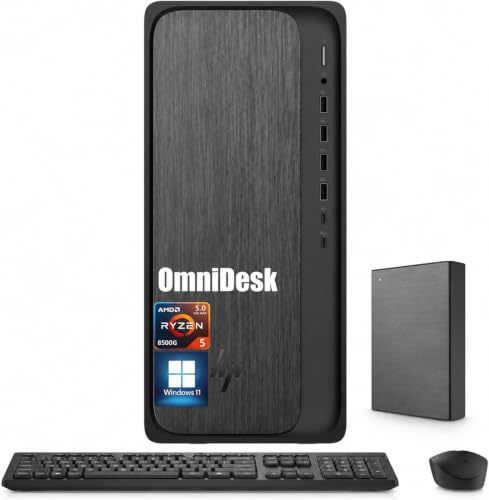
- Six-core Ryzen 5 processor
- Up to four monitor support
- Wi-Fi 6 and wireless peripherals included
Best For: Office, student, and lighter architectural workloads
Best Expandable Office Tower

- Intel Core Ultra 7 processor
- 32GB DDR5 memory
- Supports up to four monitors
Best For: Architecture offices focused on CPU-based work and expandability
Best Compact Workstation

- Professional RTX A400 graphics
- 64GB RAM and 2TB SSD
- Compact workstation design
Best For: Architects needing certified graphics performance in a small footprint
Practical Office Pick

- 32GB RAM and 1TB SSD
- Multiple display outputs and eight USB ports
- Integrated graphics for everyday workloads
Best For: Students, office work, and lighter architectural tasks
Performance Rendering Pick

- 20-core Intel Core Ultra 7 processor
- Dedicated RTX 4060 with 8GB GDDR6
- 32GB DDR5 and 1TB NVMe SSD
Best For: 3D modeling, visualization, and creative workloads
Compact Workspace Pick

- Space-saving small-form-factor design
- 32GB RAM and 1TB SSD
- HDMI and DisplayPort dual-display support
Best For: 2D drafting, documentation, and compact offices
Top Pick for Modern Workflows

- 20-core Intel Ultra 7 processor up to 5.3GHz
- 32GB DDR5 RAM and 1TB PCIe SSD
- Dual 4K display support with HDMI and DisplayPort
Best For: Architects needing fast multitasking and dual-monitor productivity
Best Professional Setup

- 16 cores and 24 threads up to 5.2GHz
- 32GB DDR5 RAM with 1TB NVMe SSD
- Windows 11 Pro and dual 4K display support
Best For: Professional architecture offices prioritizing CPU-heavy multitasking
Best Balanced Business Tower

- 12 cores and 20 threads up to 5.0GHz
- 32GB DDR5 RAM and 1TB PCIe SSD
- Dual 4K support plus TPM security features
Best For: Students and small practices wanting a balanced office workstation
Best Performance Pick – Dell Ultra 7 RTX 5060 Tower
If you need a desktop computer for architects that can handle demanding multitasking, 3D modeling, and rendering, this Dell tower offers a strong performance-focused configuration. Its Intel Ultra 7 processor, dedicated RTX graphics, 32GB of DDR5 memory, and 2TB NVMe SSD are well suited to intensive professional workflows.
Best For: Architects, designers, developers, and creators working with demanding 3D, rendering, or multimedia applications.
Pros:
- Intel Ultra 7 265F processor with 20 cores and boost speeds up to 5.3 GHz
- Dedicated NVIDIA RTX 5060 graphics with GDDR7 memory for 3D and rendering workloads
- 32GB DDR5 RAM and 2TB NVMe SSD provide substantial working memory and storage
- Windows 11 Pro, Wi-Fi 6, Bluetooth, and support for dual displays
Cons:
- Its tower form factor takes more desk space than a compact workstation
- The supplied specifications do not identify professional ISV certifications
This is the strongest all-around choice in the group for graphics-heavy architectural work. The dedicated RTX 5060 and generous storage make it especially appealing when real-time visualization and rendering matter more than compact size.
Best Everyday Value – HP OmniDesk Ryzen 5 Tower
For buyers seeking a practical desktop computer for architects for office work, drafting, research, and lighter design tasks, the HP OmniDesk emphasizes everyday usability. It combines a six-core Ryzen 5 processor with 16GB of DDR5 memory, integrated graphics, and support for up to four displays.
Best For: Students, home offices, business users, and architects handling lighter applications and multi-monitor productivity.
Pros:
- Six-core AMD Ryzen 5 8500G processor with speeds up to 5 GHz
- 16GB DDR5 memory supports everyday multitasking
- Supports up to four displays for expanded workspace
- Wi-Fi 6, Bluetooth 5.4, wireless peripherals, and ENERGY STAR certification
Cons:
- Integrated Radeon 740M graphics are less suited to demanding 3D rendering
- Storage is listed as a 512GB SSD plus a 512GB external drive
- Memory is specified at a maximum of 16GB
The OmniDesk is a sensible productivity-oriented option rather than a dedicated rendering workstation. Its multi-display support and included wireless keyboard and mouse make it convenient for office-based architectural workflows, but complex visualization tasks may require a stronger GPU.
Best Expandable Office Tower – Dell Core Ultra 7 Desktop
This Dell tower is a practical desktop computer for architects who prioritize processor performance, multiple displays, and straightforward future access. Its Intel Core Ultra 7 chip and 32GB of DDR5 RAM provide a capable base for business, education, multimedia, and general design applications.
Best For: Architectural offices needing a conventional tower with strong CPU performance, multi-monitor support, and accessible components.
Pros:
- Intel Core Ultra 7 processor with built-in AI capabilities
- 32GB DDR5 RAM supports substantial multitasking
- Can connect up to four FHD monitors or two 4K displays
- Tool-less entry and a removable side panel simplify upgrades
Cons:
- Integrated Intel UHD graphics are not intended for demanding GPU-based rendering
- Runs Windows 11 Home rather than Windows 11 Pro
- The supplied notes do not specify the SSD capacity
This model makes the most sense for CPU-led workflows, documentation, collaboration, and multi-screen office setups. Its upgrade-friendly design is useful, though users focused on intensive 3D visualization may prefer a tower with dedicated graphics.
Best Compact Workstation – Dell Pro Max Micro RTX A400
For professionals who need a desktop computer for architects without giving up workstation-oriented graphics, the Dell Pro Max Micro packs substantial capability into a compact chassis. Its RTX A400, 64GB of DDR5 RAM, 2TB SSD, and Windows 11 Pro configuration target CAD, 3D modeling, rendering, and other technical workflows.
Best For: Architects, engineers, designers, and creators who need professional graphics in a space-saving workstation.
Pros:
- NVIDIA RTX A400 professional graphics with multiple DisplayPort outputs
- 64GB DDR5 RAM and 2TB SSD support demanding projects and multitasking
- Compact 8.11-by-7-by-3.12-inch form factor weighs 5.2 pounds
- ISV certifications and Windows 11 Pro are suited to professional applications
Cons:
- No Wi-Fi or Bluetooth; networking is provided through wired Ethernet
- The system is resealed for memory and SSD upgrades, with warranty coverage split between sellers
- The Intel Ultra 5 235 processor is below the Ultra 7 class in the product title comparison
This is the most purpose-built compact option for professional design work. It offers workstation graphics and unusually generous memory in a small enclosure, but confirm that wired networking and the stated warranty arrangement fit your setup.
Practical Office Pick – HP Business Tower Desktop
For buyers seeking a desktop computer for architects for general planning, documentation, research, and office tasks, this HP tower offers a practical configuration. Its 32GB of RAM and 1TB SSD support responsive multitasking, though the integrated graphics are better suited to everyday work than demanding 3D workflows.
Best For: Students, home offices, business applications, document-heavy architectural workflows, and everyday multitasking.
Pros:
- 32GB RAM helps handle multiple applications and browser tabs.
- 1TB SSD provides fast access to documents, project files, and software.
- Includes a keyboard, mouse, wired Ethernet, and USB Wi-Fi connectivity.
- Offers HDMI, VGA, and DVI video outputs for flexible display connections.
Cons:
- Integrated shared graphics are not designed for demanding 3D rendering.
- The 180W power supply limits suitability for major graphics upgrades.
- The listed Core i5-10400 is an older processor platform.
This HP is a sensible choice when architectural work centers on 2D drafting, office productivity, and file management rather than GPU-intensive modeling or rendering. Buyers needing advanced visualization performance should consider a system with dedicated graphics.
Performance Rendering Pick – Dell Tower with RTX 4060
This Dell tower is the strongest fit here for a desktop computer for architects who need substantial modeling, visualization, and creative performance. Its 20-core Intel Core Ultra 7 processor, 32GB of DDR5 memory, and dedicated GeForce RTX 4060 graphics provide a more capable foundation for demanding applications than integrated-graphics systems.
Best For: Architectural visualization, 3D modeling, content creation, multitasking, and users who benefit from dedicated GPU acceleration.
Pros:
- 20-core Intel Core Ultra 7-265F processor supports demanding multitasking.
- GeForce RTX 4060 provides dedicated graphics with 8GB of GDDR6 memory.
- 32GB DDR5 RAM and a 1TB NVMe SSD deliver fast system responsiveness.
- Three PCIe expansion slots offer room for additional cards.
Cons:
- Storage is limited to 1TB before adding or replacing a drive.
- Keyboard and mouse are wired rather than wireless.
- The supplied information lists Windows 11 Home, despite the title referencing Pro.
With its dedicated RTX 4060 and high-core-count processor, this Dell is the most suitable option for architects working with richer 3D scenes and visual content. Confirm the operating-system configuration before purchase if Windows 11 Pro is essential.
Compact Workspace Pick – HP ProDesk SFF Desktop
For a space-conscious desktop computer for architects, this HP ProDesk SFF emphasizes compact design, connectivity, and everyday productivity. Its 32GB RAM, 1TB SSD, dual-display support, and Windows 11 Pro make it useful for drafting, documentation, and office workflows, but its Celeron processor and integrated graphics limit demanding 3D work.
Best For: Compact offices, architectural students, 2D drafting, documentation, remote work, and dual-monitor productivity.
Pros:
- Small-form-factor chassis saves desk space.
- 32GB RAM and 1TB SSD support responsive everyday use.
- HDMI and DisplayPort enable dual-display setups.
- Wi-Fi, Bluetooth, USB Type-C, and USB Type-A provide broad connectivity.
Cons:
- Intel Celeron G6900 is less capable for demanding architectural software.
- Integrated Intel graphics are not intended for advanced 3D rendering.
- Compact design may provide less upgrade flexibility than a full tower.
This ProDesk makes the most sense when space, dual-screen productivity, and routine architectural work matter more than high-end performance. It is a practical office or student system, but dedicated graphics would be preferable for complex models and rendering.
Top Pick for Modern Workflows – Dell Ultra 7 265 Tower
For architects seeking a desktop computer for architects, this Dell tower combines a 20-core Intel Core Ultra 7 265 processor with 32GB of DDR5 RAM and a 1TB PCIe SSD. Its dual 4K display support and broad connectivity suit multitasking across design applications, reference materials, and communication tools, though its integrated graphics are better suited to general productivity than graphics-intensive professional workloads.
Best For: Architects who want strong multitasking performance, fast storage, and a dual-monitor office setup.
Pros:
- 20-core processor with speeds up to 5.3GHz for demanding multitasking.
- 32GB DDR5 RAM and a 1TB PCIe SSD provide responsive everyday performance.
- Supports up to two 4K displays through HDMI and DisplayPort.
- Includes Wi-Fi, Bluetooth, USB-C, an SD card reader, keyboard, and mouse.
Cons:
- Uses integrated graphics rather than a dedicated graphics card.
- Supplied specifications list the maximum RAM as 32GB, despite the feature copy mentioning configurations up to 64GB.
This is a well-rounded choice for architecture offices that prioritize processor performance, storage speed, and a clean dual-screen workspace. Verify your software’s graphics requirements before choosing it for demanding 3D visualization.
Best Professional Setup – Dell Core i9-12900K Tower
This Dell tower is a capable desktop computer for architects who value high-end CPU performance and Windows 11 Pro features. The Core i9-12900K offers 16 cores and 24 threads, while 32GB of DDR5 memory, a 1TB NVMe SSD, and dual 4K output create a strong foundation for intensive multitasking and office-based project work.
Best For: Professional users who want a powerful processor, Windows 11 Pro, and a ready-to-use dual-display workstation.
Pros:
- 16-core, 24-thread Core i9 processor reaches up to 5.2GHz.
- 32GB DDR5 RAM and 1TB NVMe SSD support fast application loading and multitasking.
- Windows 11 Pro provides a professional operating-system environment.
- Includes HDMI, DisplayPort, Wi-Fi, Bluetooth, USB-C, keyboard, and mouse.
Cons:
- Intel UHD Graphics 770 is integrated and may limit graphics-heavy 3D workflows.
- Only 1TB of listed storage may be restrictive for large project libraries.
With its strong CPU and business-oriented Windows 11 Pro configuration, this model is well suited to architecture practices handling many applications at once. A dedicated graphics solution may still be preferable for advanced rendering or visualization.
Best Balanced Business Tower – Dell Core i7-12700K
For buyers comparing a practical desktop computer for architects, this Dell Core i7 tower offers a balanced configuration with 12 cores, 20 threads, 32GB of DDR5 RAM, and a 1TB PCIe SSD. It also supports two 4K displays and includes business-focused security features, making it a sensible fit for everyday architectural planning, documentation, and office multitasking.
Best For: Architecture students, small practices, and professionals seeking a balanced business desktop with useful security features.
Pros:
- 12-core, 20-thread processor reaches up to 5.0GHz.
- 32GB DDR5 RAM and 1TB PCIe SSD provide a solid productivity baseline.
- HDMI and DisplayPort support dual 4K monitors.
- Includes TPM security, a lock slot or padlock loop, Windows 11 Pro, keyboard, and mouse.
Cons:
- Integrated Intel UHD Graphics 770 is not a dedicated graphics solution.
- Supplied specifications list maximum RAM as 32GB, which may limit future expansion.
This model balances capable processing, convenient connectivity, and office security at a lower tier than the Core i9 option. It is a good general workstation choice, provided your architecture software does not require dedicated graphics.
How We Picked the Best Desktop Computer for Architects
We focused on the hardware that most directly affects architectural work: modern multi-core processors, sufficient RAM, fast solid-state storage, dedicated graphics where useful, display support, and practical upgrade potential. The list spans Intel Core Ultra, Core i7, Core i9, and AMD Ryzen systems, with memory configurations from 16GB to 64GB.
For general CAD, documentation, and office work, integrated graphics can be adequate. For real-time 3D views, complex models, GPU rendering, or visualization, systems with NVIDIA GeForce or RTX professional graphics are generally the stronger choices. We also considered connectivity, wireless support, operating system editions, and tower size.
Quick Comparison
| Best For | Recommended Configuration | What to Look For |
|---|---|---|
| 2D CAD and documentation | Modern Core Ultra 5/7 or Ryzen 5, 16GB–32GB RAM | Fast SSD, reliable display outputs, quiet operation |
| BIM and large project files | Core Ultra 7 or Core i7/i9, 32GB RAM | Strong single-core speed, ample storage, upgradeable memory |
| 3D modeling and visualization | Dedicated RTX graphics, 32GB RAM or more | GPU acceleration, 1TB-plus SSD, effective cooling |
| Rendering and professional workloads | High-core-count CPU, 64GB RAM, professional GPU | Sustained performance, expandability, dependable drivers |
Key Buying Factors for a Desktop Computer for Architects
Processor
CPU speed matters for many CAD and BIM operations, while additional cores help with rendering, exports, simulations, and multitasking. A current Core Ultra 7 or comparable high-end processor is a versatile choice for demanding professional use.
Graphics
Integrated graphics can handle drafting and lighter modeling, but a dedicated GPU is preferable for real-time walkthroughs, complex materials, and GPU-based rendering. GeForce RTX cards offer strong general performance; professional RTX graphics may be preferable where certified drivers and workstation reliability matter.
Memory and Storage
Choose 32GB RAM for a comfortable architecture workstation, particularly when running CAD, BIM, browsers, and rendering tools together. Consider 64GB for large models or heavy visualization. A 1TB NVMe SSD is a sensible baseline, while 2TB reduces the need for external project storage.
Ports, Displays, and Upgrades
Dual-monitor support improves drafting and reference work. Check HDMI and DisplayPort compatibility before buying. Tower systems are often easier to upgrade than small-form-factor PCs, so confirm available RAM slots, drive bays, GPU clearance, and power-supply capacity.
Who Should Buy Which Desktop Computer for Architects?
Students, small practices, and architects focused on 2D CAD can choose a well-equipped business tower with 16GB or 32GB RAM and a fast SSD. BIM users and general-purpose professionals should favor Core Ultra 7, Core i7, or similar systems with 32GB RAM and room to expand. Visualization specialists and users working with demanding 3D scenes should prioritize an RTX-equipped tower. Those needing a compact desk footprint can consider a small-form-factor or micro workstation, but should check its graphics performance and upgrade limits before purchase.