The best wireless microphones make it easier to record, present, perform, or host without being tied to a cable. This roundup covers compact creator kits, handheld systems, karaoke-ready pairs, and multi-channel setups.
Use the buying guide below to compare range, battery life, connectivity, microphone style, and the type of user each system suits best.
Best 10 Wireless Microphones Picks for 2026
Best for Creators

- 10 g transmitters with discreet on-camera design
- Up to 48 hours with the charging case
- 400 m range and two noise-cancellation levels
Best For: Content creators, interviews, livestreams, and DJI Osmo users
Best for Flexible Karaoke Setups

- Dual handheld UHF microphones
- Auto Scan with 200 selectable frequencies
- Up to 328 ft line-of-sight range
Best For: Karaoke, events, churches, DJs, and PA systems
Best for PartyBox Owners

- Two handheld microphones for JBL PartyBox speakers
- Up to 20 hours of playtime
- Cardioid pickup with pop filtering and shock mounts
Best For: JBL PartyBox karaoke and parties
Best for Four-Person Events

- Four-channel UHF system with four handheld mics
- Individual volume controls and four XLR outputs
- Metal construction with cardioid pickup
Best For: Weddings, churches, conferences, karaoke, and small performances
Best for Versatile Content Creation

- Two transmitters for recording two voices
- Adaptive gain and selectable noise cancellation
- 32-bit float backup recording
Best For: Creators, interviews, podcasts, and compatible DJI setups
Best for Party Karaoke
JBL Wireless Two Microphone System
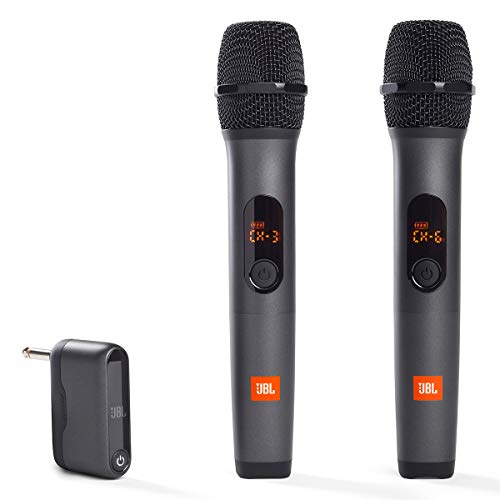
- Two microphones with dual-channel receiver
- Plug-and-play operation
- Designed for compatible JBL PARTYBOX speakers
Best For: Karaoke, parties, and JBL PARTYBOX owners
Best for Phone Vlogging
MAYBESTA Wireless Mini Microphone

- USB-C and Lightning compatibility
- Automatic plug-and-play pairing
- Noise reduction with clip-on lavalier design
Best For: Mobile vlogging, livestreams, calls, and short-form video
Best Budget Dual Handhelds
200-Foot Wireless Microphone Set

- Two handheld mics for karaoke and events
- Up to 200 feet of line-of-sight range
- Works with 3.5mm and 6.35mm mic inputs
Best For: Karaoke, ceremonies, classrooms, and small performances
Best for Mobile Creators
Mini Mic Pro Wireless Lavalier

- USB-C and Lightning adapters included
- Compact clip-on design for videos and interviews
- Up to six hours of rechargeable use
Best For: TikTok, YouTube, interviews, and mobile voiceovers
Best Long-Range System

- Up to 500 feet of stated operating range
- Independent volume controls for two microphones
- Cardioid pickup with noise reduction
Best For: Large weddings, churches, DJs, and event venues
Best for Creators – DJI Mic Mini
The DJI Mic Mini is a compact wireless microphone system for creators, interviews, livestreams, and mobile video. Its lightweight transmitters, long battery life, noise cancellation, and broad device compatibility make it a flexible choice for recording on the move.
Best For: Content creators, interviewers, livestreamers, and users of compatible DJI Osmo devices.
Pros:
- Ultralight 10 g transmitters are discreet and comfortable on camera.
- Up to 400 m transmission range and automatic limiting support reliable recording.
- Up to 48 hours of battery life with the charging case.
- Two noise-cancellation levels help reduce background noise.
Cons:
- The strongest ecosystem features are focused on compatible DJI Osmo devices.
- It uses lavalier-style transmitters rather than handheld microphones.
The DJI Mic Mini is a strong all-around option when portability and polished camera audio matter. It is especially appealing for mobile creators who want a discreet dual-transmitter kit with extended battery life.
Best for Flexible Karaoke Setups – Phenyx Pro PTU-71-2H
The Phenyx Pro PTU-71-2H is a dual handheld wireless microphone system designed for karaoke, events, presentations, and DJ use. Its UHF operation, auto-scan tuning, cardioid pickup, and metal construction focus on dependable performance in larger sound setups.
Best For: Karaoke systems, churches, weddings, DJs, public speakers, and PA-based events.
Pros:
- Auto Scan helps find a lower-interference frequency quickly.
- Two banks of 100 selectable UHF frequencies support flexible setup.
- Up to 328 ft of line-of-sight range is suitable for event spaces.
- Cardioid handheld microphones reject much ambient noise and include mute controls.
Cons:
- Requires a compatible PA system, mixer, speaker, or other audio equipment.
- Uses replaceable AA batteries rather than rechargeable microphones.
Choose this system if you need two traditional handheld microphones and want more frequency-selection flexibility than a simple plug-and-play kit. The auto-scan feature is particularly useful for changing venues or multi-microphone setups.
Best for PartyBox Owners – JBL PartyBox Wireless Mic
The JBL PartyBox Wireless Mic system is a straightforward pair of wireless microphones for singing with JBL PartyBox speakers. With cardioid pickup, pop filtering, shock mounts, rechargeable batteries, and a 2.4 GHz dongle, it is built for casual performances and parties.
Best For: JBL PartyBox owners who want an easy two-microphone karaoke setup.
Pros:
- Compatible with all JBL PartyBox speakers, from the Encore to the Ultimate.
- Cardioid pickup, built-in pop filtering, and shock mounts support clear vocals.
- Up to 20 hours of playtime, with charging support while in use.
- The dongle provides a stable 2.4 GHz connection within 30 meters.
Cons:
- Designed primarily for JBL PartyBox speakers rather than general-purpose audio systems.
- Battery life drops to up to 12 hours when using the digital wireless dongle.
This is the practical pick for PartyBox users who want to start singing without configuring a traditional receiver system. Its speaker-specific compatibility makes setup simple, though it is less versatile outside the JBL PartyBox ecosystem.
Best for Four-Person Events – Phenyx Pro PTU-5000-4H
The Phenyx Pro PTU-5000-4H is a four-channel UHF wireless microphone system for events that need multiple handheld speakers or performers. Its fixed frequencies, individual volume controls, four XLR outputs, and durable metal construction make it suited to organized PA and venue setups.
Best For: Weddings, churches, conferences, karaoke, small performances, and other four-microphone events.
Pros:
- Four channels and four handheld microphones support multiple participants.
- Fixed UHF frequencies provide a straightforward plug-and-go setup.
- Individual volume controls and four XLR outputs simplify vocal balancing and connections.
- Metal construction and cardioid cartridges are designed for regular event use.
Cons:
- Requires an amplifier, mixer, speaker, or PA system for sound output.
- Fixed frequencies offer less tuning flexibility than selectable-frequency systems.
- The supplied batteries provide up to 8 hours of operation.
If your events regularly require four handheld wireless microphones, this system offers a practical way to scale up without combining multiple receivers. It is best suited to fixed or familiar setups where the plug-and-go design is more valuable than advanced frequency coordination.
Best for Versatile Content Creation – DJI Mic 3
The DJI Mic 3 is a feature-rich choice among wireless microphones for creators who record interviews, podcasts, vlogs, and on-location video. Its two transmitters, adaptive gain control, noise-cancellation options, and internal recording provide useful flexibility when recording conditions change.
Best For: Content creators, interviewers, podcasters, and users recording with compatible cameras, phones, or DJI Osmo devices.
Pros:
- Includes two transmitters, one receiver, and a charging case for recording two voices.
- Adaptive gain control and selectable noise cancellation help maintain balanced audio.
- Dual-file 32-bit float internal recording provides backup protection against clipping or missed takes.
- Supports up to 28 hours of filming and offers compact storage for travel.
Cons:
- Its broad feature set may be more than needed for simple recording setups.
- Direct DJI ecosystem compatibility is limited to supported Osmo devices, and some Osmo Mobile products require an additional module.
The DJI Mic 3 stands out when you need dependable wireless audio across changing environments and multi-person recordings. It is a strong premium-style option for creators who value backup recording and DJI device integration.
Best for Party Karaoke – JBL Wireless Two Microphone System
The JBL Wireless Two Microphone System is a straightforward option among wireless microphones for karaoke, parties, and group singing. Its dual-channel receiver mixes two microphones together and is designed to work with compatible JBL PARTYBOX speakers.
Best For: Karaoke hosts, parties, and JBL PARTYBOX owners who want two microphones with simple plug-and-play setup.
Pros:
- Includes two microphones and a dual-channel wireless receiver.
- Plug-and-play operation gets the system running without complicated setup.
- Two voices can be mixed through a compatible speaker for up to six hours of playback.
- Replaceable AA batteries make it easy to continue using the microphones.
Cons:
- Compatibility is focused on listed JBL PARTYBOX speakers rather than general recording devices.
- It is intended for karaoke and singing, not compact lavalier-style content recording.
For JBL PARTYBOX users, this system offers a convenient way to add two wireless vocal microphones without a complicated workflow. Confirm your speaker model is included in the compatibility list before buying.
Best for Phone Vlogging – MAYBESTA Wireless Mini Microphone
The MAYBESTA Wireless Mini Microphone is a convenient pick among wireless microphones for phone-based vlogging, livestreaming, video calls, and short-form content. Its receiver supports both USB-C and Lightning phones, while automatic pairing keeps setup simple.
Best For: iPhone and Android users who want a lightweight clip-on microphone for everyday mobile recording.
Pros:
- One receiver supports both USB-C and Lightning phones.
- Automatic connection avoids Bluetooth menus and app setup.
- Noise reduction, a windscreen, and an omnidirectional microphone help keep speech clear.
- Includes two lavalier microphones, clips, and a compact receiver for flexible use.
Cons:
- The system uses a single channel, so it is less suited to more complex multi-person setups.
- It is designed primarily for phones and mobile devices rather than dedicated camera workflows.
This MAYBESTA kit is a practical choice when portability and fast phone compatibility matter most. Its case-friendly plug and automatic pairing make it especially convenient for frequent mobile creators.
Best Budget Dual Handhelds – 200-Foot Wireless Microphone Set
If you need wireless microphones for karaoke, ceremonies, speeches, or small performances, this dual-handheld set emphasizes straightforward setup and generous mobility. The receiver supports 6.35mm and 3.5mm microphone inputs, while the microphones automatically pair with the receiver.
Best For: Home karaoke, weddings, church services, classrooms, and small indoor or outdoor events using a compatible speaker, amplifier, PA system, or karaoke machine.
Pros:
- Up to 200 feet of line-of-sight operating range.
- Includes two handheld microphones, a receiver, and a 3.5mm adapter.
- Dynamic unidirectional capsules are designed for clear vocal pickup and reduced background noise.
- Plug-and-play setup with automatic pairing.
Cons:
- Not compatible with mobile phones, computers, or tablets.
- The receiver version is shipped randomly, according to the listing.
- The system requires a compatible 3.5mm or 6.35mm microphone input; an AUX interface is not applicable.
This is a practical two-mic option when you want simple operation and room to move without investing in a more specialized system. Confirm your audio device has the required microphone connection before buying.
Best for Mobile Creators – Mini Mic Pro Wireless Lavalier
For creators recording with a phone, tablet, or laptop, this wireless microphone kit focuses on portability and quick connection. It includes USB-C and Lightning adapters, so it can connect to compatible devices without an app or Bluetooth pairing.
Best For: TikTok videos, YouTube content, interviews, voiceovers, outdoor recordings, and video conferences made with compatible iPhone, Android, tablet, or laptop devices.
Pros:
- Compact clip-on design weighs under an ounce.
- USB-C and Lightning adapters support a range of mobile devices.
- Includes foam wind protection and dead cat covers for outdoor recording.
- Rechargeable operation provides up to six hours per charge.
Cons:
- This is a mini lavalier system rather than a handheld microphone for PA or karaoke use.
- Compatibility depends on using a supported USB-C or Lightning device.
- The listing specifies a 90-day refund guarantee and six months of free replacement or warranty support.
This is one of the more convenient wireless microphones for mobile-first recording. Its small size, included wind protection, and dual connector options make it a sensible pick for creators who want to record without carrying a larger audio setup.
Best Long-Range System – 500-Foot 2.4G Wireless Mics
These wireless microphones are built for larger venues where extended range and two-channel control matter. The 2.4G system claims up to 500 feet of operation, while the receiver provides separate volume controls for each handheld microphone.
Best For: Large weddings, church services, DJ events, karaoke, meetings, and classrooms using a compatible PA system, amplifier, mixer, or karaoke machine.
Pros:
- Up to 500 feet of operating range for larger spaces.
- Two-channel receiver with independent volume controls.
- Automatic pairing and power-off memory help simplify repeated setup.
- Dynamic cardioid microphones include noise reduction and support 6.35mm or XLR outputs.
Cons:
- The listing provides limited detail about included charging accessories despite describing rechargeable operation.
- Its longer-range feature set may be more than needed for small rooms or casual home use.
- Compatibility is centered on PA systems, amplifiers, mixers, and karaoke machines rather than mobile devices.
This system is a strong fit when coverage and control are priorities. The extended stated range, dual-channel volume adjustment, and memory function make it better suited to organized events than basic plug-in karaoke setups.
How We Picked These Wireless Microphones
We selected these Wireless Microphones to represent the most common buying needs, including mobile video, interviews, live singing, karaoke, classrooms, churches, weddings, parties, and larger presentations. We considered microphone format, receiver design, operating range, battery claims, channel capacity, portability, and setup requirements.
Because wireless performance depends on venue layout, interference, device compatibility, and proper gain settings, advertised range and battery life should be treated as best-case figures. A system with a convenient charging case may be better for mobile creators, while a UHF receiver can make more sense for a dedicated event or performance setup.
Quick Comparison
| Best For | Recommended Type | What to Prioritize |
|---|---|---|
| Phone video and interviews | Compact clip-on kit | Device compatibility, low weight, noise handling |
| Karaoke and parties | Dual handheld system | Simple pairing, range, battery life |
| Churches and events | UHF multi-channel system | Channel control, stable reception, receiver outputs |
| Presentations and classrooms | Handheld or lavalier system | Clear voice pickup, dependable range, easy operation |
| Professional content production | Multi-transmitter creator kit | Recording options, charging case, monitoring, backup features |
Key Buying Factors for Wireless Microphones
Compatibility and Connections
Check whether the receiver connects through USB-C, Lightning, 3.5mm audio, or a mixer-compatible output. Some mobile kits are designed for phones and cameras, while handheld systems may require a powered speaker, amplifier, or audio mixer.
Microphone Style
Lavalier microphones are discreet and useful for presenters, interviews, and videos. Handheld microphones are more durable and usually better for singing, announcements, and audience interaction. Dual-transmitter kits are useful when two people need to speak at once.
Range, Channels, and Interference
Short-range 2.4GHz systems are often convenient for content creation, but crowded wireless environments can affect reliability. UHF systems may offer more control and longer usable range, especially when they include channel selection or scanning. For multi-microphone events, confirm how many channels can operate simultaneously.
Battery Life and Charging
Look beyond the headline runtime. Consider whether the transmitters use rechargeable batteries, whether a charging case is included, how long charging takes, and whether the system supports charging during extended events.
Audio Quality and Controls
Prioritize clean voice reproduction, manageable background noise, adjustable gain, mute controls, and monitoring when available. Noise cancellation can help in casual environments, but it may alter voices if applied too aggressively.
Who Should Buy Which Wireless Microphones?
Choose a Compact Creator Kit If…
You record phone videos, interviews, livestreams, or social content and want a lightweight setup with minimal cables. Prioritize compact transmitters, straightforward pairing, and broad phone compatibility.
Choose a Dual Handheld System If…
You need microphones for karaoke, weddings, parties, classrooms, or announcements. Two handheld units provide flexibility, while a dedicated receiver can connect directly to many speakers and mixers.
Choose a Multi-Channel UHF System If…
You manage recurring performances, services, conferences, or larger events. More channels and receiver controls can simplify multi-microphone setups, but installation and frequency planning require more attention.
Choose a Professional Long-Range Set If…
You need extended operating distance, long sessions, and dependable performance for formal events. Confirm the actual venue requirements, output connections, and local wireless-frequency considerations before purchasing.