Choosing among the best synthesizers for recording depends on more than the number of keys. Your workflow, software setup, sound-design goals, and available studio space all affect which instrument makes sense.
This roundup covers analog synthesizers, MIDI controllers, groovebox-style tools, and compact portable instruments so you can find a practical fit for building tracks, recording parts, and experimenting with sound.
Best 10 Synthesizers for Recording Picks for 2026
Analog Powerhouse

- Two wavefolding VCOs plus a sub-oscillator
- 32 full-size keys with velocity and aftertouch
- Sequencer, CV, MIDI, and USB-C connectivity
Best For: Hands-on analog basses, leads, and sound design
Portable Sampling Hub

- Battery-powered standalone sampling and sequencing
- 16 pads with chopping and resampling workflows
- Built-in effects, speaker, microphone, and USB-C
Best For: Portable beatmaking and sample-based recording
DAW Control Center

- 49 velocity-sensitive keys for software instruments
- Pads, faders, encoders, and DAW integration
- Analog Lab V includes 2,000 presets
Best For: Computer-based recording and virtual instruments
Portable FM Explorer

- Six-operator FM engine with 32 algorithms
- 128 presets, effects, arpeggiator, and sequencer
- Battery power, speaker, and three MIDI options
Best For: Portable FM sound design and mobile recording ideas
Best MIDI Workflow Controller

- 25 velocity-sensitive slim keys
- RGB pads, knobs, faders, and arpeggiator
- Includes several music software packages
Best For: Computer-based recording and hands-on DAW control
Best Pocket Retro Synth

- Compact battery-powered design
- Three octaves with optional vibrato
- Records through a 3.5mm stereo connection
Best For: Portable retro sounds and experimental recording
Best Standalone Mini Keyboard

- Over 100 built-in drum and instrument sounds
- 25 keys, MPC pads, knobs, and arpeggiator
- Battery or USB operation with built-in speaker
Best For: Portable beat making and standalone recording ideas
Ableton Clip Command
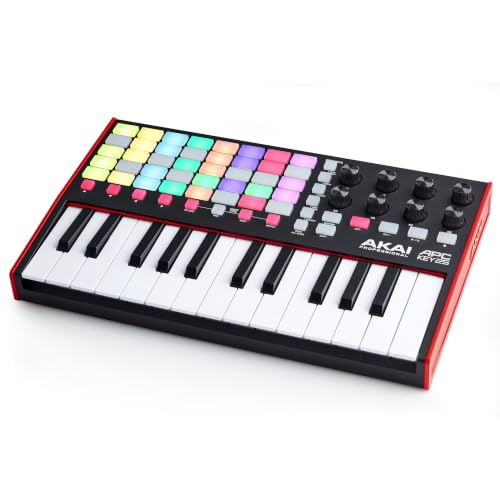
- 40 RGB pads for Ableton clip launching
- 25 velocity-sensitive mini keys
- Eight assignable knobs and USB power
Best For: Ableton Live producers needing compact clip and instrument control
Three-Octave Studio Hub

- 37-key controller across three octaves
- CV/Gate and MIDI I/O for hardware gear
- Built-in 64-step drum and melodic sequencer
Best For: Hybrid setups combining software, synthesizers, and modular equipment
Modern Mobile Production

- 25 mini keys with chord, scale, and arpeggiator tools
- Eight RGB MPC pads and eight assignable knobs
- USB-C, MIDI Out, display, and bundled instruments
Best For: Portable production, quick songwriting, and beginner-friendly workflows
Analog Powerhouse – MOOG Messenger
The MOOG Messenger is a strong choice among synthesizers for recording when you want hands-on analog sound, full-size keys, and extensive modulation in a portable mono instrument. Its two wavefolding VCOs, flexible ladder filter, presets, and studio-friendly connectivity make it practical for basses, leads, and experimental sound design.
Best For: Producers and performers seeking a full-size-key monophonic analog synthesizer with expressive control and deep sound-shaping options.
Pros:
- Two variable-shape VCOs, sub-oscillator, sync, and frequency modulation provide substantial sonic range.
- 32 velocity- and aftertouch-sensitive keys support expressive studio and live performance.
- Built-in sequencer, arpeggiator, 256 presets, CV, MIDI, USB-C, and external audio input offer flexible integration.
Cons:
- As a monophonic synthesizer, it is geared toward one-note-at-a-time parts rather than chords.
- Its feature-rich design may be more than beginners need for simple recording setups.
Choose the Messenger if tactile analog control and powerful low-end matter more than polyphonic performance. The compensated ladder filter and broad modulation section make it especially useful for recording basses, leads, and evolving mono lines.
Portable Sampling Hub – Akai MPC Sample
The Akai MPC Sample brings sampling, sequencing, and effects into a compact standalone unit, making it a practical alternative to computer-based synthesizers for recording and beat production. Battery power, a built-in microphone and speaker, pad control, and internal storage support quick idea capture wherever you work.
Best For: Beatmakers, sample-based producers, DAWless creators, and musicians who want portable recording and groove-building tools.
Pros:
- Standalone operation includes a rechargeable battery, speaker, microphone, and microSD storage.
- Sixteen pads and Instant Sample Chop Mode streamline sampling, chopping, and beatmaking.
- Four FX processors, USB-C audio/MIDI, line I/O, MIDI connectivity, and smart-device sampling support varied setups.
Cons:
- MIDI DIN connection requires the included workflow to use a separate 1/8-inch-to-DIN adapter, which is not included.
- Its focus is sampling and sequencing rather than traditional keyboard-based synthesis.
The MPC Sample is best when portability and fast sample manipulation are priorities. It can serve as a compact recording sketchpad, a DAWless production hub, or a hands-on beatmaking companion for a larger studio.
DAW Control Center – Arturia KeyLab Essential mk3
The Arturia KeyLab Essential mk3 is a USB MIDI controller for recording with software synthesizers, virtual instruments, and a DAW. Its 49 velocity-sensitive keys, hands-on controls, pads, creative modes, and included Analog Lab V software make it a versatile starting point for in-the-box production.
Best For: Home-studio musicians who record software instruments and want keyboard, pad, mixer, and DAW control from one compact controller.
Pros:
- 49 synth-action keys, eight velocity- and pressure-sensitive pads, nine faders, and nine encoders provide broad control.
- Scale Mode, Chord Mode, and arpeggiator support composition and beat-making.
- Includes Analog Lab V with 2,000 presets, plus two piano instruments and additional software subscriptions.
Cons:
- It is a controller, not a standalone synthesizer with its own sound engine.
- USB connectivity and supported computer software are required for its main instrument functions.
For computer-based synthesizers for recording, the KeyLab Essential mk3 offers strong value through its integrated software and practical DAW controls. It is a sensible pick for producers who prefer editing sounds and arrangements inside a computer.
Portable FM Explorer – M-VAVE Wireless FM Synth
The M-VAVE Wireless FM Synth is a compact option among synthesizers for recording when portability and classic digital FM tones are the priority. Its six-operator engine, 32 algorithms, onboard effects, battery operation, and multiple MIDI options make it useful for mobile sketching and compact hardware setups.
Best For: Mobile musicians, beginners, and producers exploring FM sounds, sequencing, and wireless MIDI in a small format.
Pros:
- Six operators and 32 algorithms provide access to detailed FM synthesis.
- Battery operation, built-in speaker, 27 silicone keys, and compact construction support portable use.
- Includes 128 presets, six effects, an arpeggiator, a 16-step sequencer, USB MIDI, Bluetooth MIDI, and 3.5mm MIDI input.
Cons:
- The compact 27-key silicone keyboard may feel less substantial than a traditional keyboard.
- Its plastic and silicone construction is less suited to users seeking a full-size studio instrument.
The M-VAVE makes the most sense as an affordable, portable FM sound source and MIDI device. It offers considerable functionality for its size, particularly for recording quick ideas, experimenting with digital tones, or adding wireless control to a compact rig.
Best MIDI Workflow Controller – Arturia MiniLab 3
The Arturia MiniLab 3 is a compact 25-key MIDI controller for recording setups that need hands-on control over virtual instruments, drums, and mixer functions. Its velocity-sensitive keys, pads, encoders, faders, and included software make it a practical choice for computer-based music production.
Best For: Home studios and producers who want an all-in-one controller for recording and arranging with a Mac or Windows computer.
Pros:
- 25 velocity-sensitive slim keys with synth action
- Eight RGB-backlit pads, eight rotary encoders, and four faders
- Built-in arpeggiator, pitch/modulation touch controls, and display
- Includes Ableton Live Lite, Analog Lab Intro, and UVI Model D
Cons:
- Requires a computer for its primary MIDI-controller workflow
- USB is the listed connectivity option
The MiniLab 3 is not a standalone synthesizer, but it is a versatile control surface for recording software instruments. Choose it if tactile DAW control and bundled software matter more than built-in sounds.
Best Pocket Retro Synth – Stylophone Original
The Stylophone Original is a tiny, battery-powered electronic instrument with an unmistakable vintage sound. For recording setups seeking unusual synth textures, its stylus-controlled metal keyboard offers a simple way to add melodic lines, vibrato, and retro character.
Best For: Beginners, experimental musicians, and producers looking for portable vintage-style sounds.
Pros:
- Compact pocket-sized design with built-in speaker
- Three-octave touch-sensitive playing surface and optional vibrato
- Runs on three AA batteries and includes a headphone socket
- Can connect to a computer through a 3.5mm stereo cable for recording
Cons:
- Uses an auxiliary connection rather than USB MIDI
- Its stylus-based interface is less conventional than a standard keyboard
- Limited to the supplied iconic analog-style sound
The Stylophone is best viewed as a character instrument rather than a full studio synthesizer. It makes sense when portability, ease of use, and distinctive retro tone are higher priorities than extensive synthesis controls.
Best Standalone Mini Keyboard – Akai MPK Mini Play MK3
The Akai Professional MPK Mini Play MK3 combines a 25-key MIDI controller with built-in sounds and a speaker, making it a flexible option for recording away from a full studio. It also provides pads, knobs, an arpeggiator, and USB connectivity for computer-based production.
Best For: Beat makers, songwriters, and musicians who want portable standalone sounds plus MIDI control.
Pros:
- Over 100 internal drum and instrument sounds
- 25-key dynamic keybed, eight MPC pads, and four encoder knobs
- Built-in speaker, OLED display, arpeggiator, and note repeat
- Works with batteries or USB and includes MPC Beats and other software
Cons:
- Batteries are not included
- Its compact 25-key format offers less range than a full-size keyboard
The MPK Mini Play MK3 stands out among compact synthesizers for recording because it can produce sounds without a computer while still functioning as a USB MIDI controller. It is a strong fit for mobile idea capture and compact beat-making stations.
Ableton Clip Command – APC Key 25 MK2
For producers seeking synthesizers for recording inside Ableton Live, the Akai APC Key 25 MK2 combines 25 velocity-sensitive mini keys with clip-launching controls. Its compact layout is especially useful for arranging loops, playing software instruments, and shaping sessions from a laptop.
Best For: Ableton Live users who want integrated clip launching, melodic keys, and hands-on mixing controls.
Pros:
- 1:1 Ableton Live integration with 40 RGB clip-launch pads.
- 25 velocity-sensitive mini keys support chords, basslines, and synth leads.
- Eight assignable rotary knobs provide control over volume, panning, effects sends, and automation.
- USB-powered, compact, and supplied with Ableton Live Lite plus virtual instruments.
Cons:
- The mini-key layout provides only two octaves before using the octave controls.
- Its strongest integration is centered on Ableton Live.
The APC Key 25 MK2 is a focused choice for Ableton-based recording setups where clip triggering matters as much as playing software synthesizers. It offers substantial control in a portable footprint, though users seeking broader DAW or hardware connectivity may prefer a different controller.
Three-Octave Studio Hub – MPK Mini Plus
The Akai MPK Mini Plus is a versatile option for synthesizers for recording, offering 37 keys across three octaves plus MIDI and CV/Gate connections. It suits producers who want to control software, modular equipment, and external sound sources from one compact keyboard.
Best For: Producers who need more melodic range and want to connect both a DAW and hardware synthesizers or modular gear.
Pros:
- 37-key dynamic keybed provides three full octaves for melodic and harmonic playing.
- CV/Gate and MIDI I/O support modular gear, sound modules, and synthesizers.
- Built-in 64-step sequencer can handle separate drum and melodic or chord tracks.
- Includes MPC Beats, RGB MPC pads, arpeggiator, Chord mode, and Scale mode.
Cons:
- Its larger 37-key design is less compact than a 25-key controller.
- It is a MIDI controller rather than a standalone synthesizer with built-in sounds.
With its expanded keyboard and hardware-friendly connectivity, the MPK Mini Plus is one of the more flexible choices here for hybrid recording. The built-in sequencer also supports computer-free composition, while USB integration keeps it practical for standard DAW workflows.
Modern Mobile Production – MPK Mini IV
For producers comparing synthesizers for recording, the Akai MPK Mini IV delivers a compact USB-C controller with 25 velocity-sensitive keys, MPC pads, and a color display. Its chord, scale, and arpeggiator tools make it approachable for quick songwriting while its software bundle supports a broad virtual-instrument setup.
Best For: Beginners, mobile producers, and experienced users who want a current compact controller with guided performance features.
Pros:
- Eight velocity- and pressure-sensitive MPC pads include RGB performance feedback.
- Color display, push/turn encoder, and eight assignable knobs provide hands-on navigation.
- Arpeggiator, Chord mode, and Scale mode support fast idea generation.
- USB-C, full-size MIDI Out, DAW mapping, and a substantial virtual instrument collection expand its usefulness.
Cons:
- The 25 mini keys offer less playing range than the MPK Mini Plus.
- It requires software or external equipment to produce sound; it is not a standalone synthesizer.
The MPK Mini IV is a strong all-around controller for compact recording spaces and travel rigs. Its visual feedback and performance modes reduce setup friction, while MIDI Out adds flexibility beyond a basic computer-only keyboard.
How We Picked These Synthesizers for Recording
We selected these 10 instruments by looking at the ways musicians actually record: creating sounds directly, controlling software instruments, triggering samples, sketching ideas away from a computer, and adding expressive parts to a larger production. We considered keyboard size, connectivity, portability, onboard sounds, sequencing or performance features, software compatibility, and the amount of hands-on control available.
The selection includes dedicated synthesizers as well as MIDI controllers and sampler-oriented devices. That distinction matters: some products generate sound independently, while others require a computer, tablet, or external sound source.
Quick Comparison
| Best For | Look For | Product Types |
|---|---|---|
| Hands-on analog sound design | Real-time controls and dedicated audio output | Monophonic analog synthesizer |
| Software-based recording | USB MIDI, pads, knobs, and bundled instruments | MIDI keyboard controller |
| Sampling and beat production | Pad layout, sample control, and standalone workflow | Portable sampler or groovebox |
| Travel and casual creation | Battery power, built-in speaker, or compact design | Portable synthesizer |
Key Buying Factors for Synthesizers for Recording
Sound Generation Versus MIDI Control
A hardware synthesizer produces its own audio, which can be recorded directly into an interface or mixer. A MIDI controller sends performance information to software but does not create sound on its own. If you already use a DAW and virtual instruments, a controller may offer more sounds for less money. If you want an instrument that works without a computer, prioritize onboard synthesis or sampling.
Keyboard Size and Playing Style
Compact 25-key models save space and work well for bass lines, leads, chords, and mobile setups. A 37- or 49-key controller gives you more room for two-handed playing and reduces octave shifting. Mini keys improve portability, while full-size keys are generally more comfortable for extended recording sessions.
Controls, Pads, and Expression
Knobs, faders, pads, pitch controls, and modulation controls can make recording faster and more tactile. Look for the controls that match your workflow rather than simply choosing the largest feature list. Producers focused on drums may prefer pads, while sound designers may value dedicated filter and envelope controls.
Connectivity and Software
Check USB compatibility, MIDI connections, audio outputs, sustain-pedal support, and included software. Controllers often become much more useful when their mappings and bundled instruments integrate cleanly with your DAW. For hardware synthesizers, confirm how you will record audio and whether external MIDI synchronization is needed.
Who Should Buy Which Synthesizers for Recording?
Choose the MOOG Messenger if you want a focused analog instrument for basses, leads, and hands-on synthesis. The M-VAVE FM model suits buyers who want portable digital synthesis and built-in playback. The Stylophone is best for simple, playful experiments and highly portable ideas.
For computer-based recording, the Arturia KeyLab Essential mk3 is a strong choice when you want a larger keyboard and bundled software, while the Arturia MiniLab 3 favors compact desktop setups. Akai’s MPK Mini models suit producers seeking small controllers, with the MPK Mini Plus offering more playing range. The MPK Mini Play MK3 is especially useful when standalone portability matters.
Choose the APC Key 25 MK2 if clip launching and performance control are central to your Ableton-oriented workflow. For sample-driven production, the Akai MPC Sample Portable Sampler is the better direction. Before buying, confirm whether you need onboard audio generation, and budget for an audio interface if your chosen controller only sends MIDI.