The best studio monitors with built-in DSP can compensate for room problems, improve low-frequency accuracy, and make mixing decisions more dependable. They range from compact desktop speakers to professional nearfields with advanced calibration.
This roundup compares 10 strong options for home studios, production rooms, editing suites, and creators who want clearer monitoring without relying entirely on external correction hardware.
Best 10 Studio Monitors with Built in Dsp Picks for 2026
Compact Room-Corrected Pick

- 36 Hz–32 kHz response
- ARC X correction and emulation
- Time-aligned compact design
Best For: Compact home studios and desktop mixing
Reference-Grade DSP Pick

- 5.25-inch woofer and 1-inch tweeter
- 80W LF and 80W HF bi-amplification
- MMD waveguide and DSP engine
Best For: Professional nearfield monitoring and production
Desktop Connectivity Pick
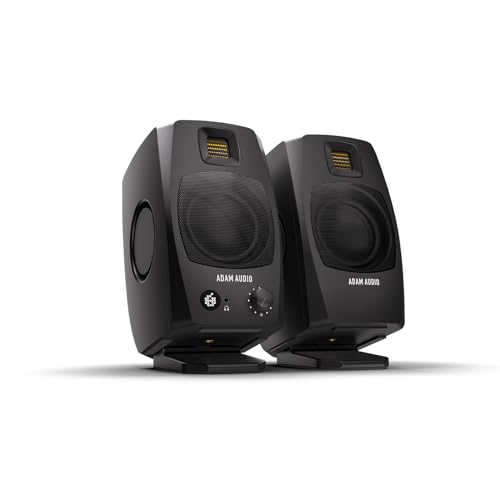
- USB-C computer connectivity
- DSP placement switches
- 45 Hz extension with passive radiators
Best For: Desktop production and computer-based listening
Compact Professional Pick

- Built-in DSP engine
- 4-inch nearfield monitor format
- Modeled dispersion waveguide
Best For: Compact professional and project-studio monitoring
Balanced Room Tuning

- 5-inch powered monitor pair
- Boundary EQ and HF Trim controls
- XLR and 1/4-inch TRS inputs
Best For: Music production, podcasting, and sound design
Compact Desktop Choice

- 4.5-inch two-way monitor pair
- Room Control and High Trim adjustments
- XLR/TRS, RCA, and stereo mini inputs
Best For: Desktop music production and video editing
Networked DSP Precision

- Advanced DSP with app control
- IP network connectivity
- Bi-amped 120W LF and 70W HF design
Best For: Professional nearfield monitoring with networked calibration
Room-Tunable Workhorse

- 73-watt self-powered 7-inch monitor
- Bi-amped Class A/B amplification
- Low/high controls and front port
Best For: Home studios needing a larger, adjustable monitor
Clean Reference Pair

- Pair of 5-inch two-way monitors
- 70 watts of bi-amplified power
- XLR and TRS inputs
Best For: Compact music-production and monitoring setups
Matched Stereo Upgrade

- Two 73-watt 7-inch monitors
- Bi-amped Class A/B amplification
- Front ports and low/high controls
Best For: Stereo home studios wanting adjustable 7-inch monitors
Compact Room-Corrected Pick – iLoud MTM MKII Pair
The IK Multimedia iLoud MTM MKII is a strong choice if you want studio monitors with built in dsp for a compact desktop setup. Its ARC room-correction tools, time alignment, and monitor-emulation features are aimed at critical listening, mixing, and production in rooms where placement and acoustics may vary.
Best For: Compact home studios, desktop mixing, and creators who want room correction and reference-monitor emulation.
Pros:
- Ultra-flat 36 Hz–32 kHz frequency range supports detailed listening across the spectrum.
- ARC X room correction helps compensate for room and placement inconsistencies.
- Time alignment is designed to improve imaging and reduce phase-related listening fatigue.
- Includes flexible tabletop and mic-stand mounting options.
Cons:
- The supplied notes indicate that the ARC microphone is sold separately.
- The compact 3.5-inch woofer format may be less suitable for users seeking a larger monitor system.
Choose this pair when space, calibration flexibility, and translation checking matter more than a traditional large-monitor setup. ARC X and the included positioning options make it particularly adaptable for desktop production.
Reference-Grade DSP Pick – Neumann KH 120 II
The Neumann KH 120 II is built for buyers seeking studio monitors with built in dsp and reference-oriented performance. Its bi-amplified 5.25-inch woofer and 1-inch tweeter are paired with an MMD waveguide and DSP engine for serious nearfield monitoring and production work.
Best For: Professional or advanced home studios, broadcasting, multichannel setups, and precise music production.
Pros:
- Bi-amped design provides 80 watts for the low-frequency driver and 80 watts for the high-frequency driver.
- Reference-class configuration combines a 5.25-inch woofer with a 1-inch tweeter.
- MMD waveguide supports controlled monitor performance in nearfield applications.
Cons:
- Sold as one speaker, so a stereo setup requires two units.
- The supplied details list a 44 Hz frequency figure without a complete response range.
- Its reference-focused design may be more monitor than casual desktop listeners need.
The KH 120 II makes sense when accurate, professional monitoring is the priority. Its powered two-way architecture and DSP engine position it as a serious choice for production environments that need a compact reference monitor.
Desktop Connectivity Pick – ADAM Audio D3V
The ADAM Audio D3V brings studio monitors with built in dsp to a compact desktop system. USB-C connectivity, DSP-powered placement switches, angled stands, and a front headphone socket make it practical for songwriters, producers, and listeners working directly at a desk.
Best For: Desktop producers, songwriters, computer-based setups, and listeners who want convenient USB-C connectivity.
Pros:
- USB-C connection supports direct use with computers and mobile devices.
- DSP-powered switches address common acoustic issues caused by speaker placement.
- 3.5-inch aluminum woofers and passive radiators extend response down to 45 Hz.
- Angled detachable stands and mic-stand mounting support flexible positioning.
Cons:
- The supplied notes identify this as a compact 3.5-inch desktop monitor system.
- Its 45 Hz low-frequency extension may not replace a larger monitor or subwoofer for bass-heavy work.
- USB-C, TRS, and RCA connectivity may still require adapters depending on the source device.
Pick the D3V if you want a streamlined desktop workflow rather than a traditional studio installation. It combines useful placement controls with direct computer connectivity and a headphone output in a compact active pair.
Compact Professional Pick – Neumann KH 80 DSP
The Neumann KH 80 DSP is a compact option for buyers comparing studio monitors with built in dsp for nearfield and professional reference use. Its 4-inch driver, DSP engine, and mathematically modeled dispersion waveguide suit project studios, post-production rooms, broadcast work, and multichannel systems.
Best For: Compact professional monitoring, project studios, broadcast spaces, post-production, and multichannel installations.
Pros:
- Built-in DSP engine supports controlled reference monitoring.
- Mathematically modeled dispersion waveguide is designed for consistent monitor dispersion.
- Compact 4-inch format fits desktop, nearfield, and space-constrained studio setups.
- App control and mounting hardware support flexible installation and adjustment.
Cons:
- Sold as one monitor, so a stereo pair requires two units.
- The supplied frequency figure is 57 Hz, indicating less low-end extension than larger monitors.
- Its 25-watt maximum output listing may be limiting for larger rooms or louder monitoring.
The KH 80 DSP is a sensible fit when professional DSP control and compact dimensions are more important than maximum bass or output. It is especially well suited to nearfield work where controlled dispersion and placement flexibility matter.
Balanced Room Tuning – JBL 305P MkII Pair
The JBL 305P MkII pair is a practical choice for anyone seeking studio monitors with built in dsp-style room adjustment features. Its Boundary EQ and HF Trim controls help tailor the monitors to their placement, while the Image Control Waveguide supports a wide, precise listening sweet spot.
Best For: Music production, podcasting, and cinematic sound design in small or midsize studio setups.
Pros:
- Includes a pair of powered 5-inch monitors.
- Image Control Waveguide delivers precise imaging and a wide sweet spot.
- Boundary EQ and HF Trim help adapt the response to the room.
- Offers XLR and 1/4-inch TRS connectivity.
Cons:
- Room adjustment is handled with onboard controls rather than app-based DSP.
- The 5-inch cabinets may be less suitable where very high output or extended low bass is required.
With dual 41-watt Class-D amplification, a 5-inch woofer, and a Slip Stream port, this pair combines useful placement controls with a studio-focused sound. It is a strong fit for creators who want straightforward monitor calibration without a more involved networked system.
Compact Desktop Choice – Yamaha HS4 Pair
The Yamaha HS4 pair suits compact workstations where studio monitors with built in dsp are being considered alongside simple analog room controls. These 4.5-inch two-way monitors include Room Control and High Trim response adjustments, plus a broad selection of inputs for computers, mobile devices, and other sources.
Best For: Music production and video editing at a desktop workstation.
Pros:
- Compact pair with 4.5-inch woofers and 1-inch dome tweeters.
- Room Control and High Trim adjust the response for the listening space.
- Accepts XLR/TRS, RCA, and stereo mini connections.
- Includes speaker cable, stereo mini-to-RCA cable, and anti-slip pads.
Cons:
- The listed output is 26 watts, so it is aimed more at nearfield use than high-volume monitoring.
- Its controls are physical response controls rather than app-based DSP.
The HS4 is a space-conscious option with a 60 Hz–22 kHz frequency response at -10 dB and convenient connectivity. Choose it when a small desktop footprint and flexible inputs matter more than deep bass or substantial headroom.
Networked DSP Precision – Neumann KH 80 DSP Pair
Neumann KH 80 DSP 4" Active 2-Way Studio Monitor (Gray, Pair) with (2) Isolation Pad, Medium Bundle
Check Price On AmazonThe Neumann KH 80 DSP pair is the most direct match for shoppers looking for studio monitors with built in dsp. Its advanced DSP, app control, and IP network connectivity provide a more sophisticated calibration approach, while bi-amped amplification and the MMD Waveguide support accurate nearfield monitoring.
Best For: Professional music and audio work where app-based monitor control and network connectivity are priorities.
Pros:
- Built-in advanced DSP with app-based control.
- IP network connectivity supports a more integrated monitoring setup.
- Bi-amped design provides 120 watts for low frequencies and 70 watts for high frequencies.
- Includes a pair of monitors and two medium isolation pads.
Cons:
- The 4-inch woofer is compact and may not provide the low-end scale of larger monitors.
- Connectivity is listed as XLR, so additional interfaces may be needed for other source formats.
- Its advanced features may be more than necessary for a basic desktop setup.
With a 4-inch woofer, 1-inch tweeter, MMD Waveguide, and app-controlled DSP, the KH 80 DSP is designed for users who want detailed control beyond basic rear-panel EQ. The included isolation pads also make the bundle convenient for a compact monitoring position.
Room-Tunable Workhorse – KRK Classic 7
The KRK Classic 7 is a practical option for shoppers seeking studio monitors with built in dsp-style room adjustment controls. This self-powered 7-inch monitor uses matched amplification, bi-amped Class A/B circuitry, and dedicated low- and high-frequency controls to help you tailor its response to your setup.
Best For: Home studios and near-wall placements that need a larger monitor with flexible response controls.
Pros:
- 73-watt, self-powered 7-inch design requires no external amplifier.
- Bi-amped Class A/B amplifiers are matched to the drivers for high headroom and low distortion.
- Front-firing port supports more flexible placement near walls.
- Dedicated low- and high-frequency adjustments help match room acoustics.
Cons:
- Sold as a single monitor in this listing, so stereo use requires two units.
- Its 7-inch format may be more monitor than smaller desktop spaces need.
- The supplied notes describe analog RCA, TRS, and XLR connectivity rather than wireless operation.
Choose this model if you want a robust, self-powered monitor with useful analog adjustment controls and placement flexibility. It is especially practical when you need to tune the monitor’s response without adding an external processor.
Clean Reference Pair – Yamaha HS5 Pair
The Yamaha HS5 pair is a straightforward choice for shoppers comparing studio monitors with built in dsp-style monitoring controls. These 5-inch, two-way bi-amplified monitors are designed to emphasize sonic purity, with 45 watts of low-frequency amplification, 25 watts of high-frequency amplification, and balanced or unbalanced inputs.
Best For: Music production and studio monitoring where a compact pair with an uncolored presentation is the priority.
Pros:
- Includes two Yamaha HS5 monitors for a complete stereo setup.
- Two-way bi-amplified design combines a 5-inch woofer with a 1-inch dome tweeter.
- Designed to emphasize the original sound without coloring or altering it.
- XLR and TRS inputs accept balanced or unbalanced signals.
Cons:
- The 5-inch woofer may provide less low-frequency reach than larger monitors.
- The supplied frequency response begins at 54 Hz, which may not suit bass-heavy work by itself.
- Wireless functionality is not supported by the listed connectivity details.
The HS5 pair makes sense when consistent stereo monitoring and a compact footprint matter more than extended bass. Its stated focus on sonic purity can be useful for making mixing decisions without an intentionally colored presentation.
Matched Stereo Upgrade – KRK Classic 7 Pair
The KRK Classic 7 pair is a convenient stereo solution for shoppers seeking studio monitors with built in dsp-style adjustment flexibility. Each self-powered 7-inch monitor delivers 73 watts through matched, bi-amped Class A/B amplification, while dedicated low- and high-frequency controls help adapt the response to the room.
Best For: Stereo home-studio setups that want larger monitors, front-firing ports, and per-monitor tonal adjustment.
Pros:
- Includes two 7-inch Classic 7 monitors for stereo monitoring.
- 73 watts per monitor with self-powered, matched amplification.
- Bi-amped Class A/B design is intended to provide high headroom and low distortion.
- Front-firing ports and low/high controls support flexible placement and tuning.
Cons:
- The larger 7-inch cabinets may require more desk or stand space than compact monitors.
- The supplied notes list corded operation and no wireless communication.
- Connections and controls are analog and manual rather than app-based.
This pair is a strong fit when you want the Classic 7’s output and adjustment features without buying monitors individually. The front ports are useful for flexible placement, while the tonal controls provide a practical way to account for room differences.
How We Picked the Best Studio Monitors with Built in Dsp
We focused on active studio monitors that include onboard digital signal processing, room correction, speaker voicing controls, or DSP-based tuning features. The selection also covers different sizes, price levels, listening distances, and use cases, from compact desktop monitoring to full nearfield mixing.
We considered driver configuration, amplifier power, frequency response, connectivity, calibration options, physical size, and whether each product is sold individually or as a pair. Because room acoustics strongly affect monitor performance, practical adjustment features received particular attention.
Quick Comparison
| Best For | What to Look For |
|---|---|
| Small desks and mobile setups | Compact cabinets, front ports, and easy placement controls |
| Accurate nearfield mixing | Room calibration, neutral voicing, and broad adjustment ranges |
| Low-end production | Larger woofers, higher output, and controlled bass extension |
| Budget-conscious studios | Balanced response, dependable inputs, and simple acoustic compensation |
Key Buying Factors for Studio Monitors with Built-In DSP
Room Size and Listening Distance
Choose monitor size according to your room and working distance, not just desired bass. Four- and five-inch models generally suit desks and smaller rooms, while seven-inch monitors can deliver more output and low end but may expose untreated-room problems.
Calibration and Control
DSP is most useful when it provides meaningful correction rather than only preset voicings. Look for onboard EQ, boundary compensation, high- and low-frequency trims, or an included measurement microphone and calibration system. These controls cannot replace acoustic treatment, but they can reduce problems caused by walls, corners, and desktop placement.
Connections and Setup
Check whether the monitor accepts balanced inputs such as XLR or TRS, and confirm that your audio interface has the appropriate outputs. Also verify whether the listed price covers one monitor or a stereo pair. Isolation pads, stands, and symmetrical placement can improve results as much as extra amplifier power.
Output and Tonal Balance
Prioritize clean headroom and a response you can work with for long sessions. A monitor that sounds impressive at first may be less useful than one that reveals harshness, masking, and bass buildup consistently across different mixes.
Who Should Buy Which Studio Monitors with Built in Dsp?
Choose a compact model such as the ADAM Audio D3V or IK Multimedia iLoud MTM MKII if desk space is limited or you work close to the speakers. The iLoud option is especially appealing when automated room correction and speaker emulation are priorities.
For detailed nearfield mixing, the Neumann KH 80 DSP and KH 120 II are strong choices when you value accurate imaging and sophisticated DSP control. The KH 80 is better suited to smaller rooms, while the KH 120 II offers a larger, more capable monitoring platform.
Yamaha HS4 and HS5 models fit creators who want familiar, straightforward monitoring for production, editing, and content work. JBL 305P MkII monitors offer a practical value-oriented option, while KRK Classic 7 models suit buyers who want greater output and a more substantial low end.
Whichever model you choose, place the monitors symmetrically, aim the tweeters toward ear level, and calibrate after positioning them. DSP works best as the final refinement of a sensible room and speaker setup.