Small rooms demand stage monitors that deliver clear vocals and instruments without overwhelming the space. The right compact wedge or powered PA speaker can improve performer confidence while keeping setup practical.
These 10 picks cover active and passive designs, different woofer sizes, and a range of power levels for rehearsals, churches, bars, presentations, and small live performances.
Best 10 Stage Monitors for Small Rooms Picks for 2026
Compact Power Monitor

- 800W Class-D active monitor
- 10-inch two-way coaxial design
- Combo input and XLR link output
Best For: Small stages, DJ booths, and high-output monitoring
Wireless Small-Room Monitor

- 350W powered 8-inch speaker
- Bluetooth and True Wireless Stereo
- Built-in two-channel mixer
Best For: Small gigs, home studios, and mobile DJ setups
Passive Wedge Monitor

- 10-inch floor monitor wedge
- 150W RMS, 300W peak handling
- Titanium compression horn
Best For: Small PA systems with a separate amplifier
Personal Nearfield PA

- 150W compact Class-D PA
- 5.25-inch full-range driver
- Mic and line inputs for personal use
Best For: Solo performers, presenters, classrooms, and close-range monitoring
Compact Passive Pick

- 10-inch woofer with 1-inch compression tweeter
- 150W RMS/300W peak at 8 ohms
- Parallel 1/4-inch jacks for daisy chaining
Best For: Small venues using an external amplifier
High-Sensitivity Classic

- 12-inch woofer and 1-inch compression driver
- 300W program/600W peak handling
- 97dB sensitivity with built-in pole socket
Best For: Small live-PA systems needing a passive 12-inch monitor
Powered Control Choice

- Built-in 250W Class-D amplifier
- Adjustable feedback filter and limiter
- XLR, 1/4-inch, RCA, and Speakon connections
Best For: Small rooms needing an all-in-one powered monitor
Compact Vocal Monitor
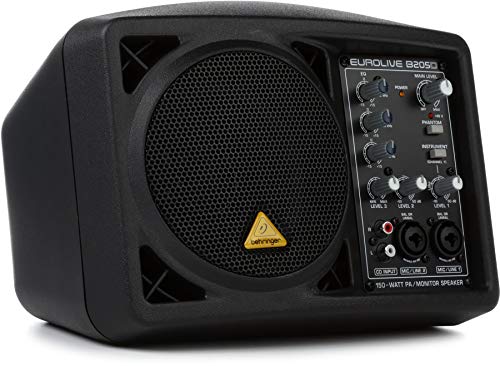
- 150-watt active monitor with full-range driver
- Three-channel mixer with three-band EQ
- Phantom-powered mic inputs and instrument input
Best For: Small-room vocal, keyboard, and home-recording monitoring
High-Power Floor Monitor

- 300-watt two-way active monitor
- 12-inch woofer with 1-inch compression driver
- Feedback filter, limiter, and sound processor
Best For: Live and playback monitoring where higher output is needed
Versatile MP3 Monitor

- 150-watt active speaker with integrated MP3 player
- Four-channel mixer with three-band EQ
- XLR and 1/4-inch TRS connectivity
Best For: Small gigs, meetings, presentations, and USB playback
Compact Power Monitor – Samson RSXM10A
For stage monitors for small rooms that still need substantial headroom, the Samson RSXM10A combines an 800-watt Class-D amplifier with a compact coaxial design. Its 10-inch driver, combo input, and monitor/FOH selector make it adaptable for rehearsals, DJ booths, and live performance setups.
Best For: Small stages, DJ booths, and performers who want a powerful active wedge with flexible connections.
Pros:
- 800 watts of output from a lightweight Class-D active design
- 10-inch woofer and 1-inch tweeter provide two-way sound
- XLR/1/4-inch combo input and XLR link output simplify connections
- All-wood coaxial cabinet includes a 1 3/8-inch pole-mount receptacle
Cons:
- At 30 pounds, it is heavier than ultra-compact monitors
- Its 10-inch format may take more floor space than a 5.25- or 8-inch option
- It requires corded power
The RSXM10A is a strong choice when a small-room monitor needs more output than a personal PA can provide. Its powered design and flexible routing reduce the need for external amplification, though its larger cabinet may be more than necessary for very close-range vocal monitoring.
Wireless Small-Room Monitor – Alto TX408
The Alto TX408 is a practical pick for stage monitors for small rooms where portability and wireless playback matter. This compact 8-inch powered speaker offers 350 watts, a built-in two-channel mixer, Bluetooth, and a wedge-monitor position for intimate performances and rehearsals.
Best For: Small gigs, home studios, mobile DJs, presentations, and performers who need Bluetooth alongside microphone or line input.
Pros:
- Compact 8-inch design with 350 watts of bi-amplified power
- Bluetooth supports streaming and True Wireless Stereo pairing
- Built-in mixer accepts microphone, line-level, and Bluetooth sources
- 90° x 60° dispersion, ergonomic handles, and integrated pole socket support flexible placement
Cons:
- Bluetooth range is listed at up to 75 feet, but wireless operation still depends on the setup
- The speaker is not water resistant
- It requires corded power
With its small footprint and broad input options, the TX408 is well suited to compact rooms and multi-use setups. Bluetooth is particularly useful for breaks or backing tracks, while the wedge position keeps it practical for on-stage monitoring.
Passive Wedge Monitor – Seismic Audio SA-10MTSingle
Seismic Audio - SA-10MTSingle - 10" Floor / Stage Monitor Wedge Style with Titanium Horn
Check Price On AmazonThe Seismic Audio SA-10MTSingle is a straightforward floor wedge for stage monitors for small rooms when you already have an amplifier or powered mixer. Its 10-inch speaker, titanium horn, and 150-watt RMS rating are aimed at focused stage monitoring rather than all-in-one convenience.
Best For: Small live setups using an existing amplifier, mixer, or PA power system.
Pros:
- Floor-mounted wedge design is purpose-built for stage monitoring
- 10-inch woofer with a 40-ounce magnet and 2-inch voice coil
- Titanium compression horn provides high-frequency coverage
- Supports wired 1/4-inch and Speakon connections
Cons:
- Passive design requires a separate amplifier or powered mixer
- 150 watts RMS is lower than the powered alternatives in this roundup
- It is not water resistant
The SA-10MTSingle makes sense for buyers building a modular PA system or adding a dedicated wedge to equipment they already own. It avoids built-in amplifier complexity, but the additional amplification requirement should be included in the setup budget.
Personal Nearfield PA – Mackie SRM150
For very close-range stage monitors for small rooms, the Mackie SRM150 prioritizes portability and simple personal monitoring. Its 5.25-inch full-range driver and 150-watt Class-D amplifier suit one microphone plus music, making it especially useful for classrooms, meetings, busking, and compact performances.
Best For: Vocalists, presenters, solo performers, and small rooms where a lightweight tabletop or pole-mounted monitor is enough.
Pros:
- Weighs 7.6 pounds and can be carried in one hand
- 150-watt Class-D amplification with a built-in limiter
- Supports a microphone through XLR and a player through the line input
- Works on a tabletop or pole and includes a top carry handle
Cons:
- Its 5.25-inch driver and 100 Hz low-end limit are not intended for bass-heavy full-band playback
- It is designed for one mic plus music, not a full-band PA
- It is not water resistant
The SRM150 is the most compact option here for personal monitoring and speech-focused use. It is easy to place and transport, but buyers needing stronger low end or coverage for a full band should consider a larger monitor.
Compact Passive Pick – Sound Town METIS-10M
For stage monitors for small rooms, the Sound Town METIS-10M offers a compact floor-monitor format with a 10-inch woofer and compression tweeter. Its passive design suits setups that already include an amplifier or powered mixer.
Best For: Small-room live performances, bars, churches, and portable systems with external amplification.
Pros:
- 10-inch woofer and 1-inch compression tweeter provide two-way monitoring.
- Handles 150W RMS and 300W peak at 8 ohms.
- Parallel 1/4-inch jacks support daisy chaining.
- Carpet finish, metal grille, corner protection, and recessed handle support portable use.
Cons:
- Passive operation requires a separate amplifier or powered mixer.
- It is not waterproof.
The METIS-10M is a practical choice when floor space is limited and you want a straightforward, chainable monitor cabinet without built-in amplification.
High-Sensitivity Classic – Yamaha BR12M
The Yamaha BR12M is a traditional passive floor monitor with a 12-inch woofer, compression driver, and 97dB sensitivity. For stage monitors for small rooms, its sturdy cabinet and pole socket add flexibility for compact sound-reinforcement setups.
Best For: Live performers and small-room PA systems that need a passive 12-inch monitor with strong sensitivity.
Pros:
- 12-inch woofer delivers punchy lows through a bass-reflex design.
- 1-inch compression driver uses a 90-by-40-degree horn.
- Supports 300W program and 600W peak power handling.
- Built-in pole socket, steel handles, and corner protectors improve placement and handling.
Cons:
- Passive operation requires an amplifier and speaker cables.
- The larger 12-inch cabinet may take more floor space than a 10-inch monitor.
- It has no wireless communication technology.
Choose the BR12M when you want a conventional, high-sensitivity monitor with useful mounting hardware and enough power handling for small live-performance systems.
Powered Control Choice – Behringer EUROLIVE F1220D
For stage monitors for small rooms, the Behringer F1220D keeps setup simple with a built-in 250W Class-D amplifier. Its 12-inch woofer, feedback filter, limiter, and multiple wired inputs make it suited to flexible monitoring and playback setups.
Best For: Small-room performers who prefer an all-in-one powered monitor with feedback control.
Pros:
- Integrated 250W Class-D amplification eliminates the need for a separate power amplifier.
- Adjustable feedback filter helps manage problem frequencies.
- Integrated limiter supports speaker protection.
- Offers XLR, 1/4-inch, RCA, and Speakon connectivity.
Cons:
- At 23.6 pounds, it is less portable than some smaller monitor options.
- It is not water resistant.
- The supplied notes identify a tabletop mount rather than a dedicated floor-mount specification.
The F1220D is the most convenient option here for users who want amplification and feedback-management features built into one monitor cabinet, provided its footprint fits the room.
Compact Vocal Monitor – Behringer Eurolive B205D
The Behringer Eurolive B205D is a compact active speaker that fits naturally into setups needing stage monitors for small rooms. Its 150-watt output, full-range driver, and built-in mixer support vocal, keyboard, home-recording, and presentation use.
Best For: Vocal and keyboard monitoring, home recording studios, small presentations, and multimedia setups.
Pros:
- Compact 7.05-pound design is easy to position and transport.
- Built-in three-channel mixer with three-band EQ adds setup flexibility.
- Two microphone preamps include phantom power, plus an instrument-ready input.
Cons:
- Its 5.25-inch full-range driver and 150-watt output are better suited to small spaces than larger live applications.
- It is a single speaker rather than a stereo pair.
For intimate monitoring duties, the B205D prioritizes portability and input flexibility over large-room projection. It is a practical choice when space is limited and you want mixer functions built into the monitor.
High-Power Floor Monitor – Behringer EUROLIVE F1320D
The Behringer EUROLIVE F1320D is a floor-standing 300-watt monitor for buyers who need more output from stage monitors for small rooms. Its 12-inch woofer, 1-inch compression driver, feedback filter, and limiter make it suited to live and playback applications.
Best For: Live performers and playback setups that need a higher-output floor monitor in a small venue or rehearsal space.
Pros:
- 300-watt two-way design offers more output than compact 150-watt models.
- 12-inch woofer and 1-inch compression driver support wide-band monitoring.
- Adjustable feedback filter and integrated limiter help with control and protection.
- Built-in sound processor adds further system management.
Cons:
- At 33.1 pounds, it is considerably less portable than compact monitor speakers.
- Its larger 19.5-inch dimensions may be more than some very tight rooms can accommodate.
- It requires corded power and is not water resistant.
The F1320D is the strongest output option in this selection, but its larger cabinet and heavier weight make it less convenient to move. Choose it when projection and feedback control matter more than a small footprint.
Versatile MP3 Monitor – Behringer EUROLIVE B207MP3
Behringer EUROLIVE B207MP3 Active 150 Watt 6.5" PA/Monitor Speaker System with MP3 Player
Check Price On AmazonThe Behringer EUROLIVE B207MP3 combines a 150-watt active speaker with a four-channel mixer and integrated MP3 player. For stage monitors for small rooms, it offers a useful balance of compact operation, playback capability, and inputs for vocal, keyboard, multimedia, and meeting applications.
Best For: Small gigs, intimate meetings, home studios, presentations, and users who want USB MP3 playback built into the monitor.
Pros:
- Integrated MP3 player can play audio files from a USB stick.
- Four-channel mixer with three-band EQ supports multiple sources.
- 150-watt Class-D design is relatively lightweight at 12.4 pounds.
- XLR and 1/4-inch TRS connectivity accommodates common audio equipment.
Cons:
- Its 6.5-inch speaker size and 150-watt output are intended for smaller applications.
- At 12.4 pounds, it is less compact than the B205D.
- It is a single speaker rather than a stereo pair.
The B207MP3 stands out when playback convenience is important alongside monitoring. Its mixer and USB player make it a flexible small-room solution, though it is not designed to replace a higher-powered floor monitor for larger spaces.
How We Picked the Best Stage Monitors for Small Rooms
We focused on monitor speakers suited to limited stage space, moderate audience sizes, and straightforward live-sound setups. Our selection includes powered models for simple plug-and-play operation as well as passive wedges for users who already have a suitable amplifier or PA system.
We also considered cabinet size, driver configuration, portability, connection flexibility, feedback-management features, and the type of coverage each monitor is likely to provide. Since room acoustics and performance volume vary, wattage alone was not treated as a measure of overall quality.
Quick Comparison
| Type | Best For | Main Advantage |
|---|---|---|
| Compact active monitor | Solo performers, speeches, small stages | Simple setup and low space requirements |
| 8- to 10-inch powered wedge | Bands, worship teams, bars | Balanced portability and output |
| 12-inch active monitor | Higher-volume performances | More headroom and fuller low end |
| Passive floor monitor | Installed or expandable PA systems | Works with an existing amplifier |
Key Buying Factors for Stage Monitors for Small Rooms
Active or Passive Design
Active monitors include a built-in amplifier, so they generally need only an audio signal and power connection. They are convenient for mobile performers and small venues. Passive models can be lighter or more economical, but they require an amplifier matched to their impedance and power handling.
Speaker Size and Output
An 8-inch or smaller monitor is often easier to position in a crowded room and can provide sufficient vocal clarity. A 10-inch model offers a useful middle ground for vocals, guitars, keyboards, and moderate low-frequency content. Choose a 12-inch monitor when you need more headroom, bass extension, or coverage, but confirm that the cabinet will not dominate the available stage area.
Inputs, Controls, and Feedback Resistance
Check whether the monitor accepts the connections used by your mixer or microphone system. Individual level controls, EQ options, balanced inputs, and feedback filters can make setup easier. Place the wedge behind the microphone’s pickup pattern and adjust the monitor level gradually to reduce feedback.
Placement and Room Acoustics
Small rooms reflect sound heavily, so excessive volume can make vocals less intelligible. Aim the monitor toward the performer’s ears, keep it as close as practical, and avoid pointing it directly at nearby walls or reflective surfaces.
Who Should Buy Which Stage Monitors for Small Rooms?
Solo performers and presenters: Choose a compact active monitor that is easy to carry and quick to connect.
Small bands and worship teams: An 8- or 10-inch powered wedge usually provides the best balance of clarity, output, and footprint.
Higher-volume acts: Consider a 12-inch active monitor for additional headroom, provided the room and stage can accommodate it.
Existing PA owners: A passive wedge may be the most practical choice if you already have an appropriate amplifier and want to expand your monitoring system.