Choosing among today’s keyboard pianos can be difficult when product listings combine full-size digital pianos, portable keyboards, and bundled starter kits. The right option depends on how closely you want the keys to feel like an acoustic piano, how much space you have, and which accessories you need.
This roundup compares 10 popular models across weighted and semi-weighted actions, beginner-friendly learning features, portability, included stands, benches, pedals, and overall value.
Best 10 Keyboard Pianos Picks for 2026
Best Weighted Keyboard Piano

- 88 weighted, touch-sensitive keys
- Includes sustain pedal and power supply
- Dual Mode layers piano and strings
Best For: Focused piano practice and acoustic-style key response
Best Beginner Keyboard Piano Bundle

- 88 touch-sensitive full-size keys
- 480 sounds and built-in learning tools
- Includes stand, headphones, pedal, and case
Best For: Beginners wanting a complete practice package
Best Portable Keyboard Piano for Beginners

- 61 full-size keys in a compact design
- Quiz Mode and Smart Chord aid learning
- Supports AC or battery power
Best For: Beginner practice in smaller spaces or on the go
Best Value Keyboard Piano Kit

- Includes stand, bench, headphones, and stickers
- 200 tones and 200 rhythms
- Simply Piano lessons support beginners
Best For: Ready-to-play beginner setups and quiet practice
Premium Weighted Pick

- 88 weighted keys with progressive hammer action
- Triple pedals for expressive piano technique
- MIDI, recording, USB playback, and 40 demo songs
Best For: Home players seeking a full-size, furniture-style digital piano
Beginner Kit Pick

- Includes stand, stool, sustain pedal, and headphones
- Touch display controls tones and rhythms
- Simply Piano lessons and keynote stickers included
Best For: Beginners wanting a complete, ready-to-use keyboard package
Interactive Learning Pick
Ktaxon 61-Key Lighted Keyboard

- Light-up keys with three teaching modes
- 200 timbres, 200 rhythms, and 60 demo songs
- Includes stand, bench, headphones, and microphone
Best For: Beginners who want guided practice and a bundled setup
Best Beginner Bundle
RockJam RJ561 61-Key Keyboard Piano Kit
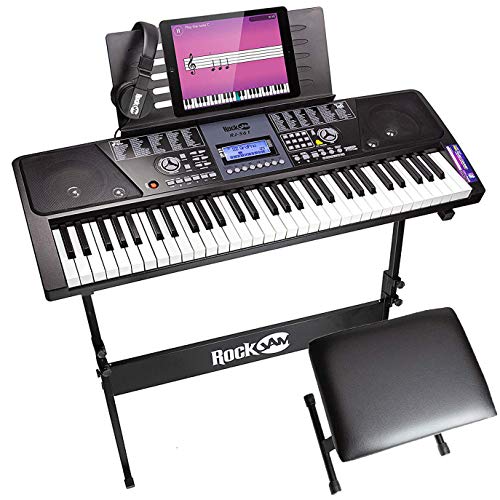
- Complete kit with stand, stool, headphones, and stickers
- 100 rhythms, 50 tones, lessons, and recording
- Headphone jack supports quiet practice
Best For: Kids and adults starting with a complete keyboard piano setup
Best Full-Size Starter Kit
88-Key Semi-Weighted Digital Piano

- Full 88-key range with semi-weighted touch
- Includes stand, case, pedal, headphones, and power supply
- Bluetooth, USB-MIDI, recording, and extensive sounds
Best For: Beginner adults wanting a versatile full-size keyboard piano
Best Feature-Packed 61-Key Kit
Donner DEK-610S Keyboard Piano Kit

- 249 voices and 249 rhythms for broad musical variety
- Includes stand, adjustable bench, microphone, and music stand
- Recording, teaching functions, and Donner Music app support
Best For: Beginners wanting a versatile, all-inclusive 61-key kit
Best Weighted Keyboard Piano – Yamaha P71
The Yamaha P71 is a strong choice for shoppers seeking keyboard pianos with a more authentic acoustic-piano feel. Its 88 touch-sensitive, weighted keys support expressive playing, while the simple controls keep practice focused.
Best For: Players of all skill levels who prioritize weighted action and a straightforward piano experience.
Pros:
- 88 weighted, touch-sensitive keys replicate an acoustic piano feel.
- Includes a sustain pedal and power supply.
- Dual Mode can layer piano and string voices.
- Built-in speakers, headphone output, and USB connectivity support flexible practice.
Cons:
- Offers 10 voices, which is a smaller library than many feature-heavy keyboards.
- Its corded-electric power setup is less travel-friendly than battery-capable models.
Choose the P71 if realistic key response matters more than extensive rhythms and built-in learning features. Its streamlined design makes it especially appealing for focused piano practice.
Best Beginner Keyboard Piano Bundle – Alesis Recital Play
The Alesis Recital Play is an all-in-one option for beginners comparing keyboard pianos. It combines 88 full-size touch-sensitive keys with 480 sounds, lesson modes, recording tools, and a useful accessory bundle.
Best For: Beginners who want a complete setup for learning, practicing, and experimenting with different sounds.
Pros:
- Includes 88 full-size, touch-sensitive keys.
- Offers 480 sounds, 160 rhythms, and 140 demo songs.
- Includes Split, Lesson, Record, metronome, and transpose functions.
- Bundle includes stand, headphones, sustain pedal, carry case, and sheet music/tablet stand.
Cons:
- It is designed for beginners rather than advanced players seeking weighted hammer action.
- The full bundle may take more storage space than a keyboard-only setup.
This is one of the most convenient keyboard pianos for starting from scratch because the main accessories are included. USB-MIDI, included software access, and battery capability add flexibility for lessons and practice away from an outlet.
Best Portable Keyboard Piano for Beginners – Yamaha PSR-E283
The Yamaha PSR-E283 is a compact choice among keyboard pianos for beginners, with 61 full-size keys and features designed to make early learning approachable. Its quiz modes, built-in songs, Smart Chord, and Portable Grand Piano button support both practice and play.
Best For: Beginners, including younger players, who want a compact keyboard with guided learning features.
Pros:
- 61 full-size keys provide a manageable starting layout.
- Quiz Mode includes two ear-training games.
- Smart Chord helps users play chords with one finger.
- Can run from an AC adapter or batteries for added portability.
Cons:
- Has 61 keys rather than the 88 keys found on a full-size piano.
- It does not list weighted or hammer-action keys.
The PSR-E283 is a practical fit when space, portability, and beginner-friendly guidance are priorities. Choose a larger weighted model instead if developing an acoustic-piano-style touch is the main goal.
Best Value Keyboard Piano Kit – RockJam RJ5061
The RockJam RJ5061 is a convenient starter choice for shoppers comparing keyboard pianos and wanting the essentials in one package. Its 61-key keyboard comes with a stand, bench, headphones, note stickers, and access to Simply Piano lessons.
Best For: Kids and adults who want an affordable, ready-to-play beginner kit with private-practice accessories.
Pros:
- Complete kit includes a stand, bench, headphones, and note stickers.
- Provides 200 rhythms, 200 tones, and demo songs.
- Pitch bend wheel adds expressive control beyond basic key playing.
- Headphones support quiet practice in shared spaces.
Cons:
- Its 61 keys are not a full 88-key piano layout.
- It does not list weighted or touch-sensitive keys.
- Battery-powered operation may require keeping spare batteries available.
The RJ5061 stands out for convenience: most of what a new player needs is included in the box. It is better suited to introductory learning and casual playing than to replicating the feel of an acoustic piano.
Premium Weighted Pick – UISCOM 88-Key Digital Piano
For shoppers comparing keyboard pianos for home practice and more expressive playing, the UISCOM offers a full 88-key layout with weighted, progressive hammer-action keys. Its wooden desk-style design, French Dream5704 sound chip, and triple pedals make it a substantial option for developing piano technique.
Best For: Adults and beginners who want a furniture-style digital piano with weighted keys, MIDI connectivity, and full pedal control.
Pros:
- 88 weighted keys with progressive hammer action for a more piano-like response.
- Triple pedals provide sustain, sostenuto, and soft-pedal functions.
- Includes eight tones, 40 demo songs, recording, playback, and adjustable reverb, chorus, and tempo.
- USB and MIDI functionality support computers, MIDI equipment, and USB music playback.
Cons:
- Its full-size wooden desk design is less portable than a compact keyboard.
- The headphones jack uses a 6.35mm connection, which may require an adapter for some headphones.
Choose this model if realistic key response and a permanent home setup matter more than portability. It also offers useful practice and recording features for players who want room to progress.
Beginner Kit Pick – RockJam RJ761 61-Key Keyboard
The RockJam RJ761 is a practical choice among keyboard pianos for beginners who want a ready-to-play package. It combines a 61-key keyboard with a stand, stool, sustain pedal, headphones, touch display, and learning support for both children and adults.
Best For: New players who want an all-in-one starter setup for lessons, home practice, and quiet playing.
Pros:
- Complete kit includes a keyboard, stand, stool, headphones, sustain pedal, and sheet music stand.
- Touch display provides direct control over tones, rhythms, and functions.
- Simply Piano lessons and keynote stickers support beginner learning.
- Headphones enable private practice in shared spaces.
Cons:
- Its 61-key layout offers less range than an 88-key digital piano.
- The included headphones use a 3.5mm jack, so compatibility with other equipment may vary.
This is a convenient starter bundle for buyers who do not want to source accessories separately. The included learning aids and quiet-practice option make it especially approachable for first-time players.
Interactive Learning Pick – Ktaxon 61-Key Lighted Keyboard
For families and beginners exploring keyboard pianos, the Ktaxon 61-key model emphasizes guided learning and variety. Lighted keys, three teaching modes, 200 timbres, 200 rhythms, and a supplied stand and bench create a flexible practice setup with plenty of built-in features.
Best For: Beginners and younger players who benefit from light-up-key instruction, bundled accessories, and battery-capable operation.
Pros:
- Lighted keys and One-Key, Follow, and Ensemble teaching modes support guided practice.
- Offers 200 timbres, 200 rhythms, and 60 demo songs for musical variety.
- Includes headphones, microphone, music rest, stand, bench, power adapter, and manual.
- Can run from the included power adapter or four AA batteries, which are sold separately.
Cons:
- Warranty coverage is listed as 30 days.
- The 61-key format provides less range than a full 88-key piano.
- The supplied microphone and power cable are packed in the small foam attached to the keyboard.
The Ktaxon stands out when learning guidance and included accessories are priorities. Its light-up keys and teaching modes can make early practice more engaging, while battery support adds placement flexibility.
Best Beginner Bundle – RockJam RJ561 61-Key Keyboard Piano Kit
The RockJam RJ561 is a practical entry point for shoppers comparing keyboard pianos because it bundles the essentials for learning and home practice. Its 61 keys, stand, stool, headphones, stickers, and lesson access help reduce the need for separate purchases.
Best For: Kids and adults who want a complete beginner keyboard piano setup with private-practice accessories.
Pros:
- Includes a stand, stool, headphones, sheet music stand, and keynote stickers.
- Offers 100 rhythms, 50 tones, teaching functions, demo songs, and recording.
- Headphone output supports quieter practice in shared spaces.
- USB connectivity and Simply Piano support add learning flexibility.
Cons:
- Its 61-key layout is shorter than a full 88-key piano.
- The notes do not specify weighted or semi-weighted keys.
Choose this model when convenience matters most. It is designed as a ready-to-use learning package rather than a minimalist keyboard, making it particularly suitable for a first home setup.
Best Full-Size Starter Kit – 88-Key Semi-Weighted Digital Piano
This 88-key model stands out among keyboard pianos for beginners who want a full-size range and a broad selection of sounds. Semi-weighted keys, a sustain pedal, stand, carrying case, headphones, and USB-MIDI compatibility make it a versatile starter package.
Best For: Beginner adults seeking a full-size keyboard piano for practice, lessons, recording, and portable use.
Pros:
- 88 semi-weighted keys provide a piano-like touch while remaining beginner-friendly.
- Includes a stand, carrying case, headphones, sustain pedal, power supply, and music rest.
- Provides 1,000 timbres, 1,000 rhythms, 150 demo songs, and dual-keyboard mode.
- Supports Bluetooth, USB-MIDI, recording, playback, and app or computer connections.
Cons:
- The larger 88-key format may be less compact than a 61-key keyboard.
- Its listed warranty is one year.
This is the strongest fit for learners who want the full span of a traditional piano without assembling a system piece by piece. The included case and stand also support flexible placement and transport.
Best Feature-Packed 61-Key Kit – Donner DEK-610S Keyboard Piano Kit
The Donner DEK-610S is a feature-rich option for shoppers comparing keyboard pianos with bundled accessories and learning tools. It combines 61 keys with 249 voices, 249 rhythms, recording, teaching functions, and a stand, bench, and microphone.
Best For: Beginners who want many accompaniment options, built-in learning support, and an all-inclusive home keyboard package.
Pros:
- Includes a keyboard stand, adjustable bench, sheet music stand, microphone, and power adapter.
- Offers 249 voices, 249 rhythms, 50 demo songs, and 32-note polyphony.
- Recording, three teaching functions, and Donner Music app courses support practice.
- Two built-in 10W speakers and a slim body balance sound and portability.
Cons:
- The 61-key layout does not provide the full range of an 88-key piano.
- The supplied notes list auxiliary connectivity rather than USB-MIDI or Bluetooth.
The DEK-610S makes sense for beginners who value variety and included furniture over a full-size keyboard. Its display, recording function, and app-based curriculum give practice sessions more structure.
How We Picked These Keyboard Pianos
We selected these Keyboard Pianos to cover the main needs of beginners, casual players, students, and home musicians. Our comparison considers key count, key action, sound and rhythm options, included accessories, learning features, portability, and setup requirements. Full 88-key models are included for players who want a traditional piano range, while 61-key options offer a smaller footprint and easier transport.
Because bundles vary considerably, we also looked at what comes in the box. A stand, bench, sustain pedal, headphones, music rest, power adapter, or microphone can add meaningful value if you are building a setup from scratch.
Quick Comparison of the Best Keyboard Pianos
| Best for | Recommended type | What to prioritize |
|---|---|---|
| Traditional piano practice | 88-key weighted digital piano | Weighted action, sustain pedal, realistic playing range |
| Beginners with limited space | 61-key portable keyboard | Learning tools, simple controls, compact design |
| Complete starter setup | Keyboard bundle | Stand, bench, headphones, pedal, and power supply |
| Creative playing | Feature-rich arranger keyboard | Voices, rhythms, recording, and accompaniment features |
| Home furniture-style setup | 88-key console-style piano | Stable cabinet, triple-pedal unit, and room placement |
Key Buying Factors for Keyboard Pianos
Key Count and Action
An 88-key keyboard matches the range of a standard acoustic piano and is usually the best choice for serious lessons or classical repertoire. Weighted or hammer-action keys provide more resistance and control. Semi-weighted keys offer some resistance but generally feel lighter. A 61-key keyboard is easier to carry and is sufficient for many beginners, pop arrangements, and basic lessons.
Sounds, Rhythms, and Learning Features
Portable keyboards often provide hundreds of voices, rhythms, lesson modes, or light-up keys. These features can make practice more engaging, especially for children and first-time players. If your priority is developing traditional piano technique, key feel and a sustain pedal matter more than a large sound library.
Accessories and Connectivity
Check whether the package includes a stable stand, bench, headphones, music rest, pedal, and power adapter. Headphone support is useful for quiet practice, while USB or MIDI connectivity can help with music apps and computer recording. Confirm the stand’s height range and weight capacity before relying on a bundled accessory.
Space and Portability
Measure your available area before choosing a full-size model. Console-style 88-key pianos are better for a permanent home setup, while 61-key keyboards are easier to store and transport. A bundled stand may improve convenience but can increase the total footprint.
Who Should Buy Which Keyboard Pianos?
Choose an 88-key weighted model if piano realism, long-term study, and a full playing range are your priorities. Select a 61-key Yamaha, RockJam, Ktaxon, or Donner-style portable keyboard if you want approachable controls, learning features, varied sounds, or easy transport. A complete kit is especially practical for beginners who need a stand, seat, headphones, and pedal without shopping for each item separately.
Before buying, confirm the product’s exact bundle contents, power requirements, dimensions, warranty, and return policy. The best keyboard piano is the one that matches your playing goals, available space, and willingness to upgrade accessories later.