The best podcast recorders for musicians need to do more than capture clear speech. They should handle vocals, instruments, rehearsals, interviews, and location recordings without adding unnecessary setup or technical friction.
We selected 10 portable recorders spanning simple stereo options, adjustable microphones, 32-bit float recording, multitrack workflows, and USB audio interfaces. Use the guide below to match features, connectivity, and portability to the way you create.
Best 10 Podcast Recorders for Musicians Picks for 2026
Most Versatile

- 32-bit float, four-track recording
- Built-in mics plus two XLR/TRS inputs
- USB-C recording or streaming with SD backup
Best For: Musicians and creators recording varied sources
Best Battery Life

- Adjustable AB/XY stereo microphones
- 32-bit float recording and USB-C interface
- Up to 17.5 hours on two AA batteries
Best For: Portable stereo music and podcast recording
Best Compact XLR Option

- Two locking XLR/TRS combo inputs
- 32-bit float/96kHz recording
- OLED waveform display and SDXC support
Best For: Compact two-source music and podcast setups
Best for Layering Songs

- Four-track recording with bounce and undo
- Built-in rhythms, effects, and stereo microphones
- Two XLR/TS inputs plus USB audio interface
Best For: Songwriters building layered arrangements
Best Multitrack Pick

- Six-track 32-bit float recording
- Four XLR/TRS inputs plus X/Y mics
- USB interface with SD backup
Best For: Bands, podcast producers, and multi-source recording
Best Professional Field Option

- 32-bit float with dual A/D converters
- Two locking XLR/TRS inputs
- Low-noise preamps for field recording
Best For: External-mic setups and demanding recording locations
Best Compact Starter

- Portable X/Y stereo microphones
- 32-bit float recording
- USB-C microphone mode
Best For: Solo musicians, podcasters, and quick stereo recordings
Best Expandable Recorder
- Interchangeable input capsules
- Four-track simultaneous recording
- Two XLR/TRS inputs and USB interface
Best For: Musicians and podcasters needing flexible inputs and multitrack recording
Best Compact 32-Bit-Float Option

- 32-bit-float stereo recording
- X/Y microphones handle up to 130 dB SPL
- USB microphone mode over USB-C
Best For: Mobile musicians and creators wanting simple, high-dynamic-range recording
Best Pattern Flexibility

- Three microphones with nine patterns
- 32-bit-float/96 kHz recording
- USB mic mode with simultaneous SD backup
Best For: Musicians and podcasters needing versatile built-in recording patterns
Most Versatile – Zoom H4 Essential
The Zoom H4 Essential is a flexible choice among podcast recorders for musicians, combining built-in stereo microphones with two XLR/TRS inputs. Its 32-bit float recording, four-track workflow, and USB-C connectivity suit everything from music and live performances to interviews and streaming.
Best For: Musicians and creators who need one recorder for instruments, microphones, live sound, podcasts, and field work.
Pros:
- 32-bit float recording helps provide clip-free audio without constant gain adjustments.
- Built-in stereo microphones and two XLR/TRS inputs support varied recording setups.
- Can record or stream over USB-C while saving a backup to an SD card.
- Spoken menu guidance can make operation easier for visually impaired users.
Cons:
- Requires two AA batteries for portable operation.
- Its broader four-track feature set may be more than simple voice recording requires.
Choose the H4 Essential if you want a capable all-purpose recorder that can move from solo music sessions to multi-source podcast and live-audio work.
Best Battery Life – TASCAM DR-07XP
The TASCAM DR-07XP is a straightforward option among podcast recorders for musicians, with adjustable stereo AB/XY condenser microphones and 32-bit float recording. It also works as a 2-in/2-out USB-C audio interface for direct computer recording.
Best For: Musicians, podcasters, and field recordists who value adjustable stereo capture and extended battery operation.
Pros:
- Adjustable AB/XY microphones support different stereo recording perspectives.
- 32-bit float, 24-bit, 16-bit, high-resolution, and MP3 recording modes provide flexibility.
- Microphones handle loud sources up to 125dB SPL.
- Offers up to 17.5 hours of operation with two AA alkaline batteries.
Cons:
- MicroSD, microSDHC, or microSDXC card is not included.
- Only one 3.5mm microphone/external input is provided for external sources.
The DR-07XP makes sense when portable stereo recording and long battery life matter more than multiple XLR inputs.
Best Compact XLR Option – Zoom H1 XLR
The Zoom H1 XLR is a compact pick among podcast recorders for musicians who need two locking XLR/TRS inputs without a larger multitrack setup. It records in 32-bit float and 96kHz, while its waveform display helps you monitor levels during a session.
Best For: Musicians and podcasters connecting two microphones, instruments, or other external sources in a compact recorder.
Pros:
- Two locking XLR/TRS combo inputs accommodate microphones and instruments.
- 32-bit float and 96kHz recording support detailed, clip-free capture.
- OLED waveform display makes level monitoring easy at a glance.
- Supports SDXC cards up to 1TB for extended sessions.
Cons:
- It does not offer the H4 Essential’s four-track recording workflow.
- Requires two AA batteries for portable use.
Pick the H1 XLR when input flexibility and a small footprint are priorities, especially for two-source recording and mobile sessions.
Best for Layering Songs – Zoom R4 Multi-Track Recorder
The Zoom R4 stands out among podcast recorders for musicians because it is designed around recording, layering, bouncing, and repeating tracks. It combines four-track recording, 32-bit float capture, built-in microphones, effects, rhythms, and USB audio interface functionality.
Best For: Songwriters and solo musicians building layered arrangements away from a computer.
Pros:
- Records up to four tracks and can bounce them to a dedicated track for additional layers.
- Two XLR/TS combo inputs connect microphones, instruments, keyboards, and more.
- More than 80 built-in rhythm patterns support practice and songwriting.
- Works as a 32-bit float USB audio interface and runs on batteries or USB-C.
Cons:
- Its music-focused workflow may be less convenient for simple interview recording.
- Requires four AA batteries when not powered by USB-C.
The R4 is the strongest fit here for hands-on songwriting, offering a self-contained way to build multi-layered demos and musical ideas.
Best Multitrack Pick – Zoom H6 Essential
For musicians who need flexible podcast recorders for musicians, the Zoom H6 Essential combines six-track, 32-bit float recording with four XLR/TRS inputs and built-in stereo microphones. It is suited to capturing a band, interview, or live event while preserving a backup recording option through USB and SD workflows.
Best For: Bands, podcast producers, and creators recording several sources at once.
Pros:
- Six-track 32-bit float recording helps prevent clipped takes.
- Four XLR/TRS inputs support vocals, instruments, and other sources.
- Interchangeable capsule system adapts the recorder to different setups.
- Can function as a USB audio interface while recording to an SD card.
Cons:
- Its larger feature set may be more than needed for simple stereo recordings.
- Requires four AAA batteries for portable operation.
The H6 Essential is the most versatile option here for musicians building a multitrack setup. Its six-track capacity, capsule flexibility, and audio guidance make it a strong choice when recording needs may grow.
Best Professional Field Option – Zoom F3
The Zoom F3 is a focused choice among podcast recorders for musicians who prioritize dependable field capture. Its dual A/D converters, 32-bit float recording, and two locking XLR inputs are designed for clean audio when levels and connections may be difficult to manage.
Best For: Musicians, filmmakers, and recordists using external microphones in demanding locations.
Pros:
- 32-bit float recording handles quiet passages and sudden peaks without constant level adjustments.
- Dual locking XLR/TRS inputs help keep microphone connections secure.
- Ultra-low-noise preamps support clean recordings in uncontrolled environments.
- Battery-powered, standalone, and USB workflows offer setup flexibility.
Cons:
- It has two XLR inputs rather than the H6 Essential’s four.
- It is built around external microphones instead of integrated stereo recording versatility.
The F3 makes the most sense when recording quality and reliability matter more than a large input count. It is a compact, professional-oriented recorder for musicians working with microphones and complex field setups.
Best Compact Starter – Zoom H1 Essential
The Zoom H1 Essential is a straightforward option for musicians seeking portable podcast recorders for musicians. Its X/Y stereo microphones capture rehearsals, songwriting sessions, acoustic performances, interviews, and room sound, while USB-C microphone mode supports calls, livestreams, and desktop or mobile recording.
Best For: Songwriters, solo performers, podcasters, and creators who want a small stereo recorder.
Pros:
- X/Y stereo microphones capture music, voices, ambience, and room tone.
- 32-bit float recording helps protect against clipped audio.
- USB-C microphone mode works for streaming, calls, podcasts, and voiceovers.
- Lightweight 92-gram design is easy to carry for spontaneous recording.
Cons:
- It provides stereo recording rather than the multitrack inputs found on the H6 Essential.
- Battery life is listed at 10 hours.
The H1 Essential is the simplest and most portable pick in this group. Choose it for quick stereo recordings and USB microphone use; choose a larger model when you need multiple XLR sources.
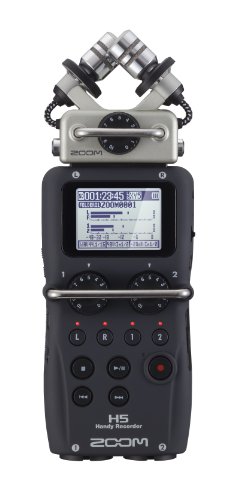
Best Expandable Recorder – Zoom H5
The Zoom H5 is a flexible choice among podcast recorders for musicians, especially if you want interchangeable microphone options and multiple inputs for interviews, rehearsals, or live performances. It records up to four tracks simultaneously and also works as a USB audio interface.
Best For: Musicians and podcasters who need expandable microphones, two external inputs, and multitrack recording.
Pros:
- Interchangeable input-capsule system supports compatible Zoom capsules.
- Records four tracks simultaneously with two XLR/TRS combo inputs.
- Includes phantom power, a -20 dB pad, and an audio safety net for recording protection.
- Works as a multichannel or stereo USB audio interface for PC, Mac, and iPad.
Cons:
- Records to SD or SDHC cards up to 32GB, which is less capacity than some newer options.
- Uses two AA batteries rather than an integrated rechargeable battery.
The H5 is a strong all-around option when input flexibility matters more than the newest 32-bit-float workflow. Its detachable capsule and combo inputs give musicians room to build a setup around different recording situations.
Best Compact 32-Bit-Float Option – Xvive XV1-R
The Xvive XV1-R is a compact option among podcast recorders for musicians, combining built-in X/Y microphones with 32-bit-float WAV recording. Its high sound-pressure-level handling, automatic recording features, and USB microphone mode suit mobile music sessions and spoken-word work.
Best For: Musicians, podcasters, and creators who want simple stereo recording with 32-bit float and USB-C connectivity.
Pros:
- 32-bit-float recording reduces the need to adjust gain during high-dynamic-range sessions.
- X/Y microphones capture up to 130 dB SPL without distortion, according to the supplied specifications.
- Supports WAV recording up to 96 kHz plus AAC for smaller files.
- Functions as a USB microphone with PC, Mac, iOS, and Android devices.
Cons:
- It has no headphone jack for direct monitoring.
- Built-in microphones provide stereo recording rather than the multi-input expansion of a larger recorder.
- Extended recordings use automatically split files at the 4GB maximum file size.
The XV1-R emphasizes portability and forgiving recording levels. It is a practical pick for musicians who record loud sources or move between standalone sessions and USB-based streaming, provided headphone monitoring is not essential.
Best Pattern Flexibility – Zoom H2essential
The Zoom H2essential stands out among podcast recorders for musicians with three built-in microphones and nine selectable recording patterns. Its 32-bit-float recording, USB microphone mode, and simultaneous SD backup make it useful for interviews, rehearsals, and wide stereo or surround-style recordings.
Best For: Musicians and podcasters who want versatile built-in microphone patterns and clip-free recording without manual gain adjustment.
Pros:
- Three built-in microphones and nine patterns cover mono, stereo, and surround recording applications.
- Records up to 32-bit float/96 kHz without requiring constant gain adjustments.
- Can operate as a USB microphone while recording a backup to an SD card.
- Supports wireless Bluetooth timecode syncing between multiple H2essential units.
Cons:
- Its built-in microphone design does not provide the external XLR inputs found on the Zoom H5.
- Bluetooth timecode synchronization requires multiple compatible H2essential units.
- Records to WAV rather than offering the AAC option listed for the Xvive XV1-R.
The H2essential is particularly appealing when recording perspective matters. Its selectable patterns let one compact recorder handle focused speech, stereo music, and broader ambient captures while 32-bit float simplifies level management.
How We Picked the Best Podcast Recorders for Musicians
We evaluated these recorders for the demands of hybrid music and podcast production: microphone quality, input flexibility, recording resolution, portability, monitoring, battery practicality, and computer connectivity. We also considered whether each model suits quick stereo capture, multitrack recording, field work, or use as a USB audio interface.
Because musicians often move between spoken-word and musical sources, the strongest choices offer useful headroom, reliable controls, and enough input options for vocals, instruments, external microphones, or small recording setups.
Quick Comparison
| Recorder type | Best suited to | What to prioritize |
|---|---|---|
| Compact stereo recorder | Interviews, rehearsals, songwriting ideas | Simple controls, built-in microphones, low weight |
| Adjustable-mic recorder | Flexible stereo recording | Mic positioning, wind protection, monitoring |
| Multitrack recorder | Music demos and layered podcast production | Input count, overdubbing, effects, track management |
| Professional field recorder | External microphones and critical location work | Low-noise preamps, gain control, durable construction |
| USB-capable recorder | Hybrid mobile and desktop workflows | Driver support, interface mode, USB-C connectivity |
Key Buying Factors for Podcast Recorders for Musicians
Inputs and Microphone Configuration
Built-in X/Y microphones are convenient for stereo room sound, rehearsals, and interviews. XLR or combo inputs matter when you want to connect a vocal microphone, guitar pickup, mixer, or condenser microphone with phantom power. Multitrack models are better when several sources must remain independently adjustable.
32-Bit Float Recording
32-bit float can provide valuable protection against poorly judged recording levels, especially during unpredictable live takes or location sessions. It does not replace good microphone placement, and it may require a compatible editing workflow, but it can reduce the risk of unusable clipping.
Portability and Power
Check the recorder’s size, battery type, included accessories, and expected runtime. A smaller unit is easier to keep in a gig bag, while a larger model may offer better controls, more inputs, or stronger mounting options. Budget for a windscreen when recording outdoors.
Monitoring and File Workflow
Headphone monitoring, clear meters, limiter or safety features, and straightforward file transfer can save time. Confirm the supported formats, storage requirements, and whether the recorder can function as a USB microphone or audio interface.
Who Should Buy Which Podcast Recorders for Musicians?
- Choose a compact stereo recorder if you mainly capture ideas, rehearsals, interviews, or acoustic performances with minimal setup.
- Choose an adjustable-microphone model if you want to fine-tune stereo width and recording direction without carrying external microphones.
- Choose a multitrack recorder if you need overdubs, separate sources, effects, or a self-contained workflow for demos and music podcasts.
- Choose a professional field recorder if clean preamps, external microphones, and dependable manual control matter more than built-in simplicity.
- Choose a USB-capable model if you want one device for mobile recording and direct podcast production at a computer.
Before buying, identify your usual source count and recording environment. The best Podcast Recorders for Musicians are not necessarily the most advanced; they are the ones whose inputs, controls, and workflow fit your sessions consistently.