The best electric violins make it easier to practice quietly, connect to an amplifier, and explore effects or recording without giving up familiar violin technique.
This roundup compares 10 full-size options across silent practice, beginner value, acoustic-electric flexibility, included accessories, and stage-ready design.
Best 10 Electric Violins Picks for 2026
Best Complete Outfit
Bunnel Edge 4/4 Electric Violin

- Includes case, bow, rosin, amp, headphones, and cables
- Piezo pickup with amp and headphone outputs
- USA setup plus lifetime guarantee
Best For: A ready-to-play electric violin package
Best Simple Plug-and-Play Pick
Yamaha YEV104NT Electric Violin
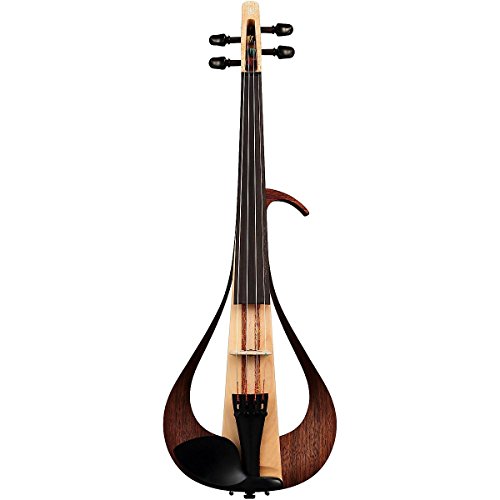
- Plugs directly into an amplifier
- Needs no batteries or preamp
- Six-wood construction with natural resonance
Best For: Direct amplified playing with minimal setup
Best Budget Silent Practice Bundle
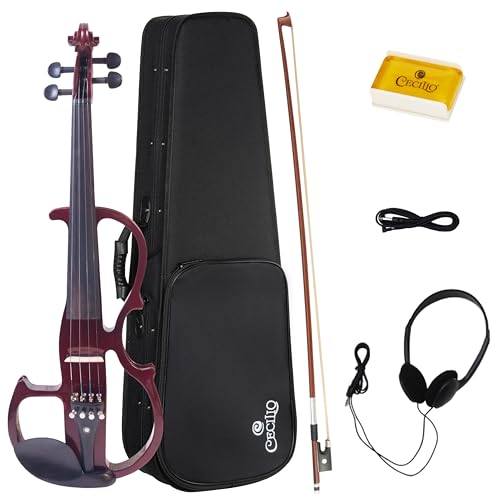
- Headphones enable quiet practice
- Includes case, bow, rosin, bridge, and aux cable
- Solid maple body with ebony fittings
Best For: Accessible practice and starter use
Best Lightweight Modern Design
Yamaha YEV104BL Electric Violin
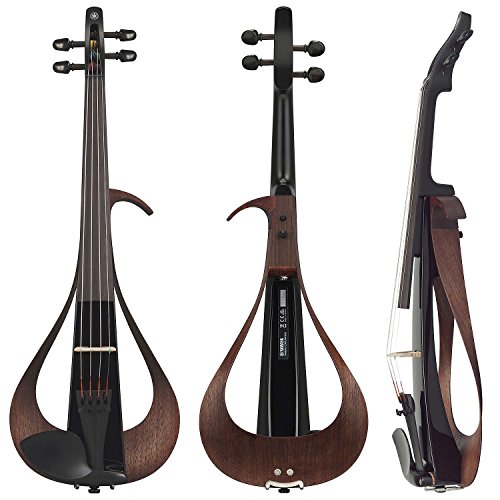
- Lightweight 2.7-pound body
- Direct amplifier connection without batteries
- Black finish and natural resonant sound profile
Best For: Lightweight amplified performance
Best Acoustic-Electric Pick
Cecilio 4/4 Pearl White Violin

- Acoustic and electric operation
- Solid spruce and maple construction
- Complete set with case and accessories
Best For: Players wanting one violin for traditional practice and amplified use
Best for Quiet Practice
Vangoa 4/4 Silent Electric Violin
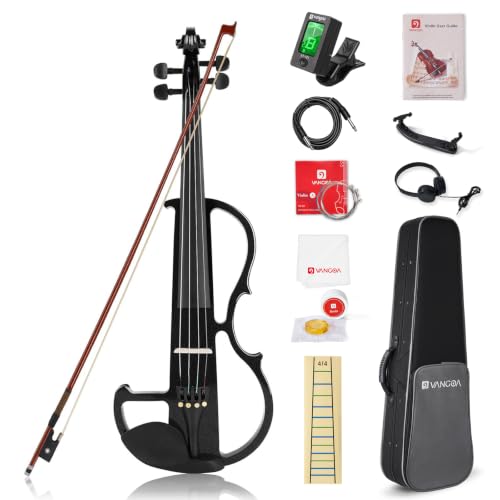
- Low-volume solid-body practice
- Headphone and amplifier outputs
- Includes case, headphones, and extras
Best For: Apartment, dorm, and late-night practice
Best Silent Starter Set
Cecilio 4/4 Blue Electric Violin
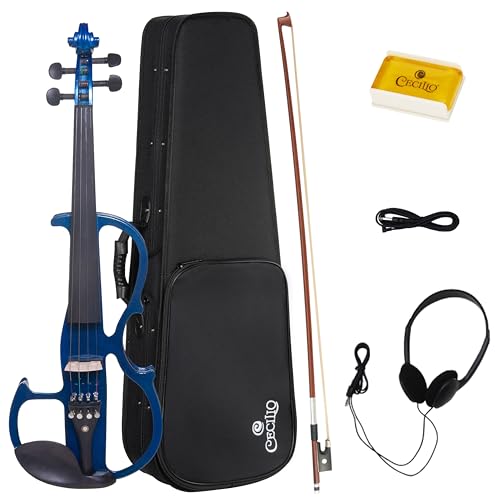
- Solid maple body with ebony fittings
- Headphones and AUX cable included
- Complete battery-powered starter set
Best For: Beginners practicing quietly or playing contemporary music
Best Value Kit
Pyle 4/4 Silent Electric Violin

- Includes amplifier, headphones, case, bow, and rosin
- Tone and volume controls are built in
- Supports silent practice or amplified playing
Best For: Complete electric violin setups for beginners and experienced players
Best for Silent Practice
Cecilio 4/4 Electric Silent Violin
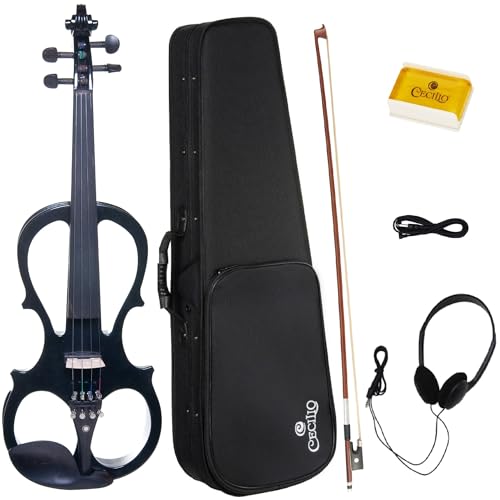
- Headphone-compatible design supports quiet practice
- Hand-carved maple body with ebony fittings
- Includes case, bow, rosin, bridge, and AUX cable
Best For: Full-size, noise-conscious practice at home or on the go
Best Hybrid Option
Cecilio 4/4 Acoustic-Electric Violin

- Works in both acoustic and electric modes
- Solid spruce top and maple body support resonance
- Includes case, bow, shoulder rest, rosin, and AUX cable
Best For: Players needing one violin for acoustic and amplified use
Best Complete Outfit – Bunnel Edge 4/4 Electric Violin
For shoppers seeking electric violins with a ready-to-play package, the Bunnel Edge Outfit combines a full-size maple instrument with a case, bow, rosin, strings, mini amp, cable, and headphones. Its piezo pickup and onboard controls support both amplified playing and headphone practice.
Best For: Players who want a comprehensive electric violin package with included practice and performance accessories.
Pros:
- Complete outfit includes case, bow, rosin, cable, mini amp, headphones, and backup strings.
- Piezo pickup with separate 1/4-inch amp and 1/8-inch headphone connections.
- Professionally assembled and set up in the USA, with a lifetime guarantee and 45-day money-back guarantee.
Cons:
- The included mini amp and accessories may be unnecessary if you already own performance gear.
- It requires a 9-volt battery for operation.
The Bunnel Edge is a practical choice when convenience matters as much as the instrument itself. Its broad accessory bundle reduces the need for separate purchases, while the dual output options make it flexible for practice and amplified use.
Best Simple Plug-and-Play Pick – Yamaha YEV104NT Electric Violin
The Yamaha YEV104NT is a streamlined option among electric violins, with a clean natural finish, a lightweight design, and a simple amplified setup. Its six-wood construction is intended to provide an organic, resonant sound, and it connects directly to an amplifier without batteries or a preamp.
Best For: Violinists who prioritize straightforward amplifier connection and a clean, natural-looking design.
Pros:
- Requires no batteries, headphones, or preamp for amplified playing.
- Six different woods contribute to an organic, natural, resonant amplified sound.
- Includes a pickup and volume-control bypass switch.
Cons:
- Only a 1/4-inch output is listed, with no headphone connection noted.
- The supplied components are limited compared with a bundled outfit.
Choose the YEV104NT if you want an uncluttered electric violin experience and already have an amplifier or related accessories. Its direct, battery-free design keeps setup simple for players who prefer fewer onboard requirements.
Best Budget Silent Practice Bundle – Cecilio 4/4 Electric Violin
The Cecilio 4/4 Electric Violin is designed for players who want electric violins for quiet practice as well as performance. Its solid maple body and ebony fittings are paired with a 9V-powered electronic setup, headphones, an aux cable, and a hard case for a practical starter package.
Best For: Beginners and practice-focused players who want headphones and core accessories included.
Pros:
- Headphones and aux cable support quiet practice.
- Includes a lightweight hard case, bow, rosin, and bridge.
- Solid maple body with ebony fingerboard, pegs, chinrest, and tailpiece.
Cons:
- Requires a 9V alkaline battery for operation.
- The listed warranty is one year against manufacturer defects.
This Cecilio outfit offers useful essentials without requiring separate purchases for basic practice. It is especially appealing if headphone use and a supplied case are priorities, though players seeking a longer warranty or more extensive amplification package may prefer another option.
Best Lightweight Modern Design – Yamaha YEV104BL Electric Violin
The black Yamaha YEV104BL is a lightweight choice among electric violins, weighing 2.7 pounds and offering a clean, organic, resonant sound profile. Its four-string design uses a standard 6.35mm output, and Yamaha specifies direct amplifier use without batteries, headphones, or a preamp.
Best For: Players who want a lightweight, visually distinctive electric violin for direct amplified playing.
Pros:
- Light 2.7-pound construction may be comfortable for extended playing.
- Battery-free design connects directly to an amplifier.
- Six-wood construction is intended to provide a natural, resonant sound.
Cons:
- No headphones or carrying case are listed among the included components.
- The package is less accessory-rich than a complete outfit.
The YEV104BL makes the most sense for players who value low weight, a black finish, and a simple signal path. Plan to supply your own amplifier and accessories, since this model is focused on the instrument rather than an all-in-one bundle.
Best Acoustic-Electric Pick – Cecilio 4/4 Pearl White Violin
For shoppers comparing electric violins, this Cecilio stands out for its dual-mode design. It can be played acoustically for traditional practice or connected electronically for performances, recording, and customized volume and tone control.
Best For: Beginners and players who want one full-size instrument for acoustic practice, amplified playing, and travel.
Pros:
- Works as both an acoustic and electric violin.
- Hand-carved solid spruce top with solid maple back and sides.
- Includes a case, bow, rosin, shoulder rest, bridge, and AUX cable.
- Ebony fittings and four nickel-plated fine tuners support precise adjustments.
Cons:
- The full-size 4/4 design may not suit smaller players.
- The set uses a 3.5 mm AUX connection, so additional equipment may be needed for some setups.
This is a versatile choice if you want the familiar response of an acoustic violin with the option to connect to external audio equipment. Its included accessories and protective foam case also make it a practical starter package.
Best for Quiet Practice – Vangoa 4/4 Silent Electric Violin
Among electric violins designed for home use, the Vangoa emphasizes quieter practice. Its solid body produces minimal unplugged sound, while the headphone connection supports more private sessions and the amplifier output allows you to perform at higher volume.
Best For: Apartment dwellers, dorm residents, and players who need a quieter practice instrument with amplification options.
Pros:
- Produces significantly less acoustic sound than a traditional violin when unplugged.
- Supports headphones for immersive practice and an amplifier for performances.
- Includes a hard case, extra strings, rosin, and headphones.
- Features an ebony fingerboard and carbon fiber tailpiece with four fine tuners.
Cons:
- It is not completely silent; bow and string friction remain faintly audible.
- The electronic output uses a 6.35 mm jack, which may require an adapter for some equipment.
The Vangoa is a practical option when noise control matters most. Its quiet unplugged profile, included headphones, and amplifier compatibility cover practice, home use, and casual performance without requiring a separate starter kit.
Best Silent Starter Set – Cecilio 4/4 Blue Electric Violin
This Cecilio is a full-size silent electric violin built around a solid maple body and ebony fittings. It is suited to quiet practice and contemporary playing, with headphones and an AUX cable included for flexible electronic use.
Best For: Adult beginners and contemporary players seeking a complete electric violin kit for private practice and performance.
Pros:
- Hand-carved solid maple body with ebony fingerboard, chin rest, pegs, and tailpiece.
- Includes headphones and an AUX cable for quiet electronic practice.
- Comes with a 9V battery, Brazilwood bow, rosin, bridge, and case.
- Blue metallic varnish gives the instrument a distinctive appearance.
Cons:
- It is an electric-only silent violin rather than a dual acoustic-electric model.
- The listed set includes a bridge and case, but the supplied notes do not specify extra strings.
With its solid maple construction and generous included accessories, this Cecilio offers a straightforward entry point into electric violins. The headphone support makes it especially useful for private practice, while its styling suits pop and contemporary music.
Best Value Kit – Pyle 4/4 Silent Electric Violin
For players comparing electric violins, the Pyle 4/4 Silent Electric Violin stands out as a complete practice-and-performance kit. It includes headphones for quieter sessions, a portable 10W amplifier for amplified playing, and core accessories such as a bow, rosin, case, and bridge.
Best For: Beginners and experienced players who want a full-size electric violin package with both silent-practice and amplified options.
Pros:
- Includes a 10W amplifier, headphones, cable, bow, rosin, bridge, and hard case.
- Headphone compatibility supports quieter practice, while the amplifier enables louder performances.
- Front-mounted tone and volume controls allow convenient sound adjustment.
- Full-size solid European maple components and an ebony fingerboard provide a traditional-style construction.
Cons:
- The included amplifier is compact, with a 5-inch speaker and 10W output.
- Its 4/4 size may not suit players who need a smaller instrument.
The Pyle is a practical choice when accessory value and flexible practice options matter most. Its bundled amplifier and headphones make it especially convenient for players building an electric violin setup from scratch.
Best for Silent Practice – Cecilio 4/4 Electric Silent Violin
Among electric violins designed for quiet sessions, the Cecilio 4/4 Electric Silent Violin emphasizes headphone-compatible practice in a full set. Its hand-carved maple body, ebony fittings, case, bow, rosin, headphones, and AUX cable make it ready for immediate use.
Best For: Students, home players, and musicians who need a full-size violin for noise-free practice and portable rehearsals.
Pros:
- Silent design works with the included headphones for quieter practice at home or during late sessions.
- Hand-carved solid maple body is paired with an ebony fingerboard and pegs.
- Complete set includes a lightweight hard case, Brazilwood bow, rosin, bridge, headphones, and AUX cable.
- Full-size design is presented as suitable for beginners through professional players.
Cons:
- The set uses a 3.5 mm AUX connector, which may require an adapter for some equipment.
- It is a right-handed, full-size instrument rather than a smaller or left-handed model.
The Cecilio focuses on accessible silent practice without leaving out essential accessories. Choose it when headphone use, a traditional maple-and-ebony build, and an included carrying case are higher priorities than an amplifier.
Best Hybrid Option – Cecilio 4/4 Acoustic-Electric Violin
For shoppers who want more than a dedicated electric instrument, this Cecilio combines acoustic and electric operation in one 4/4 violin. It pairs a hand-carved solid spruce top and maple back and sides with volume and tone controls, while the included case, bow, shoulder rest, rosin, and AUX cable complete the setup.
Best For: Beginners and professionals seeking one violin for acoustic playing, amplified use, studio work, and home practice.
Pros:
- Dual-mode design can be used as an acoustic or electric violin.
- Solid spruce top and maple back and sides are designed for rich resonance.
- Volume and tone controls provide sound-shaping flexibility when plugged in.
- Full set includes a padded case, Brazilwood bow, shoulder rest, rosin, bridge, and AUX cable.
Cons:
- The AUX connection is 3.5 mm and may not match every amplifier or recording setup directly.
- It is a full-size, right-handed instrument, limiting fit options for some players.
The acoustic-electric format makes this Cecilio the most versatile option in the group. It is a strong fit for players who want traditional acoustic capability without giving up plug-in controls and performance flexibility.
How We Picked the Best Electric Violins
We focused on full-size electric and acoustic-Electric Violins suited to common buyer needs: quiet practice, lessons, home recording, amplified playing, and first-time ownership. We considered pickup design, headphone or silent-play support, construction materials, included accessories, setup convenience, and overall value. Because instrument feel and setup can vary, buyers should also account for professional adjustment and their preferred strings, bow, and amplification equipment.
The selected range includes dedicated solid-body instruments, silent electronic models, and traditional-style violins with acoustic capability. This makes the list useful for beginners who want a complete package as well as experienced players seeking a more specialized instrument.
Quick Comparison
| Best For | What to Prioritize | Typical Advantage |
|---|---|---|
| Quiet practice | Headphone output and silent circuitry | Practice without disturbing others |
| Beginners | Complete kit and comfortable setup | More usable accessories at one time |
| Stage performance | Reliable pickup and low-noise output | Better compatibility with amps and effects |
| Acoustic flexibility | Acoustic-electric construction | One instrument for unplugged and amplified use |
| Recording | Clean signal and controllable electronics | Easier connection to interfaces and mixers |
Key Buying Factors for Electric Violins
Pickup and Electronics
Most Electric Violins use piezo pickups, which respond to string vibration and can produce a direct, focused signal. Check whether the instrument includes a preamp, volume control, tone control, or only a passive output. Active electronics may require a battery, while passive designs can be simpler to maintain.
Silent Practice and Connectivity
A headphone jack is valuable for apartment practice and late-night playing, but confirm whether headphones work directly or require an included amplifier module. Also check the output connection, power requirements, and whether the instrument can connect cleanly to an amp, audio interface, or effects pedals.
Build, Setup, and Playability
Solid wood, maple bodies, ebony fittings, and quality fine tuners can improve durability and adjustment, but materials alone do not guarantee ideal playability. Bridge height, fingerboard finish, string spacing, and overall setup matter just as much. New players may want a luthier to check the bridge, pegs, and intonation.
Included Accessories
Starter packages may include a bow, case, rosin, cable, spare strings, headphones, tuner, or mini amplifier. These extras can reduce initial cost, though accessory quality varies. Treat the included amp as a convenience rather than a substitute for a larger performance amplifier.
Who Should Buy Which Electric Violins?
Beginners should favor a complete, full-size kit with a case and basic accessories, provided the instrument is correctly set up. Quiet-practice buyers should prioritize a headphone output and silent operation over decorative styling. Performers should choose dependable electronics, a secure cable connection, and compatibility with their existing amplification chain. Players who switch between unplugged and amplified use may prefer an acoustic-electric model. Recording musicians should look for a clean, controllable output and plan to test the instrument through their interface before committing to a final setup.