Finding the right phono preamp can make a vinyl system easier to connect and better suited to your listening habits. Models with dual-input flexibility are especially useful when you want to support different cartridge types, add another audio source, or connect a turntable alongside modern equipment.
We selected 10 options across compact, tube, headphone-friendly, and full-featured designs. The best choice depends on your cartridge, available connections, gain requirements, and whether you need simple signal conversion or broader system control.
Best 10 Phono Preamps with Dual Input Picks for 2026
Flexible Source Hub

- Three RCA inputs for multiple sources
- Bass, treble, gain, and remote controls
- Compact design with motorized volume
Best For: Multi-source systems using a turntable with a built-in phono preamp
Simple Phono Upgrade
ART DJPREII Phono Preamplifier

- RCA stereo input and output
- Ground terminal included
- Power adapter included
Best For: Straightforward single-turntable setups
MM/MC Versatility
Fosi Audio BOX X5 Phono Preamp

- Works with MM and MC cartridges
- Four selectable gain settings
- RIAA equalization and grounding port
Best For: Vinyl systems needing flexible cartridge matching
Low-Noise Fidelity

- Accurate RIAA equalization
- Selectable subsonic rumble filter
- Shielded enclosure and stereo op-amps
Best For: MM turntable owners prioritizing clean stereo playback
Compact Dual-Input Pick
Mini Stereo Phono Preamplifier
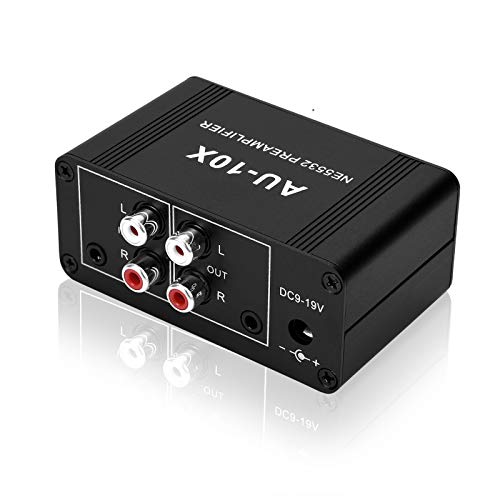
- RCA and 3.5mm inputs
- 20dB gain with NE5532 op amp
- Headphone output and volume control
Best For: Compact mixed-source and headphone setups
Tube Dual-Input Upgrade
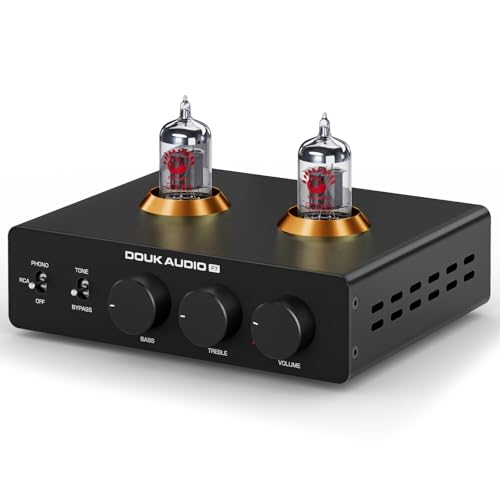
- MM phono and RCA input flexibility
- Balanced XLR and RCA outputs
- Tube amplification with tone controls
Best For: Configurable vinyl systems with balanced output
Simple Budget Converter
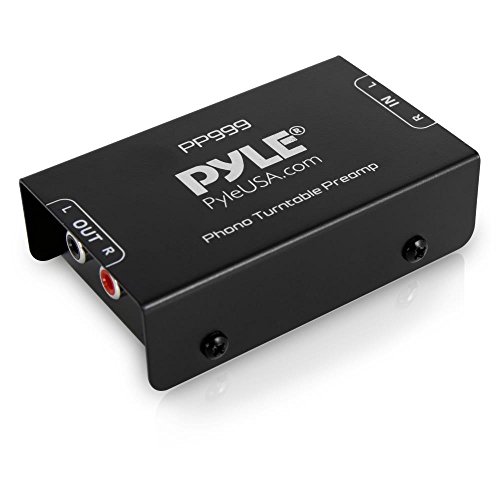
- Converts magnetic phono to line level
- Stereo RCA input and output
- Low-noise circuitry with 12V adapter
Best For: Basic turntable-to-receiver connections
Tube-Driven Versatility

- MM/MC phono and RCA inputs
- Tube sound with bass and treble controls
- 3.5mm headphone output for 16–300Ω
Best For: Vinyl listeners wanting flexible inputs and customizable tube sound
Compact Gain Control

- MM phono and 3.5mm AUX inputs
- 39, 42, and 45 dB gain settings
- Includes tubes and supports tube swapping
Best For: MM turntable owners seeking compact tube-based flexibility
Whole-System Connectivity

- RCA phono, four RCA line, and optical inputs
- EQ, low-cut crossover, and subwoofer outputs
- 1U rack-mountable design with headphone output
Best For: Multi-source home audio systems with turntable and TV connections
Flexible Source Hub – Fosi Audio P4 Mini Preamp
The Fosi Audio P4 is a practical choice for listeners who need multiple connections alongside a turntable. While it is not a standalone phono stage, its three RCA inputs can accommodate a turntable with a built-in phono preamp, plus sources such as CD players, streamers, DACs, or cassette decks.
Best For: Systems needing source switching, tone controls, and compact preamp functionality.
Pros:
- Three RCA inputs make it useful for multi-source systems.
- Includes volume, bass, treble, bypass, and three-level gain controls.
- Motorized analog volume control and remote support convenient operation.
- Compact chassis with a 24-month manufacturer warranty.
Cons:
- Requires a turntable with a built-in phono preamp or an external phono stage.
- Its listed features focus on preamp control rather than dedicated phono equalization.
For shoppers comparing phono preamps with dual input, the P4 is better understood as a flexible control hub than as a dedicated phono preamp. It suits setups where easy switching and sound adjustment matter most.
Simple Phono Upgrade – ART DJPREII Phono Preamplifier
The ART DJPREII is a straightforward dedicated phono preamplifier for adding RCA connectivity between a turntable and an amplifier or powered audio system. Its simple input, output, and grounding layout makes it a practical option for buyers prioritizing uncomplicated setup.
Best For: Basic turntable systems that need a compact phono-to-line-level interface.
Pros:
- Provides RCA left/right input and output connections.
- Includes a ground terminal for turntable setup.
- Power adapter is included.
- Compact 4.5 x 4.6 x 1.85-inch enclosure.
Cons:
- The supplied notes do not specify dual inputs or selectable MM/MC support.
- Controls and extra features are not listed, so it may be less flexible for advanced setups.
If you are searching for phono preamps with dual input, the DJPREII may not match that specific requirement based on the supplied specifications. It is instead a focused, no-frills option for a single RCA turntable connection.
MM/MC Versatility – Fosi Audio BOX X5 Phono Preamp
The Fosi Audio BOX X5 is a dedicated phono preamp built for both moving-magnet and moving-coil cartridges. Its four gain settings and MM/MC selector offer more cartridge-matching flexibility than a basic fixed-gain phono stage, although the supplied information lists RCA connectivity rather than dual inputs.
Best For: Vinyl listeners using MM or MC cartridges who want adjustable gain in a compact chassis.
Pros:
- Supports both MM and MC turntable cartridges.
- Offers four gain levels: 38, 48, 56, and 66 dB.
- Uses precise RIAA equalization and includes a grounding port.
- Aluminum-alloy chassis with gold-plated RCA jacks and a 24-month warranty.
Cons:
- The supplied details list one channel and do not describe dual input switching.
- It is designed around phono use, so it does not provide the broader source-hub functions of a line preamp.
Among phono preamps with dual input, the BOX X5 stands out more for cartridge compatibility and gain adjustment than for multiple source inputs. It is a strong fit when matching the preamp to different MM or MC cartridges is the priority.
Low-Noise Fidelity – Fluance PA10 Phono Preamp
The Fluance PA10 is a focused phono preamp for MM turntables and vinyl record players. It emphasizes accurate RIAA equalization, low noise, channel separation, and interference protection, making it a sensible choice for listeners who want clean stereo phono amplification rather than multiple source inputs.
Best For: MM turntable owners seeking accurate, low-noise stereo phono amplification.
Pros:
- Provides high-accuracy RIAA equalization for phono-to-line conversion.
- Individual left and right channel op-amps support stereo separation.
- Selectable high-pass filter reduces low-frequency rumble below 20 Hz.
- Metal shielding helps protect against electromagnetic and electronic interference.
Cons:
- Supports MM turntables rather than the supplied notes’ broader MM/MC compatibility.
- The supplied information does not list dual inputs or source switching.
For shoppers specifically seeking phono preamps with dual input, the PA10 is not presented as a multi-input model. Its appeal is its dedicated, carefully filtered MM phono path and shielding-focused design.
Compact Dual-Input Pick – Mini Stereo Phono Preamplifier
For shoppers comparing phono preamps with dual input, this compact ATNEDCVH model accepts both RCA and 3.5mm sources. Its 20dB gain is designed to raise weak signals to line level, while the volume control and headphone output add flexibility for desktop or portable setups.
Best For: Buyers who want a small, versatile preamp for a turntable, phone, computer, or other audio source, with headphone listening available.
Pros:
- Offers RCA and 3.5mm inputs, plus RCA, 3.5mm, and headphone outputs.
- Provides 20dB gain for weak signals and uses a dual NE5532 op-amp design.
- Compact housing with a convenient volume adjustment knob.
Cons:
- It is a preamp, not a power amplifier for driving passive speakers.
- The headphone output supports a maximum impedance of 16 ohms.
- Headphone output cannot be used with the other output ports at the same time.
This is a practical choice when connection flexibility and small size matter more than dedicated high-end phono features. Confirm your power supply and headphone requirements before buying.
Tube Dual-Input Upgrade – Douk Audio P7 Phono Preamp
The Douk Audio P7 is a strong option among phono preamps with dual input, combining an MM phono/RCA input with tube preamplifier functionality for other sources. It adds balanced XLR output, tone controls, bypass operation, and a phono-only high-pass filter for a more configurable listening setup.
Best For: Vinyl listeners and system builders who want tube coloration, balanced connectivity, and adjustable bass, treble, and subsonic filtering.
Pros:
- Works with MM turntables as well as phones, TVs, and CD players through its RCA input.
- Provides both standard RCA and balanced XLR outputs.
- Includes swappable PSVANE ECC83 tubes, bass and treble controls, bypass, and a phono-input high-pass filter.
Cons:
- The high-pass filter is available only when using the phono input.
- Its tube-based design may be more features than a basic line-level conversion setup requires.
- The supplied notes specify MM phono support rather than broader cartridge compatibility.
Choose the P7 if you want a feature-rich tube preamp with balanced output rather than a simple budget phono converter. Its controls and filtering make it adaptable, while bypass mode allows a more direct signal presentation.
Simple Budget Converter – Pyle PP999 Phono Preamp
For a straightforward way to connect a turntable to modern equipment, the Pyle PP999 converts magnetic-cartridge phono signals to line level. It uses stereo RCA input and output, low-noise operational amplifiers, and a supplied 12-volt DC adapter for simple plug-and-play installation.
Best For: Turntable owners whose receiver, speakers, computer, or laptop lacks a dedicated phono input.
Pros:
- Converts phono output to line level for connection to modern audio equipment.
- Simple stereo RCA input and output layout with grounding connection.
- Designed for low-noise operation and includes a 12-volt DC adapter.
Cons:
- Uses RCA connections rather than offering a second modern input such as 3.5mm.
- Supports magnetic pickups with stated 3mV input sensitivity at 50K ohms.
- Placement close to the source is recommended to reduce unwanted noise and interference.
The PP999 is best viewed as a basic phono-to-line converter, not a multi-input control preamp. Its uncomplicated RCA layout makes it a sensible choice for a conventional turntable connection.
Tube-Driven Versatility – Douk Audio T9
For listeners comparing phono preamps with dual input, the Douk Audio T9 stands out with separate Phono and RCA inputs. It supports both MM and MC cartridges, adds tube-based sound shaping, and includes bass, treble, and headphone controls for a flexible home hi-fi setup.
Best For: Vinyl listeners who want MM/MC compatibility, tube character, and convenient headphone listening.
Pros:
- Phono input supports both MM and MC cartridges, while RCA accepts phones, tablets, PCs, and MP3 players.
- Two 6E2 and two 6A2 tubes provide a warm, full-bodied presentation with an adjustable magic-eye display.
- Dedicated 3.5mm headphone output supports headphones from 16–300Ω, with adjustable treble and bass.
- All-metal construction, CNC aluminum panel, and replaceable tube sockets support durability and customization.
Cons:
- The tube-based design may be less appealing if you prefer a compact, solid-state preamp.
- It requires the included 12V DC power supply and has a freestanding rather than rack-mount format.
The T9 is a strong choice when dual-input flexibility matters as much as sound customization. Its MM/MC support, tone controls, and headphone amplifier make it more feature-rich than a basic phono stage.
Compact Gain Control – Fosi Audio Box X2
The Fosi Audio Box X2 is a compact option for shoppers seeking phono preamps with dual input. Its phono stage works with MM turntables, while the 3.5mm AUX input adds a second source and tube preamp functionality in a small desktop-friendly design.
Best For: MM turntable owners who want a space-saving preamp with selectable gain and tube rolling.
Pros:
- Combines an MM phono input with a 3.5mm AUX input for added source flexibility.
- Three switchable gain modes—39, 42, and 45 dB—help accommodate different system requirements.
- Includes two vacuum tubes and supports several compatible replacement tube models for sound customization.
- Grounding post, low-noise circuitry, RCA cable, and 12V power adapter simplify setup.
Cons:
- It is designed for MM turntables rather than MC cartridges.
- The 3.5mm AUX input may be less convenient than a full-size RCA line input for some systems.
With selectable gain and a tube-based design, the Box X2 offers useful adjustment in a compact package. It is best suited to MM systems where easy setup and a warm, smooth presentation are priorities.
Whole-System Connectivity – Dynasty ProAudio PX1
The Dynasty ProAudio PX1 expands beyond a basic phono stage for buyers comparing phono preamps with dual input. Alongside its RCA Phono input with RIAA preamp, it provides four RCA line inputs and an optical input, making it suitable for turntables, TVs, and multiple home audio sources.
Best For: Home audio systems that need phono, analog, optical, subwoofer, and headphone connectivity in one preamp.
Pros:
- Provides an RCA Phono input with RIAA preamp and ground terminal, plus four RCA line inputs.
- Optical S/PDIF input supports connection to a TV or other digital audio device.
- Includes bass, treble, and 3-band EQ controls, along with a low-cut crossover for subwoofer use.
- Offers full-range stereo, crossover, sub mono, and stereo headphone outputs in a 1U rack-mountable design.
Cons:
- Its 17-inch-wide, 6.4-pound format is considerably larger than a minimalist desktop phono preamp.
- The supplied notes do not specify MM or MC cartridge compatibility.
- Its extensive controls and connections may be unnecessary for a simple turntable-only setup.
The PX1 is the most system-oriented choice of the three. Its phono, RCA, and optical connectivity, plus EQ and subwoofer outputs, make it particularly practical for integrated home audio setups rather than standalone vinyl use.
How We Picked the Best Phono Preamps with Dual Input
We focused on practical features that matter in real-world vinyl systems: MM and MC cartridge compatibility, input and output options, RIAA equalization, gain control, noise performance, build format, and ease of installation. Because the phrase “dual input” can describe different configurations, check each product’s specifications carefully. Some models support two cartridge types, while others provide multiple line-level inputs or combine phono connectivity with optical, headphone, or balanced outputs.
We also included a range of designs, from compact budget preamps to tube-equipped units and versatile home-audio preamplifiers. This makes the roundup useful for first-time turntable owners as well as listeners upgrading an existing system.
Quick Comparison
| Best For | Features to Look For | Ideal Setup |
|---|---|---|
| Simple upgrades | Low noise, RCA input and output, RIAA equalization | Turntable to powered speakers or an amplifier |
| MM and MC flexibility | Selectable cartridge support and adjustable gain | Systems using different cartridges |
| Modern connectivity | Optical, multiple RCA inputs, or headphone output | Turntable plus TV, streamer, or headphones |
| Tone customization | Bass, treble, bypass, or high-pass controls | Listeners who want system-level adjustments |
| Tube-style presentation | Vacuum-tube stage and suitable output connections | Decorative or warmer-sounding hi-fi setups |
Key Buying Factors for Phono Preamps with Dual Input
Cartridge Compatibility
Confirm whether your turntable uses a moving-magnet (MM) or moving-coil (MC) cartridge. MM models are common and generally need less gain; MC cartridges often require higher gain and different loading. If you plan to change cartridges, choose a preamp that supports both formats or provides adjustable settings.
Input and Output Layout
Count the sources you need to connect before buying. Two phono inputs are useful for multiple turntables, while a phono input plus a line-level input may better suit a turntable-and-streamer system. RCA outputs are standard, but balanced XLR, optical, and headphone outputs can simplify more advanced setups.
Gain, Loading, and Noise
Correct gain helps the system reach a comfortable volume without excessive hiss or distortion. Adjustable loading is valuable for MC cartridges, while a quiet power supply and properly shielded design help preserve subtle vinyl detail. Avoid adding unnecessary gain if your amplifier or powered speakers already have plenty of volume.
Size and Controls
Compact units work well beside small powered speakers, but larger preamps may offer easier access to cartridge switches, tone controls, and multiple sources. Tube models can require ventilation and occasional tube replacement, so account for their operating space and maintenance.
Who Should Buy Which Phono Preamps with Dual Input?
- Choose a compact RCA preamp if you need an affordable, straightforward connection from one turntable to powered speakers or an amplifier.
- Choose an MM/MC model if you own an MC cartridge now or expect to upgrade later.
- Choose a headphone-equipped preamp if private listening is important and your amplifier lacks a convenient headphone jack.
- Choose a model with optical or extra line inputs if your turntable shares a system with a TV, digital streamer, or other source.
- Choose a tube or tone-control design if you want a distinctive component style and hands-on adjustment, provided you have room for proper ventilation.
Before ordering, verify the exact input type, cartridge support, output level, power requirements, and whether your turntable already includes a built-in phono stage. A separate preamp is only needed when the turntable or receiving equipment lacks the required phono-to-line conversion.