The best MIDI keyboards with weighted keys make software instruments feel more like a real piano, combining expressive control with the convenience of a computer-based setup. This roundup includes full-size weighted and hammer-action options alongside lighter semi-weighted models and compact controllers.
Whether you are learning piano, building a home studio, or need a practical controller for a DAW, compare key feel, size, connectivity, pedals, software support, and extra features before choosing.
Best 10 Midi Keyboards with Weighted Keys Picks for 2026
Best Piano Feel

- 88-key touch-sensitive weighted action
- Includes sustain pedal and power supply
- Dual Mode, speakers, USB, and headphone jack
Best For: Pianists wanting a simple full-size weighted digital piano
Best MIDI Controller Value

- 88 full-size semi-weighted velocity-sensitive keys
- USB-powered with pitch and modulation wheels
- Includes DAW and virtual instrument software
Best For: Computer-based production with a full-range keyboard
Best Home Piano Setup
UISCOM 88-Key Weighted Digital Piano

- Progressive hammer-action weighted keyboard
- Triple pedals: sustain, sostenuto, and soft
- MIDI, recording, tones, and USB playback
Best For: Home practice with built-in piano features and pedals
Best Compact Option

- 61 full-size semi-weighted velocity-sensitive keys
- Compact USB-powered design with performance controls
- Includes DAW, instrument, loop, and lesson software
Best For: Space-conscious producers needing expressive MIDI control
Best All-Around Home Piano
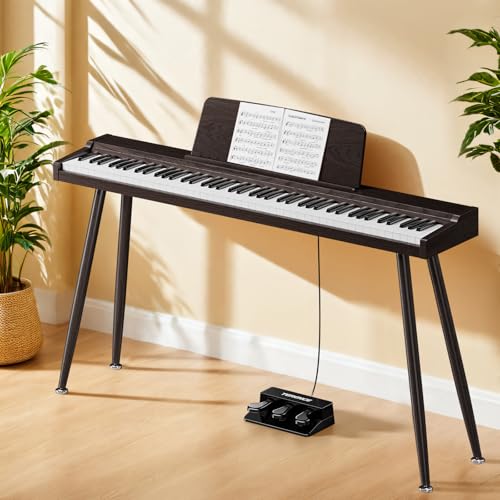
- 88 hammer-action, force-sensitive keys
- Dual-player mode and three-pedal design
- Bluetooth, USB MIDI and headphone support
Best For: Home practice, lessons and family piano playing
Best Compact MIDI Controller

- 49 full-size velocity-sensitive keys
- Lightweight, compact USB design
- Pitch/mod wheels and bundled software
Best For: Portable computer-based music production
Best Fully Weighted Option

- Fully weighted 88-key hammer action
- Wireless MIDI, USB and audio connectivity
- 128 tones, 200 rhythms and 110 demo songs
Best For: Piano-focused players wanting weighted action and built-in sounds
Feature-Rich Controller

- 49 semi-weighted keys with Scale and Chord modes
- 16 poly-aftertouch pads plus DAW controls
- Includes software and music-making content
Best For: Hands-on DAW production and live performance
Complete Starter Piano
88-Key Semi-Weighted Digital Piano

- Full 88-key semi-weighted layout
- Includes stand, pedal, headphones, and case
- Built-in sounds, rhythms, Bluetooth, and USB-MIDI
Best For: Beginners learning piano and exploring MIDI
Budget Full-Size Controller
Nektar SE61 USB MIDI Controller

- 61 full-size keys in a simple controller design
- DAW integration for numerous music applications
- Includes Bitwig Studio 8-Track and sound content
Best For: Affordable computer-based music production
Best Piano Feel – Yamaha P71
The Yamaha P71 is a strong choice for shoppers seeking midi keyboards with weighted keys and an acoustic-piano-inspired playing response. Its 88-key weighted action, touch sensitivity, built-in speakers, and included sustain pedal make it suitable for practice, lessons, and expressive performance.
Best For: Pianists and beginners who want a full-size weighted digital piano with simple controls.
Pros:
- 88 touch-sensitive weighted keys with hammer action.
- Includes a sustain pedal and power supply.
- Dual Mode blends voices such as piano and strings.
- Built-in speakers, Duo Mode, USB, and headphone connectivity.
Cons:
- Offers 10 voices, which is less variety than some controller-focused keyboards.
- Its 25-pound full-size design is less portable than compact MIDI controllers.
The P71 prioritizes a straightforward piano experience over extensive production controls. Choose it if weighted action and authentic-feeling practice matter more than a large control surface.
Best MIDI Controller Value – M-Audio Keystation 88 MK3
The M-Audio Keystation 88 MK3 brings an 88-key layout to a streamlined MIDI controller for shoppers comparing midi keyboards with weighted keys. Its full-size semi-weighted keys, USB plug-and-play setup, pitch and modulation wheels, and bundled software make it practical for computer-based music production.
Best For: Producers who need an affordable 88-key controller for virtual instruments and DAW work.
Pros:
- 88 full-size velocity-sensitive semi-weighted keys.
- USB-powered plug-and-play connection for Mac or PC.
- Includes volume, transport, directional, pitch, and modulation controls.
- Comes with MPC Beats, Ableton Live Lite, Mini Grand, Xpand!2, TouchLoops, and Velvet.
Cons:
- The keys are semi-weighted rather than fully weighted.
- It has no built-in speakers and requires a computer or compatible device for its main MIDI functions.
This model is better suited to production than standalone piano playing. Its broad key range and bundled software offer a useful starting point for a home studio without adding unnecessary complexity.
Best Home Piano Setup – UISCOM 88-Key Weighted Digital Piano
The UISCOM 88-Key Weighted Home Digital Piano combines a progressive hammer-action keyboard with furniture-style design, making it an interesting option among midi keyboards with weighted keys. It adds MIDI control, multiple tones, recording, USB playback, and a custom triple-pedal system for a more complete home setup.
Best For: Beginners and home players who want weighted keys, built-in features, and three-pedal functionality.
Pros:
- 88 weighted keys with progressive hammer action.
- Includes sustain, sostenuto, and soft pedals.
- Supports MIDI control and adjustable key sensitivity.
- Offers eight tones, 40 demo songs, recording, playback, and dual-tone mode.
Cons:
- Its desk-style format is less portable than a standalone controller.
- The supplied notes do not specify bundled DAW or virtual-instrument software.
The UISCOM emphasizes an all-in-one home experience rather than a minimalist studio controller. Its triple pedals and onboard functions make it appealing for practice, while USB MIDI adds flexibility for computer-based work.
Best Compact Option – M-Audio Keystation 61 MK3
The M-Audio Keystation 61 MK3 is a compact alternative for shoppers considering midi keyboards with weighted keys but needing less space. Its 61 full-size semi-weighted, velocity-sensitive keys provide expressive control, while USB connectivity, assignable performance controls, and bundled software support a streamlined studio setup.
Best For: Producers and performers who want a lighter, desk-friendly controller with a useful five-octave range.
Pros:
- 61 full-size velocity-sensitive semi-weighted keys.
- Includes pitch and modulation wheels, volume fader, and transport controls.
- USB-powered plug-and-play operation for Mac, PC, and compatible iOS setups.
- Includes MPC Beats, Ableton Live Lite, and additional instrument and loop software.
Cons:
- The keys use synth action and are semi-weighted, not fully weighted.
- Its 61-key range is less suitable for full piano-range repertoire than an 88-key model.
This Keystation favors portability and production control over an acoustic-piano-style action. It is a practical fit when a full-size feel and software integration matter, but a smaller footprint is still important.
Best All-Around Home Piano – TERENCE 88-Key Digital Piano
For shoppers comparing midi keyboards with weighted keys, the TERENCE P10 offers a full 88-key layout with hammer-action, force-sensitive keys and a three-pedal design. It also combines built-in speakers, Bluetooth, USB MIDI and a compact wood-style design for home practice, lessons and recording.
Best For: Beginners through advanced players who want a full-size digital piano for home use, lessons and quiet practice.
Pros:
- 88 hammer-action keys provide a piano-like playing response.
- Dual-player mode splits the keyboard into two 44-key zones for lessons or duets.
- Bluetooth, USB MIDI and headphone connectivity support apps, playback and recording.
- 20W stereo speakers and a three-pedal setup create a complete practice system.
Cons:
- The product is described as semi-weighted in its title, so it may not match the feel of a fully weighted concert-style action.
- Its 88-key format takes more space than a compact MIDI controller.
The TERENCE is a practical choice when authentic piano-style playability matters more than portability. Its teaching mode, silent-practice option and broad connectivity make it particularly flexible for households and developing players.
Best Compact MIDI Controller – M-AUDIO Keystation 49 MK3
Among midi keyboards with weighted keys, the M-AUDIO Keystation 49 MK3 is the lightweight controller option for desk-based music production. Its 49 full-size velocity-sensitive keys, USB plug-and-play setup and software controls make it easy to use with a computer-based studio.
Best For: Producers and performers who prioritize a compact, portable controller for a Mac, PC or compatible iOS setup.
Pros:
- 49 full-size velocity-sensitive keys respond to playing dynamics.
- Compact 4.9-pound design fits desks, studios and stages.
- Pitch and modulation wheels, octave buttons and sustain-pedal input add expressive control.
- Includes a software bundle with MPC Beats, Ableton Live Lite and additional instruments.
Cons:
- Its keys are synth-action rather than weighted or hammer-action.
- It has 49 keys instead of a full 88-key piano range.
- USB connection and compatible software are required for the controller-focused setup.
The Keystation 49 MK3 is not the right pick for a traditional weighted-piano experience, but it is a straightforward and portable MIDI controller. Choose it when DAW control, low weight and bundled software matter more than piano-style key resistance.
Best Fully Weighted Option – STRICH SDP-120 Digital Piano
For players specifically seeking midi keyboards with weighted keys, the STRICH SDP-120 stands out with a fully weighted hammer-action 88-key keyboard. Its wireless MIDI, USB and audio connections combine with strong built-in speakers and a broad sound library for piano practice, performance and music creation.
Best For: Players who want a full-size weighted digital piano with extensive sounds, rhythms and flexible connectivity.
Pros:
- Fully weighted hammer-action keys simulate the tactile response of a grand piano.
- Two 15W speakers, 128 tones, 200 rhythms and 110 demo songs provide variety.
- Wireless MIDI, USB MIDI and audio connections support modern setups.
- Includes a sustain pedal and headphone connectivity for quieter practice.
Cons:
- The full-size piano format is less portable than a compact MIDI controller.
- Its extensive features may be more than beginners need for basic piano practice.
- The supplied notes identify a sustain pedal but do not indicate a complete three-pedal unit.
The SDP-120 is the strongest match here for shoppers who put fully weighted action first. It balances a realistic piano feel with wireless MIDI, substantial speakers and a wide selection of built-in accompaniment features.
Feature-Rich Controller – Novation Launchkey 49 MK4
For musicians seeking MIDI keyboards with weighted keys, the Novation Launchkey 49 MK4 offers 49 semi-weighted keys alongside deep DAW control. Its pads, faders, OLED display, and creative modes make it suited to hands-on production rather than piano practice alone.
Best For: Producers who want a versatile DAW controller with semi-weighted keys, clip launching, and expressive pad control.
Pros:
- 49 semi-weighted keys with Scale and Chord modes.
- Sixteen FSR pads with polyphonic aftertouch support drumming, clip launching, sequencing, and chord triggering.
- Works with major DAWs and includes nine faders, pitch/mod wheels, and an OLED display.
- Includes Ableton Live Lite, Cubase LE, sounds, and Melodics lessons.
Cons:
- The keys are semi-weighted rather than fully weighted.
- Its broad controller feature set may be more than beginners need.
The Launchkey 49 MK4 is a strong choice when workflow control matters as much as key feel. Choose it for production, performance, and software integration, not as a dedicated digital piano replacement.
Complete Starter Piano – 88-Key Semi-Weighted Digital Piano
Among MIDI keyboards with weighted keys, this 88-key digital piano is aimed at beginners who want a full-size playing range and a semi-weighted touch. It also includes a sustain pedal, stand, headphones, carrying case, and USB-MIDI connectivity for practice and basic recording.
Best For: Beginner adults who want a bundled 88-key digital piano for learning, practice, and entry-level MIDI use.
Pros:
- Full 88-key layout with semi-weighted keys designed to simulate piano touch.
- Includes 1,000 timbres, 1,000 rhythms, 150 demo songs, and dual-keyboard functionality.
- USB-MIDI, Bluetooth, recording, playback, and headphone connectivity support varied use.
- Starter bundle includes a stand, sustain pedal, headphones, music rest, stickers, power supply, and carrying case.
Cons:
- The keys are semi-weighted, so they may not match the resistance of a fully weighted acoustic-piano-style action.
- Its beginner-focused feature set may be less appealing to advanced players seeking a dedicated MIDI controller.
This model prioritizes value and completeness. Its generous accessory package and built-in sounds make it convenient for getting started, while USB-MIDI adds flexibility for computer or mobile music work.
Budget Full-Size Controller – Nektar SE61 USB MIDI Controller
For shoppers comparing MIDI keyboards with weighted keys, the Nektar SE61 provides a straightforward 61-key USB MIDI controller with full-size keys. It focuses on accessible computer-based music making, with Nektar DAW integration and compatibility across Mac, PC, iOS, and many popular music applications.
Best For: Budget-conscious beginners and producers who need a simple 61-key controller for computer or iOS music software.
Pros:
- 61 full-size keys provide more range than compact controllers.
- Nektar DAW integration supports workflows in many popular DAWs.
- Compatible with Mac, PC, iOS, and general MIDI music software.
- Includes Bitwig Studio 8-Track and sound content.
Cons:
- The supplied notes identify full-size keys but do not specify a weighted or semi-weighted action.
- It offers USB connectivity without the broader pad, fader, and display controls found on more advanced controllers.
The SE61 is best viewed as a practical, no-frills MIDI keyboard for software-based production. Its 61-key range and software integration are useful, but buyers specifically seeking weighted piano action should verify the key feel before choosing it.
How We Picked the Best Midi Keyboards with Weighted Keys
We focused on keyboard controllers and digital pianos that offer either weighted, hammer-action, or clearly identified semi-weighted keys. The selection covers 49-, 61-, and 88-key formats so shoppers can balance realistic piano range against desk space and portability.
We also considered practical ownership factors: USB MIDI connectivity, included pedals and accessories, DAW compatibility, built-in speakers, headphone support, power requirements, and whether each model is better suited to studio production, piano practice, or flexible home use. Product descriptions and specifications can vary by seller, so confirm the current configuration before purchasing.
Quick Comparison
- Most realistic piano setup: Choose an 88-key weighted or hammer-action digital piano with a sustain or triple-pedal system.
- Best for software instruments: M-Audio, Novation, and Nektar controllers emphasize USB connectivity and DAW integration.
- Best space-saving choice: A 49- or 61-key controller offers useful range without the footprint of a full 88-key instrument.
- Best for standalone practice: Look for built-in speakers, a headphone jack, a power supply, and included pedals.
Key Buying Factors for Midi Keyboards with Weighted Keys
Key Action and Playing Feel
Weighted keys use resistance to imitate an acoustic piano, while hammer action generally provides a more piano-like response and graded resistance. Semi-weighted keys are lighter and often faster for synth parts, but they may feel less natural for classical technique. If realistic piano expression is your priority, favor an 88-key weighted or hammer-action model.
Key Count and Available Space
An 88-key keyboard provides the complete piano range but needs a sturdy stand or larger desk. Sixty-one keys are a versatile middle ground for arrangements and performances, while 49 keys are easier to transport and suitable for most electronic music workflows.
Connections, Pedals, and Software
Check whether the keyboard connects through USB, supports a sustain pedal, and includes the required power adapter. DAW integration can simplify transport controls and instrument mapping. A headphone output is especially useful for quiet practice, while MIDI ports may matter when connecting hardware instruments.
Extra Sound and Control Features
Some products are controllers with no built-in sounds; others are complete digital pianos with speakers and onboard voices. Consider knobs, pads, faders, pitch and modulation controls, split or layer functions, and included software if you plan to produce rather than simply practice.
Who Should Buy Which Midi Keyboards with Weighted Keys?
Choose a full-size weighted digital piano if you are learning piano, practicing repertoire, or want the closest acoustic-style response. Choose a 61-key controller for a balanced home-studio setup with enough range for chords, bass lines, and melodies. Choose a 49-key model when portability and desk space matter most. Choose a semi-weighted keyboard if you primarily play synths, beats, and electronic parts and prefer a lighter action. Finally, prioritize speakers, pedals, and a stand-ready design if the keyboard will serve as a standalone instrument rather than only a computer controller.