The best MIDI keyboards with pads combine expressive keys with hands-on drum control, making it easier to build beats, play melodies, and automate software instruments without relying on a mouse.
We compared 10 compact and full-size controllers across key count, pad layout, portability, connectivity, and workflow features to help you choose the right setup for your studio or stage.
Best 10 Midi Keyboards with Pads Picks for 2026
Best All-Around Pick

- 25 velocity-sensitive mini keys with eight MPC pads
- Screen, knobs, arpeggiator, Chord and Scale modes
- USB-C, MIDI Out, DAW integration, and included software
Best For: Compact beat making and versatile portable production
Best for Hands-On Workflow

- 25 velocity-sensitive keys with two banks of eight RGB pads
- Eight encoders, four faders, display, and browsing knob
- Includes arpeggiator, MIDI Out, and software suite
Best For: Hands-on DAW control and compact all-in-one setups
Best Value Classic

- 25 velocity-sensitive mini keys and eight MPC-style pads
- Eight knobs, four-way pitch/modulation thumbstick, and arpeggiator
- Includes MPC Beats, instruments, sound content, and Splice access
Best For: Affordable compact beat making and home studios
Best for Expanded Keyboard Range

- 61 semi-weighted keys with 16 responsive FSR pads
- Pads offer polyphonic aftertouch, clip launching, and step sequencing
- DAW integration, nine faders, OLED display, Scale and Chord modes
Best For: Performance-focused production with a full keyboard range
Best for Easy Setup

- 37 keys for three octaves of performance
- Eight RGB MPC pads for beats and clips
- Built-in sequencer plus CV/Gate and MIDI I/O
Best For: Producers wanting compact control for DAWs and external hardware
Best for Full-Range Control
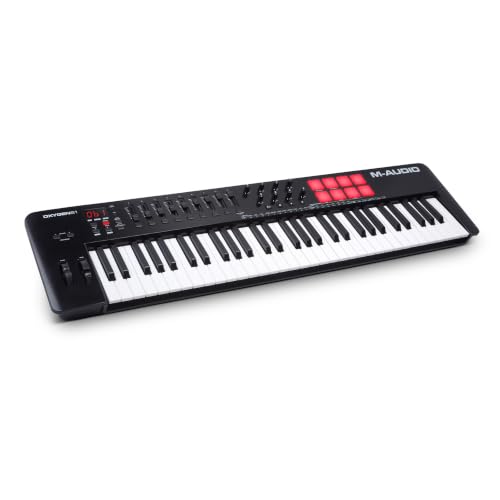
- 61 full-size velocity-sensitive keys
- 16 backlit pads across two banks
- Eight knobs and nine assignable faders
Best For: Studio producers who need keys, pads, and mixing controls
Best Portable Option

- Compact 25-key controller with eight drum pads
- Smart scales, arpeggio, note repeat, and chords
- USB-C support plus software and teaching courses
Best For: Beginners and mobile producers making music on the go
Portable Beat Starter
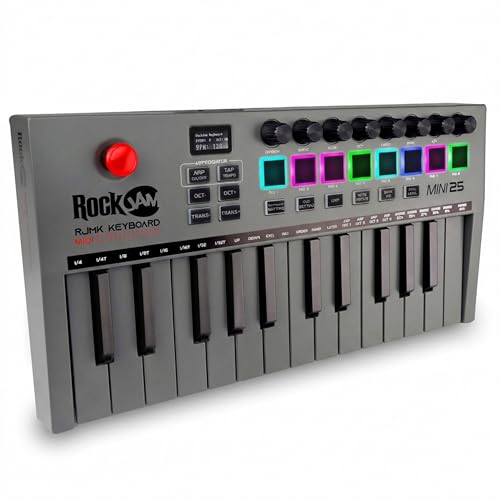
- 25 velocity-sensitive mini keys with eight backlit pads
- Rechargeable, compact design for travel production
- Eight assignable knobs plus USB MIDI and Bluetooth
Best For: Beginners and mobile beat makers
Wireless Compact Controller

- 25 velocity-sensitive keys and eight RGB backlit pads
- Bluetooth with a 2,000 mAh battery rated for about 16 hours
- Eight encoders and two capacitive touch strips
Best For: Portable songwriting and beat production
Feature-Rich Wireless Pick
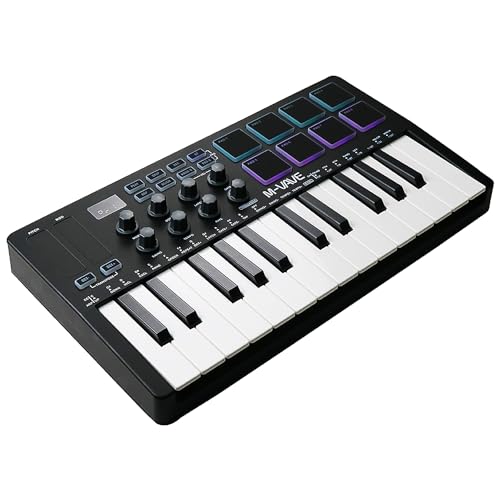
- Semi-weighted 25-key dynamic keybed
- Eight RGB pads, eight knobs, and two touch bars
- Includes MPC beat software and a 2,000 mAh battery
Best For: Expressive mobile beat production
Best All-Around Pick – Akai MPK Mini IV
The Akai Professional MPK Mini IV is a compact choice for producers seeking MIDI keyboards with pads. Its 25 velocity-sensitive mini keys, eight MPC pads, assignable knobs, screen, and USB-C connection cover beat making, virtual instruments, and portable production.
Best For: Beat makers, beginners, mobile producers, and creators who want modern controls in a compact controller.
Pros:
- Eight velocity- and pressure-sensitive MPC pads provide RGB performance feedback.
- Full-color screen, push/turn encoder, and eight assignable knobs support hands-on control.
- Includes arpeggiator, Chord and Scale modes, DAW integration, and a substantial software bundle.
- USB-C, full-size MIDI Out, and lightweight construction suit studio and mobile setups.
Cons:
- The 25 mini-key layout offers less playing range than larger controllers.
- Its broad feature set may take time for beginners to learn fully.
Choose the MPK Mini IV if you want an updated, travel-friendly controller that balances keyboard performance, pad triggering, visual feedback, and software control.
Best for Hands-On Workflow – Arturia MiniLab 3
The Arturia MiniLab 3 is a practical option among MIDI keyboards with pads, combining 25 velocity-sensitive keys with two banks of eight RGB-backed pads. Its encoders, faders, display, browsing knob, and arpeggiator make it useful for controlling instruments and DAW tracks without relying as heavily on a mouse.
Best For: Producers who want an accessible all-in-one controller for drums, track control, browsing, and virtual instruments.
Pros:
- Two banks of eight velocity- and pressure-sensitive pads provide 16 pad locations.
- Eight rotary encoders, four faders, display, and clickable browsing knob support hands-on operation.
- Includes an arpeggiator, pitch and modulation touch sensors, MIDI Out, and software suite.
- Compact 25-key design weighs 3.1 pounds and includes a five-year limited warranty.
Cons:
- The slim 25-key format is less suitable for extended piano-style playing.
- Its plastic construction may feel less substantial than larger controllers.
The MiniLab 3 stands out when streamlined control is more important than a large keyboard. Its dual pad banks and array of faders and encoders give a small setup considerable flexibility.
Best Value Classic – Akai MPK Mini MK3
The Akai Professional MPK Mini MK3 remains a straightforward pick for shoppers comparing MIDI keyboards with pads. It combines 25 velocity-sensitive mini keys, eight backlit MPC-style pads, eight assignable knobs, and a four-way pitch and modulation thumbstick in a compact USB controller.
Best For: Home-studio producers and beat makers who want familiar MPC-style pad control with essential keyboard and synth controls.
Pros:
- Eight velocity-sensitive MPC pads include Note Repeat and Full Level functions.
- Eight 360-degree knobs provide control over plug-ins, mixing, and synth parameters.
- The four-way thumbstick handles pitch and modulation, while the arpeggiator supports adjustable settings.
- Includes MPC Beats, virtual instruments, 2GB of sound content, and two months of Splice.
Cons:
- Uses a USB 2.0 Type-B connection rather than USB-C.
- Its 25 mini keys and compact layout provide limited range for two-handed playing.
- Software and preset customization require downloads and editor setup.
The MPK Mini MK3 is a sensible choice when core beat-making controls matter most. It delivers Akai’s recognizable pad workflow and useful production software without taking much space.
Best for Expanded Keyboard Range – Novation Launchkey 61 MK4
The Novation Launchkey 61 MK4 is the largest and most performance-oriented option here for anyone comparing MIDI keyboards with pads. Its 61 semi-weighted keys pair with 16 responsive FSR pads featuring polyphonic aftertouch, plus DAW controls, faders, an OLED display, and creative modes.
Best For: Producers and performers who need a full 61-key range alongside expressive pads, clip launching, and DAW integration.
Pros:
- 61 semi-weighted keys provide substantially more range than compact 25-key controllers.
- Sixteen FSR pads support drumming, clip launching, step sequencing, chord triggering, and polyphonic aftertouch.
- Works with major DAWs including Ableton Live, Logic, Cubase, Reason, Reaper, FL Studio, and Ardour.
- Includes nine faders, pitch and modulation wheels, OLED display, Scale and Chord modes, and an arpeggiator.
Cons:
- At 10.5 pounds, it is considerably less portable than mini controllers.
- The larger footprint may be excessive for small desks or travel setups.
- Its expanded controls may be more than beginners need for basic beat triggering.
Pick the Launchkey 61 MK4 when keyboard range and expressive pad performance are priorities. It is especially well suited to DAW-based production and live workflows that benefit from clip, chord, and step-sequencing control.
Best for Easy Setup – Akai MPK Mini Plus 37-Key
The Akai MPK Mini Plus is a flexible choice for shoppers comparing midi keyboards with pads. Its 37-key layout provides three octaves for melodic and chord work, while eight RGB MPC pads support beat making and dynamic performance. USB connectivity, CV/Gate and MIDI I/O, and a built-in 64-step sequencer give it room to fit into both computer-based and hardware-focused setups.
Best For: Producers who want a compact controller with pads, sequencing, and connections for both DAWs and external gear.
Pros:
- 37 velocity-sensitive keys cover three full octaves.
- Eight RGB MPC pads support beat production and performance.
- Built-in 64-step sequencer can work without a computer.
- Includes CV/Gate, MIDI I/O, eight assignable knobs, and DAW transport controls.
Cons:
- Its 37-key range is smaller than a full-size keyboard.
- It does not include onboard sounds, so USB or MIDI-connected equipment is needed for sound.
The MPK Mini Plus is a strong middle ground: more playable than a compact 25-key model while remaining portable. Its external MIDI and CV/Gate connections also make it a practical choice for expanding beyond software instruments.
Best for Full-Range Control – M-Audio Oxygen 61 MKV
The M-Audio Oxygen 61 MKV is designed for producers who need a broad playing range alongside hands-on beat controls. Its 61 full-size, velocity-sensitive keys are paired with two banks of eight backlit pads, plus eight knobs and nine faders for detailed DAW, instrument, and effect control.
Best For: Home-studio musicians who prioritize full-size keys, extensive mixing controls, and dedicated pads for beat production.
Pros:
- 61 full-size velocity-sensitive keys offer a natural piano-style response.
- Two banks of eight backlit pads include Note Repeat.
- Eight knobs and nine faders provide extensive tactile control.
- Includes Smart Chord, Smart Scale, arpeggiator, pitch and mod wheels, and production software.
Cons:
- Its 38.4-inch width makes it less portable than compact controllers.
- At 7.6 pounds, it is better suited to a fixed studio setup than frequent travel.
For players who do not want to compromise on keyboard range, the Oxygen 61 MKV offers substantially more playing space than mini controllers while still delivering serious pad and mixer-style control. It is an especially capable option for arrangement and recording workflows.
Best Portable Option – Donner DMK 25 Pro
The Donner DMK 25 Pro is a compact option for shoppers seeking midi keyboards with pads for mobile or desktop production. This 25-key controller includes eight drum pads, an OLED display, USB-C connectivity, smart scale modes, arpeggio, note repeat, chord functions, and touch controls for pitch and modulation.
Best For: Beginners and mobile producers who want a small controller with pads, guided learning content, and flexible PC or mobile compatibility.
Pros:
- Portable 25-key design weighs 680 g and measures about 13.27 inches wide.
- Eight drum pads support beat creation and performance.
- Includes 16 smart scales, arpeggio, note repeat, and chord functions.
- USB-C adapter, four DAW software offerings, and 40 teaching courses are included.
Cons:
- It does not produce sound on its own and requires a phone or computer with DAW software.
- The 25-key layout offers less range than 37- or 61-key controllers.
- Mobile use may require a separately purchased adapter for some device interfaces.
The DMK 25 Pro emphasizes portability and accessible features rather than a large playing range. Its smart modes and included lessons make it approachable for beginners, while the pads and USB-C support keep it useful for quick sketches and mobile sessions.
Portable Beat Starter – RockJam RJMK25
The RockJam RJMK25 is a practical option for shoppers seeking midi keyboards with pads in a compact, travel-friendly format. Its 25 velocity-sensitive mini keys, eight backlit drum pads, and eight assignable knobs cover basic melodic input, beat production, and DAW control.
Best For: Beginners, mobile producers, and beat makers who want a rechargeable controller with straightforward hands-on controls.
Pros:
- Eight backlit, velocity-sensitive pads include note repeat for finger drumming and sample triggering.
- Rechargeable battery and compact 1.8-pound design suit studio and travel use.
- Eight assignable knobs provide additional control over sounds and DAW parameters.
- Supports USB MIDI and Bluetooth connectivity across Windows, macOS, and iOS.
Cons:
- The 25 mini-key layout offers less range than a larger keyboard.
- The supplied notes identify the keys as mini keys, which may not suit players wanting a full-size feel.
Choose the RJMK25 when portability and an integrated pad section matter more than an expanded key range. Its rechargeable design and broad software compatibility make it a flexible starting point for mobile production.
Wireless Compact Controller – M-VAVE K5
The M-VAVE K5 combines a 25-key velocity-sensitive keyboard with eight RGB backlit pads, making it a versatile pick among midi keyboards with pads. Bluetooth connectivity, a built-in 2,000 mAh battery, and a compact body make it suitable for creating away from a fixed studio setup.
Best For: Songwriters and beat makers who want wireless portability, tactile controls, and compatibility with common DAWs.
Pros:
- Bluetooth operation and a battery rated for about 16 hours support portable use.
- Eight RGB backlit, velocity-sensitive pads are suited to beats and sample control.
- Eight assignable rotary encoders and two capacitive touch strips expand sound-shaping control.
- Works with Windows, macOS, Android, and iOS, with support for several major DAWs.
Cons:
- Its 25 mini-key format provides a limited playing range.
- The compact design may be less suitable for players who prefer a full-size keybed.
The K5 is a strong fit if wireless operation and portability are priorities. Its pads, encoders, touch strips, and smart chord and sound features give producers several ways to shape performances in a small footprint.
Feature-Rich Wireless Pick – M-VAVE K5 with MPC Software
For producers comparing midi keyboards with pads, this M-VAVE model adds a semi-weighted dynamic keybed to its compact 25-key layout. It pairs eight RGB backlit velocity-sensitive pads with eight knobs, two touch bars, wireless connectivity, and included MPC beat software.
Best For: Producers who want expressive key response, wireless operation, and bundled tools for beat and sample-based production.
Pros:
- Semi-weighted dynamic keybed offers a more responsive playing experience than a basic mini-key controller.
- Eight RGB backlit velocity-sensitive pads support expressive beat creation and sample triggering.
- Includes eight knobs, two touch bars, and MPC beat software with drum samples and instrument presets.
- Built-in 2,000 mAh battery is rated for about 16 hours, and the controller supports Windows, macOS, Android, and iOS.
Cons:
- The 25-key layout still limits range for two-handed parts.
- The supplied specifications list a plastic outer material, which may not appeal to buyers seeking a more premium build.
This version is worth considering when pad control and bundled production software are as important as keyboard feel. The semi-weighted keybed adds expression, while the wireless battery design keeps the controller practical for mobile sessions.
How We Picked the Best Midi Keyboards with Pads
We focused on controllers that pair playable piano-style keys with dedicated drum pads and useful controls for modern music software. The lineup includes compact 25-key models for mobile production, mid-sized controllers for balanced portability, and 61-key options for broader playing range.
We also considered pad responsiveness, key feel, control layout, USB connectivity, wireless options where available, DAW integration, display feedback, portability, and overall practicality. Because feature priorities vary by musician, this list includes both established models and budget-friendly alternatives.
Quick Comparison
| Best For | Recommended Type | Why It Stands Out |
|---|---|---|
| Travel and compact desks | 25-key controller | Small footprint with essential pads and controls |
| Balanced studio use | 37-key controller | More playing range without the size of a full keyboard |
| Two-handed playing | 61-key controller | Extended range for chords, bass lines, and melodies |
| Beat-focused production | Pad-equipped mini controller | Quick access to drums, samples, and clip launching |
| Wireless setups | Bluetooth-capable model | Flexible placement and fewer cables |
Key Buying Factors for Midi Keyboards with Pads
Key Count and Playing Feel
Twenty-five keys are convenient for portable production but can feel limiting for two-handed parts. Thirty-seven keys provide a useful middle ground, while 61 keys are better for players who need full melodic and harmonic range. Check whether the keys are velocity-sensitive and whether the action feels suitable for piano parts, synth leads, or basic beat programming.
Pad Quality and Layout
Look for velocity-sensitive pads with clear spacing and dependable triggering. Backlit pads make it easier to perform in dim rooms, while banks or multiple pad modes can expand the number of samples, drums, and software functions available.
Software Control and Connectivity
DAW integration can save time by mapping transport, instruments, clips, and effects automatically. USB-C is convenient on newer computers, while USB-A compatibility may require an adapter. Bluetooth can help with wireless workflows, but wired USB remains the dependable choice for low-latency performance.
Size, Controls, and Extra Features
Knobs, faders, pitch and modulation controls, arpeggiators, scale modes, displays, and chord functions can improve workflow. Prioritize the controls you will actually use, especially if desk space or travel weight matters.
Who Should Buy Which Midi Keyboards with Pads?
Choose a compact 25-key model if you produce on a small desk, travel frequently, or mainly sequence drums and simple melodies. A 37-key controller is a strong all-purpose choice for producers who want additional range without committing to a large keyboard. Choose a 61-key model if you play extended parts, use both hands often, or want a more traditional keyboard experience.
For beat makers, prioritize responsive pads and easy pad-bank access. For live performers, look for reliable DAW integration, clear visual feedback, and sturdy controls. Beginners may benefit from scale, arpeggio, and chord features, while experienced producers should focus on mapping flexibility and the controls that match their existing software workflow.