Making music in an apartment calls for gear that delivers expressive control without taking over your desk—or disturbing neighbors. The best MIDI controllers for apartments combine compact footprints, responsive keys or pads, and flexible USB or wireless connectivity.
We selected 10 practical options for beat makers, producers, performers, and beginners, ranging from mini keyboards to portable pad controllers. The right choice depends on your workflow, available space, noise tolerance, and preferred music software.
Best 10 Midi Controllers for Apartments Picks for 2026
Best All-Rounder

- 25 velocity-sensitive mini keys with pads
- Eight knobs, display, and performance modes
- Compact USB-C design with bundled software
Best For: Compact all-purpose production and beat making
Best Simple Setup

- Slim 25-key responsive keybed
- USB-C, lightweight, and plug-and-play
- Includes 500 presets and Ableton Live Lite
Best For: Simple keyboard playing in compact or mobile setups
Best Extended Keyboard

- 37 keys across three full octaves
- Pads, knobs, and built-in 64-step sequencer
- USB, MIDI I/O, and CV/Gate connectivity
Best For: Apartment producers needing range and hardware integration
Compact Keybed Pick

- 32 velocity-sensitive keys in a lightweight body
- Built-in chord, arpeggiator, sequencer, and pitch controls
- Includes 40 teaching courses and works across major platforms
Best For: Apartment musicians wanting a small keyboard-style controller
Clip-Launch Favorite

- 64 RGB pads for Ableton clip launching
- Eight assignable faders plus a master fader
- USB-powered design with Drum and Note modes
Best For: Ableton Live producers working in compact home studios
Wireless Mixing Choice
Donner STARRYCTRL Wireless MIDI Controller
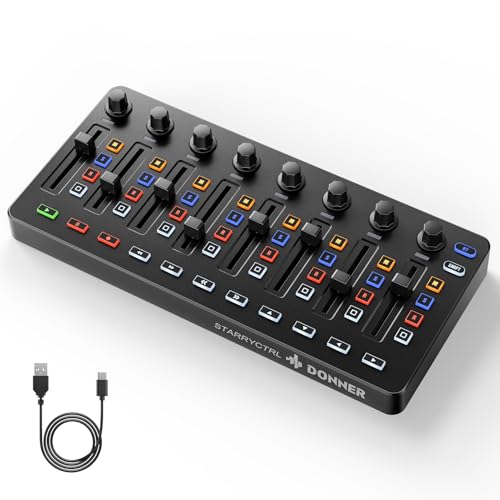
- Wireless, rechargeable design helps reduce desk cables
- Eight faders, eight knobs, and 43 assignable buttons
- Anti-jump indicators and Mackie Control support
Best For: Home producers wanting flexible wireless DAW mixing
Compact Beat Pad

- Eight RGB-backlit MPC-style pads
- Eight assignable knobs and four presets
- Slim, USB-powered Mac/PC design
Best For: Small-space beat making with a computer
Wireless Mobile Pick

- Bluetooth and USB MIDI connectivity
- 16 RGB velocity pads with aftertouch
- Up to 15 hours of rechargeable battery life
Best For: Portable apartment and mobile music production
Portable Production Hub

- 16 pads with velocity sensitivity and aftertouch
- Eight knobs plus dedicated DAW transport controls
- Wireless/USB-C operation and up to 10-hour battery
Best For: Compact production setups needing expanded DAW control
Best All-Rounder – Akai MPK Mini IV
For apartment producers who want plenty of control without filling a desk, the Akai MPK Mini IV combines 25 velocity-sensitive mini keys, MPC pads, knobs, and a compact USB-C design. It is a versatile choice among midi controllers for apartments, especially for beat making and DAW-based production.
Best For: Beat makers, songwriters, beginners, and producers needing a compact all-purpose controller.
Pros:
- Compact, lightweight, and USB-powered for small workspaces.
- Includes eight velocity- and pressure-sensitive RGB MPC pads.
- Offers eight assignable knobs, a display, arpeggiator, chord mode, and scale mode.
- Includes DAW integration, software instruments, Melodics, Splice, and NKS options.
Cons:
- Its 25 mini keys provide less playing room than larger controllers.
- Requires a computer or compatible mobile setup for its USB-powered workflow.
The MPK Mini IV is a strong fit when one small controller needs to cover keys, finger drumming, sound browsing, and hands-on DAW control in an apartment studio.
Best Simple Setup – Arturia MicroLab Mk3
The Arturia MicroLab Mk3 keeps apartment music-making straightforward with a slim 25-key layout, USB-C power, and two touch strips instead of a crowded control surface. Its small footprint makes it a practical pick among midi controllers for apartments and mobile setups.
Best For: Beginners, mobile producers, and musicians who prioritize simplicity and a responsive keybed.
Pros:
- Small, lightweight, durable, and USB-powered.
- Upgraded slim keybed is designed for a responsive playing experience.
- Includes 500 Analog Lab Intro presets and Ableton Live Lite.
- Plug-and-play USB-C connectivity keeps setup uncomplicated.
Cons:
- It has fewer physical controls than pad-and-knob-heavy alternatives.
- The 25-key format offers limited range for two-handed parts.
Choose the MicroLab Mk3 if desk space and ease of use matter more than extensive hardware control. It is especially well suited to compact keyboard-focused setups.
Best Extended Keyboard – Akai MPK Mini Plus 37-Key
The Akai MPK Mini Plus adds three full octaves, pads, knobs, and standalone sequencing while remaining compact enough for an apartment desk. For producers who need more melodic range from their midi controllers for apartments, it offers a broader playing surface without moving to a full-size keyboard.
Best For: Producers who want more keyboard range, hardware connectivity, and hands-on sequencing.
Pros:
- 37 keys provide three full octaves for melodic and harmonic parts.
- Includes eight RGB MPC pads and eight assignable rotary knobs.
- Built-in 64-step sequencer supports drums and melodic or chord tracks.
- USB, MIDI I/O, and CV/Gate support connect to computers and external gear.
Cons:
- It takes more desk space than 25-key mini controllers.
- Its broader feature set may be more than beginners need.
The MPK Mini Plus is a practical middle ground for apartment producers who want stronger keyboard range and external-gear options while keeping the controller relatively compact.
Best Wireless Beat Pad – EMP16 MIDI Pad Controller
The EMP16 is designed around finger drumming rather than piano-style playing, with 16 RGB pads, Bluetooth, and battery operation. Its wireless option and compact format make it an appealing alternative among midi controllers for apartments, particularly when minimizing cable clutter matters.
Best For: Beat makers, DJs, and mobile producers who prefer pads over keys.
Pros:
- Sixteen velocity-sensitive RGB pads expand to 64 assignable pads across four banks.
- Bluetooth 5.0, USB, and optional two-AA-battery power support flexible setups.
- Includes assignable faders, buttons, knobs, an OLED display, and performance controls.
- Provides MIDI input and output for software and external MIDI equipment.
Cons:
- It does not provide piano-style keys for keyboard parts.
- AA batteries are not included.
- Wireless compatibility is listed for iOS and Mac, while other setups may use USB.
The EMP16 makes the most sense for rhythm-focused apartment setups. Its wireless connection, battery option, and extensive pad controls can help keep a small production area flexible.
Compact Keybed Pick – Donner N-32
For shoppers comparing MIDI controllers for apartments, the Donner N-32 offers a compact way to play notes without taking over a desk. Its 32 velocity-sensitive keys, lightweight design, screen, and built-in creative controls suit bedroom producers, learners, and mobile setups. Keep in mind that it is a controller only and requires DAW software to produce sound.
Best For: Apartment musicians who want a small keyboard-style controller with learning tools and expressive controls.
Pros:
- 32 velocity-sensitive keys provide more playing range than many compact controllers.
- Includes chord, arpeggiator, octave, pitch-shifter, sequencer, and sustain-pedal functions.
- Works with Mac, Windows, Android, and iOS, with support for several popular DAWs.
- Includes 40 teaching courses and music production software.
Cons:
- It does not produce sound independently; DAW software is required.
- The scaled-down keys may feel less spacious than full-size keyboard keys.
The N-32 is a practical choice when apartment space and portability matter more than a full-size keybed. Its teaching content and broad device compatibility make it especially approachable for beginners.
Clip-Launch Favorite – Akai APC Mini MK2
Among MIDI controllers for apartments, the Akai APC Mini MK2 is designed for hands-on Ableton Live production rather than traditional keyboard playing. Its compact footprint combines a bright 8×8 RGB pad matrix with eight assignable faders and a master fader, giving home-studio users direct control over clips, mixing, drums, and notes.
Best For: Ableton Live users building loops, launching clips, mixing, or performing in a compact home studio.
Pros:
- 64 RGB pads provide visual feedback for launching clips and samples.
- Eight assignable faders plus a master fader offer hands-on mixer control.
- Includes Drum and Note modes, with Smart Scale View for playing melodies.
- USB-powered plug-and-play operation needs no batteries or power adapter.
Cons:
- Its integration and included software are centered on Ableton Live.
- It is a pad-and-fader controller, not a conventional piano-style keyboard.
The APC Mini MK2 makes sense for apartment producers who prioritize clip-based workflows and tactile mixing over piano performance. Its shallow, compact design and USB power are convenient for a small desk.
Wireless Mixing Choice – Donner STARRYCTRL Wireless MIDI Controller
The Donner STARRYCTRL stands out among MIDI controllers for apartments by reducing desk clutter with wireless operation and a rechargeable battery. It provides eight faders, eight knobs, and 43 assignable buttons for DAW mixing and custom control, while its anti-jump indicators help show when a physical fader does not match a track value.
Best For: Home producers and DJs who want wireless DAW mixing, extensive customization, and flexible placement.
Pros:
- Wireless connectivity and a rechargeable 780mAh battery help reduce cable clutter.
- Eight faders, eight knobs, and 43 assignable controls support detailed DAW workflows.
- Smart LED anti-jump indicators help prevent sudden parameter changes.
- Supports Mackie Control Universal and works with multiple popular DAWs.
Cons:
- It focuses on mixing and control rather than keyboard-style note playing.
- Wireless operation still includes USB Type-C charging and wired connectivity hardware.
STARRYCTRL is a strong fit for an apartment setup where flexible placement and fewer cables matter. Its broad customization and MCU support make it more suitable for producers who want to build a tailored mixing workflow.
Compact Beat Pad – Akai LPD8
For apartment producers who want hands-on control without a large setup, the Akai Professional LPD8 is a compact USB MIDI pad controller with eight RGB-backlit pads and eight assignable knobs. Its slim, driver-free design works with Mac and PC and needs no AC adapter.
Best For: Apartment beat makers who prioritize a small, straightforward wired controller for DAW work.
Pros:
- Compact 12.12-inch-wide design is easy to store in a laptop bag.
- Eight responsive RGB pads support samples, loops, and virtual instruments.
- Eight assignable Q-Link knobs add tactile control over DAW and plugin parameters.
- Four programmable presets simplify switching between mappings.
Cons:
- USB wired operation does not offer wireless freedom.
- It has eight pads rather than the 16-pad layout found on larger controllers.
- It requires a computer and software to produce sound.
The LPD8 is a practical choice for small apartments because it delivers essential pad and knob control while taking up very little space. Choose it if portability and simple USB setup matter more than a larger performance surface.
Wireless Mobile Pick – Mini 16-Pad MIDI Controller
This mini wireless MIDI controller suits apartment musicians who need flexible control for beat making, DJ performance, or mobile production. Bluetooth MIDI, USB MIDI, a rechargeable battery lasting up to 15 hours, and a compact footprint make it easy to use away from a permanent desk.
Best For: Mobile producers, DJs, and beginners who want wireless pad control across computers, phones, and tablets.
Pros:
- Bluetooth and USB MIDI support flexible wired or wireless setups.
- Sixteen velocity-sensitive RGB pads include aftertouch for expressive triggering.
- Up to 15 hours of battery life supports extended sessions.
- App and PC customization includes mappings, MIDI commands, velocity curves, and lighting.
Cons:
- Its compact format may provide less physical room than a full-size controller.
- Customization requires the companion software or mobile app.
- It does not generate audio by itself and must control compatible software or hardware.
With wireless connectivity and a rechargeable battery, this controller is especially convenient when apartment space doubles as a living, working, or travel area. Its 16 pads and expandable banks provide more triggering capacity without requiring a large studio surface.
Portable Production Hub – Donner STARRYPAD PRO
The Donner STARRYPAD PRO offers substantial control in a portable format, making it a strong option for apartment producers who want expressive pads, knobs, and transport controls without a bulky workstation. It supports USB-C or wireless MIDI across computers, tablets, and smartphones.
Best For: Producers seeking a versatile compact controller with deeper DAW control and bundled learning software.
Pros:
- Sixteen velocity-sensitive RGB pads feature polyphonic aftertouch.
- Eight assignable rotary knobs and dedicated DAW transport controls expand hands-on workflow.
- Built-in battery provides up to 10 hours of portable use.
- Includes Cubase LE, WaveLab LE, and Melodics software licenses.
Cons:
- It requires DAW software to generate sound.
- Its broader feature set may be more than beginners need for basic pad triggering.
- Battery life is rated at up to 10 hours, shorter than the 15-hour rating of the mini wireless controller above.
The STARRYPAD PRO is well suited to apartment setups that need more control without sacrificing portability. Its pad expression, knobs, transport section, connectivity options, and included software make it a flexible all-around production tool.
How We Picked the Best Midi Controllers for Apartments
We focused on controllers that suit limited workspaces and shared living environments. Our selection considers physical size, portability, connection options, playing feel, control flexibility, and compatibility with common DAWs and mobile devices. We also included several controller styles so you can choose between piano-style keys, drum pads, knobs, faders, and wireless operation.
For apartment use, practical design matters as much as feature count. Compact hardware is easier to store, while USB bus power reduces cable clutter. Velocity sensitivity, aftertouch, programmable controls, and low-latency connectivity can make a small controller feel considerably more capable.
Quick Comparison
| Controller type | Best for | Main advantage |
|---|---|---|
| 25- to 32-key keyboard | Melodies, chords, and portable production | Small footprint with familiar key layout |
| 37-key keyboard | More comfortable two-handed playing | Extra range without a full-size keyboard footprint |
| Pad controller | Drums, clips, and finger performance | Quiet, tactile beat-making control |
| Wireless controller | Flexible desk or mobile setups | Less cable clutter and easier placement |
Key Buying Factors for Midi Controllers for Apartments
Size and Storage
Measure your desk before buying, including room for a laptop, audio interface, and mouse. A 25-key keyboard or compact pad controller is easier to leave set up, while smaller wireless models can be stored in a drawer when not in use.
Keys Versus Pads
Choose keys if you play melodies, bass lines, or chord progressions. Pads are usually better for drum programming, sample triggering, and clip launching. If you produce several styles, look for a model with both pads and keyboard controls, or pair a small keyboard with a separate pad unit.
Noise and Playing Feel
MIDI controllers do not produce sound by themselves, but physical keys can still create tapping noise through a desk or floor. Use a desk mat or soft stand, and consider pads if late-night beat making is a priority. Velocity sensitivity and aftertouch are valuable for expressive software instruments.
Connectivity and Software
USB MIDI is typically the simplest apartment setup. Bluetooth can reduce wires and work well with compatible tablets or computers, but verify latency and operating-system support before relying on it for live performance. Check DAW mappings, MIDI editor availability, and whether the controller requires a powered hub.
Who Should Buy Which Midi Controllers for Apartments?
Choose a compact keyboard if you want the most versatile option for learning, composing, and controlling virtual instruments. A 25- or 32-key model is ideal for small desks, while a 37-key controller gives you more room for two-handed parts.
Choose a pad controller if your focus is electronic drums, finger drumming, clip launching, or sampling. Models with assignable knobs add hands-on control over effects and mixer parameters without requiring a larger keyboard.
Choose a wireless controller if you frequently move between a desk, couch, and mobile setup. It is especially useful when minimizing visible cables matters, though wired USB remains the safest choice for the lowest-latency studio work.
For most apartment producers, the best overall setup is the smallest controller that supports your main workflow. Prioritize comfortable control, reliable software integration, and easy storage over a long feature list you may rarely use.