The best headphone amplifiers with preamp output can make headphones easier to drive while also feeding powered speakers, a power amplifier, or another audio component. That makes them useful for flexible desktop systems, turntables, and shared listening setups.
Our selection includes compact analog amps, DAC-equipped models, phono preamps, Bluetooth tube units, and multi-channel headphone distribution amplifiers. Use the guide below to match features and connections to your system.
Best 10 Headphone Amplifiers with Preamp Output Picks for 2026
Vinyl-Friendly Pick

- MM phono preamp with RIAA response
- RCA and 3.5mm headphone outputs
- Low-noise design with grounding post
Best For: MM turntable owners needing headphone and line outputs
Shared Listening Pick
Mackie HM-4 Four-Channel Headphone Amp

- Four independent headphone outputs
- Separate volume control per listener
- Compact metal plug-and-play design
Best For: Tracking sessions and rehearsals with multiple listeners
Adjustable Desktop Pick
Fosi Audio SK01 Class A Headphone Amp

- Three-band analog EQ and loudness control
- Up to 2400mW in high-impedance mode
- 3.5mm and 6.35mm outputs with battery power
Best For: Desktop listeners wanting adjustable tone and gain
Studio Monitoring Pick
LZSIG LHA2 Four-Channel Amplifier
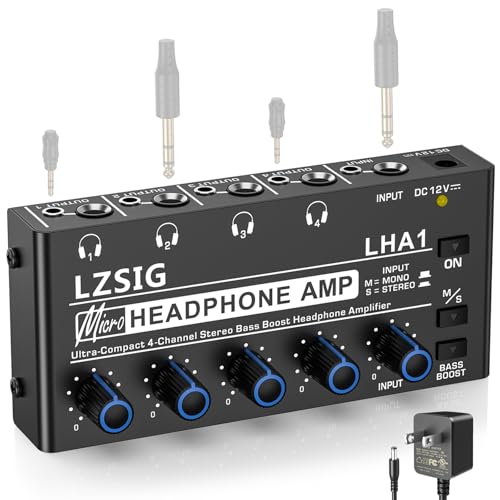
- Four independently controlled headphone channels
- Bass boost and stereo/mono switching
- Metal chassis for studio or stage use
Best For: Shared monitoring in home studios and rehearsals
Compact Analog Pick
Mini Stereo Headphone Preamplifier
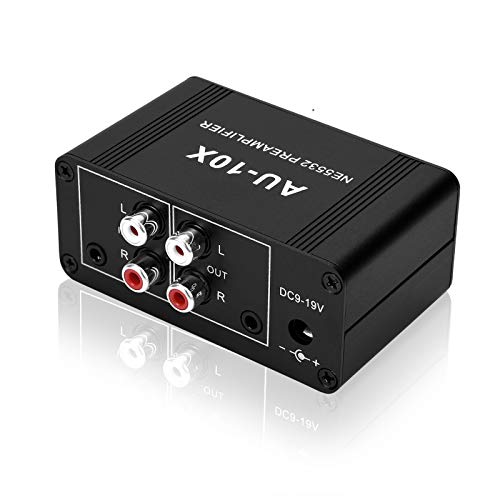
- 20dB gain for weak audio signals
- RCA and 3.5mm input/output connections
- Supports headphones up to 16 ohms
Best For: Basic desktop systems and low-impedance headphones
Tube Bluetooth Choice

- Supports 16Ω to 300Ω headphones
- Bluetooth 5.1 with aptX HD and aptX LL
- RCA, AUX, and 3.5mm outputs
Best For: Flexible home audio and tube-style headphone listening
Balanced Connectivity Pick

- XLR, RCA, and 3.5mm input/output options
- 20dB gain for weak source signals
- Volume control and NE5532 dual op amp
Best For: Audio systems requiring balanced XLR connections
Best Compact DAC Preamp

- USB-C and optical DAC inputs
- 3.5mm and 4.4mm outputs
- Functions as a desktop preamp
Best For: Compact desktop systems using headphones, active speakers, or a separate amplifier
Best Tube Phono Preamp

- MM/MC phono and RCA inputs
- Independent 3.5mm headphone amp
- Tube design with tone controls
Best For: Vinyl listeners building a warm-sounding home Hi-Fi system
Best Value Class A Headphone Amp

- RCA input for analog systems
- 6.35mm and 3.5mm outputs
- Class A design with op-amp socket
Best For: Affordable desktop headphone listening with an analog RCA source
Vinyl-Friendly Pick – BOX X1 Phono Headphone Preamp
The Fosi Audio BOX X1 is a practical choice if you need headphone amplifiers with preamp output for a moving-magnet turntable. It combines phono amplification with RCA line output and a 3.5mm headphone output, making it suitable for both private listening and powered-speaker setups.
Best For: MM turntable owners who want headphone and RCA outputs in one compact unit.
Pros:
- Provides both RCA line output and 3.5mm headphone output.
- Uses low-noise circuitry and follows the RIAA frequency-response standard.
- Includes a grounding post and 12V power adapter.
- Its aluminum case is designed for durable everyday use.
Cons:
- Designed for MM turntables rather than other cartridge types.
- Has a single channel and no listed tone controls.
The BOX X1 is less of a general-purpose desktop headphone amp than a focused vinyl accessory, but its simultaneous RCA and headphone connectivity makes it flexible for a turntable-based system.
Shared Listening Pick – Mackie HM-4 Four-Channel Headphone Amp
The Mackie HM-4 is a straightforward option among headphone amplifiers with preamp output when several listeners need to monitor one source. Its four outputs each have independent volume control, and it accepts either a 1/4-inch or 1/8-inch source connection.
Best For: Tracking sessions, rehearsals, and shared monitoring with up to four listeners.
Pros:
- Drives four headphones from a single source.
- Provides separate volume control for every listener.
- Compact metal enclosure can be attached to a desk, rack, or stand.
- Plug-and-play operation does not require a separate power supply.
Cons:
- It is a splitter-style headphone amplifier rather than a tone-shaping preamp.
- The supplied notes do not specify additional RCA or dedicated preamp outputs.
The HM-4 prioritizes simple multi-user monitoring over customization. It is a good fit when independent listener volume is more important than EQ, battery operation, or advanced preamp features.
Adjustable Desktop Pick – Fosi Audio SK01 Class A Headphone Amp
The Fosi Audio SK01 stands out among headphone amplifiers with preamp output for listeners who want hands-on sound adjustment. It combines a desktop headphone amplifier with a three-band analog EQ, loudness function, gain control, and 3.5mm and 6.35mm headphone connections.
Best For: Desktop listeners who want tone controls, gain adjustment, and flexible headphone compatibility.
Pros:
- Offers bass, midrange, and treble controls with a tone-defeat button.
- Provides gain adjustment and up to 2400mW in high-impedance mode.
- Supports 3.5mm and 6.35mm headphones rated from 32 to 300 ohms.
- Built-in 2500mAh battery provides up to six hours of use.
Cons:
- The supplied notes do not identify a dedicated RCA preamp output.
- Its feature-rich controls may be unnecessary for listeners seeking a simple amplifier.
The SK01 is a versatile choice for users who want a headphone amp that can also act as an analog preamp and equalizer. Its rechargeable battery adds portability, while its desktop connections support common headphone formats.
Studio Monitoring Pick – LZSIG LHA2 Four-Channel Amplifier
The LZSIG LHA2 is built for shared monitoring and fits the headphone amplifiers with preamp output category when you need four independently controlled headphone feeds. It accepts 3.5mm and 6.35mm inputs and outputs, adds bass boost and stereo/mono switching, and is designed for home-studio or stage use.
Best For: Small studio teams, rehearsals, and performers sharing one monitoring source.
Pros:
- Supports up to four pairs of 32–100-ohm headphones.
- Gives each channel its own volume control.
- Includes bass boost and stereo/mono switching.
- Uses a metal chassis and heavy-duty control knobs.
Cons:
- It is a four-channel headphone amplifier, not a mixer.
- The supplied notes do not specify a separate RCA or dedicated line-level preamp output.
- Its stated headphone range may not suit headphones outside 32–100 ohms.
The LHA2 is a practical monitoring distributor rather than a full recording mixer. Its independent level controls, dual-size connectivity, and robust construction make it well suited to shared headphone sessions.
Compact Analog Pick – Mini Stereo Headphone Preamplifier
This compact option is a straightforward choice among headphone amplifiers with preamp output for boosting weaker sources to line level. It uses a NE5532 dual op amp, offers RCA and 3.5mm connectivity, and includes a volume control for basic desktop or component-system use.
Best For: Buyers needing an inexpensive, portable preamp with a headphone output and 20dB gain.
Pros:
- Provides 20dB gain for weak signals and includes RCA and 3.5mm inputs and outputs.
- Compact enclosure with a convenient volume adjustment knob.
- Can directly drive headphones rated up to 16 ohms.
Cons:
- The headphone output cannot be used simultaneously with the other output ports.
- Its headphone output is limited to headphones up to 16 ohms.
- It is a preamp, not a power amplifier for passive speakers.
This is best suited to simple signal-boosting duties and low-impedance headphones. Check your headphone impedance and source connections before choosing it.
Tube Bluetooth Choice – Fosi Audio P3 Tube Preamp
The Fosi Audio P3 is a flexible choice among headphone amplifiers with preamp output, combining tube-based amplification with Bluetooth and wired connectivity. Its RCA, AUX, and 3.5mm outputs make it suitable for headphones, active speakers, amplifiers, and subwoofer-based setups.
Best For: Listeners who want tube-style preamplification, wireless input, tone controls, and support for a broad range of headphone impedances.
Pros:
- Supports headphones from 16Ω to 300Ω.
- Offers Bluetooth 5.1 with aptX HD and aptX LL, plus RCA inputs.
- Includes RCA, AUX, and 3.5mm outputs, with bass and treble controls.
- Can help build a 2.1-channel system with active speakers or an amplifier and subwoofer.
Cons:
- Tube installation requires removing the copper rings.
- Its tube-based design may be less suitable for buyers seeking a purely solid-state unit.
Choose the P3 when connectivity and system flexibility matter as much as headphone listening. Its wide impedance range and multiple preamp outputs make it the most adaptable option here.
Balanced Connectivity Pick – XLR Stereo Headphone Preamp
This balanced model is a practical choice among headphone amplifiers with preamp output when your system uses XLR as well as RCA or 3.5mm connections. It provides 20dB gain, a front-panel volume control, and outputs for routing the boosted signal to downstream audio equipment.
Best For: Systems that need compact balanced XLR signal handling alongside conventional RCA and 3.5mm connections.
Pros:
- Accepts and outputs XLR balanced, RCA, and 3.5mm connections.
- Provides 20dB gain for bringing weak signals to line level.
- Uses a NE5532 dual op amp and includes a volume adjustment knob.
- Works with a wide range of listed sources, including turntables, computers, and musical instruments.
Cons:
- The supplied notes do not specify a headphone impedance range or dedicated headphone output details.
- It is a preamp and cannot power passive speakers directly.
- The unit is larger than the smaller mini preamplifier in this roundup.
This model makes the most sense when balanced connectivity is a priority. Confirm your system’s power and headphone requirements, particularly if you need it to drive headphones directly.
Best Compact DAC Preamp – Fosi Audio SK02
For shoppers seeking headphone amplifiers with preamp output, the Fosi Audio SK02 combines a USB-C or optical DAC with headphone amplification and preamp functionality. Its compact desktop design supports both 3.5mm single-ended and 4.4mm balanced headphones, while the high/low gain settings help accommodate a broad range of headphones and IEMs.
Best For: Desktop listeners who want a compact DAC, balanced headphone output, and a preamp for active speakers or a separate amplifier.
Pros:
- Supports PCM up to 32-bit/384kHz and DSD256 decoding.
- Offers both 3.5mm and powerful 4.4mm balanced headphone outputs.
- Works as a preamp with active speakers or compatible amplifiers.
- Driver-free operation, multifunction control knob, and optical or USB input.
Cons:
- Its preamp-oriented connectivity is focused on digital USB-C and optical sources.
- The compact desktop format may provide fewer connection options than a full-size component.
The SK02 is a versatile choice when you want one small unit to handle digital conversion, headphone listening, and basic desktop system duties. Its balanced output and high power make it especially appealing for demanding headphones, while the preamp mode adds flexibility for powered speakers or an amplifier.
Best Tube Phono Preamp – Douk Audio T9
The Douk Audio T9 suits buyers looking for headphone amplifiers with preamp output in a vinyl-focused home audio setup. It combines MM/MC phono support, RCA line input, a dedicated 3.5mm headphone jack, and adjustable bass and treble controls in a tube-based preamp design.
Best For: Turntable owners who want phono preamplification, tube coloration, tone controls, and headphone listening in one component.
Pros:
- Supports both MM and MC phono cartridges along with RCA sources.
- Includes an independent headphone amplifier for 16–300Ω headphones.
- Two 6E2 and two 6A2 tubes provide a warm, full-bodied presentation and visual signal display.
- Replaceable tube sockets and adjustable treble and bass controls add customization.
Cons:
- Its 3.5mm headphone output may be less convenient for users with only 6.35mm headphone plugs.
- The tube-based design is larger and heavier than a compact desktop DAC amp.
- It requires the included 12V DC power supply.
The T9 is a strong fit for listeners who want a more traditional vinyl and tube experience rather than a purely digital desktop DAC. Its phono versatility, tone controls, and dedicated headphone circuit make it useful as the control center of a small home Hi-Fi system.
Best Value Class A Headphone Amp – Douk Audio U3
The Douk Audio U3 is a straightforward option for shoppers comparing headphone amplifiers with preamp output for a home or office desktop. It uses an RCA input, Class A amplification, and both 6.35mm and 3.5mm headphone connections, with enough drive capability for many demanding headphones.
Best For: Budget-conscious desktop listeners who need a compact analog headphone amplifier for standard RCA-based systems.
Pros:
- Provides both 6.35mm and 3.5mm headphone outputs.
- Class A circuit and NE5532 op amp aim for a warm, smooth presentation.
- Strong output capability is designed to drive many high-impedance headphones.
- Pluggable op-amp socket supports future experimentation and upgrades.
Cons:
- Uses RCA input rather than USB or optical digital connections.
- The supplied notes identify it primarily as a headphone amplifier, so preamp connectivity is less clearly specified than on the SK02.
- Its small enclosure may offer fewer system-integration features than larger preamps.
The U3 makes sense when simplicity, analog connectivity, and headphone drive matter more than built-in digital conversion. It is a practical desktop companion for an RCA source, especially if you value a compact Class A design and the ability to try different op amps.
How We Picked the Best Headphone Amplifiers with Preamp Output
We focused on models that combine headphone amplification with a line-level or preamp-style output, or that serve a closely related role in a compact audio system. The lineup covers several use cases rather than treating every amplifier as interchangeable: desktop PC listening, turntable playback, balanced connections, Bluetooth streaming, tube coloration, and multi-listener monitoring.
We also considered input and output flexibility, gain and tone controls, headphone connector formats, channel count, power requirements, and the practical differences between an analog amplifier and a DAC-equipped unit. Because specifications and bundled accessories can vary, confirm the listing details before purchase.
Quick Comparison
| Best For | Look For | Product Types In This Roundup |
|---|---|---|
| PC or desktop listening | USB or DAC functionality, compact controls | Desktop headphone amps and DAC amps |
| Turntables | MM/MC support, phono gain, RCA connectivity | Phono preamps with headphone output |
| Multiple listeners | Several independently usable headphone outputs | Four-channel distribution amps |
| Flexible home audio | Preamp output, Bluetooth, RCA, or balanced I/O | Hybrid preamps and balanced converters |
Key Buying Factors for Headphone Amplifiers with Preamp Output
Inputs and Outputs
Check whether the unit has the connections your system requires. RCA is common for turntables and traditional components, while 3.5mm inputs suit computers and portable sources. XLR connections can be useful in balanced systems, but a balanced connector does not automatically guarantee a fully balanced signal path. If you want to connect powered speakers or a power amp, verify that the preamp output is present and determine whether its level follows the volume control.
Headphone Power and Impedance
Match the amplifier to your headphones. Efficient low-impedance headphones need clean, quiet output, while high-impedance or planar headphones may benefit from greater voltage or current capability. A gain switch, bass boost, or tone control can improve flexibility, but excessive boost may reduce headroom or add distortion at high listening levels.
DAC, Phono, and Bluetooth Features
A DAC amp is useful when your source is a computer and you want to bypass questionable onboard audio. For vinyl, choose a phono stage that matches your cartridge type, such as moving magnet or moving coil. Bluetooth adds convenience, but codec support, antenna placement, and wireless source quality still matter.
Size, Power, and Controls
Compact units fit neatly beside a computer or turntable, but smaller enclosures may have fewer connections and less power. Confirm the included power supply, connector size, channel layout, and whether the controls operate independently for headphones and preamp output.
Who Should Buy Which Headphone Amplifiers with Preamp Output?
- Choose a compact analog amp if you mainly need a simple headphone upgrade with RCA or 3.5mm connectivity.
- Choose a DAC headphone amp for computer-based listening and a cleaner, more convenient digital-to-analog path.
- Choose a phono preamp if your turntable needs phono gain or you want direct headphone monitoring from a vinyl setup.
- Choose a multi-channel amplifier for rehearsals, recording, demonstrations, or shared listening with several headphones.
- Choose a Bluetooth or tube preamp if wireless streaming and a warmer, more feature-rich home-audio setup are priorities.
- Choose a balanced model only when its inputs and outputs match the rest of your equipment and you specifically need that connection standard.
Before ordering, map every source and destination in your system, then confirm connector compatibility, cartridge support, output behavior, and the amplifier’s power requirements.