The best drum pads for live performances give drummers fast access to samples, electronic percussion, backing parts, and expressive triggering without taking over the stage. The right model depends on your sound requirements, playing style, connectivity needs, and available setup space.
This roundup compares 10 options ranging from full-featured multipads to compact sample and practice pads, helping you choose dependable gear for rehearsals, touring, worship, studio-stage hybrids, and live shows.
Best 10 Drum Pads for Live Performances Picks for 2026
Best All-in-One Choice

- Nine velocity-sensitive RGB pads
- Built-in looper and sample loading
- 32GB storage with 700+ sounds
Best For: Versatile live sets using drums, loops, samples, and melodic sounds
Best Road-Ready Option
- Rugged design for gigging
- Backlit controls for dark stages
- Four dual-trigger inputs for expansion
Best For: Live drummers needing durable operation and expandable triggering
Best Sound Library

- 1,061 percussion and effects sounds
- 216 keyboard sounds included
- Five external pad trigger inputs
Best For: Live players seeking broad sounds and expandable triggering
Best Practice-Focused Pick
Vic Firth Heavy Hitter Quadropad

- Realistic marching practice response
- Integrated rims for rimshot work
- Supports five- and six-drum setups
Best For: Marching percussion practice, warm-ups, and technique development
Feature-Rich Live Rig

- 1,000 sounds and 32GB internal storage
- Wireless Bluetooth sampling and onboard effects
- LEDs, MIDI, and extensive trigger expansion
Best For: Performers building an expandable sampling setup
Marching Setup Choice

- Designed for 4-, 5-, or 6-pad configurations
- Rubber and silicone construction
- Dedicated tenor-pad format
Best For: Marching percussionists needing a multi-pad tenor setup
Compact Performance Expander

- Four velocity-sensitive pads
- SD card sample expansion
- MIDI output and dual trigger input
Best For: Portable live rigs needing simple sample expansion
Compact Mesh Versatility

- 10-inch tensionable mesh head
- Dual-trigger sensor and metal rim
- Dual-mounting design for flexible placement
Best For: Compact V-Drums snare or floor tom setups
Quiet Three-Zone Control

- Three-zone triggering with rimshots
- Textured silicone playing surface
- Free-floating design helps limit crosstalk
Best For: Expressive, quiet electronic drumming
Stage-Ready Tom Feel

- 10-inch dual-zone tom pad
- Adjustable double-ply mesh head
- Wood shell with included tom bracket
Best For: Compact electronic tom setups using acoustic-style mounts
Best All-in-One Choice – Alesis Strike Multipad
The Alesis Strike Multipad is a versatile option for drummers who need expressive drum pads for live performances. Its nine velocity-sensitive RGB pads, built-in looper, sample loading, effects, and substantial onboard storage support varied live setups.
Best For: Performers who want one pad to handle drums, percussion, loops, melodic parts, and sample-based arrangements.
Pros:
- Nine velocity-sensitive RGB-lit pads with more than 700 sounds.
- Built-in looper supports recording from the pads or external audio input.
- 32GB of storage includes over 6GB of loops, drums, percussion, and melodic content.
- USB audio/MIDI connectivity, sample loading, effects, and included Ableton Live Lite and MPC Beats add production flexibility.
Cons:
- Its extensive features may require more setup time than a simpler pad.
- The unit weighs 3,500 g, which may matter for highly portable rigs.
Choose the Strike Multipad if you value broad sound design and looping capabilities alongside responsive pads. It is particularly compelling when live performance and music production need to share one device.
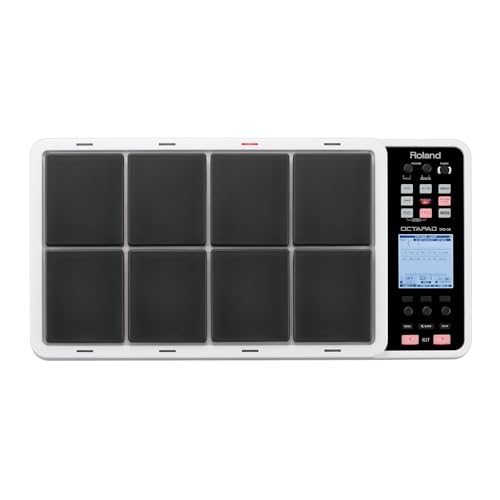
Best Road-Ready Option – Roland OCTAPAD SPD-30
The Roland OCTAPAD SPD-30 is built for dependable stage use, making it a practical contender among drum pads for live performances. Its rugged design, illuminated controls, accurate triggering, and expansion inputs suit players who need a focused electronic percussion setup.
Best For: Gigging drummers who prioritize durable construction, clear low-light operation, and the ability to add external pads or acoustic triggers.
Pros:
- Rugged, road-worthy design for regular transport and performance.
- Backlit LCD and pad indicator lights improve visibility in low-light settings.
- Four dual-trigger inputs plus hi-hat controller support expansion.
- Phrase Loop records playing in real time and allows up to three overdub layers.
Cons:
- The supplied notes do not indicate included components.
- Its plastic body may feel less substantial than a metal-bodied alternative.
The SPD-30 is a strong fit when reliable triggering and expansion matter more than an especially broad production feature set. Its looping function also gives live players a way to build layered percussion parts onstage.
Best Sound Library – Yamaha DTX Multi Pad
The Yamaha DTX Multi Pad offers a large built-in sound palette and external-trigger support for players comparing drum pads for live performances. With percussion, effects, keyboard sounds, sequencing, and preset loops, it can cover more than conventional drum duties.
Best For: Performers who want extensive onboard sounds, layered parts, sequencing, and connections for additional pads or controllers.
Pros:
- Includes 1,061 drum, percussion, and effects sounds plus 216 keyboard sounds.
- Mute and layer functions support flexible sound combinations.
- Sequencer and preset loops can add structure to a live performance.
- Trigger inputs for five external pads, plus footswitch and hi-hat controller connections.
Cons:
- Its 64MB Flash-ROM provides less user-sample storage than some larger-storage alternatives.
- The supplied notes do not specify onboard looping or a display.
The DTX Multi Pad stands out for sound variety and expansion potential. It is worth considering when your live rig needs percussion, effects, keyboard tones, and external triggers from a single instrument.
Best Practice-Focused Pick – Vic Firth Heavy Hitter Quadropad
The Vic Firth Heavy Hitter Quadropad is a practice-focused alternative to electronic drum pads for live performances. Its realistic response, integrated rims, and configurable spock-drum design help marching percussionists prepare technique away from a full drum setup.
Best For: Marching percussionists working on warm-ups, rehearsals, rimshots, stick placement, articulation, and multi-drum configurations.
Pros:
- Designed to provide realistic response and feedback for daily practice.
- Integrated rims support rimshot technique and natural stick placement.
- Spock drum design allows practice of five- and six-drum configurations on one pad.
- Included laminates let players create a firmer surface for precision and stick control.
Cons:
- This is an acoustic practice pad, not an electronic sound-generating performance instrument.
- At 43.1 inches long and 13.6 pounds, it is less compact than many electronic pads.
- The supplied warranty description is limited to 30 days.
While it cannot trigger sounds or loops, the Quadropad can be valuable preparation for live performance. Choose it for physical technique and rehearsal realism rather than electronic playback features.
Feature-Rich Live Rig – HXW PD708 Sample Pad
For drummers seeking drum pads for live performances, the HXW PD708 combines extensive built-in sounds, sample storage, effects, and visual customization in a compact multipad. Its sensitivity, crosstalk protection, and expansion inputs make it suitable for setups that may grow over time.
Best For: Live performers who need extensive sampling, onboard sounds, customizable LEDs, and expansion options.
Pros:
- Includes 1,000 built-in sounds, 30 ready-to-play kits, and 32GB of internal storage.
- Supports wireless sampling through Bluetooth 5.0 and includes MIDI, USB, audio, and trigger connections.
- Offers four effect processors, 24 effects, customizable LEDs, and multiple expansion inputs.
- Five timbre layers and crosstalk protection support detailed, responsive playing.
Cons:
- Its broad feature set may require more setup time than a simpler sample pad.
- Firmware updating is recommended through the manufacturer’s website.
The PD708 is the most expandable and feature-heavy option here, particularly appealing to performers who want wireless sampling and a large internal sound library. Its 7.19-pound weight is still manageable for a compact live rig.
Marching Setup Choice – Ahead CHAVEZ Tenor Pad
The Ahead CHAVEZ Tenor Pad is a specialized option for players looking for drum pads for live performances in marching-style configurations. Rather than functioning as a sampling multipad, it is designed around four-, five-, or six-pad arrangements.
Best For: Marching percussionists using a four-, five-, or six-pad tenor configuration.
Pros:
- Designed specifically for 4, 5, or 6 pad configurations.
- Uses rubber and silicone materials for the pad construction.
Cons:
- The supplied notes do not list built-in sounds, sampling, MIDI, or electronic connectivity.
- At 47 inches long and 12 pounds, it is less compact than the electronic sample pads in this roundup.
The CHAVEZ Tenor Pad is best considered a dedicated tenor-pad solution rather than a general-purpose electronic performance sampler. Its value depends on whether your live setup specifically calls for a multi-pad marching configuration.
Compact Performance Expander – Alesis SamplePad 4
The Alesis SamplePad 4 offers a straightforward way to add electronic sounds to a live setup. For drum pads for live performances, its four velocity-sensitive pads, SD card support, and MIDI output provide useful performance flexibility without the larger footprint of a full multipad.
Best For: Drummers who want a compact sample pad with expandable sounds and basic MIDI control.
Pros:
- Four velocity-sensitive pads support expressive playing.
- Accepts user samples through a standard SD/SDHC card slot.
- Includes 25 built-in sounds across eight ready-to-play kits.
- Provides a dual trigger input, MIDI output, and adjustable tuning and reverb.
Cons:
- Its four-pad layout offers less playing surface than larger multipads.
- The supplied notes specify MIDI output, but do not list MIDI input or onboard internal storage.
Weighing 2.6 pounds and measuring 7.5 by 10.25 by 2.5 inches, the SamplePad 4 is the most portable electronic choice in this group. It suits performers who prioritize simple sample expansion and easy transport.
Compact Mesh Versatility – Roland PDX-100
For drummers building drum pads for live performances, the Roland PDX-100 offers a lightweight 10-inch mesh playing surface in a compact V-Pad design. Its dual-trigger setup and dual-mounting capability make it adaptable as either a snare or floor tom pad in compatible V-Drums configurations.
Best For: V-Drums players who need a compact, position-flexible snare or floor tom pad.
Pros:
- Lightweight 10-inch tensionable mesh head.
- Advanced dual-trigger sensor with a metal rim hoop.
- Dual-mounting capability supports flexible setup positioning.
- Compact casing works well for snare or floor tom applications.
Cons:
- Designed specifically for compatible V-Drums setups.
- Included components are not specified beyond the pad itself.
The PDX-100 is a practical choice when stage space and placement flexibility matter. Its mesh head, rim triggering, and compact construction provide useful live-performance versatility without adding much weight.
Quiet Three-Zone Control – Yamaha XP80
The Yamaha XP80 is a strong option for drum pads for live performances when expressive rim control and a realistic playing feel are priorities. Its three-zone design supports open and closed rimshots, while the textured silicone surface and free-floating construction are designed for sensitivity and low crosstalk.
Best For: Drummers seeking detailed three-zone triggering and a quiet, realistic-feeling electronic pad.
Pros:
- Three zones support open and closed rimshots.
- Textured cellular silicone provides a realistic feel.
- Free-floating construction improves sensitivity and helps reduce crosstalk.
- Quiet operation is suitable for home practice and controlled performance environments.
Cons:
- At 8 inches, it offers less surface area than larger pads.
- Compatibility with a specific Yamaha electronic drum system should be verified.
Choose the XP80 if rim articulation is central to your playing style. Its three-zone triggering and quiet silicone surface make it especially useful for players who want nuanced control without excessive acoustic or mechanical noise.
Stage-Ready Tom Feel – Roland PDA100L-BK
For drum pads for live performances, the Roland PDA100L-BK combines a compact 10-inch tom format with a wood shell and adjustable double-ply mesh head. Independent head and rim triggers support dual-zone playing, while the included tom bracket is intended for standard acoustic tom holders.
Best For: Performers who want a compact electronic tom with acoustic-style mounting and adjustable mesh rebound.
Pros:
- 10-inch by 4-inch dual-zone tom pad with independent head and rim triggers.
- Adjustable double-ply mesh head lets players customize rebound and feel.
- Shallow wood-shell design saves space while maintaining performance features.
- Tom bracket and mounting rod are included for standard acoustic tom-holder mounting.
Cons:
- Its compact 4-inch shell may provide less physical depth than a conventional acoustic tom.
- Mounting compatibility still depends on the available holder and 9–13 mm mounting rod range.
The PDA100L-BK suits players who want an electronic tom that integrates naturally into an acoustic-style setup. Its wood shell, mesh-head adjustment, and included mounting hardware make it a focused option for compact live rigs.
How We Picked the Best Drum Pads for Live Performances
We focused on the features that matter most onstage: trigger response, playable surface design, sound access, editing flexibility, connectivity, portability, and overall suitability for live workflows. The selection includes standalone multipads with built-in sounds, sample-focused units, add-on electronic drum pads, and acoustic-style practice pads for players who need realistic rebound or compact percussion support.
Because performance needs vary, we did not treat the most expensive or feature-rich model as automatically best. A compact pad may be a better choice for a drummer adding one electronic voice, while a multipad can replace several pieces of hardware in a more demanding rig.
Quick Comparison
- Best for broad live control: Full multipads such as the Alesis Strike Multipad, Roland OCTAPAD SPD-30, and Yamaha DTX Multi Pad.
- Best for sample playback: Sample-focused options such as the PD708 and Alesis Sample Pad 4.
- Best for expanding an electronic kit: Roland and Yamaha V-Drum-style pads with dedicated triggering behavior.
- Best for practice and acoustic-style playing: The Vic Firth Heavy Hitter Quadropad and Ahead CHAVEZ Tenor Pad.
Key Buying Factors for Drum Pads for Live Performances
Triggering and Playing Feel
Responsive triggering is essential when parts are rhythmically exposed. Look for pads with suitable sensitivity, multiple zones, rim triggering, or textured surfaces if you need expressive dynamics. A practice pad should provide rebound and durability rather than electronic features, while an electronic pad should respond consistently at different playing intensities.
Sounds, Samples, and Editing
Built-in sounds are convenient, but sample support and editing determine how easily a pad fits your setlist. Check the available memory, storage, loading method, effects, layering options, and whether you can organize sounds into performance-ready kits. More onboard sounds are not always better if navigation is slow during a show.
Connections and Stage Integration
Review audio outputs, MIDI, USB, trigger inputs, headphone connections, and any footswitch or external-control options. Multiple outputs can simplify mixing, while MIDI and USB are useful when the pad must control software, a module, or external instruments. Also confirm power requirements and cable placement before committing to a crowded stage setup.
Portability and Reliability
Touring players should consider weight, mounting options, screen visibility, protective cases, and how quickly the unit can be set up. A pad that offers fewer features but survives transport and is easy to operate may be the smarter live choice.
Who Should Buy Which Drum Pads for Live Performances?
Choose a full multipad if you need several sounds, samples, effects, and playing zones from one station. Select a sample pad if your main goal is launching custom hits, loops, or backing elements. Add a dedicated electronic drum pad when you already own a module and want another tom, cymbal, or percussion voice.
For acoustic drummers building technique or marching players seeking a focused practice surface, a non-electronic quad or tenor pad is more appropriate. Before buying, match the pad to your sound system, mounting hardware, and performance method so it solves a real stage problem rather than adding unnecessary complexity.