Small flowers reveal remarkable detail when you move beyond a lens’s standard minimum focusing distance. Extension tubes offer an affordable way to increase magnification without adding extra glass between your lens and subject.
This roundup compares 10 options for Canon, Nikon, Sony, Fujifilm, and Micro Four Thirds systems, with attention to mount compatibility, electronic communication, focusing support, and practical field use.
Best 10 Camera Extension Tubes for Flower Photography Picks for 2026
Best for Canon EF/EF-S Versatility
Fotodiox Macro Extension Tube Set

- Multiple tube combinations
- All-metal construction
- Canon EF/EF-S compatible
Best For: Manual-control flower macro photography with Canon EOS cameras
Best for Lightweight M4/3 Kits
MCOPlus Automatic Extension Tube Set

- Three tube lengths
- Autofocus support
- Lightweight Micro Four Thirds design
Best For: Portable Olympus and Panasonic flower close-ups
Best for Canon Electronic Communication

- Eight electronic contacts
- Shortens focusing distance
- Includes pouch and caps
Best For: Canon EF users wanting a branded single-tube setup
Best for Sony E-Mount Flexibility
Meike Auto Focus Macro Tube Set

- 10mm and 16mm tubes
- Supports autofocus
- Works with APS-C and full-frame Sony cameras
Best For: Portable Sony flower and small-subject macro photography
Best Canon EF/EF-S Pick
Movo/Kooka AF 25mm Extension Tube

- 25mm tube for closer focusing
- Autofocus and metering passthrough
- Compatible with Canon EF and EF-S
Best For: Canon EOS users wanting automatic operation
Best Fujifilm X-Mount Set

- 10mm and 16mm tubes
- Combine for 26mm extension
- Compact Fujifilm X-Mount design
Best For: Fujifilm mirrorless users wanting adjustable magnification
Best Nikon F Value Set
Fotodiox Macro Extension Tubes

- 7mm, 14mm, and 28mm sections
- Combine tubes for varied magnification
- No optical insert preserves lens quality
Best For: Nikon F users comfortable with manual focus
Flexible Canon Macro Kit
VILTROX DG-C Auto Focus Extension Tubes

- 12mm, 20mm, and 36mm tubes
- Autofocus and auto exposure support
- Individual or combined tube use
Best For: Canon EF/EF-S photographers wanting flexible flower close-ups
Manual Nikon Macro Value
FocusFoto F-Mount Extension Tube Set

- 7mm, 14mm, and 28mm tubes
- Metal construction
- Manual focus and exposure required
Best For: Nikon F-mount users comfortable with fully manual shooting
Canon Autofocus Starter Set
JJC EF/EF-S Macro Extension Tubes
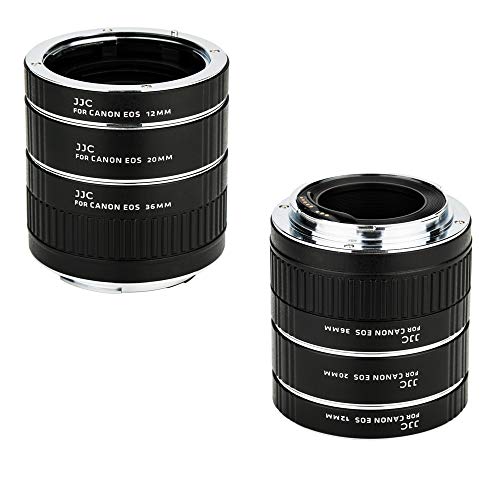
- 12mm, 20mm, and 36mm tubes
- Autofocus and auto exposure support
- Brass mounts with ABS tube construction
Best For: Canon EOS DSLR users exploring flower macro photography
Best for Canon EF/EF-S Versatility – Fotodiox Macro Extension Tube Set
For Canon photographers comparing camera extension tubes for flower photography, this Fotodiox set offers multiple combinations for adjusting magnification and working distance. Its all-metal construction is designed for repeated macro use, while the manual-focus design suits deliberate close-up compositions.
Best For: Canon EOS users who want flexible, manual-control flower macro setups.
Pros:
- Compatible with Canon EF and EF-S mounts.
- Multiple combinations allow different macro effects.
- All-metal construction.
- Designed not to alter optical quality.
Cons:
- Manual focus and manual exposure control require more hands-on adjustment.
- Not water resistant.
This is a practical choice when durability and configuration flexibility matter more than automated focusing. Confirm your Canon lens and camera compatibility before ordering.
Best for Lightweight M4/3 Kits – MCOPlus Automatic Extension Tube Set
Mcoplus EXT-M4/3-M Automatic Extension Tube for Olympus Panasonic Micro 4/3 System Camera(10 16 21)
Check Price On AmazonThis automatic three-piece set is a convenient option for Olympus and Panasonic users shopping for camera extension tubes for flower photography. The 10mm, 16mm, and 21mm tubes provide different working configurations, and the lightweight design is easy to carry into the garden or field.
Best For: Micro Four Thirds photographers who want automatic exposure and autofocus support in a portable kit.
Pros:
- Compatible with Olympus and Panasonic Micro Four Thirds cameras.
- Includes 10mm, 16mm, and 21mm tube lengths.
- Supports autofocus and automatic exposure control.
- Lightweight individual tubes.
Cons:
- Not water resistant.
- Requires care when dismounting the tube and lens.
With three lengths and automatic operation, this set is well suited to photographers who want a simpler path to close-ups. Its Micro Four Thirds mount limits it to compatible Olympus and Panasonic systems.
Best for Canon Electronic Communication – Canon EF 12 II Extension Tube
The Canon EF 12 II is a straightforward choice for Canon EOS owners seeking camera extension tubes for flower photography. It shortens the lens’s focusing distance for higher-magnification work and retains continuous camera-lens communication through its eight electronic contacts.
Best For: Canon EF users who prefer a branded single-tube solution with electronic communication.
Pros:
- Compatible with Canon EOS cameras using the EF mount.
- Eight electronic contacts maintain camera-lens communication.
- Shortens focusing distance for close-up photography.
- Includes caps, pouch, and limited one-year warranty.
Cons:
- Not compatible with several lenses, including the 15mm f/2.8 fisheye, 14mm f/2.8L, and MP-E 65mm f/2.8.
- Single 12mm tube offers less configuration flexibility than multi-tube sets.
- Manual exposure control is listed.
This tube makes sense for Canon users who value system integration and a compact accessory rather than multiple extension lengths. Check the specific lens exclusions carefully before purchase.
Best for Sony E-Mount Flexibility – Meike Auto Focus Macro Tube Set
Sony mirrorless photographers can use this Meike set to explore camera extension tubes for flower photography with two interchangeable lengths. The 10mm and 16mm tubes work individually or together, and autofocus support makes it easier to frame small subjects before fine-tuning exposure manually.
Best For: Sony E/FE photographers who want portable, adjustable magnification for flowers and other small subjects.
Pros:
- Compatible with Sony E-mount APS-C and full-frame cameras.
- 10mm and 16mm tubes can be used separately or stacked.
- Supports autofocus and all shooting modes.
- Metal bayonet and compact, portable construction.
Cons:
- Exposure compensation is required, and manual mode is recommended for direct shutter-speed control.
- No image stabilization.
- Not water resistant.
The two-length design gives Sony users useful control over magnification without carrying a large accessory kit. It is best for photographers comfortable managing exposure compensation during close-up work.
Best Canon EF/EF-S Pick – Movo/Kooka AF 25mm Extension Tube
For Canon users looking at camera extension tubes for flower photography, this 25mm Movo/Kooka tube adds closer-focusing capability without adding a new optical lens. Its automatic focusing and metering passthrough make it a straightforward option for EOS DSLR close-ups.
Best For: Canon EOS photographers who want a simple 25mm tube with autofocus and automatic exposure support.
Pros:
- Compatible with Canon EF and EF-S mounts.
- Maintains autofocus and automatic exposure functionality.
- Provides closer focusing for macro-style flower images.
- Includes a one-year warranty.
Cons:
- Designed for Canon EOS cameras, so it is not a universal option.
- Its economy plastic mount may feel less substantial than a premium metal mount.
The 25mm length offers a focused, uncomplicated way to explore flower photography at closer distances. It is especially appealing when retaining autofocus is more important than having a multi-piece tube set.
Best Fujifilm X-Mount Set – Meike MK F AF3 Macro Tubes
This Meike set is a flexible choice among camera extension tubes for flower photography with Fujifilm mirrorless cameras. The 10mm and 16mm tubes can be used individually or combined into 26mm, letting you adjust magnification and working distance for different subjects.
Best For: Fujifilm X-Mount photographers who want adjustable extension lengths in a compact, lightweight set.
Pros:
- Designed for Fujifilm X-Mount cameras and lenses.
- Offers 10mm, 16mm, or combined 26mm extension.
- Supports all camera shooting modes, with exposure compensation as needed.
- Compact and lightweight at about 3.52 ounces.
Cons:
- Manual mode is recommended for direct shutter-speed control.
- The lens focal length should be greater than the selected tube length.
- Exposure compensation may be required.
Its modular design makes it easier to tailor magnification for flowers of different sizes. The set is particularly practical for photographers comfortable making exposure adjustments while working close to the subject.
Best Nikon F Value Set – Fotodiox Macro Extension Tubes
For Nikon F photographers seeking camera extension tubes for flower photography, this Fotodiox set provides three extension lengths without adding optical elements. The 7mm, 14mm, and 28mm sections can be combined in different ways to vary reproduction ratios and achieve closer focus.
Best For: Nikon F users who want an economical, manual-focus tube set for experimenting with different close-up magnifications.
Pros:
- Compatible with Nikon F-mount cameras.
- Includes 7mm, 14mm, and 28mm sections for flexible combinations.
- No optical insert, preserving the lens’s optical quality.
- Backed by a limited two-year manufacturer warranty.
Cons:
- Uses manual focus.
- Tube combinations require hands-on setup for different reproduction ratios.
- Not water resistant.
This set is a strong fit for Nikon photographers who value flexibility and low cost over automated focusing. Its multiple sections allow more experimentation than a single fixed-length tube.
Flexible Canon Macro Kit – VILTROX DG-C Auto Focus Extension Tubes
For Canon DSLR users comparing camera extension tubes for flower photography, the VILTROX DG-C set offers three tube lengths and preserves electronic communication between the camera and lens. That makes it a flexible option for creating close-up compositions without buying a dedicated macro lens.
Best For: Canon EF or EF-S users who want adjustable magnification with autofocus and automatic exposure support.
Pros:
- Includes 12mm, 20mm, and 36mm tubes for different magnification levels.
- Tubes can be used individually or combined.
- Maintains autofocus and automatic exposure functions.
- Uses precision-engineered metal mounts and electronic contacts.
Cons:
- Compatible with Canon EF and EF-S mounts only.
- Does not include image stabilization.
Its broad Canon DSLR compatibility and electronic features make this a strong all-purpose choice for photographing flowers at varying working distances. The three-piece configuration also gives you room to experiment with magnification.
Manual Nikon Macro Value – FocusFoto F-Mount Extension Tube Set
For Nikon photographers seeking camera extension tubes for flower photography, the FocusFoto set provides three lengths for adjusting close-focus range. Its all-metal construction offers a straightforward, budget-conscious approach, but the lack of electrical contacts means you must work with manual focus and exposure.
Best For: Nikon F-mount users who are comfortable setting focus, exposure, and aperture manually.
Pros:
- Includes 7mm, 14mm, and 28mm tubes.
- Can be used individually or in combinations.
- Metal construction and broad Nikon F-mount DSLR compatibility.
- Works with a normal lens for close-up photography.
Cons:
- No electrical contacts, autofocus, or automatic exposure.
- Aperture control is unavailable with lenses lacking a manual aperture ring.
- Requires manual exposure adjustment.
This set is best suited to deliberate, tripod-based flower photography where manual control is acceptable. Before buying, confirm that your Nikon lens supports the aperture adjustments you need.
Canon Autofocus Starter Set – JJC EF/EF-S Macro Extension Tubes
The JJC EF/EF-S set is a practical choice for Canon users researching camera extension tubes for flower photography. Its 12mm, 20mm, and 36mm tubes shorten a lens’s minimum focusing distance, while electronic compatibility supports autofocus and automatic exposure.
Best For: Canon EOS DSLR photographers who want a cost-conscious way to explore flower close-ups with EF or EF-S lenses.
Pros:
- Includes 12mm, 20mm, and 36mm extension tubes.
- Supports autofocus and automatic exposure compatibility.
- Tubes can be used separately or combined.
- Brass camera and lens mounts are paired with an ABS plastic tube.
Cons:
- Designed for Canon EF and EF-S systems only.
- The manufacturer recommends manual focus or a tripod with a focusing rail for best results.
With three selectable lengths and electronic support, this JJC set offers useful flexibility for experimenting with different flower compositions. Manual focusing may still be preferable when precise placement matters.
How We Picked the Best Camera Extension Tubes for Flower Photography
We focused on extension tubes that match common interchangeable-lens systems and support close-up work with flowers, leaves, and other small subjects. Compatibility was the first filter: an extension tube must match both the camera mount and the lens mount. We also considered whether each set provides autofocus and electronic metering passthrough, the available tube lengths, and whether the design is suited to DSLR or mirrorless use.
Manual tubes can be excellent value, but electronic contacts are often more convenient outdoors, where changing light and moving subjects make exposure adjustments less predictable. Sets with multiple lengths also offer more flexibility because greater extension generally produces higher magnification, though it reduces the focusing range.
Quick Comparison
| Feature | What to look for | Why it matters |
|---|---|---|
| Mount | Exact camera and lens compatibility | Prevents fit and communication problems |
| Electronic contacts | AF and metering passthrough | Preserves more camera functions |
| Tube length | Single or multiple sections | Controls magnification and working distance |
| Build | Secure bayonet and light-blocking finish | Improves stability and image consistency |
Key Buying Factors for Camera Extension Tubes for Flower Photography
Choose the Correct Mount
Check the exact mount designation rather than relying only on the camera brand. Canon EF and EF-S, Nikon F, Sony E, Fujifilm X, and Micro Four Thirds accessories are not interchangeable. For DSLR systems, confirm that the tube accommodates the lens type you plan to use, particularly when working with EF-S or other lenses designed for smaller sensors.
Decide Between Manual and Automatic Tubes
Automatic tubes with electronic contacts can retain autofocus, aperture control, and metering. Autofocus may be less reliable at extreme magnification, but electronic aperture control remains useful. Manual tubes are simpler and often cheaper; they work best when you are comfortable setting aperture and focusing by moving the camera.
Match Extension to Your Subjects
Longer extension gives more magnification but can leave you with a very short working distance and a narrower focusing range. For larger blossoms, a shorter tube may be easier to use. Multiple sections let you adjust the setup for different flowers and lenses.
Consider Stability and Lighting
Close-up photography magnifies camera shake, so a sturdy mount, fast shutter speed, tripod, or focusing rail can help. Extension tubes also reduce the light reaching the sensor in practical use. A reflector, diffuser, or close-up-friendly LED or flash setup can make fine details easier to capture without harsh highlights.
Who Should Buy Which Camera Extension Tubes for Flower Photography?
Choose an automatic set if you want the easiest transition from ordinary shooting to close-up flower photography or regularly use aperture-priority modes. A Canon, Nikon, Sony, Fujifilm, or Micro Four Thirds-specific electronic set is the safest choice when maintaining camera-lens communication matters.
Choose a manual set if you want the lowest-cost route to experimenting with macro magnification and do not mind manual exposure. A multi-piece set is best for photographers who use several lenses or want to vary magnification, while a single tube suits anyone seeking a straightforward, repeatable setup. Before ordering, verify both mounts, supported lens types, and the exact tube lengths included.