Changing camera systems does not always mean replacing your entire lens collection. The right autofocus camera lens adapter can preserve access to compatible lenses while maintaining features such as autofocus, aperture control, vibration reduction, and EXIF communication.
This roundup covers options for Nikon F, Canon EF and EF-S, Four Thirds, Micro Four Thirds, Sony E, Nikon Z, Canon RF, and Canon EF-M users. Check mount compatibility carefully before buying, because adapter performance depends on both the lens and camera body.
Best 10 Autofocus Camera Lens Adapters Picks for 2026
Best Nikon F-to-Sony E Adapter

- Autofocus support for compatible Sony bodies
- Aperture and EXIF transmission
- Supports lens or camera stabilization
Best For: Sony users adapting Nikon F lenses
Best Native Nikon Upgrade Adapter

- Full AF/AE with specified F-mount lenses
- Retains weather sealing and image quality
- Designed for Nikon Z cameras
Best For: Nikon Z users with compatible F-mount lenses
Best Sony E-to-Nikon Z Adapter
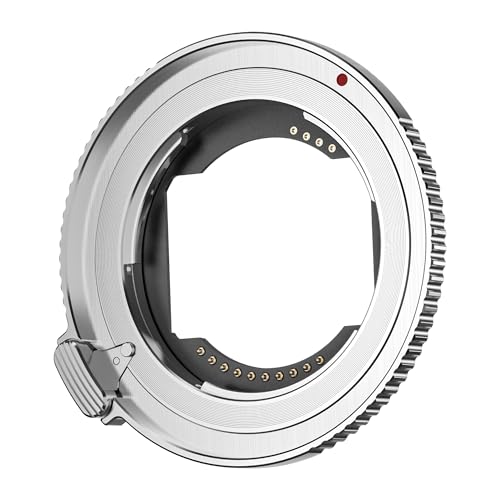
- Autofocus support through electronic contacts
- Fits listed Nikon Z mirrorless cameras
- Precision alignment without optical elements
Best For: Nikon Z users adapting Sony E lenses
Balanced EOS R Upgrade
K&F Concept EF to EOS R Adapter

- Autofocus and aperture control
- Image stabilization and EXIF transmission
- Lightweight 40 g construction
Best For: Canon EOS R users adapting EF and EF-S lenses
Compact EOS M Option

- Supports EF and EF-S lenses on EOS M
- Autofocus and aperture adjustment
- Lightweight 50 g design
Best For: Canon EOS M owners expanding lens choices
Rugged Metal Build

- Broad EOS R and RED Komodo compatibility
- Autofocus and automatic exposure support
- Metal body with gold-plated contacts
Best For: Users wanting a durable, feature-rich EF-to-EOS R adapter
Best MFT Autofocus Adapter

- Autofocus and electronic aperture control
- EXIF data transmission
- USB firmware upgrade support
Best For: Olympus and Panasonic MFT users adapting Canon EF/EF-S lenses
Best Canon EOS-M Adapter

- Autofocus and aperture control
- EXIF transmission via electronic contacts
- Detachable tripod support
Best For: Canon EOS-M users adapting EF/EF-S lenses
Best Canon RF Autofocus Adapter

- Broad EOS R-series compatibility
- Autofocus, stabilization, and EXIF support
- Full-metal body with tripod mount
Best For: Canon EOS R-series users adapting EF/EF-S lenses
Best Nikon F-to-Sony E Adapter – VILTROX NF-E1
If you want to keep using Nikon F lenses on a Sony E-mount body, the VILTROX NF-E1 is a practical choice among autofocus camera lens adapters. It supports autofocus on listed Sony models in Phase Detection Focus mode, provides aperture control, and transmits EXIF information.
Best For: Sony shooters adapting Nikon F lenses while retaining selected electronic features.
Pros:
- Supports autofocus on compatible Sony cameras in Phase Detection Focus mode
- Transmits aperture, shutter speed, and exposure information through EXIF
- Supports lens VR and camera-body stabilization options
- Firmware updates are available through USB
Cons:
- Compatibility is limited to the listed Sony camera models and supported Nikon lenses
- Autofocus operation requires Phase Detection Focus mode on supported cameras
The NF-E1 offers a compact way to expand a Sony E-mount kit with Nikon F glass. Its electronic communication and VR support make it more versatile than a basic mechanical adapter, provided your camera and lens combination is supported.
Best Native Nikon Upgrade Adapter – Nikon FTZ II
The Nikon FTZ II is designed for photographers moving from Nikon F-mount lenses to Nikon Z-mount mirrorless cameras. Among autofocus camera lens adapters, it stands out for retaining image quality, autofocus performance, automatic exposure, and weather sealing with compatible lenses.
Best For: Nikon Z users who want to continue using compatible F-mount lenses with strong electronic integration.
Pros:
- Supports full AF and AE with specified AF-S, AF-P, and AF-I lenses
- Designed to retain image quality and autofocus performance
- Maintains weather sealing and comfortable handling
- Works with Nikon Z-mount cameras
Cons:
- Full AF/AE support depends on the specific lens type
- Does not provide image stabilization itself
The FTZ II is the straightforward choice for Nikon owners who want a manufacturer-made bridge between F and Z systems. Check your lens designation before buying, since electronic feature support varies by lens family.
Best Budget Four Thirds Adapter – Hersmay 4/3 to Micro 4/3
The Hersmay electronic adapter connects Four Thirds lenses to selected Olympus PEN, OM-D, and Panasonic Lumix Micro Four Thirds cameras. It is a useful option among autofocus camera lens adapters for photographers who want electronic communication and autofocus with existing Four Thirds lenses.
Best For: Olympus and Panasonic Micro Four Thirds users adapting original Four Thirds system lenses.
Pros:
- Designed for Four Thirds lenses and Micro Four Thirds cameras
- Electronic contacts permit autofocus and signal transmission
- Supports numerous Olympus PEN and Panasonic Lumix models
- Uses a bronze bayonet mount for secure attachment
Cons:
- No image stabilization is provided by the adapter
- Compatibility is focused on the listed Olympus and Panasonic systems
- The body is plastic
This adapter can help extend the life of an existing Four Thirds lens collection without giving up electronic focus communication. Verify both the camera model and lens system before purchasing, especially if stabilization is important to your setup.
Best Sony E-to-Nikon Z Adapter – VILTROX E-Z
The VILTROX E-Z lets Nikon Z-mount mirrorless camera owners use Sony E-mount lenses. As autofocus camera lens adapters go, it focuses on electronic communication, autofocus support, and precise alignment for compatible Nikon Z bodies such as the Z5, Z50, Z6 series, Z7 series, and Zfc.
Best For: Nikon Z photographers expanding their lens choices with compatible Sony E-mount lenses.
Pros:
- Supports listed Nikon Z cameras, including the Z5, Z50, Z6, Z7, and Zfc
- Electronic contacts maintain lens-to-camera communication
- Designed to preserve the connected lens’s original image quality
- Precision alignment supports secure mounting
Cons:
- Does not provide weather resistance
- Compatibility should be confirmed for each Sony E lens and Nikon Z body
- It is an adapter rather than a lens and adds no optical elements
The E-Z is a useful system-expansion tool for Nikon Z owners with access to Sony E glass. Its electronic contacts make it more capable than a purely mechanical adapter, but careful compatibility checking remains important.
Balanced EOS R Upgrade – K&F Concept EF to EOS R Adapter
For photographers comparing autofocus camera lens adapters, the K&F Concept EF-EOS R is a lightweight option for using Canon EF and EF-S lenses on EOS R cameras. It supports autofocus, aperture control, image stabilization, and EXIF communication through electronic contacts.
Best For: Canon EOS R users who want a compact adapter for retaining autofocus and lens communication with EF or EF-S lenses.
Pros:
- Supports autofocus, aperture control, and EXIF signal transmission.
- Maintains image stabilization for steadier low-light images.
- Compatible with a broad selection of Canon EOS R cameras and EF/EF-S lenses.
- Lightweight 40 g design with a 1/4-inch tripod-thread hole.
Cons:
- Not water resistant.
- Compatibility is focused on Canon EF/EF-S lenses and EOS R cameras.
This adapter is a practical choice when portability and electronic lens support matter. Its broad EOS R compatibility and built-in stabilization support make it a versatile everyday option.
Compact EOS M Option – VILTROX EF-EOS M AF Adapter
Among autofocus camera lens adapters for Canon EOS M bodies, the VILTROX EF-EOS M provides access to Canon EF and EF-S lenses while preserving key electronic functions. It supports autofocus, aperture adjustment, image stabilization, and automatic exposure control in a compact form.
Best For: EOS M owners who want to use an existing collection of Canon EF or EF-S lenses for travel, everyday shooting, or creative experimentation.
Pros:
- Connects EOS M cameras with Canon EF and EF-S lenses.
- Supports autofocus, aperture adjustment, and automatic exposure functions.
- Retains image stabilization support.
- Small, lightweight 50 g design with a removable tripod mount.
Cons:
- Designed for Canon EF-M mount camera models rather than EOS R bodies.
- Not water resistant.
The VILTROX is a sensible system-expansion adapter for EOS M users. Its lightweight build and support for major lens functions make it convenient for carrying a larger EF/EF-S lens selection.
Rugged Metal Build – Meike EF-EOS R AF Adapter
The Meike EF-EOSR is one of the autofocus camera lens adapters aimed at photographers moving Canon EF or EF-S lenses to EOS R cameras. Its electronic contacts support autofocus, auto-exposure, automatic diaphragm, auto-aperture, and image stabilization functions.
Best For: EOS R-series, C70, and RED Komodo users seeking a metal-bodied adapter with broad camera compatibility and full electronic lens support.
Pros:
- Supports EF/EF-S lenses on EOS-R, EOS-RP, R5, R6, R7, R10, C70, and RED Komodo cameras.
- Enables autofocus, auto-exposure, automatic diaphragm, and auto-aperture functions.
- Built-in image stabilization support can improve focus accuracy and clarity.
- Metal construction, gold-plated pins, and dust-proof and waterproof structure.
Cons:
- Heavier than the other listed adapters at 130 g.
- The supplied specifications also list it as not water resistant.
This Meike adapter stands out for its durable metal construction and extensive stated compatibility. It is a strong fit for users who prioritize a substantial build and broad electronic functionality over minimum weight.
Best MFT Autofocus Adapter – VILTROX EF-M1
The VILTROX EF-M1 is a practical choice for photographers searching for autofocus camera lens adapters to use Canon EF or EF-S lenses on Micro Four Thirds cameras. It supports autofocus, electronic aperture control, and EXIF data transmission for compatible Olympus and Panasonic bodies.
Best For: Olympus and Panasonic MFT users adapting Canon EF/EF-S lenses while retaining electronic camera communication.
Pros:
- Supports autofocus with a focusing speed described as close to the original lens.
- Transmits aperture, shutter, ISO, and other EXIF information.
- Offers electronic aperture control and USB firmware upgrades.
- Includes a durable aluminum-alloy design and 1/4-inch tripod thread.
Cons:
- Does not provide optical image stabilization.
- Compatibility is intended for Micro Four Thirds cameras and Canon EF/EF-S lenses.
Choose the EF-M1 if maintaining autofocus and electronic lens communication matters more than built-in stabilization. Its firmware-upgrade capability also gives it added flexibility for future compatibility updates.
Best Canon EOS-M Adapter – EBYPHAN EF-EOS M
The EBYPHAN EF-EOS M is designed for Canon EOS-M owners who need autofocus camera lens adapters for EF and EF-S lenses. It combines autofocus, aperture control, EXIF transmission, and image-stabilization support in a metal adapter with a detachable tripod base.
Best For: Canon EOS-M users adapting EF or EF-S lenses for still photography and supported electronic lens functions.
Pros:
- Supports fast autofocus and direct aperture control from the camera.
- Transmits shutter, aperture, and ISO information through gold-plated contacts.
- Includes built-in image-stabilizer support.
- Detachable tripod support adds mounting flexibility.
Cons:
- Designed specifically for Canon EOS-M cameras rather than newer RF bodies.
- Image-stabilization performance depends on compatible lens and camera functions.
This adapter is a good fit for EOS-M owners with an existing EF/EF-S lens collection. Its electronic features make it more useful than a basic mechanical ring, especially when tripod mounting is part of your setup.
Best Canon RF Autofocus Adapter – SNIPIZ EF-EOS R
The SNIPIZ EF-EOS R helps Canon RF-mount users continue using EF and EF-S lenses, making it a useful option among autofocus camera lens adapters. It is specified for a broad range of EOS R-series cameras and supports autofocus, image stabilization, aperture control, and EXIF transmission.
Best For: Canon EOS R-series photographers transitioning from EF/EF-S lenses to mirrorless RF-mount bodies.
Pros:
- Compatible with numerous EOS R-series cameras, including the R5, R6 Mark II, R7, R8, R10, R50, and R100.
- Maintains autofocus, image stabilization, aperture control, and EXIF transmission with compatible lenses.
- Uses gold-plated copper contacts for signal transmission.
- Full-metal construction includes a removable tripod mount.
Cons:
- Designed for Canon RF-mount cameras and EF/EF-S lenses only.
- Image-stabilization functionality depends on the attached lens and compatible camera features.
Consider the EF-EOS R if you want to extend an existing EF/EF-S collection onto a Canon EOS R body without giving up key electronic functions. Its broad listed compatibility and sturdy construction make it especially practical for mixed lens systems.
How We Picked These Autofocus Camera Lens Adapters
We selected adapters based on mount compatibility, electronic communication, advertised autofocus support, aperture control, EXIF transmission, stabilization compatibility, and the range of cameras and lenses each model is designed to support. We also considered construction, brand reputation, and whether the adapter is intended for everyday photography or more specialized combinations.
Compatibility claims should be treated as a starting point rather than a guarantee. Autofocus speed and reliability can vary by lens generation, camera firmware, focusing mode, and available light. Before purchasing, confirm the exact lens mount, camera mount, and supported functions listed by the manufacturer.
Quick Comparison
| Adapter Type | Best For | Electronic Features |
|---|---|---|
| Nikon F to Sony E | Using Nikon DSLR lenses on Sony mirrorless cameras | Autofocus, aperture, EXIF, VR support on compatible combinations |
| Nikon F to Nikon Z | Modernizing a Nikon F lens collection | Designed for electronic communication and native-style integration |
| Canon EF/EF-S to RF | Using Canon DSLR lenses on EOS R cameras | Autofocus and aperture control on compatible lenses |
| Canon EF/EF-S to EF-M | Canon EOS M owners | Autofocus and electronic lens functions |
| Canon EF/EF-S to Micro Four Thirds | Using Canon lenses on Olympus or Panasonic bodies | Electronic autofocus and control on supported combinations |
| Four Thirds to Micro Four Thirds | Retaining Four Thirds lenses on MFT cameras | Autofocus and electronic communication vary by lens and body |
Key Buying Factors for Autofocus Camera Lens Adapters
Mount Direction and Coverage
An adapter must match the lens’s original mount to the camera’s mount. “EF to RF,” for example, is not interchangeable with “EF to EF-M.” Also verify whether the adapter supports full-frame or crop-sensor coverage and whether EF-S or other crop-format lenses are appropriate for your camera.
Autofocus and Electronic Communication
Look for explicit support for autofocus, aperture control, EXIF data, and stabilization if those features matter to your workflow. Some adapters support single-shot autofocus well but perform less consistently with continuous autofocus or video tracking.
Firmware and Physical Design
Firmware updates can improve compatibility with newer camera bodies and lenses, so USB-updatable models may offer more long-term value. A secure locking mechanism, accurate flange distance, metal mount components, and low play are important for heavy lenses and frequent use.
Speed Boosters and Optical Elements
A standard adapter usually changes the mount without changing focal length. A booster or focal reducer adds optics, potentially increasing light transmission and widening the effective field of view, but it also adds cost, complexity, and another possible source of optical compromises.
Who Should Buy Which Autofocus Camera Lens Adapters?
Choose the Nikon FTZ II if you are moving from Nikon F-mount DSLRs to Nikon Z and want the most straightforward system continuity. Sony users with Nikon F lenses should consider the VILTROX NF-E1, while Nikon Z owners using Sony E lenses may prefer the VILTROX E-Z option.
Canon EF and EF-S owners have several paths: RF adapters suit EOS R cameras, EF-M adapters suit EOS M bodies, and Micro Four Thirds adapters suit compatible Olympus and Panasonic cameras. The Four Thirds-to-Micro Four Thirds option is best for photographers retaining older Four Thirds glass. If autofocus is less important than basic mechanical compatibility, a simpler manual adapter may be cheaper, but electronic models are the better choice when you need camera-controlled aperture and lens data.