Choosing the right microphone preamp with optical output can be surprisingly complicated. Some models are built for studio recording, while others combine microphone gain with karaoke effects, Bluetooth, USB, or home-audio inputs.
This roundup compares 10 options across gain range, noise performance, phantom-power support, connectivity, and practical use cases so you can match the preamp to your microphone and digital audio setup.
Best 10 Microphone Preamp with Optical Output Picks for 2026
Best All-in-One Karaoke Processor

- DSP vocal effects and 13-band EQ
- Optical, Bluetooth, USB, coaxial, and AUX inputs
- LCD, remote, mic priority, and feedback suppression
Best For: Karaoke, events, streaming, and flexible home audio setups
Best for Multichannel Recording
Behringer ADA8200 ADAT Interface

- Eight microphone preamplifier channels
- ADAT optical output for digital expansion
- 24-bit conversion at 44.1/48 kHz
Best For: Studios needing eight additional inputs through ADAT
Best Inline Gain Booster

- Up to 29 dB of gain for dynamic and ribbon mics
- Compact metal inline XLR design
- Requires 48V phantom power; excludes condenser mics
Best For: Quiet dynamic microphones, ribbon mics, podcasts, and streaming
Best KTV Effects Processor

- Optical fiber, Bluetooth, USB, and AUX inputs
- Echo, tone controls, and microphone adjustment
- One-button anti-howling and multiple analog outputs
Best For: Karaoke, KTV, home entertainment, and live events
High-Gain Choice

- Up to 75dB gain with stated -120dB EIN
- 48V phantom power for condenser microphones
- Balanced XLR plus dual 3.5mm outputs
Best For: Vocal recording and flexible analog microphone setups
Optical Home Audio Pick

- Includes S/PDIF optical input
- Front-panel low-noise microphone preamp
- Adds phono, RCA, subwoofer, and headphone connections
Best For: Optical-equipped home audio systems with microphone support
Compact Analog Booster
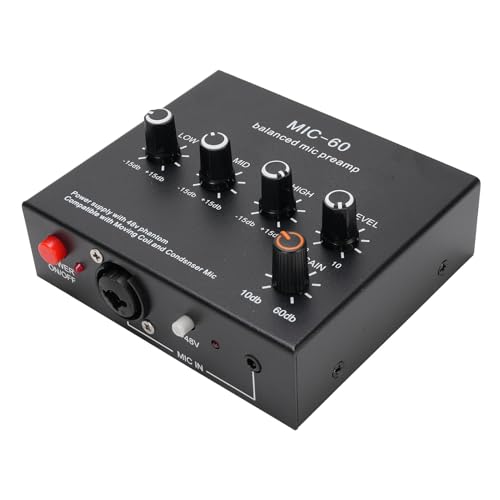
- Up to 60dB gain with 48V phantom power
- XLR, 3.5mm, and 6.35mm connectivity
- Compact housing for recording and streaming
Best For: Portable analog recording, podcasting, and live streaming
Best Flexible Gain Booster

- 0–72 dB adjustable gain
- -120 dBV EIN claim
- Mic, instrument, and 48V support
Best For: Flexible studio, streaming, and mobile setups
Best Compact Dynamic-Mic Booster

- +25 dB clean gain
- Balanced XLR input/output
- Compact metal chassis
Best For: Dynamic-mic podcast and broadcast setups
Best Multi-Output DI Preamp

- 19–66 dB variable gain
- Three simultaneous outputs
- 1 MΩ instrument input
Best For: Streaming, analog routing, and DI use
Best All-in-One Karaoke Processor – DSP-11 Digital Karaoke Mixer
If you need a microphone preamp with optical output for karaoke, events, or a home audio system, the DSP-11 combines digital processing, vocal effects, feedback suppression, and flexible source connectivity in one rack-style unit. Its optical input works alongside Bluetooth, USB, coaxial, and AUX sources, while multiple outputs support broader system integration.
Best For: Home karaoke, live events, streaming, and users who want vocal effects and source switching in a single processor.
Pros:
- DSP processing includes vocal enhancement, echo/reverb, key shifting, and 13-band EQ.
- Optical, Bluetooth, USB, coaxial, and AUX inputs provide flexible connectivity.
- LCD display, remote control, mic priority, and feedback suppression simplify operation.
- Offers RCA stereo, subwoofer, and four XLR outputs.
Cons:
- This is a feature-heavy karaoke processor rather than a simple standalone mic preamp.
- The supplied notes specify optical audio input, not optical output.
The DSP-11 is a practical choice when karaoke-focused controls matter more than a minimal recording setup. Verify your source and output requirements carefully, especially if you specifically need optical output rather than optical input.
Best for Multichannel Recording – Behringer ADA8200 ADAT Interface
Behringer ADA8200 Audiophile 8 In/8 Out ADAT Audio Interface with Midas Mic Preamplifiers
Check Price On AmazonThe Behringer ADA8200 is a strong fit for buyers searching for a microphone preamp with optical output for expanding a recording interface. It provides eight microphone preamps and eight-channel ADAT optical connectivity, making it suited to multichannel studio or live-recording setups that support ADAT.
Best For: Recording engineers and studios that need eight additional mic inputs through an ADAT-compatible interface.
Pros:
- Provides eight microphone preamplifier channels.
- Includes ADAT optical output for compatible digital audio systems.
- Uses Midas microphone preamplifiers and 24-bit A/D and D/A conversion.
- Supports 44.1 and 48 kHz operation.
Cons:
- Requires a compatible ADAT-equipped interface or system.
- Maximum sample rate listed in the supplied details is 48 kHz.
- It is a wired rack-style audio interface, not a compact plug-in booster.
Choose the ADA8200 when channel count and ADAT expansion are priorities. It is considerably more appropriate for multichannel recording than for a basic one-microphone setup, so confirm that your main interface accepts ADAT optical connections.
Best Inline Gain Booster – StudioMan DPM1 XLR Preamp
The StudioMan DPM1 is an inline XLR gain booster for low-output dynamic and ribbon microphones. While it does not provide optical output, it can help users build a cleaner microphone chain before feeding an interface or mixer, adding up to 29 dB of gain when 48V phantom power is supplied by the connected equipment.
Best For: Podcasters, streamers, and vocalists using quiet dynamic or ribbon microphones with an interface that has phantom power.
Pros:
- Adds up to 29 dB of stated clean gain.
- Designed for standard XLR dynamic and ribbon microphones.
- Compact plug-and-play metal construction helps fit it into existing XLR chains.
- Can improve signal-to-noise performance by boosting the signal at the source.
Cons:
- It does not have optical output or digital connectivity.
- Requires 48V phantom power, which is not included.
- Not intended for condenser microphones.
The DPM1 makes sense as a focused solution for gain-hungry dynamic microphones, not as a complete digital preamp. Pair it with an interface or mixer that supplies phantom power, and look elsewhere if optical connectivity is essential.
Best KTV Effects Processor – KT150 Optical Audio Preamp
The KT150 is a karaoke-oriented digital preamp and effects processor with optical fiber connectivity, Bluetooth, USB, microphone inputs, echo, and anti-howling control. It is worth considering for buyers who want a microphone preamp with optical output in a KTV or home-entertainment chain, but note that the supplied details describe an optical input rather than an optical output.
Best For: Karaoke systems, family entertainment, weddings, bars, and live events needing vocal effects and feedback control.
Pros:
- Supports optical fiber, Bluetooth, USB, and AUX audio sources.
- Provides echo, delay, tone controls, and microphone volume adjustment.
- One-button howling prevention helps control feedback.
- Includes XLR, 6.35 mm, subwoofer, and recording signal connections.
Cons:
- The notes specify optical fiber input, not optical output.
- Optical use requires a connected device with an optical fiber output interface.
- Its feature set is tailored to karaoke and reverberation rather than neutral studio preamplification.
The KT150 is a practical entertainment processor when vocal effects, Bluetooth playback, and anti-howling features are central to the setup. Confirm the direction of the optical connection before buying, particularly if your system requires a digital optical signal out.
High-Gain Choice – JCANOL MIC-1
If you need a microphone preamp with optical output, note that the JCANOL MIC-1 does not include optical connectivity. Instead, it focuses on clean analog gain, offering up to 75dB, a stated -120dB EIN, balanced XLR output, and two 3.5mm outputs for compact audio setups.
Best For: Vocal recording, dynamic microphones, condenser microphones, and portable analog audio connections.
Pros:
- Up to 75dB of gain and a stated -120dB EIN support quiet-source recording.
- 48V phantom power works with compatible condenser microphones.
- Balanced XLR, 3.5mm mic, and 3.5mm line outputs provide flexible analog connectivity.
- Compact metal housing, 1MΩ instrument input, and a three-year warranty add practical value.
Cons:
- No optical output is listed, so it is not a direct match for digital optical systems.
- The two input ports cannot be used simultaneously.
The MIC-1 is a strong analog-focused option when gain, low-noise performance, phantom power, and flexible output formats matter more than optical connectivity.
Optical Home Audio Pick – Dynasty ProAudio PX1
Among these options, the Dynasty ProAudio PX1 is the clearest fit for shoppers seeking a microphone preamp with optical output. It combines a front-panel low-noise microphone input with an S/PDIF optical input, making it useful for integrating a microphone and digital home-audio sources in one preamplifier.
Best For: Home audio systems using a TV or digital source alongside a microphone, turntable, or power amplifier.
Pros:
- Includes an S/PDIF optical input for TV and other digital audio devices.
- Front-panel 1/4-inch microphone input uses a low-noise mic preamp.
- Offers phono RIAA input, four RCA line inputs, and a ground terminal for turntables.
- Provides full-range stereo, crossover, sub mono, and headphone outputs.
Cons:
- The optical connection is an input rather than an optical output.
- Its home-audio preamplifier layout may be less suitable for a dedicated recording interface.
The PX1 is the most versatile choice here for an optical-equipped home system, especially if you also need phono, RCA, subwoofer, and headphone connectivity.
Compact Analog Booster – VBESTLIFE 3-Input Preamp
If your setup can work without optical connectivity, this VBESTLIFE unit provides a compact analog microphone preamp with up to 60dB of gain. It supports dynamic and condenser microphones, includes 48V power, and offers XLR, 3.5mm, and 6.35mm connection options for recording, streaming, and live sound.
Best For: Home studios, podcasting, vocal recording, live streaming, and portable analog setups.
Pros:
- Up to 60dB of gain supports dynamic microphone amplification.
- 48V phantom power accommodates compatible condenser microphones.
- Three-channel input and XLR, 3.5mm, and 6.35mm outputs support varied analog equipment.
- Compact metal housing is designed for portability and interference reduction.
Cons:
- No optical input or output is listed.
- The supplied warranty is limited to 90 days.
This is a practical budget-oriented analog booster for flexible microphone connections, but shoppers specifically needing a microphone preamp with optical output should consider a different device or add a separate digital converter.
Best Flexible Gain Booster – RO-04 Mic Preamp
The RO-04 is a versatile choice if you need a microphone preamp with optical output in a broader recording or streaming setup, although the supplied specifications list USB-C, mic, instrument, and dedicated output-level connections rather than an optical connector. Its 0–72 dB gain range, very low claimed noise floor, and support for 48V phantom power make it suitable for demanding microphones and instruments.
Best For: Home studios, podcasts, livestreams, and mobile or desktop setups using dynamic, condenser, ribbon microphones, guitar, or bass.
Pros:
- Wide 0–72 dB adjustable gain range for low-output microphones and quieter sources.
- Claims an exceptionally low -120 dBV EIN for clean signal boosting.
- Includes separate microphone and high-impedance instrument inputs, plus 48V phantom power.
- USB-C power supports standard chargers and power banks for portable use.
Cons:
- The supplied details do not confirm an optical output, so verify connectivity before buying for an optical-based chain.
- At 2.42 pounds, it is less lightweight than a simple inline booster.
Choose the RO-04 when gain flexibility, instrument compatibility, and portable power matter more than a minimal signal-booster design. Confirm the output format carefully if optical connectivity is essential.
Best Compact Dynamic-Mic Booster – StudioMan CL-100 XLR Preamp
The StudioMan CL-100 is a straightforward XLR booster for dynamic and passive ribbon microphones. It is not identified in the supplied notes as a microphone preamp with optical output; instead, it uses balanced XLR input and output, so it fits best ahead of an audio interface, mixer, or other XLR-equipped device.
Best For: Dynamic-microphone podcasts, livestreams, broadcast setups, and compact home or mobile recording systems.
Pros:
- Provides a dedicated +25 dB clean gain boost for low-level dynamic and passive ribbon microphones.
- Standard balanced XLR input and output support interfaces, mixers, and recording devices.
- Compact metal housing offers portability and EMI/RFI shielding.
- Includes a 10 Hz–20 kHz frequency response and a one-year warranty.
Cons:
- No optical output is listed in the supplied specifications.
- Its fixed 25 dB gain is less adjustable than the other preamps in this roundup.
- It is designed primarily for dynamic and passive ribbon microphones rather than a broad instrument-input setup.
The CL-100 is a practical, compact choice when you need a simple XLR gain lift for a dynamic microphone. If your setup specifically requires optical output, plan on using an appropriate downstream converter or choose a product with confirmed optical connectivity.
Best Multi-Output DI Preamp – RO03 Mic Preamp
The RO03 is a useful option for creators comparing a microphone preamp with optical output, but its supplied connection details specify XLR, TRS, TS, and USB-C rather than optical output. Its strength is flexible analog routing: one input can feed three outputs simultaneously, with selectable professional and consumer-level output formats.
Best For: Podcasting, livestreaming, instrument recording, and setups that need simultaneous analog feeds from one microphone or instrument.
Pros:
- Offers 19–66 dB variable gain with a claimed -120 dBV EIN noise performance.
- Supports three simultaneous outputs, including +4 dBu and -10 dBV levels.
- USB-C 5V/1A power works with chargers and power banks.
- Approximately 1 MΩ instrument-input impedance lets it function as a DI box for high-impedance pickups.
Cons:
- The supplied specifications do not list an optical output.
- Only one input can be active at a time; it is not intended for dual-microphone recording.
- The 19 dB minimum gain is less suitable when virtually no preamp boost is needed.
The RO03 stands out for simultaneous analog outputs and portable USB-C power, making it a strong routing tool for streaming and recording. Verify that its XLR, TRS, or TS outputs meet your needs before purchasing for an optical workflow.
How We Picked the Best Microphone Preamp with Optical Output
We focused on the specifications that matter when a microphone signal must feed a digital audio system: available gain, noise performance, input and output formats, phantom-power support, and control flexibility. The selection includes dedicated mic boosters, multi-channel ADAT interfaces, karaoke processors, and stereo preamps with optical inputs. Because “optical output” can describe different connections, verify whether a product offers optical digital output, optical input, or another digital format before ordering.
We also considered practical installation factors, including balanced XLR connections, compact housings, USB or Type-C power, monitoring outputs, equalization, anti-feedback controls, and compatibility with dynamic or condenser microphones.
Quick Comparison
| Best For | Look For | Useful Features |
|---|---|---|
| Home karaoke | DSP, echo, anti-howling | Bluetooth, USB, MP3, multiple mic inputs |
| Studio expansion | Multiple preamp channels | ADAT, phantom power, low-noise gain |
| Low-output dynamic microphones | High clean gain | Balanced XLR, low EIN, simple operation |
| Hi-fi systems and TV audio | Optical or RCA compatibility | Phono, line-level, and digital inputs |
| Portable or compact setups | Small footprint and simple power | USB or Type-C power, direct outputs |
Key Buying Factors for a Microphone Preamp with Optical Output
Confirm the Optical Connection
Optical may mean TOSLINK digital audio input or output, while ADAT uses optical cabling for multichannel digital expansion. These are not automatically interchangeable. Check the exact connector, signal direction, sample-rate support, and channel count required by your receiver, audio interface, soundbar, or mixer.
Match Gain to the Microphone
Dynamic and ribbon microphones often need substantially more clean gain than condensers. A wide adjustable range—roughly 50 to 75 dB on some dedicated units—can help, but maximum gain alone is not enough. Look for low equivalent input noise, or EIN, so quiet sources do not become hissy.
Check Phantom Power and Balanced I/O
Condenser microphones typically require 48V phantom power. Balanced XLR connections help reject interference over longer cable runs. If you use a passive ribbon microphone, confirm the manufacturer’s phantom-power guidance before connecting it.
Separate Studio Features from Karaoke Features
DSP effects, echo, equalization, anti-howling, Bluetooth, and USB playback are valuable for karaoke and live entertainment, but they may add unnecessary processing to a recording chain. For transparent recording, prioritize clean preamps, straightforward routing, and reliable digital conversion.
Plan the Entire Signal Chain
Check whether the preamp feeds a mixer, interface, amplifier, receiver, or powered speaker. Confirm output level, connector type, monitoring needs, power requirements, and whether you need one channel or several. A compact booster may solve a gain problem, while an ADAT unit is better suited to expanding an interface with multiple microphone inputs.
Who Should Buy Which Microphone Preamp with Optical Output?
Choose a karaoke processor if your priority is vocal effects, anti-feedback control, music playback, and flexible entertainment inputs. Choose an ADAT-equipped multi-channel interface when you need to add several microphone channels to a compatible recording interface.
For a single quiet dynamic microphone, a dedicated high-gain booster or low-noise preamp is usually the simplest choice. Producers using condenser microphones should prioritize dependable 48V phantom power and balanced connections. Finally, home-audio buyers should favor a model whose optical, RCA, phono, or line-level connections match the receiver and source equipment exactly.