Adding a second projector, television, or monitor does not have to mean rebuilding your entire AV setup. The right HDMI splitter can duplicate one source across multiple displays while preserving the resolution and refresh rate your equipment supports.
This roundup compares 10 HDMI splitters for projectors, including compact 1×2 models, higher-output 1×4 units, and options with useful extras such as power adapters, HDMI cables, and long-distance transmission support.
Best 10 Hdmi Splitters for Projectors Picks for 2026
Best for Four-Display Mirroring

- Mirrors one source to four displays
- Supports 4K@30Hz, 3D, and HDCP 1.4
- Powered metal design with long-distance support
Best For: Classrooms, conference rooms, retail displays, and home theaters needing four synchronized screens
Best for Switching Sources to One Projector

- Connects two HDMI sources to one display
- Supports 4K@60Hz, HDR, 3D, and Dolby
- Manual button switching with no automatic detection
Best For: Single-projector setups that need quick selection between two HDMI sources
Best Compact Dual-Display Splitter

- Mirrors one source to two displays
- Supports 4K@30Hz and 1080p
- Includes a 5V/2A power adapter
Best For: Presentations, home theaters, and classrooms using two synchronized displays
Best Format-Flexible 1x4 Splitter
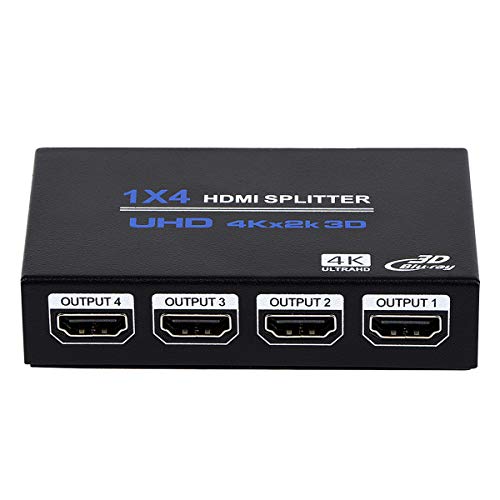
- Mirrors one source across four outputs
- Supports 4K30, 2K60, 1080p120, and 3D
- Includes broad audio-format support and power supply
Best For: Four-display projector installations needing flexible video and audio compatibility
Best 4K 1-to-2 Pick

- 4K at 60Hz and 18 Gbps bandwidth
- Mirrors one source to two displays
- Supports broad audio formats
Best For: Two-display 4K projector and monitor setups
Best 4K60 Mirror Splitter

- Mirrors one HDMI source to two displays
- Supports 4K at 60Hz and 18.5Gbps
- Includes power adapter and HDMI cable
Best For: 4K presentations and home theater mirroring
Best Budget 4K30 Splitter

- Mirrors one source to two displays
- Supports 4K at 30Hz
- Includes a 4-foot HDMI cable
Best For: Basic projector and TV duplication
Best for Four-Display Mirroring – 4K 1×4 HDMI Splitter
For buyers comparing hdmi splitters for projectors, the MT-ViKI 1×4 is a practical choice when one source needs to mirror the same content across up to four projectors, TVs, or monitors. Its powered design and metal housing are suited to stable, extended-use installations.
Best For: Mirroring one HDMI source to four displays in home theaters, classrooms, conference rooms, retail spaces, or commercial setups.
Pros:
- Distributes one HDMI input to four identical outputs simultaneously.
- Supports up to 4K@30Hz, 1080p@60Hz, 3D, deep color, and HDCP 1.4.
- Includes a 5V/2A power adapter and durable metal case for stable operation.
- Supports signal transmission up to 100 feet total and cascading for larger installations.
Cons:
- Supports mirror mode only; it cannot extend the desktop across displays.
- Limited to 4K at 30Hz rather than 4K at 60Hz.
- It is a splitter, not a switch, and has no remote or built-in speaker.
This model makes sense when four projectors or displays must show identical content and reliable powered distribution matters more than extended mode or 4K60 playback.
Best for Switching Sources to One Projector – 4K60 HDMI Switch
Although it is not a splitter, the Anker 2-in-1 HDMI switch is worth considering alongside hdmi splitters for projectors when the real need is to connect two sources to one projector and select between them without swapping cables.
Best For: Users switching manually between a game console, laptop, media player, or other HDMI source connected to one projector or display.
Pros:
- Connects two HDMI inputs to one display output.
- Supports resolutions up to 4K@60Hz, plus HDR, 3D, and Dolby formats.
- Provides convenient manual button switching without unplugging cables.
- Works with laptops, desktops, game consoles, projectors, TVs, and VR headsets.
Cons:
- Does not duplicate one source to multiple projectors or displays.
- Supports one display at a time and has no automatic signal detection.
- 4K60 requires short, suitable cables; combined cable length must not exceed 6.5 feet under the listed conditions.
Choose this Anker unit only if you need source selection rather than signal duplication. It is a useful projector companion for a single-screen setup, but it does not replace a true HDMI splitter.
Best Compact Dual-Display Splitter – 4K 1×2 HDMI Splitter
The MT-ViKI 1×2 is a straightforward option among hdmi splitters for projectors when one HDMI source must feed two displays with matching content. Its included power adapter is designed to help maintain a stable signal during longer viewing or presentation sessions.
Best For: Mirroring a laptop, media player, camera, or game console to two projectors, TVs, or monitors.
Pros:
- Duplicates one HDMI input to two displays simultaneously.
- Supports up to 4K@30Hz, with backward compatibility for 1080p and lower resolutions.
- Includes a 5V/2A adapter for more consistent signal transmission.
- Plug-and-play setup requires no drivers or software.
Cons:
- Mirror mode only; it does not support extended dual-screen output.
- Cannot switch multiple sources to one display or perform matrix-style routing.
- Does not include a built-in audio port.
This is a sensible compact splitter for synchronized two-projector presentations or dual-display viewing. Verify that your HDMI cables support the desired resolution, particularly for 4K output.
Best Format-Flexible 1×4 Splitter – 4K HDMI Distributor
The ENBUER 1×4 HDMI distributor is designed for buyers seeking hdmi splitters for projectors with broad format support and four mirrored outputs. It can distribute one source to multiple projectors or other HDMI displays without drivers or software.
Best For: Duplicating a computer, Blu-ray player, game console, or set-top box to four projectors, monitors, or HDTVs.
Pros:
- Splits one HDMI input into four identical outputs.
- Supports 4K@30Hz, 2K@60Hz, 1080p@120Hz, 3D, and 8/10/12-bit deep color.
- Supports multiple audio formats, including DTS-HD, Dolby TrueHD, DTS, Dolby AC-3, and DSD.
- Includes a 5V DC power supply and plug-and-play operation.
Cons:
- Only duplicates the image; extended or independently different screens are not supported.
- Does not support CEC, HDR, or VRR.
- It is not an HDMI switch and cannot connect multiple inputs to one output.
With its broad listed video and audio compatibility, this ENBUER model is a versatile choice for four-screen mirroring. Its 4K performance is capped at 30Hz in the listed standard mode, so check source and display requirements before buying.
Best 4K 1-to-2 Pick – OREI UltraHD 4K HDMI Splitter
If you need HDMI splitters for projectors that mirror one source to two displays, the OREI UHDS-102 is a practical 4K option. It supports 4K at 60Hz, 18 Gbps bandwidth, 3D, and multiple PCM and surround-sound formats. It duplicates the signal rather than creating an extended desktop, so it suits synchronized projector or monitor setups.
Best For: Home theaters, presentations, trade shows, and rooms needing one HDMI source on two displays.
Pros:
- Supports 4K at 60Hz with 18 Gbps bandwidth.
- Compatible with HDMI 1.3, 1.4, and 2.0 devices.
- Supports stereo, Dolby, DTS, and other listed audio formats.
- Includes a 1-year warranty and international power adapter support.
Cons:
- Mirrors the source and does not extend monitors into dual-screen mode.
- HDMI cables longer than 30 feet may not work reliably.
- Does not bypass HDCP.
The OREI is a strong choice when smooth 4K60 mirroring matters more than adding multiple outputs. Keep cable runs short and confirm your source and displays meet its HDCP requirements.
Best Complete 1-to-3 Kit – NEWCARE 4K HDMI Splitter
Among HDMI splitters for projectors, the NEWCARE 1×3 model is convenient when one source must feed three displays. It mirrors 4K video at up to 30Hz, supports 1080p at 60Hz and 3D, and includes a 4-foot HDMI cable plus a power adapter for a straightforward setup.
Best For: Home entertainment, office presentations, and retail displays using up to three TVs, monitors, or projectors.
Pros:
- Mirrors one HDMI source to three displays simultaneously.
- Supports 4K at 30Hz, 1080p at 60Hz, and 3D video.
- Supports Dolby TrueHD and DTS-HD audio.
- Includes a 4-foot HDMI cable, power adapter, and 1-year warranty.
Cons:
- Mirrors only and cannot extend the desktop.
- Does not extract audio to external audio devices.
- Not compatible with ARC/eARC.
This NEWCARE splitter offers useful three-display capacity and a complete accessory bundle. It is best for straightforward mirroring, provided you do not need audio extraction, ARC/eARC, or extended-display functionality.
Best Long-Run 1-to-4 Pick – Happfeel 4K HDMI Splitter
For larger setups, this powered Happfeel model is one of the more flexible HDMI splitters for projectors, sending one source to four screens. It supports 4K at 30Hz, 1080p at 120Hz, and transmission up to 100 feet with suitable HDMI 2.0 cables, making it useful for multi-room viewing and presentations.
Best For: Large homes, conference rooms, exhibitions, and backyard theaters requiring four synchronized displays.
Pros:
- Mirrors one HDMI source to four displays simultaneously.
- Supports 4K at 30Hz and 1080p at 120Hz.
- Supports up to 100 feet of transmission with specified cable lengths.
- Includes a UL-certified 5V adapter, metal shell, and LED indicators.
Cons:
- Mirrors only and does not create an extended display.
- Uses HDMI 1.4 and HDCP 1.4 compatibility.
- Requires external DC power.
The Happfeel stands out when you need four outputs or longer cable runs. Its 4K30 limit and HDMI 1.4/HDCP 1.4 compatibility should be checked against your projector and source before purchase.
Best 4K60 Mirror Splitter – avedio links HDMI 1-in-2-out
For sharing one source across two displays, this avedio links model is one of the more capable hdmi splitters for projectors. It mirrors the same video and audio to two HDMI displays, supports up to 4K at 60Hz, and includes a power adapter and HDMI cable.
Best For: Home theaters, presentations, classrooms, and digital signage setups that need the same content on a projector and another display.
Pros:
- Supports 4K at 60Hz with 18.5Gbps bandwidth.
- Can output to two displays simultaneously, including mixed 4K and 1080p displays with automatic or forced downscaling.
- Includes a USB cable with power adapter and a 4-foot HDMI 2.0 cable.
Cons:
- Mirrors one source only; it cannot extend separate content.
- It is not an HDMI switcher or audio extractor and does not support ARC/eARC or CEC.
- For reliable 4K output, cable length is advised at 16 feet or less.
This is the strongest option here when smooth 4K60 mirroring matters. Just verify that your projector and source support the desired resolution and that you do not need extended desktop output.
Best Budget 4K30 Splitter – avedio links HDMI 1-in-2-out
This compact avedio links unit is a practical choice among hdmi splitters for projectors when 4K at 30Hz is sufficient. It duplicates one HDMI source to two displays, includes a 4-foot HDMI cable, and uses a USB power connection for stable operation.
Best For: Projector presentations, TV mirroring, and gaming or media setups using 4K sources that do not require 60Hz output.
Pros:
- Supports 4K at 30Hz and is backward compatible with several HD resolutions.
- Outputs the same video and audio to two displays at once.
- Includes a 4-foot high-speed HDMI cable and requires no external drivers.
Cons:
- It mirrors only and cannot extend separate content to two monitors.
- It is not a switcher or audio extractor and does not support HDCP 2.2.
- The power adapter is not included, so the USB power cable must connect to a suitable adapter.
Choose this model for straightforward HD or 4K30 duplication at a potentially lower-cost setup. It is less suitable for high-frame-rate 4K video or systems that require HDCP 2.2 compatibility.
Best Simple HD Splitter – Sorthol HDMI 1-in-2-out
For basic HD duplication, this Sorthol model offers a simple way to connect one HDMI source to two displays. It supports resolutions up to 1080p and can work with a projector, though its notes emphasize same-model displays for simultaneous output.
Best For: Simple 720p or 1080p setups using a compatible projector and matching display, such as a DVD, Blu-ray, or game-console connection.
Pros:
- Supports common HD resolutions including 720p, 1080i, and 1080p.
- Can direct one HDMI source to one or two output devices.
- Compact, lightweight design with broad standard HDMI-device compatibility.
Cons:
- Mirrors or routes one source only; it cannot extend a desktop or switch between multiple inputs.
- Two displays need to be the same model for simultaneous output according to the supplied notes.
- The package listing includes an HDMI cable but does not specify an external power connection.
This is a basic choice for older or 1080p projector systems. If you need dependable 4K, mixed-display downscaling, or more flexible compatibility, one of the powered avedio links splitters is a better fit.
How We Picked the Best Hdmi Splitters for Projectors
We focused on practical compatibility rather than simply counting output ports. The selected models were compared by supported resolution and refresh rate, HDMI bandwidth, output count, included accessories, power requirements, transmission distance, and overall suitability for mirrored projector setups. Because most HDMI splitters duplicate one source instead of creating an extended desktop, we also considered how clearly each type fits common home theater, classroom, meeting-room, and event applications.
Quick Comparison
| What to Compare | Best For |
|---|---|
| 1×2 splitter | Sending one source to two displays |
| 1×3 splitter | Adding a third mirrored display without using a larger 1×4 unit |
| 1×4 splitter | Home theaters, classrooms, and multi-screen presentations |
| 4K at 60Hz and 18Gbps | Smoother modern 4K playback and gaming-compatible sources |
| Included power adapter or cable | More predictable installation and fewer extra purchases |
| Long-distance transmission support | Large rooms and projector placements far from the source |
Key Buying Factors for Hdmi Splitters for Projectors
Output Count and Signal Behavior
Choose a 1×2 model for one source and two displays, or a 1×4 model when you need up to four outputs. These devices generally mirror the same image; they do not expand one computer desktop across separate screens. Verify that your intended projector and television can display the shared signal at a compatible resolution.
Resolution, Refresh Rate, and Bandwidth
For current 4K equipment, look for explicit support for 4K at 60Hz and, where relevant, 18Gbps bandwidth. A splitter advertised only for basic 4K may not deliver the same refresh rate or color performance. If you mainly use 1080p projectors, a lower-bandwidth model may be sufficient and more economical.
Power, Cables, and Distance
Powered splitters are usually the safer choice, especially with multiple outputs or longer HDMI runs. Check whether a power adapter is included, and treat bundled cables as a convenience rather than proof of premium performance. For large rooms, confirm the stated transmission distance and use suitable, high-quality HDMI cables.
Audio and Content Protection
Check compatibility with the source, projector, sound system, and any HDCP-protected content. Streaming devices, game consoles, Blu-ray players, and receivers can have different handshake requirements. If audio must be routed separately, confirm that the splitter supports the needed audio format and output behavior.
Who Should Buy Which Hdmi Splitters for Projectors?
Choose a 1×2 splitter for a simple projector-and-TV or dual-projector setup. Choose a 1×4 model for classrooms, presentations, and home theaters with several mirrored screens. Choose a 4K 60Hz option when your source and displays support modern 4K playback or smoother gaming. Choose a model with a bundled cable or adapter when you want a straightforward installation. Finally, remember that Hdmi Splitters for Projectors are for duplicating a signal; buyers who need independent content on each display should look for an HDMI matrix, video wall controller, or separate-source setup instead.