Choosing the right monitor can be difficult when your desk, walls, and listening position limit speaker placement. Studio monitors with front port design can offer more flexible positioning while delivering the detail needed for production, mixing, and everyday listening.
We selected 10 popular powered monitors across compact, mid-size, and larger formats so you can compare practical features, room suitability, and value before buying.
Best 10 Studio Monitors with Front Port Design Picks for 2026
Compact Yamaha Precision
HS4 Powered Studio Monitor Pair

- Compact 4.5-inch two-way monitor pair
- XLR/TRS, RCA, and stereo mini inputs
- Room control and high-trim adjustments
Best For: Small desks, DAW workstations, and video editing
Wide-Sweet-Spot Behringer Value

- 64-watt compact reference monitor pair
- Advanced Waveguide for broad dispersion
- 1-inch silk-dome tweeters and 3.5-inch woofers
Best For: Home recording, gaming, and multimedia desks
Front-Ported Mixing Upgrade
Eris E5 5.25-Inch Near-Field Monitor

- Front-firing acoustic port for bass reproduction
- 80-watt Class AB bi-amplification
- Balanced XLR, 1/4-inch, and RCA inputs
Best For: Home-studio mixing and near-field monitoring
Desk-Friendly Mackie Control

- Compact 3.5-inch monitor pair
- Tone Knob for quick voicing changes
- Location Switch for placement correction
Best For: Small home studios and multimedia desktops
High-Resolution Room Flexible Pick

- Detailed U-ART tweeter and HPS waveguide
- DSP room-adjustment filters
- XLR, TRS, and RCA inputs
Best For: Producers needing detailed monitoring with room-tuning controls
Compact Front-Access Workstation Pair

- 50W Class AB stereo amplification
- Front headphone output and aux input
- TRS, RCA, and tuning controls
Best For: Desktop users wanting compact, versatile stereo monitoring
Low-Diffraction Imaging Choice

- Class D amplification
- Low-diffraction baffle for imaging
- Combo XLR/1/4-inch TRS input
Best For: Producers focused on imaging and resonance control
Wide-Sweet-Spot Choice

- 6.55-inch woven-composite woofer
- Wide EBM waveguide for broad imaging
- Room-tuning controls and software bundle
Best For: Home producers needing flexible placement and a wide listening area
Deep-Bass Nearfield Pick
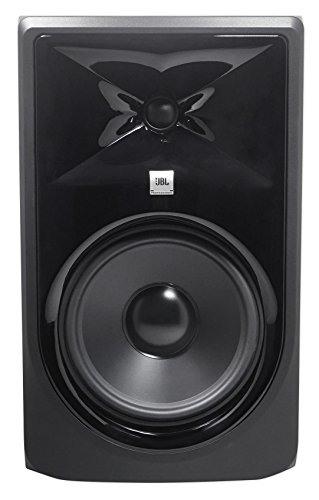
- 8-inch woofer for deep bass
- Slip Stream low-frequency port
- Boundary EQ and balanced inputs
Best For: Nearfield production where bass extension and placement flexibility matter
Compact Powered Option

- 6.5-inch woofer and 1-inch tweeter
- 112-watt powered two-way design
- Desk, floor, or stand placement
Best For: Desktop production and versatile near-field monitoring
Compact Yamaha Precision – HS4 Powered Studio Monitor Pair
The Yamaha HS4 is a compact powered pair for desktop music production, video editing, and general DAW work. Its 4.5-inch woofers, 1-inch dome tweeters, front-accessible controls, and multiple input options make it a practical choice when you want studio monitors with front port design in a smaller workspace.
Best For: Desktop producers, video editors, and listeners who need a compact stereo monitor pair with flexible wired inputs.
Pros:
- Sold as a complete pair with speaker cable, stereo mini-to-RCA cable, and anti-slip pads.
- Offers XLR/TRS combo, RCA, and stereo mini inputs for varied sources.
- Includes room control and high-trim response controls for basic placement adjustment.
- Compact 4.5-inch woofer and 26-watt output suit smaller desks.
Cons:
- The 60 Hz–22 kHz response is less extended at the low end than larger monitors.
- At 26 watts, it provides less output headroom than higher-powered alternatives.
The HS4 stands out as a tidy, versatile desktop solution. Choose it when compact size and broad connectivity matter more than maximum bass extension or volume.
Wide-Sweet-Spot Behringer Value – TRUTH 3.5 Studio Monitors
Behringer Truth 3.5 Audiophile 3.5" Studio Monitors with Advanced Waveguide Technology.
Check Price On AmazonThe Behringer TRUTH 3.5 is a compact 64-watt monitor pair designed for home recording, gaming, and multimedia workstations. Its advanced waveguide aims to create broad acoustic dispersion, making it a useful option for shoppers comparing studio monitors with front port design for flexible desktop listening.
Best For: Home recordists, gamers, and multimedia users who want compact monitors with a wide listening area.
Pros:
- 64 watts of stated output provides useful power for a compact monitor system.
- Advanced Waveguide technology is designed for broad dispersion and a large sweet zone.
- Uses a 1-inch silk-dome tweeter and deformation-resistant glass-fiber woofer.
- Suitable for music creation, casual listening, gaming, and multimedia use.
Cons:
- The 3.5-inch woofer is smaller than those in many near-field monitors.
- Connectivity is listed as wired auxiliary/3.5mm, offering fewer input formats than some competitors.
The TRUTH 3.5 prioritizes a broad listening area and strong stated power in a small enclosure. It is especially appealing for mixed-use desks where production, gaming, and entertainment share the same space.
Front-Ported Mixing Upgrade – Eris E5 5.25-Inch Near-Field Monitor
The PreSonus Eris E5 is a 5.25-inch near-field monitor built for more controlled music production and mixing. Its front-firing acoustic port directly fits the search for studio monitors with front port design, while balanced inputs, acoustic tuning controls, and 80-watt bi-amplification add flexibility for different monitoring setups.
Best For: Home-studio mixing and near-field monitoring where front-port bass reproduction, tuning controls, and connection flexibility are priorities.
Pros:
- Front-firing acoustic port is designed to support bass-frequency reproduction.
- 5.25-inch woven-composite woofer delivers solid low end with minimal stated bass distortion.
- 80-watt Class AB bi-amplification provides useful volume and headroom.
- Balanced XLR and 1/4-inch inputs plus unbalanced RCA support varied studio connections.
Cons:
- This listing is for one monitor rather than a pair.
- The 5.25-inch design is larger and heavier than compact desktop alternatives.
The Eris E5 is the clearest fit for buyers specifically seeking a front-firing port and more substantial near-field monitoring. Confirm the quantity you need, since the supplied package information lists one monitor.
Desk-Friendly Mackie Control – CR3.5 Studio Monitor Pair
The Mackie CR3.5 is a compact pair aimed at small studios, desktops, and multimedia setups. A front-panel Tone Knob and Location Switch make quick adjustments convenient, while the supplied cables and isolation pads help simplify setup for shoppers considering studio monitors with front port design.
Best For: Small home studios, desktop audio work, and casual listening where simple controls and included accessories are valuable.
Pros:
- Sold as a pair with speaker wire, two audio cables, and foam isolation pads.
- Tone Knob allows desk-side voicing adjustments without menus.
- Location Switch is designed to correct bass response for wall-adjacent or free placement.
- Compact 3.5-inch woofers suit desks and small workspaces.
Cons:
- The small woofers may provide less low-end authority than larger monitors.
- Its listed RCA and TRS connectivity is less extensive than models with XLR and additional inputs.
The CR3.5 focuses on convenience rather than elaborate studio features. It makes sense for a compact desk where quick tonal and placement adjustments, a complete accessory bundle, and stereo playback are the main priorities.
High-Resolution Room Flexible Pick – ADAM Audio T5V
The ADAM Audio T5V is a revealing 5-inch monitor for recording, podcast editing, guitar tracking, and mixing. While it is not a front-port model—the bass reflex port fires from the rear—it offers room-adjustment filters and a beveled cabinet for flexible placement when choosing studio monitors with front port design is not essential.
Best For: Producers and creators who want detailed high-frequency monitoring and room-tuning controls.
Pros:
- U-ART tweeter and HPS waveguide target detailed high-frequency reproduction.
- High- and low-shelf DSP filters help adapt the monitor to difficult rooms.
- Supports XLR, 1/4-inch TRS, and RCA connections.
- Compatible with the matched ADAM Audio T10S subwoofer for additional low end.
Cons:
- The rear-firing port may require more care with close-wall placement than a front-port design.
- This listing describes one monitor, so a stereo setup may require a second unit.
The T5V stands out when tonal detail and placement flexibility matter more than a front-facing port. Its adjustment controls and broad analog connectivity make it a practical choice for compact production spaces.
Compact Front-Access Workstation Pair – PreSonus Eris E4.5
The PreSonus Eris E4.5 pair suits desks, bookshelves, and small listening spaces where accessible controls matter. For shoppers comparing studio monitors with front port design, note that the supplied specifications do not identify a front bass port; however, the pair does provide a front-panel auxiliary input, volume control, and headphone output.
Best For: Home producers, multimedia listeners, and gamers who want compact stereo monitors with convenient front-panel access.
Pros:
- 50 watts of Class AB amplification delivers 25 watts per side.
- 4.5-inch woven-composite woofers and 1-inch silk-dome tweeters target clear, balanced sound.
- Includes balanced TRS, RCA, and front 1/8-inch auxiliary connectivity.
- Front headphone output and amplifier simplify quick monitoring changes.
Cons:
- The supplied notes do not confirm a front bass-port layout.
- Its 4.5-inch woofers provide less driver area than larger studio monitors.
Eris E4.5 is a practical desktop pair when compact dimensions and easy front-panel access are priorities. Its tuning controls also let you adjust the presentation for your room and speaker orientation.
Low-Diffraction Imaging Choice – KRK ROKIT 5 Generation Five
The KRK RP5G5 ROKIT 5 Generation Five is a 5-inch powered monitor focused on imaging, amplifier efficiency, and setup stability. The supplied notes do not confirm a front-port design, so consider the cabinet layout separately if front-ported studio monitors are a firm requirement.
Best For: Producers who prioritize stereo imaging, reduced resonance, and flexible analog connectivity.
Pros:
- Custom Class D amplification is designed for audio integrity and reduced operating temperature.
- A 1-inch silk-dome tweeter targets improved high-mid, high-frequency, and phase performance.
- Low Diffraction Baffle Design supports lower distortion and stereo imaging.
- Includes a combo XLR/1/4-inch TRS analog input.
Cons:
- The supplied information does not specify a front-port enclosure.
- Only one monitor is identified in the product title, so stereo monitoring may require a second unit.
The RP5G5 makes a strong case for buyers who value imaging and controlled resonance. Its isolation pads and combo input also help streamline placement and connection in a working studio.
Wide-Sweet-Spot Choice – PreSonus Eris E7 XT
PreSonus Eris E7 XT 2-Way Active Studio Monitor with EBM Waveguide (Pack of 1)
Check Price On AmazonThe PreSonus Eris E7 XT is a strong option if you want studio monitors with front port design for mixing in a compact or moderately treated room. Its 6.55-inch woofer targets deep lows, while the EBM waveguide is designed to provide a wide sweet spot and solid imaging.
Best For: Home producers who value broad listening coverage and room-adjustment controls.
Pros:
- 6.55-inch woven-composite woofer supports deep low-frequency reproduction.
- 100° horizontal by 60° vertical EBM waveguide creates a wide sweet spot.
- Acoustic controls include high-pass filter, LF trim, HF trim, and acoustic-space adjustment.
- Includes Studio One Prime and the Studio Magic plug-in suite.
Cons:
- Sold as a single monitor, so a stereo setup requires two units.
- Its 6.5-inch-class cabinet may require more space than smaller nearfield monitors.
The Eris E7 XT stands out for flexible tuning and wide imaging. It is a practical pick when positioning options and a generous listening area matter as much as low-end extension.
Deep-Bass Nearfield Pick – JBL 308P MkII
The JBL 308P MkII is a substantial choice among studio monitors with front port design, pairing an 8-inch woofer with JBL’s Slip Stream low-frequency port. It is aimed at near-field music production and includes controls for adapting the monitor to desktop and wall-adjacent placement.
Best For: Producers who want pronounced bass capability and flexible connectivity from a larger nearfield monitor.
Pros:
- 8-inch woofer provides deep bass performance.
- Patented Slip Stream port is designed for strong bass at different playback levels.
- Boundary EQ helps restore a neutral low-frequency response on work surfaces and near walls.
- Balanced XLR and 1/4-inch TRS inputs support flexible studio connections.
Cons:
- Sold individually, requiring two units for stereo monitoring.
- Larger 8-inch design may be less suitable for very small desks or rooms.
Choose the 308P MkII when low-end reach and placement flexibility take priority. Its larger driver and boundary EQ make it especially useful for desktop setups that cannot be positioned far from walls.
Compact Powered Option – JBL 306P MkII
The JBL 306P MkII offers a more compact route to studio monitors with front port design for desktop and near-field work. Its powered two-way configuration combines a 6.5-inch woofer with a 1-inch tweeter and delivers 112 watts per monitor.
Best For: Desktop producers and general-purpose listeners seeking a powered 6.5-inch-class monitor.
Pros:
- Powered two-way design pairs a 6.5-inch woofer with a 1-inch tweeter.
- 112-watt output supports near-field music production and desktop use.
- Can be placed on a desk, floor, or speaker stand.
- Magnetic shielding is included.
Cons:
- Sold individually, so a stereo pair requires two monitors.
- The supplied notes list fewer room-tuning controls than the PreSonus and larger JBL option.
The 306P MkII is a sensible middle-ground monitor for users who want powered studio sound without moving to an 8-inch cabinet. Its multiple mounting options make it adaptable to desktop or stand-based setups.
How We Picked the Best Studio Monitors with Front Port Design
We focused on powered nearfield monitors suitable for home studios, desktop setups, editing suites, and small production rooms. Our selection considers cabinet size, woofer diameter, connection flexibility, tuning controls, waveguide design, stated frequency response, and overall reputation among creators. Because front-port construction varies by model, confirm the manufacturer’s specifications before purchase rather than assuming every speaker has the same port arrangement.
We also included compact pairs for limited desks, individual monitors for building a custom stereo setup, and larger models for listeners who need greater low-frequency output. The goal is to match monitor size and features to your room—not simply recommend the most powerful option.
Quick Comparison
- Compact desktop choices: Smaller 3.5- and 4.5-inch monitors are easier to fit near a computer and work well for casual production, streaming, and editing.
- Balanced all-purpose options: Five- and 5.25-inch monitors typically offer a useful compromise between bass extension, detail, and desk-friendly size.
- More headroom: Six-, seven-, and eight-inch models can produce stronger bass and higher output, but they need more space and a better-controlled room.
- Pair versus single monitor: Some products are sold as pairs, while others are sold individually. Check the package contents before ordering.
Key Buying Factors for Studio Monitors with Front Port Design
Room Size and Placement
Match the woofer size to your listening distance and room. A larger monitor placed too close to a wall or desk can exaggerate bass, while a small monitor may struggle to fill a larger room. Front-port designs can simplify placement near a rear wall, but they do not eliminate acoustic reflections or boundary effects.
Frequency Balance and Controls
Look for rear-panel or onboard controls that let you adjust high and low frequencies for your room. A monitor with a neutral, revealing presentation is generally preferable for mixing, while a more enhanced sound may suit gaming, media, or casual listening.
Connectivity and Workflow
Check whether the inputs match your audio interface, mixer, computer, or turntable setup. Balanced TRS or XLR connections can help reduce noise in studio systems, while unbalanced inputs may be convenient for simple desktop use. Also consider whether you need a volume control, headphone integration, or a tone knob within easy reach.
Stands, Isolation, and Stereo Setup
Budget for isolation pads or stands if the monitors will sit on a desk. Position the tweeters near ear level, form an approximately equal-sided triangle with your listening position, and angle both speakers toward you. These adjustments often matter as much as small specification differences.
Who Should Buy Which Studio Monitors with Front Port Design?
Choose a compact pair if you have limited desk space or mainly produce podcasts, videos, electronic music, or general media. Choose a five-inch model for the most versatile home-studio starting point. Step up to six or seven inches when you need more low-end information and have enough room for proper positioning. Choose an eight-inch monitor for larger rooms, greater headroom, and stronger bass, provided you can manage room acoustics. If accuracy is your priority, pair any selection with careful placement, reference tracks, and—when possible—basic acoustic treatment.