The best field recorder with dual XLR inputs gives you professional connectivity without requiring a full-size mixer or studio setup. These compact recorders support microphones, line-level sources, and flexible workflows for filmmaking, interviews, music, and live sound.
We selected 10 standout models from TASCAM and Zoom, including 32-bit float options, multitrack recorders, timecode-capable units, and straightforward two-channel designs. Use the guide below to match features, portability, and recording needs.
Best 10 Field Recorder with Dual Xlr Picks for 2026
Best for Timecode Workflows

- 32-bit float recording with dual ADCs
- Built-in timecode generation and sync
- Two XLR/TRS inputs in a compact body
Best For: Videographers needing synchronized dual-input audio
Best Accessible All-Rounder

- Two XLR/TRS inputs plus stereo microphones
- 32-bit float, four-track recording
- USB-C recording and streaming support
Best For: Musicians, podcasters, and filmmakers wanting flexible operation
Best for Four-Channel Recording
- Four-channel recording with built-in and external inputs
- Two XLR/TRS inputs with HDDA preamps
- Adjustable A-B or X-Y stereo microphones
Best For: Location creators combining microphones and external sources
Best for Hands-On Control

- Dedicated gain knobs and two XLR/TRS inputs
- Large 19.4 mm X/Y stereo microphones
- 32-bit float and up to 192 kHz recording
Best For: Filmmakers and musicians wanting tactile portable control
Best for Multi-Mic Field Work
Zoom H6essential 6-Track Bundle
- Six locking XLR/TRS inputs with expansion capsule
- 32-bit float recording on every channel
- USB-C interface with simultaneous SD recording
Best For: Documentaries, panels, ENG, and multi-mic events
Best Compact Dual-XLR Recorder
Zoom F3 Professional Field Recorder

- Two locking XLR/TRS inputs
- 32-bit float recording for changing peaks
- Compact design with low-noise preamps
Best For: Run-and-gun film and location recording
Best for Layered Music Ideas

- Two XLR/TS combo inputs for varied sources
- Four-track recording with bounce and undo
- Built-in stereo mic and 80-plus rhythm patterns
Best For: Songwriting, mobile music, and layered demos
Professional Production Pick

- 32-bit float recording with dual A/D converters
- Six XLR inputs and up to 14 tracks
- Timecode I/O for video synchronization
Best For: Film crews and multitrack location recording
Compact Dual-Input Pick

- Two locking XLR/TRS combo inputs
- 32-bit/96kHz recording with waveform display
- Lightweight 6.4-ounce design
Best For: Portable interviews, podcasts, and small setups
Flexible Handheld Pick
- Two XLR/TRS inputs with phantom power
- Four-track simultaneous recording
- Interchangeable input capsules
Best For: Musicians and filmmakers needing expandable recording
Best for Timecode Workflows – TASCAM FR-AV2
If you need a field recorder with dual XLR for video production, the TASCAM FR-AV2 combines two XLR/TRS combo inputs, 32-bit float recording, and built-in timecode generation in a compact body. Its dual ADCs and Ultra HDDA preamps are designed for fast, worry-free capture.
Best For: Videographers who need dual-input recording with integrated timecode synchronization.
Pros:
- 32-bit float recording helps reduce concerns about clipped takes.
- Built-in timecode generation, input, output, and synchronization support.
- Compact 9.5-ounce design with two XLR/TRS combo inputs and a 3.5 mm input.
- Supports recording at 48, 96, and 192 kHz.
Cons:
- Bluetooth monitoring requires the optional AK-BT2 adapter.
- Requires three AA batteries.
The FR-AV2 is the most video-focused option here, especially when timecode is central to the workflow. Choose it when compact size and synchronized production audio matter more than built-in microphones.
Best Accessible All-Rounder – Zoom H4 Essential
The Zoom H4 Essential is a versatile field recorder with dual XLR/TRS inputs for musicians, podcasters, filmmakers, and interview recording. It also includes built-in stereo microphones, 32-bit float recording, four-track capability, and USB-C connectivity for recording or streaming.
Best For: Creators who want built-in microphones, external-input flexibility, and guided operation in one handheld recorder.
Pros:
- Two XLR/TRS inputs support external microphones, instruments, mixers, or soundboards.
- 32-bit float recording helps capture quiet dialogue and loud performances without distorted takes.
- Can save audio to an SD card while connecting to a phone, tablet, or computer over USB-C.
- Spoken menu guidance can make operation easier for visually impaired users and other creators.
Cons:
- Uses two AA batteries.
- The supplied notes specify WAV recording but do not detail higher sample-rate options.
With built-in stereo microphones and two combination inputs, the H4 Essential is a practical general-purpose choice. It suits users who want a straightforward recorder that can also serve as a USB audio interface.
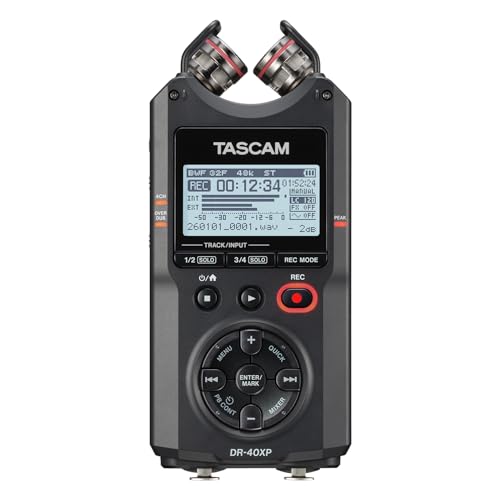
Best for Four-Channel Recording – TASCAM DR-40XP
For buyers seeking a field recorder with dual XLR that can capture more than two sources, the TASCAM DR-40XP offers four-channel recording. Its adjustable stereo microphones can record alongside the two XLR/TRS inputs, while 32-bit float support and USB-C connectivity suit music, video, and interview workflows.
Best For: Creators who want to combine the built-in microphones with external inputs during location recording.
Pros:
- Four-channel recording captures built-in microphones and external inputs simultaneously.
- Two XLR/TRS inputs use ultra-low-noise HDDA preamps.
- Adjustable A-B or X-Y microphones support flexible stereo recording.
- Functions as a 2-in/2-out USB-C audio interface.
Cons:
- microSD card and batteries are not included.
- Its 6.1-ounce weight and handheld design may provide fewer physical controls than larger recorders.
The DR-40XP stands out when you want the convenience of built-in microphones without giving up two external inputs. Its four-channel design makes it particularly useful for layered location or performance recordings.
Best for Hands-On Control – Zoom H5 Studio
The Zoom H5 Studio is a field recorder with dual XLR/TRS inputs, large stereo microphones, and dedicated gain knobs for hands-on level adjustments. Its 32-bit float recording, F-Series preamps, and support for up to four simultaneous tracks make it a strong portable option for filmmakers and musicians.
Best For: Users who prioritize direct gain control, high-resolution recording, and strong built-in stereo microphones.
Pros:
- Two XLR/TRS inputs and dedicated gain knobs provide direct recording control.
- 19.4 mm X/Y microphones are designed for detailed stereo capture.
- 32-bit float recording helps protect against clipped recordings.
- Records up to four tracks simultaneously at up to 192 kHz in WAV format.
Cons:
- Requires four AA batteries.
- At 14.4 ounces, it is heavier than the listed TASCAM handheld options.
The H5 Studio is a good fit when tactile controls and built-in microphone quality are as important as dual-input connectivity. Its high-resolution and multi-track features give it room for more demanding portable recording setups.
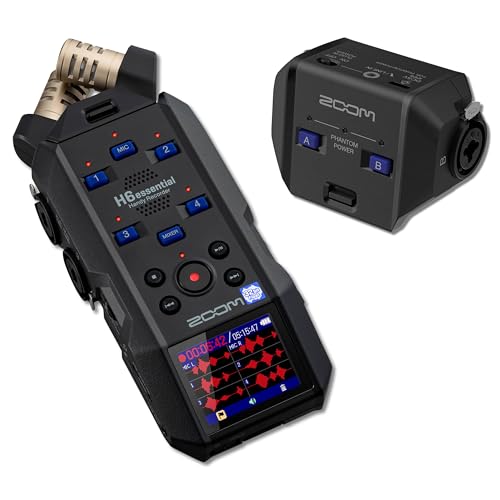
Best for Multi-Mic Field Work – Zoom H6essential 6-Track Bundle
If you need a field recorder with dual XLR inputs—and more room to grow—the Zoom H6essential bundle adds the EXH-6e capsule to provide six locking XLR/TRS inputs in one handheld setup. Its 32-bit float recording, per-channel phantom power, lavalier input, and USB-C interface make it suited to demanding documentary, panel, and event work.
Best For: Documentary filmmakers, panel podcasters, ENG operators, and multi-mic event recordists.
Pros:
- Six XLR inputs with the EXH-6e capsule, plus a 3.5mm lavalier input.
- 32-bit float recording on every channel helps recover clipped audio in post.
- Works as a 6-in/2-out USB-C interface while recording to an SD card.
- Includes the XYH-6e stereo capsule for switching between multi-mic and stereo recording.
Cons:
- The larger six-input configuration is more than needed for simple two-mic sessions.
- Using the expanded inputs requires the EXH-6e capsule to be attached.
This is the most capable option here for productions that may expand beyond two microphones. Choose it when channel count and flexible field connectivity matter more than keeping the recorder especially compact.
Best Compact Dual-XLR Recorder – Zoom F3 Professional Field Recorder
The Zoom F3 is a focused field recorder with dual XLR inputs for filmmakers and recordists who need secure connections without carrying a larger multitrack unit. Its locking XLR/TRS inputs, 32-bit float recording, and ultra-low-noise preamps are designed for unpredictable production environments.
Best For: Run-and-gun filmmakers, location recordists, and musicians using a compact two-input setup.
Pros:
- Two locking XLR/TRS inputs help keep microphone connections secure.
- 32-bit float recording reduces the need to stop and adjust levels during changing peaks.
- Ultra-low-noise preamps support clean recording in demanding conditions.
- Flexible battery, standalone, and USB workflows suit long days on location.
Cons:
- Only two XLR/TRS inputs are provided, so it is not intended for larger multi-mic setups.
- It does not offer the built-in rhythm and layering features found on the R4.
For a straightforward field recorder with dual XLR connections, the F3 is the specialist choice. It keeps the setup compact while prioritizing secure inputs, clean preamps, and clip-resistant recording.
Best for Layered Music Ideas – Zoom R4 Multi-Track Recorder
The Zoom R4 combines a field recorder with dual XLR/TS combo inputs, a built-in stereo microphone, and simple multitrack production tools. It is a practical alternative if your idea of a field recorder with dual XLR inputs includes layering tracks, bouncing parts, and rehearsing with built-in rhythms.
Best For: Musicians, songwriters, and mobile creators recording vocals, instruments, and layered ideas.
Pros:
- Two XLR/TS combo inputs accept microphones, instruments, keyboards, and other sources.
- Supports up to four tracks with bouncing and undo for continued overdubbing.
- Built-in stereo microphone and more than 80 rhythm patterns support portable songwriting.
- Provides 32-bit float recording and works as a 2-in/2-out USB audio interface.
Cons:
- It offers fewer external inputs than the H6essential bundle.
- Its 14-hour stated digital recording time is shorter than the F3’s listed 73 hours.
The R4 is less focused on documentary-style capture and more useful as a portable creative workstation. Pick it when dual combo inputs, onboard microphones, rhythms, and track layering are central to your workflow.
Professional Production Pick – Zoom F6 Field Recorder
If you need a field recorder with dual XLR—or more inputs—the Zoom F6 is built for demanding location work. Its 32-bit float recording, six XLR inputs, and timecode I/O make it a strong choice for filmmakers, musicians, and multitrack productions.
Best For: Film crews, broadcast workflows, and recording multiple microphones at once.
Pros:
- 32-bit float recording with dual A/D converters helps capture quiet and loud sources without clipping.
- Six XLR inputs support simultaneous multichannel recording, with up to 14 tracks.
- Timecode I/O enables frame-accurate synchronization with video.
- Works as a standalone recorder or USB audio interface.
Cons:
- Its six-input professional design is likely more recorder than casual users need.
- At 2.4 pounds, it is heavier than compact handheld options.
The F6 is the most capable option here for complex productions. Choose it when input count, timecode, and clip-resistant recording matter more than minimum size.
Compact Dual-Input Pick – Zoom H1 XLR Recorder
The Zoom H1 XLR is a practical field recorder with dual XLR for interviews, podcasts, music, and small production setups. It combines two locking XLR/TRS inputs with 32-bit/96kHz recording, a waveform display, and a compact 6.4-ounce body.
Best For: Solo creators, podcasters, interview recording, and lightweight camera audio setups.
Pros:
- Two locking XLR/TRS combo inputs accommodate microphones and instruments.
- 32-bit/96kHz recording provides detailed audio capture.
- OLED waveform display makes level monitoring straightforward.
- Supports SDXC cards up to 1TB and includes 3.5mm input and headphone output.
Cons:
- Two XLR inputs limit simultaneous sources compared with larger multitrack recorders.
- It requires two AA batteries, which are not listed as included.
The H1 XLR is the simplest dual-input choice in this group. Its small size and straightforward monitoring make it especially convenient when portability and quick setup are priorities.
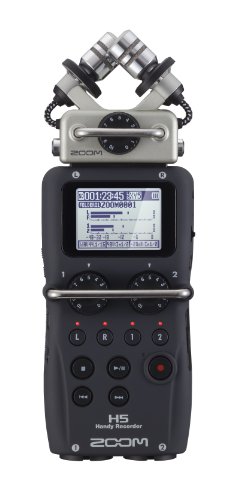
Flexible Handheld Pick – Zoom H5 4-Track Recorder
The Zoom H5 is a flexible handheld field recorder with dual XLR/TRS inputs and four-track simultaneous recording. Its interchangeable capsule system, phantom power, selectable pads, and USB interface make it useful for musicians and filmmakers who want room to expand.
Best For: Musicians, filmmakers, and users who want interchangeable microphones and four-track recording.
Pros:
- Two XLR/TRS combo inputs include selectable phantom power and -20dB pads.
- Four-track simultaneous recording supports more than basic stereo capture.
- Interchangeable input capsules allow different microphone configurations.
- Functions as a multichannel or stereo USB audio interface for PC, Mac, and iPad.
Cons:
- Records to SD/SDHC cards up to 32GB, offering less listed capacity than the H1 XLR’s SDXC support.
- Its feature set may be more than needed for simple two-input recordings.
The H5 is a strong middle ground between a basic dual-XLR recorder and a larger professional unit. It is particularly appealing if capsule flexibility and four-track capability are valuable to your workflow.
How We Picked the Best Field Recorder with Dual Xlr
We focused on recorders with at least two XLR or XLR/TRS combo inputs, since dual professional inputs allow stereo recording, two-microphone interviews, dual-system film audio, and flexible music setups. We also considered recording format, preamp capability, input monitoring, portability, power options, storage, and ease of use.
32-bit float models receive special attention because they provide substantial protection against clipped recordings when levels change unexpectedly. However, bit depth does not replace good microphone placement, monitoring, or sensible gain practices. The right choice depends on whether you prioritize simplicity, multitrack expansion, timecode, or maximum portability.
Quick Comparison
- Best for compact film rigs: TASCAM FR-AV2 and Zoom F3.
- Best for larger multitrack setups: Zoom F6 and Zoom H6essential.
- Best for musicians and overdubbing: Zoom R4.
- Best all-around handheld designs: TASCAM DR-40XP and Zoom H5.
- Best for simple two-channel recording: Zoom H1 XLR.
- Best for straightforward handheld versatility: Zoom H4 Essential.
Key Buying Factors for a Field Recorder with Dual Xlr
Input Type and Channel Count
XLR/TRS combo inputs accept microphones, balanced line sources, and some instrument-level connections. Two inputs are enough for stereo pairs, interviews, and basic dual-microphone production. If you expect to record several sources at once, choose a model with additional inputs or expansion support.
32-Bit Float Recording
32-bit float recording can make location work more forgiving by preserving usable audio when a sudden peak exceeds the initial gain setting. It is particularly useful for unpredictable dialogue, events, and documentary recording. Confirm that your editing software supports the format and remember that analog overload before conversion cannot be repaired.
Power, Mounting, and Portability
Handheld models suit mobile interviews and music practice, while compact bodypack-style recorders can mount neatly on a camera or rig. Check battery life, USB power, mounting threads, weather protection, and whether the recorder remains practical with cables attached.
Monitoring and Workflow
Look for a clear display, headphone monitoring, level controls, limiter or safety features, and easy file management. Timecode support matters for multi-camera filmmaking; multitrack and overdub functions matter more for musicians and complex productions.
Who Should Buy Which Field Recorder with Dual Xlr?
Filmmakers: Choose a compact recorder with reliable preamps, camera-friendly mounting, and timecode if synchronization is important. Musicians: Prioritize multitrack recording, overdubbing, effects, and instrument-friendly inputs. Podcasters and interviewers: Favor simple controls, dependable headphone monitoring, and fast setup. Documentary and event recordists: Consider 32-bit float and extended battery or USB power options for changing sound levels.
Before buying, confirm the included capsule, cables, memory-card requirements, and power accessories. A recorder that matches your workflow is usually more valuable than one with the highest headline channel count.