The best samplers with sequencer combine sound capture, beat programming, and pattern-based composition in one compact instrument. That makes them useful for sketching ideas quickly, performing without a computer, or building complete grooves on the go.
This roundup compares 10 options across portable samplers, grooveboxes, drum machines, and advanced production instruments. Consider workflow, sequencing depth, sampling features, portability, and connectivity to find the right fit.
Best 10 Samplers with Sequencer Picks for 2026
Pocket Sampling Pick

- Built-in mic and line-in sampling
- Melodic, drum, and sequencer modes
- Pocket-sized with 16 onboard effects
Best For: Portable beat-making and quick sound sketches
Standalone Production Choice

- Four flexible sampler, drum, or synth tracks
- Built-in mic, speaker, battery, and 16-step sequencer
- Includes Ableton Live 12 Intro
Best For: Portable production and Ableton-based workflows
Pattern Sequencing Value
- Eight-voice sample-based drum machine
- 16-step sequencer with pattern chaining
- Speaker, headphone output, and USB connectivity
Best For: Hands-on electronic beat programming
Advanced Sound Design Pick

- Built-in mic with chopping and resampling
- Chromatic, polyphonic sample playback
- Granular controls plus per-sample filters and envelopes
Best For: Portable experimental sampling and sound design
Portable Idea Station

- All-in-one sampler, sequencer, drums, and synth system
- Built-in speaker, microphone, and rechargeable battery
- Compact controls for composing and arranging ideas
Best For: Mobile musicians and electronic creators
MPC Sampling Hub

- Portable standalone sampler, sequencer, and effects processor
- 16 MPC pads with sample chopping and resampling tools
- Battery power, microphone, speaker, and microSD storage
Best For: Beatmakers and DAWless producers
Beginner Groovebox

- Combines sequencer, sampler, and drum machine functions
- Automatic note compatibility supports quick musical results
- Captures voices, instruments, and everyday sounds
Best For: Beginners and exploratory music makers
Best Overall

- 16 audio tracks for stereo or mono samples
- 128-step sequencer with Song Mode
- Per-track effects, filters, and LFOs
Best For: Detailed beat production and full compositions
Best Pocket Sampler
Teenage Engineering PO-35 Speak

- Built-in mic and 3.5 mm line input
- 120 seconds of sample memory
- Eight voice characters and effects
Best For: Portable sampling and quick musical sketches
Best Themed Sampler
Teenage Engineering EP-1320 Medieval

- Hundreds of medieval sounds and samples
- Four-track sequencer with stereo or mono voices
- Built-in mic, effects, and 999 sample slots
Best For: Medieval-themed production and live performance
Pocket Sampling Pick – PO-33 K.O. Micro Sampler
For shoppers seeking samplers with sequencer functionality in the smallest possible format, the teenage engineering PO-33 K.O. combines a built-in microphone, line input, drum machine, melodic sampling, sequencing, and effects in a battery-powered pocket unit.
Best For: Portable beat-making, quick environmental sampling, and beginners who want an affordable, hands-on sampler.
Pros:
- Samples through the built-in microphone or 3.5 mm line input.
- Offers melodic and drum modes with sequencing for complete patterns.
- Includes 16 effects, a built-in speaker, and headphone output.
- Compact battery-powered design with approximately 40 seconds of sample memory.
Cons:
- Sample memory is limited to about 40 seconds.
- Its ultra-compact controls may be less comfortable for extended sessions.
The PO-33 K.O. is a strong choice when portability and immediacy matter more than extensive memory or a larger interface. It is especially practical for sketching beats and melodies anywhere.
Standalone Production Choice – Ableton Move
The Ableton Move is a more complete option among samplers with sequencer features, pairing four flexible tracks with a 16-step sequencer, built-in microphone, speaker, rechargeable battery, and standalone operation. It can also connect to Ableton Live 12 Intro for expanded editing and production.
Best For: Producers who want a portable groovebox for building tracks, sampling, performing, and later refining ideas in Ableton Live.
Pros:
- Works without a computer and includes a built-in rechargeable battery, microphone, speaker, and processor.
- Four tracks can function as drum kits, samplers, or synthesizers.
- Captures samples through the microphone, 3.5 mm input, or USB-C and supports sample slicing.
- Includes 32 velocity-sensitive pads, polyphonic aftertouch, effects, and Ableton Live 12 Intro.
Cons:
- Its 2.1-pound weight is less pocketable than compact sampler-only devices.
- Ableton Live 12 Intro has limited tracks and instruments/effects compared with larger editions.
Move suits buyers who want an instrument that can develop from a quick sketch into a more structured production. Its wireless Ableton integration and onboard tools make it the most workflow-oriented choice here.
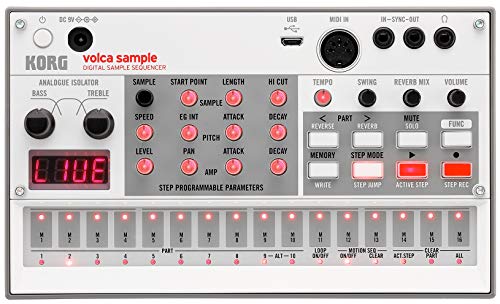
Pattern Sequencing Value – Korg Volca Sample 2
Korg Volca Sample 2 Digital Sample Sequencer Drum Machine w/Pattern Chain Mode and 16-step Sequencer
Check Price On AmazonThe Korg Volca Sample 2 is a focused digital sample sequencer for buyers who prioritize pattern-based drum programming. It combines eight-voice polyphony with a 16-step sequencer, pattern chaining, start delay, onboard effects, and computer connectivity for managing samples and patterns.
Best For: Beatmakers working in electronic styles such as future bass, trap, and lo-fi hip hop who want hands-on pattern sequencing.
Pros:
- Provides eight-voice polyphony and a 16-step sequencer.
- Pattern Chain mode and start delay support more advanced sequencing.
- Includes digital reverb, a double filter, and increased memory over previous models.
- Works standalone with an integrated speaker and headphone output.
Cons:
- Sample management and pattern organization rely on dedicated computer software.
- It is primarily focused on sample-based drum-machine workflows rather than broad synthesis.
Volca Sample 2 is a sensible middle ground for users who want sequencing depth without moving to a larger groovebox. Its compact design, pattern chaining, and computer librarian make it well suited to repeatable beat construction.
Advanced Sound Design Pick – Roland AIRA Compact P-6
The Roland AIRA Compact P-6 is designed for detailed sample manipulation in a small format. Along with its built-in microphone and powerful sequencer, it offers chopping, step sampling, resampling, chromatic playback, per-sample filters and envelopes, and granular controls.
Best For: Sound designers and performers who want portable sampling with deeper editing, resampling, and granular experimentation.
Pros:
- Captures sounds directly with its built-in microphone.
- Supports sample chopping, step sampling, resampling, and chromatic polyphonic playback.
- Provides dedicated filters and envelopes for each sample.
- Offers extensive granular controls and sample transfer through P-6 Sample Tool software.
Cons:
- Its advanced granular and sample-editing features may require more learning than simpler samplers.
- Sample editing and import/export use a separate computer software tool.
The P-6 stands out when creative manipulation is more important than straightforward drum sequencing. Its combination of onboard sampling, sequencing, and granular controls gives experienced users plenty of room for unusual textures and custom loops.
Portable Idea Station – Yamaha SEQTRAK
For musicians seeking samplers with sequencer functionality in a compact format, the Yamaha SEQTRAK combines onboard sampling, drums, synths, sound design, and sequencing in one portable unit. Its built-in speaker, microphone, rechargeable battery, and hands-on controls make it practical for developing ideas away from a computer.
Best For: Mobile songwriters, electronic musicians, and creators who want an all-in-one groovebox for capturing and arranging ideas anywhere.
Pros:
- Combines drums, synths, sound design, sampling, and sequencing in one system.
- Advanced sequencer supports composition, arrangement, and dynamic playback.
- Compact, lightweight design includes a speaker, microphone, and rechargeable battery.
Cons:
- Its plastic construction may feel less substantial than larger studio hardware.
- The compact interface may require learning the three-part control layout.
The SEQTRAK is a strong choice when portability and fast idea capture matter most. It offers a focused hardware workflow without requiring separate sampling, sequencing, and sound-design devices.
MPC Sampling Hub – Akai Professional MPC Sample
The Akai Professional MPC Sample is one of the more focused samplers with sequencer options for beatmakers who want the classic MPC workflow in a portable format. It supports standalone sampling, chopping, sequencing, effects, and playback without requiring a computer or DAW.
Best For: Beatmakers, finger drummers, DAWless producers, and performers who want hands-on sampling with portable standalone operation.
Pros:
- Includes 16 responsive MPC pads, a color display, and an intuitive chopping workflow.
- Battery power, built-in speaker, microphone, and microSD storage support mobile creation.
- Offers internal effects, resampling, timestretching, repitching, and more than 100 factory kits.
- Provides USB-C audio/MIDI, line I/O, headphone output, and MIDI connectivity through an adapter.
Cons:
- The MIDI DIN adapter is not included.
- Its feature-rich MPC workflow may take time for beginners to master.
Choose the MPC Sample if sampling and beat construction are your priorities. Its pads, effects, storage, and standalone design give it a particularly complete workflow for portable production and live use.
Beginner Groovebox – myTRACKS Groovebox
The myTRACKS Groovebox is a beginner-friendly option among samplers with sequencer features, pairing a sampler, drum machine, and sequencer with simple controls. It is designed to help users build complete tracks from instruments, loops, effects, recordings, and captured everyday sounds without lessons or apps.
Best For: Beginners, families, and curious creators who want an approachable way to experiment with beats, instruments, recordings, and sound effects.
Pros:
- Supports complete tracks with drums, instruments, loops, effects, and recordings.
- Built-in sampler can capture voices, instruments, and everyday sounds.
- Automatic note compatibility helps beginners create musical results without lessons.
- Includes hands-on filters, echoes, pitch effects, drum pads, and push-button controls.
Cons:
- USB is the listed connectivity option, so broader hardware integration may be limited.
- It is aimed at accessible experimentation rather than advanced professional sequencing.
The myTRACKS stands out for simplicity rather than deep technical control. It is a sensible starting point for anyone who wants to explore sampling and sequencing through an easy, play-focused workflow.
Best Overall – Elektron Digitakt II
The Elektron Digitakt II is a powerful choice among samplers with sequencer capabilities, combining 16 audio tracks with a flexible 128-step Elektron sequencer. Its track-level effects, filters, Euclidean sequencing, and Song Mode make it suited to detailed beat production and complete compositions.
Best For: Producers who want deep sequencing, extensive track control, and a full-featured sampling workstation.
Pros:
- 16 stereo or mono audio tracks, plus MIDI sequencing.
- Song Mode supports creating, editing, and playing full compositions.
- Includes per-track effects, assignable LFOs, Euclidean sequencing, and multiple filter options.
Cons:
- Less compact and portable than pocket-sized samplers.
- Its extensive feature set may require more time to learn.
With its broad sequencing architecture and track-by-track sound-shaping tools, the Digitakt II is the strongest all-around option here for users who prioritize control and composition depth.
Best Pocket Sampler – Teenage Engineering PO-35 Speak
The PO-35 Speak is a highly portable option among samplers with sequencer functionality. It can capture sounds through its built-in microphone or 3.5 mm line input, store up to 120 seconds of samples across eight voice-character slots, and add built-in effects for quick, portable experimentation.
Best For: Beginners, mobile beatmakers, and performers who want a battery-powered sampler that fits in a pocket.
Pros:
- Built-in microphone and line input support convenient sampling.
- Eight voice characters and eight built-in effects encourage sound experimentation.
- Compact, battery-powered design with a built-in speaker.
Cons:
- 120 seconds of sample memory is limited compared with larger samplers.
- Its small format provides fewer tracks and controls than full-sized units.
The PO-35 Speak favors immediacy and portability over extensive sequencing depth. It is an appealing pick for sketching ideas, manipulating vocals, and making music away from a full studio setup.
Best Themed Sampler – Teenage Engineering EP-1320 Medieval
The Teenage Engineering EP-1320 Medieval offers a distinctive take on samplers with sequencer features, pairing hundreds of medieval samples with a four-track sequencer and built-in microphone. Stereo effects, punch-in effects, and 999 sample slots give it room for both themed production and original recordings.
Best For: Creators who want medieval instruments, chants, and performance-focused sampling in one specialized device.
Pros:
- Includes hundreds of samples recorded with medieval instruments and performers.
- Supports sampling through the built-in microphone or line input.
- Four-track sequencing, 6 stereo or 12 mono voices, and 999 sample slots.
Cons:
- The medieval sound library is specialized and may not suit every genre.
- Four sequencer tracks are fewer than the Digitakt II provides.
The EP-1320 stands out for its focused sound world and live-oriented controls. It is a particularly interesting choice when its medieval library matches your creative direction, while still allowing external sampling and MIDI or sync connections.
How We Picked the Best Samplers with Sequencer
We focused on instruments that combine sampling with an onboard sequencer rather than treating either feature as an afterthought. The selection spans compact pocket devices, dedicated sample sequencers, standalone grooveboxes, and more advanced production systems. We considered how quickly each unit supports idea creation, how much control it offers over samples and patterns, and whether it can work independently from a computer.
We also looked at practical details such as built-in microphones, speakers, effects, pattern chaining, track count, portability, connectivity, and the learning curve. Since these products target different users, the “best” choice depends on whether you prioritize immediacy, performance control, sound design, or full song construction.
Quick Comparison
- Most portable: Pocket-sized samplers are easy to carry and excel at quick sketches, beat ideas, and spontaneous performance.
- Best for standalone creation: Larger grooveboxes and workstation-style instruments offer more tracks, effects, controls, and arrangement options.
- Best for pattern-based workflows: Dedicated sample sequencers make it easy to build loops, switch patterns, and develop rhythmic ideas.
- Best for computer integration: Instruments designed around modern music software may provide smoother editing, arranging, and project transfer.
Key Buying Factors for Samplers with Sequencer
Sampling and Sound Capture
Check whether the instrument samples through a built-in microphone, line input, USB, or a combination of connections. Also verify sample memory, recording time, format support, trimming tools, and whether samples can be pitched, sliced, or resampled. A microphone is convenient for field recordings and vocal ideas, while dedicated inputs are generally better for instruments and external gear.
Sequencer Workflow
Look at step count, track count, pattern length, parameter locks, probability, motion recording, pattern chaining, and song-mode features. A simple 16-step sequencer can be ideal for fast drum programming, but longer patterns and more advanced automation matter if you want evolving arrangements or complete tracks.
Performance and Effects
Pads, buttons, knobs, touch controls, and live effects all influence how naturally an instrument performs. Consider whether you can mute tracks, adjust effects, resample loops, and change patterns without interrupting playback. Built-in effects can make a compact sampler much more useful for live work.
Portability and Connectivity
Battery operation, built-in speakers, size, and weight matter for mobile production. For studio use, check MIDI, USB, audio outputs, synchronization options, and compatibility with your existing setup. A portable instrument is most valuable when it fits the way you actually create music.
Who Should Buy Which Samplers with Sequencer?
Choose a pocket sampler if you want the smallest, fastest tool for beats, vocal snippets, and playful experimentation. Choose a dedicated sample sequencer if pattern programming and rhythmic performance are your main priorities. Choose a modern groovebox if you want sampling, sequencing, effects, and multiple sound sources in one standalone device. Choose an advanced sampler or drum computer if you need deeper sound shaping, more tracks, detailed automation, and room to grow.
Before buying, match the workflow to your experience level and intended setting. The most feature-packed option is not always the best choice; a focused instrument that encourages regular use can be more productive than a complex system that slows down the creative process.