Finding the right studio monitors for small room setups is about more than size. You need clear mids, controlled bass, and a balanced sound that stays honest when your desk and walls are working against you.
In this roundup, we focus on compact picks that suit bedrooms, desks, and limited home studios without overloading the space.
Best 10 Studio Monitors for Small Room Picks for 2026
Compact Room Accuracy

- Front-firing port supports small-room placement
- 5.25-inch woofer gives accurate low end
- EBM waveguide widens the sweet spot
Best For: Home studios that need flexible tuning in a small room
Desktop Minimalist Pick

- Compact tabletop design saves desk space
- 2-band EQ for simple tonal adjustment
- Bluetooth adds extra convenience
Best For: Desk-based monitoring in a very small setup
Budget Stereo Pair
- Matched pair for true stereo monitoring
- Front-firing port supports tight spaces
- Acoustic tuning helps adapt to the room
Best For: Home studio users who want a conventional nearfield stereo pair
Desktop Audiophile Choice

- USB-C makes desktop hookup simple
- D-ART tweeter delivers detailed highs
- Angled stands and DSP aid placement
Best For: Desktop creators who want compact, premium-sounding monitors
Compact Multimedia Pick
Mackie CR3-X 3.5-Inch Monitors
- 50 watts of clean stereo sound
- Front-facing headphone jack
- 1/4-inch, 1/8-inch, and RCA inputs
Best For: Small desks and simple wired desktop setups
Flexible Budget Monitor
Edifier MR3 Powered Studio Speakers

- Hi-Res Audio Certified, 52Hz to 40kHz
- TRS, RCA, AUX, headphone out, and Bluetooth
- Music, Monitor, and Custom modes
Best For: Creators who need flexible inputs and easy tuning
Ultra-Compact Reference Choice
IK Multimedia iLoud Micro Monitor

- True linear frequency response with DSP tuning
- 50W RMS total power and 55Hz low end
- Bluetooth, RCA, and 1/8-inch aux inputs
Best For: Tiny studios and portable desktop production
Compact Starter Pick
PreSonus Eris 3.5 Powered Studio Monitors

- 50W active pair with clear, distortion-free sound
- Room tuning controls help adapt to small spaces
- TRS, RCA, aux, and headphone jack support easy hookups
Best For: Small desks, beginner home studios, and mixed-use listening
Flexible Desk Tuner
Mackie CR3.5 Creative Reference Monitors

- Tone knob adjusts from flat sound to extra bass and sparkle
- Location switch optimizes desktop or bookshelf placement
- TRS, RCA, and 3.5 mm inputs cover many sources
Best For: Users who want one compact speaker pair that can switch between accurate monitoring and casual listening
Wireless Feature Pick
Ortizan C7 Powered Studio Monitors Pair

- Bluetooth 5.3 plus USB, RCA, AUX, and TRS inputs
- Built-in 24-bit DAC supports direct digital audio
- Flat-response tuning aims for clear, accurate monitoring
Best For: Small home studios and desktop setups that need flexible wired and wireless input options
Compact Room Accuracy – PreSonus Eris Studio 5
PreSonus Eris Studio 5 5.25-inch 2-Way Active Studio Monitors with EBM Waveguide
Check Price On AmazonIf you’re shopping for studio monitors for small room setups, the PreSonus Eris Studio 5 is built around placement flexibility and controlled bass. Its front-firing port, Acoustic Space controls, and wide EBM waveguide make it easier to get a balanced listening position when your speakers have to sit close to a wall or corner.
Best For: Home producers who need a full-size 5.25-inch monitor that can be tuned for a tight room.
Pros:
- Front-firing port and room-tuning controls help with small-room placement.
- 5.25-inch woven-composite woofer delivers smooth, accurate low end.
- Wide EBM waveguide creates a broad sweet spot for stereo imaging.
- Balanced XLR, 1/4-inch TRS, and RCA inputs cover common setups.
Cons:
- Not as compact as desktop-focused speakers.
- Best results depend on using the acoustic tuning features correctly.
Overall, this is a practical pick when you want a monitor that can still sound controlled in a smaller space without giving up usable bass extension.
Desktop Minimalist Pick – Yamaha MS101-4
For studio monitors for small room work where desk space is limited, the Yamaha MS101-4 keeps things simple. Its compact tabletop design, 4-inch woofer, and built-in 2-band EQ make it a straightforward option for everyday monitoring at close range.
Best For: Creators who want a compact powered monitor for a desk-based setup.
Pros:
- Small tabletop footprint fits neatly on a crowded desk.
- 2-band EQ helps you make quick tone adjustments.
- 30W powered design is suited to near desktop listening.
- Bluetooth support adds convenience for compatible devices.
Cons:
- 4-inch woofer is less suited to deeper bass needs.
- Single-speaker format means it’s not a traditional stereo pair out of the box.
This is a clean, practical choice if you care more about footprint and ease of use than maximum low-end output.
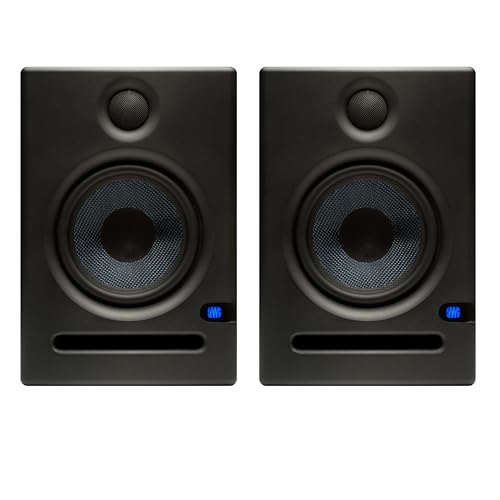
Budget Stereo Pair – PreSonus Eris E5 Pair
If you want studio monitors for small room mixing with a true left-right setup, the PreSonus Eris E5 Pair offers a straightforward nearfield option. The 5.25-inch woofer, front-firing port, and acoustic tuning controls are all useful when you need controlled sound in a compact space.
Best For: Buyers who want a matched stereo pair for nearfield monitoring in a home studio.
Pros:
- Matched pair gives you a proper stereo monitoring setup.
- Front-firing port helps with bass reproduction near walls.
- Acoustic tuning controls let you adapt to your room.
- Balanced XLR, 1/4-inch, and RCA inputs support flexible connections.
Cons:
- 5.25-inch size is still more desk-and-stand oriented than ultra-compact.
- Setup takes a bit of adjustment to get the tuning right.
For small rooms, this pair makes sense when you want the structure of a traditional monitoring rig without jumping to larger speakers.
Desktop Audiophile Choice – ADAM Audio D3V
For studio monitors for small room setups that lean heavily toward desktop use, the ADAM Audio D3V is a compact active pair with serious placement tools. USB-C connectivity, DSP-powered room switches, and angled stands make it especially convenient for close listening at a desk.
Best For: Creators who want a compact desktop monitor pair with detailed highs and modern connectivity.
Pros:
- USB-C input makes direct computer connection easy.
- D-ART tweeter is designed for precise, unfatiguing high frequencies.
- Passive radiators help extend low end down to 45 Hz.
- DSP switches and angled stands support desktop placement.
Cons:
- 3.5-inch woofers are limited compared with larger studio monitors.
- Best suited to nearfield desktop use rather than bigger rooms.
This is the most desk-centered option here, and it stands out if you want a compact monitor system with modern connectivity and detailed top-end clarity.
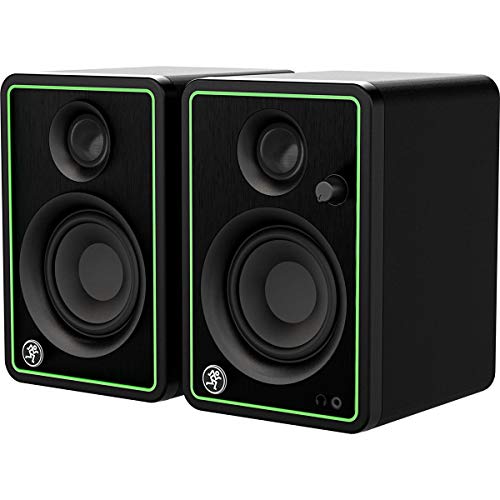
Compact Multimedia Pick – Mackie CR3-X 3.5-Inch Monitors
If you need studio monitors for a small room, the Mackie CR-X Series CR3-X is a compact wired option that fits easily on a desk while still delivering clean, articulate stereo sound. Its front-facing headphone jack and flexible inputs make it practical for computer use, music playback, gaming, and light video editing in tight spaces.
Best For: Small desks, home offices, and budget-friendly desktop setups that need simple wired monitoring.
Pros:
- 50 watts of clean stereo output for desktop listening
- Front-facing headphone jack automatically defeats speaker output
- Flexible 1/4-inch, 1/8-inch, and RCA inputs
- Hookup cables are included
Cons:
- Designed as multimedia monitors rather than a dedicated pro monitoring system
- Smaller 3.5-inch size may not provide deep low-end output
For a compact setup, the CR3-X focuses on convenience and straightforward wired connectivity. It is a sensible pick if you want an affordable, space-saving pair that handles everyday audio tasks without taking over the room.
Flexible Budget Monitor – Edifier MR3 Powered Studio Speakers
For studio monitors for a small room, the Edifier MR3 offers a versatile powered design with balanced TRS, RCA, AUX, and Bluetooth 5.4 connectivity. Its Hi-Res Audio certification and MDF cabinet are aimed at accurate listening, making it a strong everyday choice for music creation, video editing, guitar practice, and general desktop use.
Best For: Small-room creators who want flexible inputs, a compact footprint, and easy sound tuning.
Pros:
- Hi-Res Audio Certified with a flat response from 52Hz to 40kHz
- Balanced TRS, RCA, AUX, headphone output, and Bluetooth support
- Music, Monitor, and Custom modes plus EQ control through the EDIFIER ConneX app
- MDF cabinet helps reduce distortion
Cons:
- Smaller 3.5-inch mid-low drivers limit bass compared with larger monitors
- More feature-rich than a basic plug-and-play speaker pair
The MR3 stands out if you want one pair that can handle both casual playback and more deliberate monitoring in a small space. Its mix of inputs and app-based tuning makes it especially practical when your desk setup has multiple devices.
Ultra-Compact Reference Choice – IK Multimedia iLoud Micro Monitor
If your priority is studio monitors for a small room, the IK Multimedia iLoud Micro Monitor is built around an ultra-compact footprint and true linear frequency response. It includes internal DSP with EQ and position compensation, making it well suited to home and project studios where desktop placement and room quirks matter.
Best For: Tiny studios, travel setups, and desktop producers who need accurate monitoring in very limited space.
Pros:
- Smallest active studio reference monitoring system in the world
- Internal DSP provides EQ settings and position compensation
- 50W RMS total power with low-end response down to 55Hz (-3dB)
- Bluetooth plus Stereo RCA and 1/8-inch aux inputs
Cons:
- Very compact size means it is not intended for large-room filling volume
- Premium, feature-heavy design may be more than some casual listeners need
The iLoud Micro Monitor is a strong fit when desk space is tight but accuracy still matters. Its combination of DSP tuning, portable size, and multiple input options makes it one of the most space-efficient monitoring choices here.
Compact Starter Pick – PreSonus Eris 3.5 Powered Studio Monitors
If you want studio monitors for small room setups, the PreSonus Eris 3.5 is a compact, easy-to-place option with enough output for desktop listening, music production, and casual entertainment. The 3.5-inch woven-composite woofers and silk-dome tweeters are tuned for clear, balanced sound, while the built-in acoustic controls help you tailor the speakers to your space without extra gear.
Best For: Small desks, beginner home studios, and mixed-use listening where simple setup matters.
Pros:
- 50W built-in amplification delivers clean, distortion-free sound.
- High- and low-frequency tuning controls help adapt sound to the room.
- Balanced TRS, RCA, front aux, and headphone jack give flexible connectivity.
- Compact 3.5-inch design fits easily on a desk or bookshelf.
Cons:
- Small woofer size limits deep bass compared with larger monitors.
- Best suited to near-field use rather than filling a large room.
This is a practical pick if you need a compact, reliable pair that stays clear and controlled in tight spaces. It focuses on flexibility and tuning rather than raw low-end output.
Flexible Desk Tuner – Mackie CR3.5 Creative Reference Monitors
For studio monitors for small room setups, the Mackie CR3.5 stands out because it combines a compact 3.5-inch monitor design with useful sound-shaping controls. The tone knob lets you keep the response transparent for monitoring or add extra bass and sparkle for gaming and casual listening, and the location switch helps optimize the speakers for desktop or bookshelf placement.
Best For: Users who want one compact speaker pair that can switch between accurate monitoring and more fun everyday listening.
Pros:
- Tone knob lets you move from flat monitoring to boosted bass and highs.
- Location switch helps tune the speakers for desk or bookshelf use.
- TRS, RCA, and 3.5 mm inputs make connection to many devices simple.
- Built-in headphone output adds a private listening option.
Cons:
- Only one subwoofer option is mentioned, and it is sold separately.
- The 3.5-inch woofer is compact, so bass output will stay limited versus larger systems.
The CR3.5 is a strong choice if your small room setup needs flexibility more than maximum size. It gives you practical controls that help one pair work well for both focused and casual use.
Wireless Feature Pick – Ortizan C7 Powered Studio Monitors Pair
If you are shopping for studio monitors for small room use and want modern connectivity, the Ortizan C7 adds Bluetooth 5.3, USB, RCA, AUX, and balanced TRS support in a compact active pair. It is tuned for clear, precise sound with a flat response curve, and the 3.5-inch carbon fiber woofer plus silk dome tweeter aim for clean mids, smooth highs, and controlled detail.
Best For: Small home studios and desktop setups that need flexible wired and wireless input options.
Pros:
- Bluetooth 5.3 makes wireless playback quick and convenient.
- USB input with built-in 24-bit DAC supports direct digital audio.
- Balanced TRS input works with mixers, instruments, and pro gear.
- Flat-response tuning is designed for accurate monitoring.
Cons:
- Wireless convenience may not matter if you only want a strictly wired setup.
- The 3.5-inch design is compact, so it is not aimed at big-room bass output.
The C7 is a smart fit when connectivity is a priority in a tight space. It blends monitoring-focused tuning with the convenience of Bluetooth and USB for everyday use.
How We Picked the Best Studio Monitors for Small Room
We focused on compact monitors that make sense for Studio Monitors for Small Room use, prioritizing accurate tonal balance, manageable low-end output, nearfield performance, and practical features like rear- or front-panel controls, desktop tuning options, and flexible connectivity. We also favored models that are easy to place on a desk, shelf, or small stand without dominating the room.
Quick Comparison
Most buyers should compare driver size, cabinet footprint, connection options, and whether the speaker is designed for nearfield monitoring or more general desktop listening. In a small room, a 3.5-inch or 5.25-inch monitor may be easier to integrate than a larger cabinet, but the best choice depends on how much low-end extension you need and how far you’ll sit from the speakers.
Key Buying Factors for Studio Monitors for Small Room
Size and Placement
Measure your desk and listening distance before buying. Smaller cabinets are easier to position correctly, while larger monitors can sound oversized if they sit too close to walls or corners.
Bass Response and Room Control
In a compact room, too much bass can create muddy mixes. Look for monitors with usable low-end without hype, plus tone controls, boundary switches, or EQ features that help you tame room buildup.
Connectivity and Workflow
Match the inputs to your gear. USB-C, balanced inputs, Bluetooth, and desktop-friendly controls can be useful, but for mixing work, balanced analog connections are usually the safest choice.
Listening Distance and Intended Use
Nearfield monitors are typically the best fit for small spaces because they’re designed to sound consistent at close range. If your setup doubles as a gaming or media station, you may prefer a model that leans more versatile than strictly analytical.
Who Should Buy Which Studio Monitors for Small Room?
Choose the smallest, simplest monitor if your room is very tight or your desk is the main listening position. Step up to a 5.25-inch class monitor if you want more full-range sound and can manage placement carefully. For producers who value portability, desktop convenience, or multiple-device connectivity, compact powered models can be the most flexible option.
For most shoppers comparing Studio Monitors for Small Room setups, the sweet spot is a monitor that sounds accurate at low to moderate volumes, fits comfortably in the space, and gives you enough control to compensate for the room—not one that simply plays louder.