Fosi Audio ZH3 review: this is a compact desktop audio hub for people who want one box to handle DAC, headphone amp, and preamp duties.
If you need balanced outputs, multiple inputs, and tuning controls in a single unit, the ZH3 is built for that job.
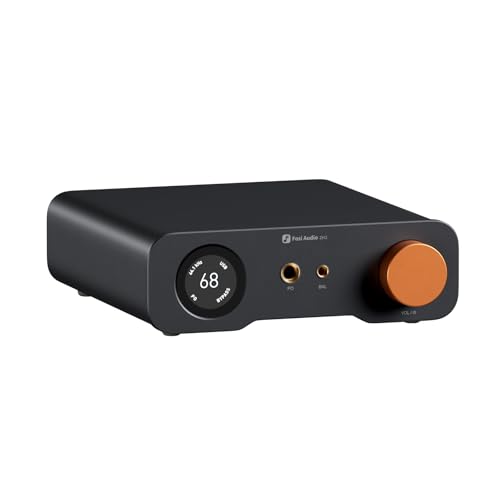
ZH3 Review Summary
The Fosi Audio ZH3 makes the most sense for desktop listeners who want a flexible front end for headphones, powered speakers, or an external amplifier without stacking several separate boxes.
Its appeal is not only the feature list, but the way those features are arranged around practical desktop use: balanced and single-ended headphone outputs, RCA and XLR line outputs, digital and analog inputs, remote control, and onboard tone shaping.
Verdict: strong fit for buyers who want one configurable hub instead of a minimal DAC. The ZH3 is especially attractive if you value output options, source compatibility, and the ability to tune sound without swapping gear.
Review Scorecard
| Category | Score | Buyer-focused rationale |
|---|---|---|
| DAC flexibility | 9/10 | USB, optical, coax, and RCA inputs cover many desktop and living-room setups. |
| Headphone output options | 9/10 | 6.35mm and 4.4mm outputs support both standard and balanced headphone cables. |
| Preamp usefulness | 8/10 | RCA and XLR outputs make it useful as a control center for active speakers or an amplifier. |
| Sound shaping | 8/10 | Bass, treble, filters, and swappable op-amps give real adjustment room. |
| Power and headroom | 8/10 | The listing supports demanding use better than basic entry DAC/amps. |
| Ease of integration | 9/10 | Remote control, screen-based controls, and UAC switching reduce setup friction. |
| Value for feature set | 8/10 | It concentrates a lot of desktop functionality into one unit, which many buyers will prefer. |
Key Features and Specifications of ZH3
The ZH3 is an all-in-one desktop HiFi DAC, headphone amplifier, and preamp.
The listing places it in the category of flexible source-switching gear rather than a stripped-down headphone amp, and that is the right way to judge it.
The core digital section uses an AKM4493SEQ DAC and XMOS XU316 USB platform, with support for PCM up to 768kHz/32bit and DSD512.
That is more capability than most listeners will ever need, but it matters because it signals broad modern input support and headroom for high-resolution playback.
On the output side, the ZH3 offers both 6.35mm single-ended and 4.4mm balanced headphone outputs.
The listing also calls out 640mW at 32 ohms from the single-ended output and 2570mW at 32 ohms from the balanced output, along with a 3-level gain switch for headphones from 16 ohms to 300 ohms.
For buyers choosing between easy-to-drive headphones and more demanding pairs, that range is a meaningful advantage.
For system use, the ZH3 includes coaxial, optical, USB, and RCA inputs, plus RCA and XLR outputs.
That means it can sit between multiple sources and multiple playback targets, which is useful if you want to switch between a computer, console, and external speakers without rearranging your desk.
Other notable details from the listing:
- Bass and treble EQ controls
- Six filter types, including bypass mode
- Two swappable op-amps
- UAC mode switching for broader console compatibility
- Remote control
- Screen-integrated controls for a cleaner front panel
- Fully balanced circuitry with low-noise design emphasis
- 12V trigger input
The manufacturer also notes that RCA and XLR output levels differ, so buyers should match the output type to the downstream gear.
Another important note is that EQ applies to headphone output only, not the preamp output.
That is the kind of detail that matters in real setups and should not be overlooked.
Pros and Cons of ZH3
Pros
- Very flexible connectivity for desktop, console, and speaker use
- Balanced and single-ended headphone outputs in one unit
- Useful preamp role for powered speakers or an external amplifier
- Tone controls and filters add real user control
- Remote and screen controls make daily use easier
- Gain switching helps it fit a wider range of headphones
Cons
- More complex than a basic DAC if you only need simple playback
- EQ is headphone-only, so preamp users do not get the same adjustment
- RCA and XLR output levels differ, which requires more careful system matching
- Feature depth may be overkill for buyers who want a minimalist desktop stack
Who Should Buy ZH3?
The ZH3 is a good match for buyers building a serious desktop audio setup around a PC, console, or mixed-source desk.
It makes sense if you want one unit to do the work of DAC, headphone amp, and preamp without giving up balanced connections or control over tone.
It also suits listeners who like to fine-tune sound with EQ and filter options.
If you already know you want bass and treble adjustment, a choice of filters, and the option to experiment with op-amps, the ZH3 gives you a lot to work with.
You should probably skip it if you want the simplest possible DAC/amp. If all you need is a small box that disappears into the desk and never changes, the ZH3 is probably more feature-rich than necessary.
Skip it too if your system is purely fixed-output. Because the ZH3 is designed around flexible routing and active control, buyers who do not need balanced outputs, preamp functionality, or tone shaping may be paying for capabilities they will never use.
Desktop Audio Setup Fit
Balanced Headphone Chains
The ZH3 is strongest when paired with headphones and cables that can take advantage of the 4.4mm balanced output.
The listing’s higher balanced power figure and gain switch suggest it is built to handle more demanding listening chains without feeling limited.
Speaker and Amplifier Control
If you use powered speakers or an external amplifier, the RCA and XLR outputs turn the ZH3 into a control center rather than just a headphone box.
That is a real usability upgrade for buyers who want one volume knob and one source switch for the whole desk.
Source Switching and Console Use
USB, optical, coax, and RCA inputs make the ZH3 easy to slot into mixed setups.
The UAC mode switching is especially relevant if you want console compatibility alongside music playback, because it broadens the number of systems the unit can reasonably serve.
Tuning and Long-Term Tweaks
Bass and treble controls, filter options, and swappable op-amps give the ZH3 a longer useful life than a fixed-voicing unit.
That matters for buyers who expect their preferences to evolve or who like to refine a setup over time instead of replacing hardware.
Alternatives to ZH3
If you want a different balance of simplicity, brand ecosystem, or tuning style, these are credible alternatives to compare on Amazon:
The FiiO K7 is a natural comparison if you want a more streamlined balanced DAC/amp path.
The Topping DX3 Pro+ is worth a look if compact digital control and all-in-one convenience matter most.
The iFi ZEN DAC line is often appealing to buyers who want a different tuning philosophy.
Schiit’s stack approach is a better fit if you prefer separating DAC and amp functions into distinct components.
Is ZH3 Worth It?
Yes, if you actually need what the ZH3 is built to do.
It is worth considering for buyers who want a balanced desktop DAC/amp/preamp with broad input support, flexible outputs, and real tuning controls in one unit.
It is less compelling if you only need a basic DAC for casual headphones and nothing else.
In that case, the ZH3’s extra routing, switching, and control options may be more than you want.
But if your goal is a versatile desktop hub that can handle headphones, speakers, and multiple sources, the Fosi Audio ZH3 is a sensible buy.