If you want a wireless handheld mic that is built around mobile recording rather than studio complexity, the COMICA Revo S is an easy product to understand.
This COMICA Revo S Wireless Handheld Microphone review focuses on where it fits, where it saves time, and where buyers should stay realistic.
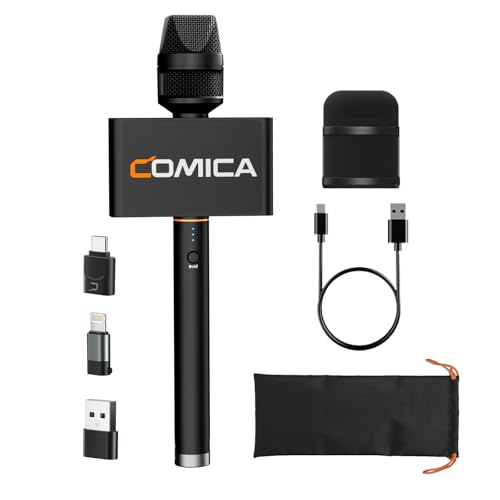
Revo S Review Summary
The COMICA Revo S is aimed squarely at creators who need a handheld microphone for interviews, speech clips, podcasts, and on-the-go video work.
Based on the listing, its biggest appeal is the combination of wireless digital output, one-key denoise, 48kHz/24bit recording, and wide device compatibility, which makes it attractive for people who want a streamlined setup with fewer cables and fewer steps.
If you are recording with an iPhone, Android phone, iPad, laptop, or computer and you value speed over deep manual control, this product makes sense.
It looks especially useful for reporters, vloggers, teachers, event hosts, and content creators who need a microphone that can be grabbed, paired, and used with minimal fuss.
Review Scorecard
| Category | Score | Editorial rationale |
|---|---|---|
| Setup simplicity | 9/10 | Wireless digital output and plug-and-play positioning suggest a fast start for mobile creators. |
| Audio capture focus | 8/10 | The 14mm condenser capsule and cardioid pattern are well matched to spoken voice. |
| Noise handling | 8/10 | One-key CalMix denoise is a strong fit for unpredictable indoor or outdoor environments. |
| Battery convenience | 8/10 | The listed up-to-15-hour battery life supports longer shoots and events. |
| Control flexibility | 7/10 | Three gain levels add some useful adjustment without turning it into a complex recorder. |
| Device compatibility | 8/10 | USB-C receiver support and broad phone/computer compatibility widen the use cases. |
| Value for creators | 8/10 | The feature set is focused on practical recording needs rather than unnecessary extras. |
Key Features and Specifications of Revo S
The COMICA Revo S is a wireless handheld microphone with a clear creator-first brief.
The listing describes a wireless digital output design that removes the need for cables during phone-based recording, which is exactly the kind of convenience many interview and vlog users want.
Several core details stand out:
- 14mm condenser mic capsule
- Cardioid polar pattern
- 48kHz/24bit recording
- One-key CalMix denoise
- Built-in 350mAh lithium battery
- Up to 15 hours of use
- Three gain levels
- USB-C receiver
- Compatibility with iPhone 16/15, Android smartphones, iPads, laptops, and computers
The listing also notes a Lightning adapter requirement for OTG use on Lightning-port devices.
That matters because buyers with older Apple hardware may need an extra accessory before the mic is fully ready.
From a practical buying standpoint, the feature mix suggests a microphone that is optimized for spoken voice, portability, and fast deployment.
It is not trying to be a full studio chain replacement; it is trying to make mobile speech capture easier and more reliable.
Pros and Cons of Revo S
Pros
- Very easy to understand for mobile creators. Wireless digital output and USB-C receiver support reduce setup friction.
- Well suited to spoken audio. The cardioid pattern and condenser capsule are logical choices for interviews, podcasts, and reporting.
- Useful noise reduction built in. One-key CalMix denoise should help in places where background noise is hard to control.
- Long battery window for a compact tool. Up to 15 hours is a meaningful convenience for creators who record all day.
- Gain control adds flexibility. Three levels are enough for basic adjustment without overwhelming casual users.
Cons
- Not built for deep audio tinkering. Buyers who want extensive manual control may find it too streamlined.
- Older Lightning users may need an extra adapter. The listing explicitly calls out OTG support requirements for Lightning-port devices.
- Best for voice-first work, not everything. The product is clearly aimed at interviews and speech recording rather than broad multipurpose sound capture.
The overall tradeoff is straightforward: convenience and voice-focused design are the main strengths, while advanced control and legacy-device simplicity are the main limitations.
Who Should Buy Revo S?
The COMICA Revo S is a strong fit for creators who need a microphone that works well in fast-moving, real-world scenarios.
If you make interviews, street clips, event coverage, vlogs, podcasts, classroom recordings, or product demos, the feature set is aligned with your workflow.
It also makes sense for buyers who want one microphone they can carry for multiple devices.
The wide compatibility list is one of the listing’s best selling points because it reduces the chance that the microphone ends up stuck in only one setup.
You should probably skip it if you want a more traditional studio microphone path with layered controls, or if your recording style depends on a highly configurable audio chain.
It is also less attractive if you are using older Lightning-based Apple gear and do not want to manage an extra adapter.
Revo S for Mobile Voice Recording
Wireless Simplicity
The biggest day-to-day advantage here is that the COMICA Revo S is designed to cut down the friction that often slows creators down.
If the goal is to get a microphone into use quickly on a phone, the wireless digital output approach is more valuable than a long list of niche features.
Voice Capture Focus
The 14mm condenser capsule and cardioid pattern point to a microphone that is meant to highlight the speaker and keep the recording focused.
That is a sensible combination for interviews and narration-style work, where clarity matters more than capturing a wide sound field.
Noise Control and Gain
The one-key denoise function and three gain levels make the microphone more adaptable in messy environments.
That does not turn it into a miracle fix for bad locations, but it does give buyers a practical way to handle changing room tone, street noise, or distance from the speaker.
Battery and Compatibility
Battery life and compatibility often decide whether a creator actually uses a microphone consistently.
The stated up-to-15-hour battery and broad support for phones, tablets, laptops, and computers make the COMICA Revo S easier to keep in rotation across different projects.
Alternatives to Revo S
If you are comparing options, these Amazon search pages are sensible starting points:
These alternatives cover different buyer priorities.
Rode Wireless GO and DJI Mic are obvious comparisons if you want a compact wireless creator setup.
Hollyland Lark is another family worth checking if your main goal is mobile convenience.
Shure MV7 is better known for voice-focused recording, while Rode VideoMic is useful if your workflow leans more toward camera-adjacent capture than handheld interview work.
Is Revo S Worth It?
Yes, if you want a practical wireless handheld microphone for speech-first content and you value speed, portability, and broad compatibility. The COMICA Revo S looks especially worth considering for interviews, vlogging, podcast-style clips, and mobile reporting where simple setup matters more than deep customization.
If you need a studio-centric mic with more manual control, or if your hardware setup makes the Lightning adapter requirement inconvenient, it is worth comparing alternatives before buying.
For the right creator, though, the COMICA Revo S appears to be a focused, sensible tool rather than a gimmicky one.