The best voice recorders for podcasts make it easier to capture clean dialogue, manage multiple speakers, and record confidently outside a studio. The right choice depends on your microphone setup, portability needs, and whether you want built-in editing or AI transcription.
We compare 10 options for solo hosts, interviewers, musicians, filmmakers, students, and creators—from dedicated podcast recorders to compact handheld and AI-powered devices.
Best 10 Voice Recorders for Podcasts Picks for 2026
Best Multitrack Podcast Setup

- Four XLR inputs for group podcasts
- Four individually controlled headphone outputs
- AI audio tools and direct phone video connection
Best For: Roundtable podcasts with multiple microphones
Best AI Note-Taking Recorder

- Transcription in 113 languages
- 128GB storage with up to 33 hours of recording
- One-touch operation with app-based summaries
Best For: Interviews, meetings, and spoken notes needing transcription
Best Flexible Field Recorder

- Stereo mics plus two XLR/TRS inputs
- 32-bit float and four-track recording
- USB-C recording with SD-card backup
Best For: Podcasters who also record music, video, or live events
Best Simple Long-Recording Option

- 64GB storage for extended recording
- Up to 32 hours of continuous recording
- Voice activation with adjustable sensitivity
Best For: Portable solo recording, interviews, and lectures
Best Portable Podcast Recorder

- 32-bit float recording for clip-free audio
- X/Y stereo microphones
- USB-C microphone mode
Best For: Portable podcasting, interviews, music, and content creation
Best High-Capacity Voice Recorder

- 128GB storage capacity
- Voice-activated recording
- MP3 and WAV recording options
Best For: Long lectures, interviews, notes, and spoken-word recording
Best Two-Person Podcast Recorder

- Two USB microphone inputs
- Two headphone outputs
- AI noise reduction and mix-minus
Best For: Two-person podcasts, remote guests, and live streaming
Best AI Workspace Recorder
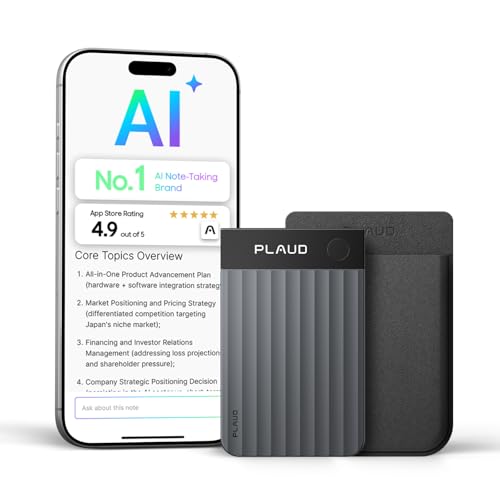
- Beamforming microphones capture voices across a room.
- Transcribes in 112 languages with speaker labels and summaries.
- Compact magnetic design with a free 300-minute starter plan.
Best For: Podcasters who want automated transcripts and organized follow-up notes
Best High-Capacity Recorder
Tonfarb 136GB Digital Voice Recorder

- Records PCM audio with automatic noise reduction.
- Offers up to 136GB of storage and 68 hours of battery life.
- Includes one-touch recording, voice activation, and USB-C transfer.
Best For: Users who need long, local recordings without AI subscriptions
Best Pocket AI Note Taker

- One-tap recording captures calls, meetings, and ideas.
- Creates summaries, action items, and conversation maps.
- MagSafe-compatible design offers hands-free mobile use.
Best For: Mobile creators who want AI-organized notes from recorded conversations
Best Multitrack Podcast Setup – Zoom PodTrak P4next
For creators comparing voice recorders for podcasts, the Zoom PodTrak P4next is built for roundtable sessions and remote guests. Four XLR inputs, multitrack recording, separate headphone controls, and phone connectivity give you a practical setup for recording and monitoring multiple speakers.
Best For: Podcasts with up to four local microphones, a call-in guest, and multiple people monitoring the conversation.
Pros:
- Four XLR inputs support up to four people and multitrack recording.
- Four headphone outputs have individual volume controls.
- AI noise reduction, Tone Enhancement, and compression help simplify mixing.
- Can send high-quality audio directly to a phone for video recording.
Cons:
- Designed around XLR microphones rather than a simple built-in-mic workflow.
- Requires two AA batteries for portable operation.
The P4next is the strongest fit when your podcast involves several speakers and you want recording, monitoring, and basic audio enhancement in one device. Its phone connection is also useful for creators who want to avoid syncing audio later.
Best AI Note-Taking Recorder – EVISTR L359
The EVISTR L359 is a compact option for buyers seeking voice recorders for podcasts that can also organize spoken content afterward. Its 3072Kbps recording, noise reduction, and companion app support transcription, summaries, speaker identification, and other AI-assisted workflows.
Best For: Interviewers, students, and professionals who want portable recording with transcription and summary tools.
Pros:
- AI DVR Link supports transcription in 113 languages and smart summaries.
- 128GB storage provides substantial room for recordings.
- Up to 33 hours of continuous recording from a full charge.
- One-touch recording, password encryption, and a HOLD switch simplify use and protect files.
Cons:
- The built-in microphone operates in mono rather than offering multitrack podcast inputs.
- AI processing uses the AI DVR Link app and a wired OTG connection.
The L359 makes the most sense when the value of a recording extends beyond playback. It is a pocket-friendly choice for capturing interviews or notes and turning them into searchable, summarized information through the app.
Best Flexible Field Recorder – Zoom H4 Essential
For podcasters who also record music, video, or live events, the Zoom H4 Essential offers more flexibility than a basic dictaphone. It combines built-in stereo microphones with two XLR/TRS inputs, 32-bit float recording, four-track capability, and USB-C connectivity for recording or streaming.
Best For: Podcasters, musicians, filmmakers, and interviewers who need a handheld recorder for varied sources.
Pros:
- Built-in stereo microphones work alongside external microphones or instruments.
- Two XLR/TRS inputs support microphones, instruments, mixers, and soundboards.
- 32-bit float recording helps capture demanding audio without clip-related concerns.
- Can record to a device over USB-C while saving a backup to an SD card.
Cons:
- Its two external inputs are less suited to large group podcasts than a four-input recorder.
- Portable recording requires two AA batteries.
The H4 Essential is a strong all-purpose pick when podcasting is only one part of your recording routine. Its built-in microphones suit quick setups, while the external inputs and USB-C connection accommodate more advanced production and streaming needs.
Best Simple Long-Recording Option – EVISTR L357
The EVISTR L357 is a straightforward choice among voice recorders for podcasts when portability, storage, and easy controls matter most. It records in WAV or MP3, includes adjustable noise reduction and gain, and uses voice activation to reduce silent sections in lectures, meetings, and interviews.
Best For: Solo interviewers, students, and everyday users who want a compact recorder with long battery life.
Pros:
- 64GB storage can hold up to 4,660 hours at 32Kbps.
- Up to 32 hours of continuous recording and 35 hours of playback.
- Voice activation and seven sensitivity levels help reduce silent passages.
- Supports WAV and MP3 recording, playback controls, and USB-C file transfer.
Cons:
- It uses a built-in microphone rather than multiple external microphone inputs.
- Its compact recorder design is better suited to individual recording than multi-person podcast production.
The L357 is practical for users who want dependable recording without a complicated interface. Its long runtime, large storage capacity, and voice-activated mode are especially useful for extended interviews, meetings, and spoken notes.
Best Portable Podcast Recorder – Zoom H1 Essential
The Zoom H1 Essential is a compact choice among voice recorders for podcasts, interviews, and content creation. Its X/Y stereo microphones, 32-bit float recording, and USB-C microphone mode make it practical for capturing voices and connecting directly to a computer or smartphone.
Best For: Solo podcasters, interviewers, musicians, and creators who want a lightweight recorder that can also work as a USB microphone.
Pros:
- 32-bit float recording helps provide clip-free audio.
- X/Y stereo microphones capture natural-sounding voices and surroundings.
- USB-C microphone mode supports podcasts, calls, livestreams, and voiceovers.
- Runs for up to 10 hours on two AAA batteries.
Cons:
- Its stereo recorder design may be more than needed for a simple single-voice memo.
- Requires separate headphones or other accessories for a more complete podcast setup.
Choose the H1 Essential when portability and flexible recording matter more than built-in podcast mixing. It is especially useful for creators who want one device for field audio, interviews, and USB recording.
Best High-Capacity Voice Recorder – EVIDA 128GB Digital Recorder
The EVIDA digital recorder is a practical option among voice recorders for podcasts when long storage, voice activation, and straightforward file management are priorities. It records in MP3 or WAV formats, includes noise cancellation, and can transfer files to a computer through USB.
Best For: Podcasters, students, writers, and interviewers who need extensive storage, voice-activated recording, and a simple playback device.
Pros:
- 128GB storage accommodates extensive recordings and other files.
- Voice activation can reduce blank sections and quiet snippets.
- Supports MP3 and WAV recording at multiple quality settings.
- Includes password protection, bookmarks, A-B repeat, and four storage folders.
Cons:
- The built-in microphone uses mono operation rather than stereo recording.
- No headphone jack is listed in the supplied specifications.
- Its 54-hour battery and recording figures may be less suitable for very long unattended sessions than its storage capacity suggests.
This recorder favors capacity and convenience over a full podcast production workflow. It can suit spoken-word recording, but creators wanting stereo ambience, direct monitoring, or dedicated podcast inputs may prefer a more specialized recorder.
Best Two-Person Podcast Recorder – Zoom PodTrak P2
The Zoom PodTrak P2 is purpose-built for two-person shows and stands out among voice recorders for podcasts with two USB microphone inputs and two headphone outputs. It also combines remote-call support, mix-minus echo reduction, AI noise reduction, and simultaneous streaming and SD card recording.
Best For: Two-person podcasts, remote interviews, and creators who want simple USB microphone connections with monitoring and live-streaming options.
Pros:
- Connects two USB microphones with a simple setup.
- Two headphone outputs support host and guest monitoring.
- Mix-minus helps reduce echo when adding a remote guest.
- AI noise reduction, tone shaping, compression, and de-essing support cleaner speech.
Cons:
- Battery life is listed at up to four hours on four AA batteries.
- It is designed around two USB microphones rather than built-in stereo microphones.
- Its podcast-focused features may be unnecessary for basic one-person dictation.
The P2 is the strongest fit here for a structured two-person podcast setup. Its dedicated inputs, headphone outputs, remote-guest handling, and simultaneous streaming make it more capable than a general-purpose voice recorder for conversation-based shows.
Best AI Workspace Recorder – Plaud Note Pro
For shoppers comparing voice recorders for podcasts, the Plaud Note Pro stands out when you want more than raw audio files. Its multi-microphone setup, automatic recording modes, and built-in transcription tools are designed to help capture interviews, calls, and online conversations with less manual note-taking.
Best For: Podcasters, journalists, and professionals who want recordings automatically converted into searchable transcripts, summaries, decisions, and action items.
Pros:
- Four MEMS microphones and one VPU microphone use AI beamforming to capture voices across a room.
- Smart Dual-Mode Recording switches between phone calls and in-person recording.
- Plaud Intelligence supports transcription in 112 languages, speaker labels, summaries, and customizable templates.
- Compact 1.06-ounce design includes a 0.95-inch AMOLED display and magnetic phone attachment options.
Cons:
- Advanced usage may require upgrading beyond the free 300-minute monthly transcription allowance.
- Its AI-focused workflow may be more functionality than users who only need basic audio recording require.
The Note Pro is a strong choice for podcast workflows that involve interviews, research calls, or frequent follow-up notes. It is particularly useful when transcription and organization matter as much as the recording itself.
Best High-Capacity Recorder – Tonfarb 136GB Digital Voice Recorder
For voice recorders for podcasts, the Tonfarb 136GB Digital Voice Recorder is a practical option when dependable storage, long battery life, and straightforward controls are priorities. It records in MP3 or WAV, supports PCM audio, and transfers files through USB-C.
Best For: Podcasters, students, and interviewers who want a traditional standalone recorder for extended sessions without relying on cloud-based transcription.
Pros:
- Supports 1536 kbps PCM recording with dual noise-reduction microphones.
- Includes 8GB of built-in storage and a 128GB TF card for up to 136GB total storage.
- 1100mAh battery provides up to 68 hours of continuous recording.
- One-click recording, voice activation, an LCD screen, A-B repeat, and password protection simplify daily use.
Cons:
- It does not include automatic transcription or AI summaries.
- The listed USB hardware interface is USB 2.0, which may be slower than newer transfer standards.
- At approximately 97 to 100 grams, it is less lightweight than ultra-compact recorders.
The Tonfarb favors capacity and recording endurance over smart editing features. It makes sense for creators who prefer to record locally, manage files on a computer, and keep long interviews available in WAV or MP3 format.
Best Pocket AI Note Taker – Pocket AI Voice Recorder
Among voice recorders for podcasts, the Pocket AI Voice Recorder is aimed at creators who want quick capture followed by automated organization. It can record meetings, calls, and ideas with one tap, then produce transcripts, summaries, action items, and conversation maps through its companion AI workflow.
Best For: Mobile podcasters and interviewers who want a compact, phone-friendly recorder for capturing ideas and turning conversations into structured notes.
Pros:
- One-tap recording is designed for meetings, calls, and in-person conversations.
- AI features can create summaries, action items, and structured conversation maps.
- “Ask Pocket” lets users query recordings and generate next steps based on captured conversations.
- MagSafe compatibility supports hands-free attachment to compatible iPhones and devices.
Cons:
- Additional premium features are available through an optional subscription.
- The supplied details identify smartphone compatibility and Bluetooth connectivity rather than standalone file-transfer specifications.
- The listed four-day battery life is strong for daily use but is not expressed as continuous recording time.
The Pocket is best suited to podcasters who value mobile convenience and searchable takeaways over a conventional recorder interface. Its AI tools can reduce post-interview organization, while the MagSafe design keeps it easy to carry with a compatible phone.
How We Picked the Best Voice Recorders for Podcasts
We focused on the features that most affect real-world podcast recording: input count, microphone compatibility, recording quality, monitoring, portability, storage, battery performance, and workflow. Dedicated podcast recorders were evaluated for multitrack control and remote interviews, while handheld models were considered for field recording, ambient sound, and flexible content creation.
AI-focused voice recorders were judged separately for transcription, summaries, searchable notes, and convenience. These devices can be useful after recording, but their results depend on language support, speaker clarity, software access, and subscription terms. Product claims such as storage capacity and recording time should also be treated as maximums rather than typical podcast-session figures.
Quick Comparison
| Best For | Look For | Recommended Type |
|---|---|---|
| Solo podcasting | Simple controls and a reliable microphone input | Compact handheld recorder or two-input podcast recorder |
| Co-hosts and interviews | Multiple inputs, headphone monitoring, and separate tracks | Multichannel podcast recorder |
| Outdoor recording | Durable design, battery operation, and low self-noise | Handheld field recorder |
| Meetings and research | Voice activation, generous storage, and playback | Digital dictation recorder |
| Fast notes and transcripts | Automatic transcription and summary tools | AI voice recorder |
Key Buying Factors for Voice Recorders for Podcasts
Inputs and Microphone Support
Count how many people you will record at once. Two inputs may be enough for a host and guest, while panel discussions require more channels. Check whether the recorder accepts XLR microphones, USB microphones, built-in microphones, or only its own integrated capsule.
Audio Quality and Monitoring
Look for uncompressed WAV recording when you plan to edit heavily, and confirm that the device supports headphone monitoring. Gain controls, limiter protection, and noise-reduction features can help prevent clipped speech, but good microphone placement remains essential.
Portability, Power, and Storage
A small recorder is easier to carry, but dedicated podcast hardware may offer better controls and connections. Check battery type, charging options, memory-card support, and file-transfer compatibility. Large advertised capacities are less important than dependable recording time and easy file management.
Transcription and Software
AI transcription can save time with interviews and research, but verify whether processing happens on the device, in an app, or through a subscription. Review privacy policies before recording sensitive conversations, and do not rely on automated transcripts without checking names, technical terms, and unclear passages.
Who Should Buy Which Voice Recorders for Podcasts?
Choose a multichannel podcast recorder if you regularly host guests, use several microphones, or want hands-on control during a live conversation. These models are the best fit for planned podcast sessions and repeatable setups.
Choose a handheld recorder if you record on location, capture music or ambient sound, or want one flexible device for podcasts and video work. They suit creators who value portability over dedicated podcast controls.
Choose a traditional digital voice recorder for lectures, meetings, interviews, and backup notes. These models prioritize long battery life, storage, playback, and simple operation rather than studio-level microphone connectivity.
Choose an AI voice recorder if searchable transcripts and summaries are more valuable to you than multitrack audio. They are especially convenient for research and meetings, provided the app, privacy terms, and transcription limits fit your workflow.