Choosing the right studio monitors can make mixing decisions faster and more reliable, especially when high-frequency detail matters. This roundup compares 10 options ranging from compact desktop speakers to larger nearfield monitors for home and professional studios.
We focus on practical differences such as driver size, room compatibility, connectivity, output, and placement so you can match your monitor upgrade to your workspace, listening distance, and production goals.
Best 10 Studio Monitors with Ribbon Tweeters Picks for 2026
Best for Bass-Intensive Rooms
ADAM Audio T8V Ribbon-Tweeter Monitor Pair

- ART ribbon-derived tweeter with HPS waveguide
- 35Hz–22kHz response and 118dB SPL
- Isolation pads and XLR cables included
Best For: Bass-heavy production and larger mix rooms
Best Flexible 7-Inch Monitor
KRK Classic 7 Powered Studio Monitor

- 73-watt self-powered two-way design
- Front-firing port supports flexible placement
- Dedicated high- and low-frequency controls
Best For: Project studios and near-wall placement
Best Compact Ribbon-Tweeter Option

- U-ART tweeter with HPS waveguide
- Adjustable high- and low-shelf filters
- XLR, TRS, and RCA connectivity
Best For: Compact home studios and desktop production
Best Value Accuracy Alternative

- Updated DSP targets flat frequency response
- Front port and boundary EQ improve placement flexibility
- 80W bi-amped output with 115dB max SPL
Best For: Budget-conscious home and project studios
Bass-Forward Ribbon Detail

- 8-inch woofer reaches down to 33 Hz
- U-ART ribbon tweeter reaches up to 25 kHz
- HPS waveguide widens the listening sweet spot
Best For: Bass-heavy production, mixing, mastering, and film scoring
Compact Stereo Accuracy

- Includes a pair of active 5-inch monitors
- U-ART tweeters support detailed highs
- HPS waveguide improves stereo imaging
Best For: Home studios, desktop mixing, and nearfield monitoring
Desktop Ribbon Convenience
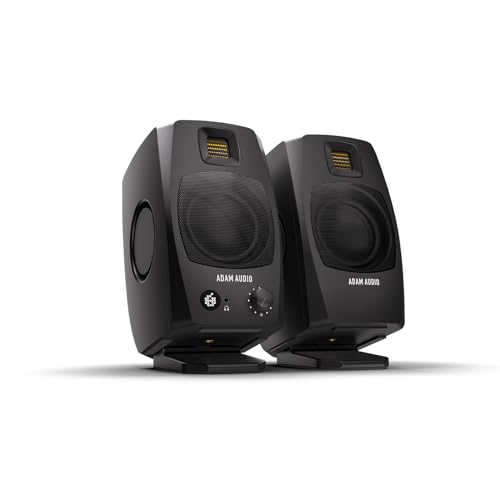
- Compact pair with 1.5-inch D-ART tweeters
- USB-C connects directly to computers and mobile devices
- 3.5-inch woofers extend response to 45 Hz
Best For: Desktop production, songwriting, and compact listening setups
Large-Room Detail

- U-ART ribbon tweeter reaches 25 kHz
- 7-inch woofers extend to 39 Hz
- Balanced connection cables included
Best For: Home studios needing fuller nearfield bass
Desktop Ribbon Precision

- D-ART ribbon tweeter for detailed highs
- USB-C connectivity for computers and mobile devices
- Includes angled desktop stands
Best For: Compact computer-based production and listening
Flexible Nearfield Value

- U-ART ribbon tweeter reaches 25 kHz
- XLR and RCA cables included
- 5-inch woofers extend to 45 Hz
Best For: Small home studios and nearfield production
Best for Bass-Intensive Rooms – ADAM Audio T8V Ribbon-Tweeter Monitor Pair
For producers seeking studio monitors with ribbon tweeters and extended low end, the ADAM Audio T8V bundle combines an ART ribbon-derived tweeter with an 8.5-inch woofer. Its 35Hz–22kHz response, 118dB SPL capability, multiple analog inputs, and included isolation pads suit demanding production work.
Best For: Hip-hop, trap, electronic, R&B, and larger mix rooms where deep bass extension matters.
Pros:
- ART ribbon tweeter with HPS waveguide supports detailed high-frequency imaging.
- 35Hz–22kHz response and up to 118dB SPL provide substantial low-end range and headroom.
- Includes large isolation pads, XLR cables, and IEC power cables.
- XLR, TRS, and RCA inputs plus adjustable high- and low-frequency shelving.
Cons:
- The 8.5-inch woofer and deep bass extension may be excessive for small or untreated rooms.
- This bundle is larger and less desktop-friendly than smaller nearfield monitors.
The T8V is the most bass-capable option here and offers a practical package for users who need large-monitor output without immediately adding a subwoofer. Room placement and acoustic treatment remain important when using its extended low end.
Best Flexible 7-Inch Monitor – KRK Classic 7 Powered Studio Monitor
The KRK Classic 7 is a self-powered two-way monitor for buyers comparing studio monitors with ribbon tweeters against more conventional dynamic-driver designs. Its 73-watt bi-amped Class A/B system, front port, and room-adjustment controls make it a practical choice for recording and mixing setups.
Best For: Home and project studios needing a flexible 7-inch monitor with straightforward placement options.
Pros:
- 73 watts of self-powered output with amplifiers matched to the drivers.
- Bi-amped Class A/B amplification is designed for headroom and low distortion.
- Front-firing port allows more flexible placement near walls.
- Dedicated high- and low-frequency controls help adapt the monitor to the room.
Cons:
- It uses a dynamic driver rather than a ribbon tweeter.
- The supplied information describes a single monitor, so a stereo pair requires two units.
The Classic 7 is a sensible alternative when placement flexibility and familiar KRK-style monitor functionality matter more than ribbon-tweeter technology. Its front port and adjustable frequency controls are especially useful in less-than-perfect rooms.
Best Compact Ribbon-Tweeter Option – ADAM Audio T5V Studio Monitor
The ADAM Audio T5V is a compact choice for shoppers looking for studio monitors with ribbon tweeters in a smaller workspace. Its U-ART tweeter and HPS waveguide focus on high-frequency detail, while multiple analog connections and adjustable shelf filters help with varied recording, podcasting, and mixing setups.
Best For: Compact home studios, desktop production, podcast editing, and users who may later add the matching T10S subwoofer.
Pros:
- U-ART tweeter and HPS waveguide deliver detailed high-frequency reproduction.
- Beveled cabinet and rear-firing bass reflex port support flexible placement.
- High- and low-shelf filters help adapt the monitor to difficult acoustic environments.
- Accepts XLR, 1/4-inch TRS, and RCA connections.
Cons:
- The 5-inch woofer has less low-end reach than larger monitors.
- A separate T10S subwoofer may be useful for mixes requiring deeper bass.
The T5V offers the clearest compact path into ADAM’s ribbon-derived high-frequency approach. It is well suited to smaller rooms, though bass-focused producers should plan carefully around its 5-inch woofer or consider the matched subwoofer option.
Best Value Accuracy Alternative – Kali Audio LP-6 V2 Monitor
The Kali Audio LP-6 V2 is a single powered monitor for buyers evaluating studio monitors with ribbon tweeters alongside accurate conventional designs. Its updated DSP, low-noise improvements, front port, boundary EQ, and 80-watt bi-amped output target reliable monitoring across desks, stands, and wall-adjacent setups.
Best For: Budget-conscious music producers who want broad placement flexibility and a flat, low-noise presentation.
Pros:
- Updated DSP is designed for a flat frequency response.
- Front port and noise-reduction improvements help minimize turbulence and hiss.
- Boundary EQ supports placement on a desk, stand, or near a wall.
- 80 watts of bi-amped power and up to 115dB SPL provide useful headroom.
Cons:
- It uses a conventional 1-inch dynamic tweeter rather than a ribbon tweeter.
- The listing is for a single monitor, so stereo monitoring requires two.
The LP-6 V2 is a strong practical alternative for listeners who prioritize consistent response, low noise, and placement flexibility over ribbon-driver construction. Its 6.5-inch woofer offers a useful middle ground for home and project studios.
Bass-Forward Ribbon Detail – ADAM T8V
The ADAM Audio T8V is a strong choice for anyone seeking studio monitors with ribbon tweeters and extended low-end response. Its 8-inch woofer reaches down to 33 Hz, while the U-ART tweeter and HPS waveguide support detailed highs and a wider listening sweet spot.
Best For: Bass-heavy music production, mixing, mastering, and film scoring in a desktop or studio setup.
Pros:
- Low-frequency extension reaches 33 Hz for defined bass reproduction.
- U-ART ribbon tweeter reaches up to 25 kHz and is designed to reduce high-frequency distortion.
- HPS waveguide creates a more controlled, wider sweet spot.
- Offers XLR, 1/4-inch TRS, and RCA connectivity.
Cons:
- The 8-inch cabinet is relatively large for compact desks.
- This listing supplies one monitor rather than a stereo pair.
- It is wired and does not provide water resistance.
Choose the T8V when bass translation and generous headroom matter more than a compact footprint. It combines a large woofer with ADAM’s ribbon-tweeter design for full-range monitoring in demanding production work.
Compact Stereo Accuracy – ADAM T5V Pair
The ADAM Audio T5V pair suits buyers looking for studio monitors with ribbon tweeters in a manageable nearfield format. Its U-ART tweeters, 5-inch woofers, and HPS waveguides are designed for detailed stereo imaging and a reliable 45 Hz to 25 kHz response.
Best For: Home studios, desktop mixing, and producers who want a ready-to-use stereo pair with included XLR cables.
Pros:
- Includes two active T5V monitors and XLR microphone cables.
- U-ART tweeters deliver detailed high-frequency reproduction.
- HPS waveguides support a wide, precise stereo image.
- Bi-amplified 70-watt design provides useful headroom for nearfield work.
Cons:
- The 5-inch woofers do not extend as low as the T8V’s 8-inch design.
- The supplied listing has conflicting warranty details, so confirm coverage before purchase.
- Connectivity is wired rather than wireless.
The T5V pair is a practical middle ground for smaller rooms and desks. It offers the core ADAM ribbon-tweeter approach, stereo imaging, and useful room-adjustment controls without the footprint of a larger monitor.
Desktop Ribbon Convenience – ADAM D3V
The ADAM Audio D3V brings studio monitors with ribbon tweeters to compact desktop setups. Its 1.5-inch D-ART tweeters pair with 3.5-inch aluminum woofers and passive radiators, while USB-C connectivity makes it convenient for computers and mobile devices.
Best For: Songwriters, producers, and listeners who need a compact active monitoring system for a desk.
Pros:
- Compact pair uses 1.5-inch D-ART desktop ribbon tweeters.
- 3.5-inch woofers and passive radiators extend response to 45 Hz.
- USB-C connectivity supports direct computer and mobile-device integration.
- Includes angled stands, headphone output, volume control, and placement adjustments.
Cons:
- Its compact 3.5-inch woofers provide less low-end reach than larger monitors.
- It is intended primarily for desktop use rather than high-output studio monitoring.
- The standard warranty is two years unless extended through registration.
The D3V is the most desk-friendly option in this group. It emphasizes convenience and compact placement while retaining ADAM’s ribbon-tweeter character, making it a sensible choice when space and USB connectivity are priorities.
Large-Room Detail – ADAM Audio T7V Pair
The ADAM Audio T7V pair is a strong fit for producers searching for studio monitors with ribbon tweeters and more low-end reach. Its 7-inch woofers extend to 39 Hz, while the U-ART tweeter reaches 25 kHz for detailed, non-fatiguing highs. Balanced XLR cables are included for a straightforward interface or mixer setup.
Best For: Home studios, project rooms, and producers who want fuller nearfield bass without immediately adding a subwoofer.
Pros:
- U-ART ribbon tweeter delivers detailed highs up to 25 kHz.
- 7-inch woofers reach down to 39 Hz for clear kick, bass, and synth lows.
- Includes two balanced TRS-to-XLR cables for interface connection.
- High- and low-shelf trims help compensate for desks, corners, and reflective rooms.
Cons:
- The larger 7-inch design may be more monitor than compact desks need.
- The bundle is intended for a setup with an audio interface, mixer, or other suitable outputs.
Choose the T7V when low-frequency extension and a wider monitoring scale matter more than saving desk space. Its room-tuning controls and HPS waveguide add flexibility for practical home-studio placement.
Desktop Ribbon Precision – ADAM Audio D3V White
The ADAM Audio D3V brings studio monitors with ribbon tweeters to a compact desktop setup. Its 1.5-inch D-ART tweeter is paired with 3.5-inch woofers, passive radiators, USB-C connectivity, and included angled stands for convenient computer-based monitoring.
Best For: Songwriters, producers, and music listeners who need a compact active monitor pair for a desk.
Pros:
- D-ART ribbon tweeter provides precise, unfatiguing high-frequency reproduction.
- USB-C connection supports direct use with computers and mobile devices.
- 3.5-inch woofers and dual-sided passive radiators extend response to 45 Hz.
- Includes 15-degree monitor stands, headphone output, and microphone-stand mounting points.
Cons:
- Compact 3.5-inch woofers offer less low-end scale than the larger T7V or T5V models.
- Its desktop-focused design may not suit larger rooms or high-output monitoring needs.
The D3V is the most convenient choice here for a modern desk, especially when USB-C connectivity and included positioning accessories are priorities. DSP-powered placement controls add useful flexibility around common desktop acoustic issues.
Flexible Nearfield Value – ADAM Audio T5V Pair
The ADAM Audio T5V is a practical option for buyers seeking studio monitors with ribbon tweeters in a smaller nearfield format. Its U-ART tweeter reaches 25 kHz, while the 5-inch woofers extend to 45 Hz. The bundle also includes balanced XLR and RCA-to-1/4-inch cables for flexible connections.
Best For: Bedroom producers, singer-songwriters, podcast editors, and home studios with limited desk space.
Pros:
- U-ART ribbon tweeter and HPS waveguide support precise highs and a broad sweet spot.
- Includes both balanced XLR and RCA-to-1/4-inch cables.
- 5-inch woofers and 70W bi-amping provide useful nearfield output down to 45 Hz.
- HF and LF shelf trims help adapt the monitors to desks, walls, and corners.
Cons:
- Its 5-inch woofers provide less low-end extension than the T7V.
- The monitors require a wired audio source and do not provide wireless connectivity.
The T5V balances ribbon-tweeter detail, manageable size, and connection flexibility. It is a sensible starting point for a home studio that needs dependable nearfield monitoring and room-adjustment controls without moving to a larger cabinet.
How We Picked the Best Studio Monitors with Ribbon Tweeters
We evaluated these monitors by looking at the features that most affect real-world recording and mixing: high-frequency response, woofer size, amplifier power, maximum output, cabinet design, connectivity, and intended listening distance. We also considered whether each model suits a compact desktop setup, a treated project studio, or a larger nearfield environment.
Several selected ADAM Audio models use the company’s folded-ribbon X-ART-style tweeter design, while the other monitors provide comparable professional nearfield functionality and are included as practical alternatives. Bundles were judged on their included cables and accessories as well as the monitor itself.
Quick Comparison
| Type | Best For | Typical Advantage |
|---|---|---|
| 5-inch monitors | Small rooms and desktops | Better nearfield fit with less low-end buildup |
| 6.5- to 7-inch monitors | General project studios | Balanced detail and bass extension |
| 8-inch monitors | Larger rooms and louder monitoring | More low-end authority and headroom |
| Desktop monitors | Editing, production, and casual mixing | Compact footprint and simple placement |
Key Buying Factors for Studio Monitors with Ribbon Tweeters
Room Size and Listening Distance
Choose the woofer size according to your room, not simply the biggest model you can afford. Five-inch monitors often work well in small rooms, while 7- and 8-inch models need more space and careful placement to prevent excessive bass. If your listening position is close to the speakers, compact nearfields may provide a more controlled response.
High-Frequency Detail
Ribbon tweeters are designed to deliver fast transient response and detailed upper frequencies. That can help reveal vocal sibilance, cymbal texture, editing clicks, and compression artifacts. However, detailed monitors also expose poor room acoustics, so soft furnishings, acoustic treatment, and symmetrical placement remain important.
Low-End Extension and Headroom
Compare published frequency range and maximum SPL, but treat specifications as a starting point. Larger woofers generally provide deeper bass and greater output, while smaller monitors may be easier to balance in untreated spaces. If you produce bass-heavy music, consider whether a subwoofer or larger monitor is more appropriate than boosting the low end.
Inputs and Placement
Check whether the monitor accepts balanced XLR or TRS connections from your audio interface. Balanced cabling helps reduce noise over longer runs. Leave clearance around rear ports, use isolation pads or stands, and angle the tweeters toward your ears at the listening position.
Who Should Buy Which Studio Monitors with Ribbon Tweeters?
Choose a 5-inch model if you work in a bedroom, edit at a desk, or sit close to the speakers. These monitors are usually easier to integrate into smaller rooms.
Choose a 6.5- or 7-inch model for an adaptable project-studio setup with a useful balance of midrange clarity, bass reach, and output. This is often the safest size for general music production.
Choose an 8-inch model if your room is reasonably large and treated, your listening distance is greater, and you need stronger low-end monitoring or higher playback levels.
Choose a desktop-focused model when space, convenience, and everyday production matter more than maximum volume. Whatever you buy, prioritize symmetrical placement, isolation, and basic acoustic treatment before judging tonal differences.