Choosing the right studio monitors for mixing can make every EQ move, balance decision, and low-end check more reliable. The best pair for you depends on room size, listening distance, and how much detail you need.
Below, we focus on practical options for home studios, desktop production, and more serious mixing setups, so you can match the speaker size and features to your workflow.
Best 10 Studio Monitors for Mixing Picks for 2026
Neutral Nearfield Classic

- Uncolored sound for honest mixing
- 5-inch woofer, 1-inch tweeter
- 54 Hz to 30 kHz response
Best For: Mixers who want a compact, accurate nearfield reference
Big-Sweet-Spot All-Rounder

- 8-inch woofer with extended low end
- Wide EBM waveguide for stereo imaging
- Room tuning controls for placement
Best For: Producers wanting fuller-range monitoring with tuning flexibility
Compact Desktop Pair

- Small 3.5-inch woofer pair
- Room control and high trim adjustment
- Includes cables and anti-slip pads
Best For: Desktop users and portable setups with limited space
Value Nearfield Workhorse
- 5.25-inch woofer with solid low end
- 80W Class AB bi-amplification
- Acoustic tuning and multiple inputs
Best For: Home studios needing flexible nearfield monitoring
Compact Reference Pair

- 4.5-inch woofer and 1-inch tweeter
- Room control and high trim adjustments
- XLR/TRS, RCA, and stereo mini inputs
Best For: Small-room mixing and desktop reference listening
Balanced Nearfield Pick

- 5.25-inch woofer with solid low-end
- 80W Class AB amplification
- Balanced XLR, 1/4-inch, and RCA inputs
Best For: Home studio mixing with fuller bass and tuning flexibility
Smart Desktop Monitor Set
- 240W bi-amplified 5-inch monitor pair
- DSP modes plus 5-band app EQ
- Bluetooth 5.0 and TRS inputs
Best For: Desktop mixing with wireless playback and app-based tuning
Portable Reference

- Ultra-compact studio reference monitors
- DSP EQ and position compensation
- Bluetooth, RCA, and aux inputs
Best For: Portable mixing and small home studios
Desktop Starter Pair

- 50W powered stereo pair
- High/low tuning for room adjustment
- TRS, RCA, aux, and headphone jack
Best For: Compact desktop mixing and near-field listening
Compact Wired Pick

- 4.5-inch Kevlar woofers
- Latency-free wired monitoring
- Rear EQ controls and multiple inputs
Best For: Small desktop mixing and beginner studios
Neutral Nearfield Classic – Yamaha HS5 Pair
If you want studio monitors for mixing with a reputation for staying honest, the Yamaha HS5 pair is built around a simple idea: sonic purity without added color. The 5-inch woofer and 1-inch dome tweeter make these a straightforward nearfield choice for checking balance, EQ moves, and stereo placement in a compact setup.
Best For: Mix engineers and home producers who want an uncolored, nearfield reference in a smaller room.
Pros:
- Emphasizes sonic purity without coloring the source
- 5-inch cone woofer plus 1-inch dome tweeter for nearfield monitoring
- 54 Hz to 30 kHz frequency response
- XLR and TRS phone jack inputs support balanced or unbalanced signals
Cons:
- 5-inch woofer is smaller than larger studio monitors in this roundup
- Less low-end reach than models with 8-inch drivers
Overall, the HS5 is a clean, no-nonsense option if accuracy matters more than extra bass. It is especially appealing when you already know your room and want a compact monitor that does not hype the mix.
Big-Sweet-Spot All-Rounder – PreSonus Eris Studio 8
For studio monitors for mixing in a room where imaging and bass extension both matter, the PreSonus Eris Studio 8 brings more scale than smaller 5-inch models. Its 8-inch woven-composite woofer, front-firing port, and custom EBM waveguide are aimed at giving you a wide sweet spot, clear highs, and a smoother view of the low end.
Best For: Producers who want a fuller-range monitor with room-tuning controls and a wide stereo image.
Pros:
- 8-inch low-frequency driver with extended low-end response
- Custom-tuned 120° x 60° EBM waveguide for a wide sweet spot
- 140W Class AB biamplification and up to 105 dB SPL peak
- HF/Midrange controls, highpass filter, and Acoustic Space settings help tailor the room response
Cons:
- Larger cabinet may be less convenient for very small desks
- More monitor than you need if you only want a compact nearfield pair
This is the most flexible option here if you want a stronger low end and some real room compensation tools. It should suit mixers who need a monitor that can adapt rather than just play loud.
Compact Desktop Pair – Yamaha HS3 B
The Yamaha HS3 pair is the smallest option here for studio monitors for mixing, and that makes it a smart fit when desk space is tight. With a 3.5-inch woofer, 0.75-inch tweeter, and included cables and anti-slip pads, these are set up for simple desktop monitoring and basic production work.
Best For: Small desks, portable setups, and creators who need a compact pair for music production and studio recording.
Pros:
- Very compact 3.5-inch woofer design for tabletop use
- Includes stereo mini to RCA cable, speaker cable, and anti-slip pad
- Room control and high trim response controls for basic adjustment
- XLR/TRS combo, RCA, and stereo mini inputs add flexibility
Cons:
- 70 Hz to 22 kHz response is narrower than the larger models listed here
- 26W+26W output is modest compared with higher-powered monitors
HS3 makes sense when you need Yamaha monitoring in a smaller footprint rather than maximum output. It is best treated as a space-saving desktop reference, not the most full-range mixer in the group.
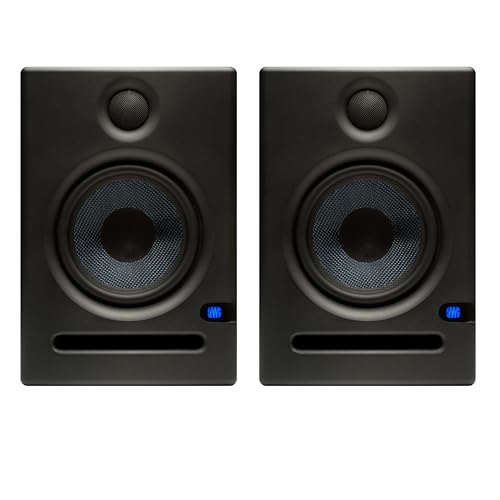
Value Nearfield Workhorse – PreSonus Eris E5 Pair
If you are shopping for studio monitors for mixing and want a practical nearfield pair with a little more output, the PreSonus Eris E5 is built for that job. Its 5.25-inch woven composite woofer, 1-inch silk-dome tweeter, front-firing port, and acoustic tuning controls are all aimed at helping mixes translate better.
Best For: Home studios and project rooms that need solid nearfield monitoring with room-adjustment options.
Pros:
- 5.25-inch woofer delivers solid low-end sound with minimal bass distortion
- 80W Class AB bi-amplification provides strong nearfield headroom
- Balanced XLR and 1/4-inch inputs plus unbalanced RCA inputs
- Acoustic tuning controls help contour the sound to the room
Cons:
- Smaller low-frequency driver than the 8-inch model in this roundup
- Requires some tuning to get the most from the monitoring environment
The E5 sits in a very usable middle ground: compact enough for a home studio, but with enough power and control to serve as a serious mixing monitor. It is a strong pick when you want practical features without moving up to a larger cabinet.
Compact Reference Pair – Yamaha HS4 White
If you want studio monitors for mixing in a small workspace, the Yamaha HS4 pair keeps the focus on clarity and practical control. These compact 2-way powered speakers use a 4.5-inch woofer, 1-inch tweeter, and room/high trim controls to help you adapt the sound to your setup.
Best For: Mixing in compact rooms, desktop production setups, and creators who want a straightforward reference monitor pair.
Pros:
- Compact 4.5-inch woofer design suits smaller desks and rooms
- Room control and high trim controls help tailor the response
- Multiple inputs: XLR/TRS combo, RCA, and stereo mini
- Includes stereo mini to RCA cable, speaker cable, and anti-slip pad
Cons:
- 60 Hz – 22 kHz frequency response is more limited than larger monitors
- 26 W + 26 W output is best suited to small-to-medium nearfield use
Overall, the HS4 is a practical pick if you want a clean, compact monitoring solution with flexible connections and simple tuning controls. It is a solid fit when desk space matters and you need dependable reference speakers for everyday mixing.
Balanced Nearfield Pick – PreSonus Eris E5
The PreSonus Eris E5 is a classic choice for studio monitors for mixing when you want more low-end reach and strong nearfield detail. Its 5.25-inch woven composite woofer, silk-dome tweeter, and acoustic tuning controls make it easy to shape the sound for your room.
Best For: Nearfield mixing, home studios, and users who want a fuller low end in a compact monitor.
Pros:
- 5.25-inch woofer delivers solid low-end with minimal bass distortion
- 1-inch silk-dome tweeter is designed to reduce harshness
- 80-watt Class AB bi-amplification provides strong headroom
- Balanced XLR and 1/4-inch inputs plus RCA inputs add flexibility
Cons:
- Larger than ultra-compact desktop monitors
- Designed for nearfield monitoring, so it is not a room-filling speaker
For mixing, the Eris E5 stands out as a versatile, room-tunable monitor with enough power and bass extension to support confident decisions. It is especially appealing if you want a balanced step up from entry-level desktop speakers.
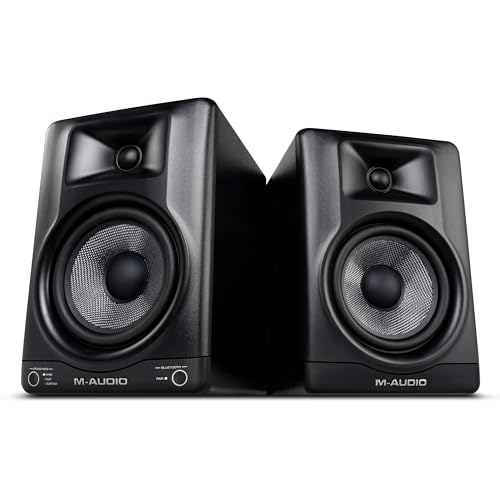
Smart Desktop Monitor Set – M-AUDIO BX5BT
The M-AUDIO BX5BT is a modern option for studio monitors for mixing if you want DSP tuning, app control, and Bluetooth in a compact pair. With 240W of bi-amplified power, a 5-inch Kevlar woofer, and front-panel reference modes, it is built for flexible desktop production.
Best For: Creators who want mixing monitors with wireless convenience, app-based EQ, and multiple voicing options.
Pros:
- 240W bi-amplified output offers plenty of power for a compact pair
- DSP crossover with FLAT, HYPE, and CUSTOM reference modes
- Studio Control App adds 5-band EQ and saved presets
- Bluetooth 5.0 and TRS connectivity support flexible setups
Cons:
- Bluetooth features may be less essential for purist mixing workflows
- App and DSP controls add extra setup compared with simple analog monitors
For modern creators, the BX5BT combines monitor basics with useful digital control features that can simplify room matching and quick playback checks. It is a strong fit if you want studio monitoring and wireless convenience in one package.
Portable Reference – iLoud Micro Monitor
If you want studio monitors for mixing that are easy to move but still aim for an accurate response, the IK Multimedia iLoud Micro Monitor is built for that job. Its compact design, DSP-based EQ options, and desktop/free-field compensation make it especially useful in small rooms, home studios, and travel setups where placement changes often.
Best For: Portable mixing, home studios, and creators who need accurate sound in a very small footprint.
Pros:
- True linear frequency response with no coloration
- Internal DSP with bass, treble, and position compensation settings
- 50W RMS total power with solid low-end extension down to 55Hz
- Bluetooth plus RCA and 1/8″ aux inputs for flexible listening
Cons:
- Very small drivers may not deliver the full output of larger monitors
- Low-end reach is good for the size, but still limited by compact cabinet design
The iLoud Micro Monitor stands out when desk space and portability matter as much as mix accuracy. It is a strong choice for mobile producers who need reliable translation across headphones, cars, TVs, and other consumer playback systems.
Desktop Starter Pair – PreSonus Eris 3.5
The PreSonus Eris 3.5 is a practical pick for studio monitors for mixing when you want a compact desktop pair with straightforward controls. Its 3.5-inch woofers, silk-dome tweeters, and built-in high/low tuning make it easy to adapt the sound to a bedroom setup, editing desk, or small project space.
Best For: Entry-level mixing, desktop studios, and users who want a compact powered stereo pair.
Pros:
- 50 watts of built-in amplification for clear, distortion-free playback
- High- and low-frequency acoustic tuning controls help adjust for your room
- Balanced TRS, RCA, and front aux input for easy connectivity
- Front headphone jack supports private listening sessions
Cons:
- 3.5-inch woofers are best suited to small rooms and near-field use
- Designed as a desktop pair, so they are not ideal for larger monitoring spaces
Overall, the Eris 3.5 is a sensible desktop monitor choice if you need balanced sound, simple setup, and flexibility across music production, gaming, and everyday listening.
Compact Wired Pick – M-AUDIO BX4 Pair
The M-AUDIO BX4 is a solid option for studio monitors for mixing if you want a compact wired desktop setup with stronger bass presence than many tiny speakers. Its 4.5-inch Kevlar woofers, silk-dome tweeters, and MDF cabinet are aimed at clean stereo imaging and controlled sound for recording, beat-making, and everyday production work.
Best For: Small desktops, beginner mixing setups, and producers who want wired monitoring with flexible inputs.
Pros:
- Latency-free wired connection for uninterrupted monitoring
- 4.5-inch Kevlar woofers for punchy low-frequency response
- Rear 1/4″, 1/8″, and RCA inputs for broad compatibility
- Rear high/low EQ controls and left/right position switch for setup tuning
Cons:
- Compact size still limits the authority of deeper bass
- Best suited to desktop monitoring rather than larger control rooms
For a budget-friendly wired pair with useful tuning options and enough flexibility for music production gear, the BX4 is a practical near-field monitor solution.
How We Picked These Studio Monitors for Mixing
We prioritized accuracy, output matched to common home-studio spaces, and features that matter in real mixing use. That includes driver size, amplification, tonal consistency, connectivity, and whether the monitors are a better fit for nearfield desktop work or a larger room.
Quick Comparison of the Best Studio Monitors for Mixing
In general, 3.5-inch and 4.5-inch models suit compact desks and very small rooms, while 5-inch speakers are the most versatile choice for many home studios. Larger 8-inch monitors can deliver fuller low end and more headroom, but they work best when your room can support them.
Key Buying Factors for Studio Monitors for Mixing
Driver Size and Room Size
Driver size affects bass extension, overall loudness, and how far the monitor can fill a space. Smaller drivers are easier to place on a desk and can sound cleaner at close range, while larger drivers are better for hearing low-end detail without relying as heavily on a subwoofer.
Accuracy Over Hype
Look for a neutral or honest response rather than boosted bass or overly bright treble. The goal with Studio Monitors for Mixing is translation: your mix should sound balanced on headphones, speakers, cars, and consumer systems.
Connectivity and Placement Controls
Balanced inputs, trim controls, and room-tuning features can make setup easier and improve results. If you work at a computer desk, compact enclosures and front-panel conveniences may matter more than raw power.
Nearfield Use
Most home producers benefit from nearfield monitoring, where speakers sit close to the listening position. This reduces room influence and helps you hear detail more clearly, especially in untreated spaces.
Who Should Buy Which Studio Monitors for Mixing?
If you want the most versatile all-around option, a 5-inch class monitor is usually the safest starting point. If your room is very small or your desk is tight, compact 3.5-inch or 4.5-inch models are easier to manage. If you mix bass-heavy music or have a larger treated room, 8-inch monitors can be the better fit.
Choose the pair that matches your space first, then your workflow and budget. The best Studio Monitors for Mixing are the ones you can place correctly, listen to for long sessions, and trust when making critical decisions.