When you’re starting out in music production or multimedia projects, selecting the right studio monitors is essential. You want monitors that not only deliver clear sound but also fit your budget and space. With so many options out there, it can be overwhelming to find the perfect pair for your needs. Fortunately, we’ve narrowed it down to the ten best studio monitors for beginners, ensuring you achieve the sound quality you aim for. Let’s explore your options.
PreSonus Eris 3.5 Studio Monitors (Powered, Active Monitor Speakers)

If you’re just starting in music production or need reliable speakers for your desktop setup, the PreSonus Eris 3.5 Studio Monitors are a fantastic choice. These powered monitors deliver studio-quality sound, perfect for music production and multimedia work. With woven-composite woofers, you’ll enjoy tight bass and a cleaner overall sound. The 50 Watts Class AB amplification guarantees you get loud volumes without compromising tonal balance. You can customize your listening experience with high- and low-frequency tuning controls. Plus, the various connectivity options make it easy to hook up your favorite devices. These monitors are a solid investment for any beginner.
Best For: Beginners in music production or anyone needing reliable desktop speakers for multimedia work.
Pros:
- Studio-quality sound with accurate audio reproduction ideal for music production.
- Customizable tuning controls for tailored audio output based on room size and setup.
- Multiple connectivity options, including TRS and RCA inputs, make it versatile for various devices.
Cons:
- Limited bass response without a subwoofer for more extensive low-frequency needs.
- May not be loud enough for larger spaces without additional amplification.
- 3.5-inch woofers might not satisfy audiophiles looking for deeper bass performance.
PreSonus Eris 3.5BT Studio Monitors, Pair

The PreSonus Eris 3.5BT studio monitors are an ideal choice for beginners looking to enhance their audio experience in music production, gaming, or content creation. With 50 Watts of Class AB amplification and woven-composite woofers, these monitors provide loud, clear sound without distortion. The Bluetooth 5.0 connectivity lets you wirelessly connect to your devices, while the ¼-inch TRS and RCA inputs offer versatile wired options. Customize your sound with high- and low-frequency tuning controls, and enjoy private listening through the front-panel headphone output. Compact yet powerful, these monitors are perfect for any desk setup, earning a 4.6-star rating from users.
Best For: Beginners looking to enhance their audio experience in music production, gaming, or content creation.
Pros:
- High-quality sound with 50 Watts of Class AB amplification and woven-composite woofers for clear audio without distortion.
- Versatile connectivity options including Bluetooth 5.0, ¼-inch TRS balanced inputs, and unbalanced RCA inputs.
- Compact design makes them suitable for any desk setup while still delivering room-filling sound.
Cons:
- Limited bass response due to the smaller 3.5″ woofers compared to larger monitors.
- Some users may find the volume not loud enough for larger spaces.
- The power-saving mode may be inconvenient for continuous use without frequent interaction.
JBL 305P MkII 5″ Active Powered Studio Reference Monitors

For aspiring music producers and content creators, the JBL 305P MkII 5″ Active Powered Studio Reference Monitors offer an impressive combination of sound quality and customization features. With dual 41-Watt Class-D amplifiers and a 5-inch woofer, you’ll experience dynamic range and deep bass, perfect for cinematic sound design. The patented Image Control Waveguide guarantees immersive sound with a wide sweet spot. You can tailor your audio with Boundary EQ and HF Trim, making it suitable for any room. Built with a sleek MDF enclosure and rigorously tested for reliability, these monitors are ideal for both home studios and professional settings.
Best For: Aspiring music producers and content creators seeking high-quality sound and customizable audio options in both home and professional studio settings.
Pros:
- Patented Image Control Waveguide provides immersive sound and a wide sweet spot for accurate listening.
- Dual 41-Watt Class-D amplifiers deliver dynamic range and deep bass, enhancing cinematic sound design.
- Boundary EQ and HF Trim allow for tailored audio adjustments to suit different room acoustics.
Cons:
- The 5-inch woofer may not be sufficient for larger spaces or professional audio environments.
- The MDF enclosure, while sleek, may not be as durable as other materials like plywood.
- Limited connectivity options with only XLR/TRS inputs, which may not suit all users’ needs.
YAMAHA Hs5 Powered Studio Monitor, Pair

Yamaha HS5 Powered Studio Monitors are an excellent choice for beginners looking to achieve high-quality sound in their home studio. With a 5-inch cone woofer and 1-inch dome tweeter, they deliver a frequency response from 54 Hz to 30 kHz, ensuring you hear every detail in your mix. The 70-watt bi-amplified system provides ideal sound reproduction, emphasizing sonic purity without altering the original audio. Plus, their connectivity options, including XLR and TRS inputs, accommodate both balanced and unbalanced signals. These monitors will help you create a professional sound environment, making your music production experience more enjoyable and effective.
Best For: Beginners looking to achieve high-quality sound in their home studio setup.
Pros:
- Exceptional sound clarity and detail across a wide frequency range.
- Bi-amplified system enhances sound reproduction without coloration.
- Versatile connectivity options for both balanced and unbalanced signals.
Cons:
- Limited bass response compared to larger studio monitors.
- May require additional acoustic treatment in the room for optimal performance.
- The 5-inch woofer may not suffice for larger studio spaces.
Yamaha HS3 Powered Studio Monitor in Black, Pair (HS3 B)

If you’re diving into music production or studio recording, the Yamaha HS3 Powered Studio Monitor is an excellent choice for beginners. This compact, 2-way bass-reflex speaker features a 3.5-inch cone woofer and a 0.75-inch dome tweeter, delivering a frequency response of 70 Hz to 22 kHz. With 26 watts of output power, it’s perfect for small spaces. The HS3 offers versatile connectivity options, including XLR/TRS and RCA inputs. Plus, its room control and high trim response controls guarantee tailored sound. Rated 4.6 stars by users, it’s a dependable monitor for your audio projects.
Best For: The Yamaha HS3 Powered Studio Monitor is best for beginners in music production, studio recording, and video editing looking for a compact and reliable audio solution.
Pros:
- Compact design makes it ideal for limited spaces.
- Versatile connectivity options including XLR/TRS and RCA inputs enhance compatibility with various devices.
- Room control and high trim response controls allow for tailored sound adjustments.
Cons:
- Limited output power of 26 watts may not be sufficient for larger rooms.
- Small woofer size (3.5 inches) may not deliver deep bass compared to larger monitors.
- Limited to tabletop mounting which may not suit all studio setups.
Mackie CR3.5 Creative Reference Powered Studio Monitors

The Mackie CR3.5 Creative Reference Powered Studio Monitors are an excellent choice for budding producers and casual listeners alike, thanks to their impressive sound quality and user-friendly features. With connectivity options like TRS, RCA, and a 3.5 mm input, you can easily connect them to gaming consoles and PCs. The tone control knob lets you customize sound, boosting bass or enhancing highs for any setting. Plus, the flexible placement options allow you to switch between desktop and bookshelf modes. Experience clean audio with their silk dome tweeter and woven woofer, and consider adding the CR8SBT subwoofer for deeper bass.
Best For: Budding producers, casual listeners, and gamers seeking studio-quality sound in a compact design.
Pros:
- Versatile connectivity options with TRS, RCA, and 3.5 mm inputs for easy integration with various devices.
- Sound customization through a tone control knob for tailored audio experiences to suit different environments.
- Flexible placement modes allow for optimal performance whether on a desktop or as bookshelf speakers.
Cons:
- Limited low-end response without a subwoofer, which may not satisfy bass enthusiasts.
- Size may not suit larger rooms, as they are designed for close listening environments.
- Power output may be insufficient for larger spaces or louder listening preferences without additional equipment.
PreSonus Eris 4.5BT Bluetooth Studio Monitors (Pair)

For anyone venturing into audio production or multimedia projects, the PreSonus Eris 4.5BT Bluetooth Studio Monitors offer an exceptional introduction to professional sound. With 50W Class A/B power, these 4.5-inch powered speakers deliver strong volume and balanced audio. The woven-composite drivers provide robust bass, while the silk-dome transducers guarantee clear highs for an immersive experience. Bluetooth 5.0 connectivity lets you stream wirelessly, and the versatile inputs cater to various devices. Plus, you can customize your listening environment with high and low acoustic tuning. The built-in headphone amp allows for private sessions, making these monitors a fantastic choice for beginners.
Best For: Audio enthusiasts and beginners looking for high-quality studio monitors for multimedia projects and music production.
Pros:
- High-quality audio performance with balanced sound, thanks to 50W Class A/B power and advanced driver technology.
- Versatile connectivity options including Bluetooth 5.0, TRS balanced inputs, and RCA inputs for various devices.
- Customization features such as high and low acoustic tuning controls and a built-in headphone amp for private listening.
Cons:
- Limited bass response without the addition of a companion subwoofer for those seeking deeper low-end frequencies.
- Size may not suit larger studio spaces as the 4.5-inch speakers are designed for smaller environments.
- Bluetooth connectivity may introduce slight latency for critical audio applications.
Edifier MR5 2.0 Studio Monitor Bookshelf Speakers

Looking for an affordable yet high-quality option for your home studio? The Edifier MR5 2.0 Studio Monitor Bookshelf Speakers deliver studio-grade sound with a 3-way active crossover system, ensuring accurate audio reproduction from 46Hz to 40kHz. You’ll enjoy hi-res audio support, making your music crystal clear. Customize your listening experience using the rear knobs or the EDIFIER ConneX App for advanced tuning. With Bluetooth 6.0 and multiple connectivity options, connecting your gear is seamless. Plus, the 110W RMS Class D amplifier and pro-grade MDF build provide powerful sound and durability, perfect for any budding producer.
Best For: Budding producers and home studio enthusiasts seeking high-quality sound without breaking the bank.
Pros:
- Studio-grade sound reproduction with a wide frequency response (46Hz–40kHz).
- Multiple connectivity options including Bluetooth 6.0 and various audio inputs for versatility.
- Customizable sound settings through physical knobs or the EDIFIER ConneX App for tailored listening experiences.
Cons:
- May be too powerful for very small rooms, leading to potential overpowering sound.
- Limited portability due to the size and weight of the speakers.
- The rear knobs for tuning may be less convenient compared to a fully app-controlled interface for some users.
Edifier MR4 Powered Studio Monitor Speakers (Pair)
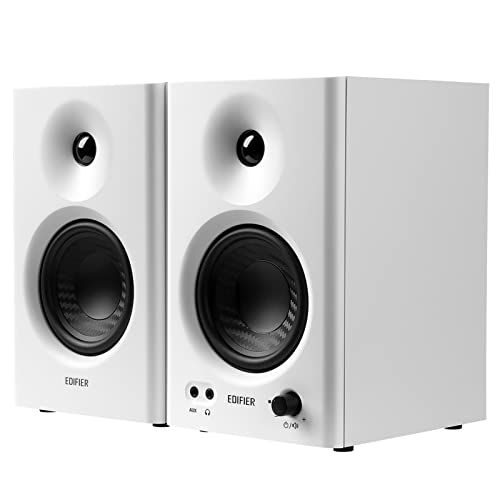
Crafted for aspiring musicians and content creators, the Edifier MR4 Powered Studio Monitor Speakers deliver exceptional audio quality that enhances your production experience. With 1-inch silk dome tweeters and 4-inch composite woofers, you’ll enjoy studio-quality sound. The MDF wooden structure minimizes resonance, ensuring accurate audio with a near-flat response. You’ll appreciate the flexible connectivity options, including balanced TRS and unbalanced RCA inputs. The dual mode design lets you switch between monitor mode for precise audio and music mode for casual listening. Plus, user-friendly controls allow for easy high- and low-frequency adjustments, making it perfect for your creative journey.
Best For: Aspiring musicians and content creators seeking studio-quality sound for music production and casual listening.
Pros:
- Studio-quality audio with 1-inch silk dome tweeters and 4-inch composite woofers for clear sound reproduction.
- Flexible connectivity options, including balanced TRS and unbalanced RCA inputs, for compatibility with various devices.
- Dual mode design allows for easy switching between monitor mode for precise audio and music mode for everyday enjoyment.
Cons:
- Limited low-frequency response due to the 4-inch woofers, which may not satisfy bass-heavy music enthusiasts.
- MDF wooden structure, while reducing resonance, may not match the durability of more robust materials.
- User controls may require some adjustment for optimal sound settings, which could be a learning curve for beginners.
M-AUDIO BX4 Studio Monitors

The M-AUDIO BX4 Studio Monitors are an ideal choice for beginners in music production, gaming, and streaming, thanks to their powerful 120W output and versatile connectivity options. With 4.5″ Kevlar low-frequency drivers and 1″ silk dome tweeters, these monitors deliver crystal-clear sound that enhances your audio experience. Their bass reflex design and rear ports provide deep bass response, while the computer-optimized tweeter waveguide guarantees precise imaging. You’ll appreciate the adjustable EQ controls for sound customization. Plus, with multiple input options, including 1/4″, 1/8″, and RCA, connecting to your devices is a breeze. Enjoy immersive sound with the BX4s!
Best For: The M-AUDIO BX4 Studio Monitors are best for beginners in music production, gaming, and streaming who seek high-quality sound and versatile connectivity.
Pros:
- Powerful Output: 120W of crystal-clear sound enhances audio experiences for various applications.
- Versatile Connectivity: Multiple input options (1/4″, 1/8″, and RCA) make it easy to connect to different devices.
- Customizable Sound: Adjustable high and low EQ controls allow for personalized sound settings.
Cons:
- Size Limitations: Compact design may not suit larger studio setups.
- Rear Port Design: Rear ports can limit placement options in smaller spaces for optimal bass response.
- Limited Warranty: The warranty is limited and may not cover all potential issues.
Factors to Consider When Choosing Studio Monitors for Beginners
When choosing studio monitors, you’ll want to evaluate several key factors. Sound quality, connectivity options, and size can greatly impact your listening experience. Don’t forget to assess your budget and any customization features that might enhance your setup.
Sound Quality Importance
Choosing the right studio monitors means prioritizing sound quality, as this is essential for accurate audio reproduction in mixing and mastering. A high-frequency response, like that offered by silk-dome tweeters, enhances clarity and detail, enabling better stereo imaging. You’ll also want monitors with woven-composite woofers for tight bass and reduced distortion during playback, ensuring a cleaner overall sound. A balanced frequency response across the audio spectrum is vital for maintaining tonal balance and fidelity, especially in various listening environments. Additionally, features such as customizable high- and low-frequency tuning controls allow you to adapt the monitors to your specific room acoustics, improving sound accuracy. Investing in quality sound will elevate your audio projects greatly.
Connectivity Options Available
Sound quality isn’t the only factor to take into account; connectivity options play a significant role in how effectively you can use your studio monitors. You’ll find models equipped with various inputs, like ¼-inch TRS balanced inputs, RCA inputs for consumer gear, and ⅛-inch TRS aux inputs for mobile devices, guaranteeing versatility for different audio sources. Many monitors now include Bluetooth connectivity, allowing you to stream wirelessly from compatible devices, which is convenient for a cable-free setup. Additionally, dedicated headphone outputs with built-in amplifiers make private listening easy. Some models even offer EQ controls and acoustic tuning options, letting you customize audio output based on your room’s acoustics. Consider these connectivity features to guarantee compatibility with your existing audio equipment.
Size and Placement Considerations
While selecting studio monitors, understanding size and placement is essential for achieving the best audio experience. Choose monitor size based on your workspace; smaller monitors with 3.5-inch woofers fit well on limited desks, while larger models (5-inch woofers and above) are better for spacious studios. Position your monitors at ear level to enhance stereo imaging and frequency response. Aim to create an equilateral triangle between the monitors and your listening position for ideal sound. Additionally, avoid corners and reflective surfaces to reduce bass buildup and improve clarity. Finally, use isolation pads or stands to decouple the monitors from your desk, minimizing vibrations that could affect sound quality. Proper size and placement make a significant difference in your audio setup.
Budget and Value Assessment
Setting a budget is one of the most important steps in selecting studio monitors as a beginner. Studio monitors can range from around $100 to over $1,000, so it’s crucial to determine how much you’re willing to invest. Look for monitors that offer a good balance between cost and performance; even entry-level models can deliver studio-quality sound. Consider the features within your budget, such as power output, frequency response, and connectivity options, to guarantee they meet your production needs. Investing in quality monitors can provide long-term value through improved sound accuracy and durability. Finally, read customer reviews and expert ratings to identify reliable options that deliver solid performance without breaking the bank.
Customization Features Offered
When choosing studio monitors, customization features can greatly enhance your listening experience and guarantee the best sound quality for your specific environment. Look for models that offer high- and low-frequency tuning controls, as these allow you to adjust audio output based on room size and speaker placement. Tone control knobs can also be a game changer, letting you boost bass or highlight high frequencies based on your preferences. Boundary EQ adjustments assure accurate sound reproduction in different acoustics. Some monitors even include built-in headphone outputs, so you can listen privately without hassle. Finally, consider models with dual mode designs to easily switch between monitor mode for production and music mode for casual enjoyment.