Choosing the right encoder can make live streaming simpler, more stable, and far easier to scale across cameras and platforms. The best streaming encoders for video production balance signal quality, protocol support, and workflow flexibility.
Below, we focus on options that suit different production needs, from straightforward single-input streaming to more advanced multi-camera and 4K workflows.
Best 10 Streaming Encoders for Video Production Picks for 2026
Multi-Input 4K Live Encoder

- HDMI or SDI input with dual-source mixing
- 4K encoding with multi-protocol streaming
- Streams to six destinations and records simultaneously
Best For: Live production teams needing a versatile all-in-one encoder
Compact 1080p SDI Encoder
Blackmagic Streaming Encoder HD

- H.264/H.265 streaming up to 1080p60
- 12G-SDI input with loop out
- Compact dedicated HD encoder
Best For: HD live streaming workflows centered on SDI
All-in-One HDMI Switcher Encoder

- Four HDMI inputs plus dual outputs
- Streams to three platforms and records locally
- Built-in audio, keying, and hardware controls
Best For: Hands-on multi-camera live production with switching and encoding
4K SDI/HDMI Streaming Encoder
Blackmagic Streaming Encoder 4K

- DCI 4K streaming up to 60 fps
- H.264/H.265 to RTMP or SRT
- SDI and HDMI monitor outputs with local controls
Best For: Dedicated 4K live streaming with monitoring and simple control
URayCoder 4K HDMI Network Encoder
Multi-Protocol Live Streaming Box
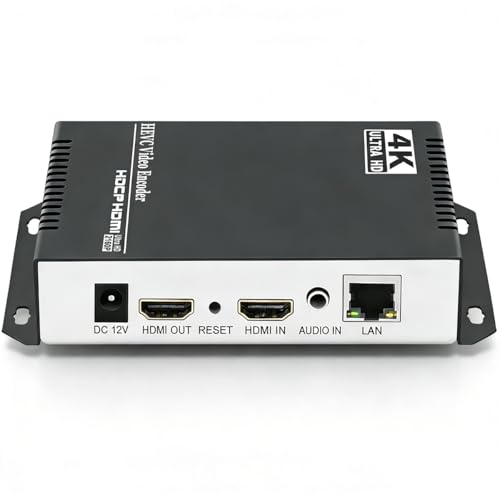
- 4K HDMI input with H.265/H.264 encoding
- Supports RTSP, RTMP(S), SRT, HLS, WebRTC, and more
- Adds text, logos, captions, and timestamps
Best For: Multi-platform live streaming and custom overlays
Blackmagic Streaming Encoder 4K
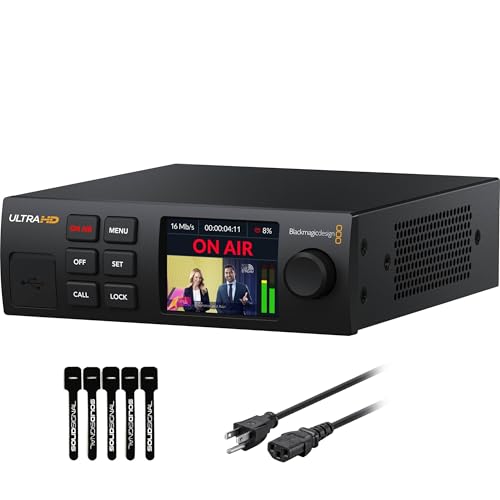
- H.264/H.265 streaming up to 2160p60
- 12G-SDI input with standards conversion
- Ethernet plus mobile auto-failover
Best For: Broadcast teams needing SDI and resilient streaming
URayCoder 4K HDMI IP Encoder

- 4K HDMI input with H.265/H.264 encoding
- Outputs up to 4 protocol-based streams
- Supports overlays, captions, and audio input
Best For: HDMI live streams with multi-platform delivery
SDI Multi-Output Encoder
SDI to IP Encoder with 4 Outputs

- Accepts SDI input for live video production workflows.
- Pushes up to 4 streams with different protocols.
- Includes lifetime support plus SDK/API docs.
Best For: Teams needing SDI capture, multi-platform delivery, and flexible stream control.
4K HDMI Encoder
Multi-Channel HDMI to IP Encoder
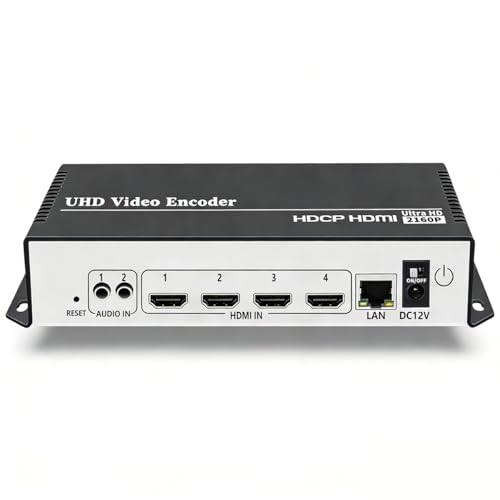
- Handles 4K UHD HDMI input with H.265/H.264 encoding.
- Outputs up to 4 simultaneous streams.
- Supports RTSP, RTMP(S), SRT, HLS, WebRTC, and more.
Best For: 4K HDMI productions needing multi-stream platform delivery and broad protocol support.
Browser-Setup HDMI Encoder

- Hardware H.265/H.264 encoding at 1080P60.
- Browser setup with no software or drivers required.
- Supports RTSP, RTMP(S), SRT, HLS, WebRTC, and more.
Best For: Creators and small teams wanting quick setup, compact hardware, and reliable 1080P60 streaming.
Multi-Input 4K Live Encoder – Magewell Ultra Encode AIO
If you need a flexible option in streaming encoders for video production, the Magewell Ultra Encode AIO is built for mixed-source workflows. It handles HDMI or SDI input, supports picture-in-picture and side-by-side layouts, and can stream, record, and add overlays at the same time.
Best For: Live production teams that want one encoder for 4K streaming, recording, and multi-input switching.
Pros:
- Accepts either HDMI or SDI, with dual-input mixing for PIP or side-by-side layouts.
- Supports 4K encoding and multiple protocols including RTMP, SRT, and NDI|HX2/HX3.
- Can stream to up to six destinations while recording to SD card, USB storage, or network drives.
- Includes onboard processing, up to eight overlays, PoE, Wi-Fi, and 4G USB modem support.
Cons:
- Its rack-mount form factor may be more than some compact setups need.
- Advanced feature set may be unnecessary if you only need basic single-stream output.
This is a strong fit when you want one box to cover capture, conversion, streaming, and recording without adding extra gear.
Compact 1080p SDI Encoder – Blackmagic Streaming Encoder HD
For buyers comparing streaming encoders for video production, this Blackmagic Design unit keeps things focused on reliable 1080p delivery. It supports H.264 and H.265 streaming, takes 12G-SDI in with loop out, and is sized for straightforward HD streaming workflows.
Best For: HD live streaming setups that need SDI input and a compact dedicated encoder.
Pros:
- Supports H.264 and H.265 streaming at up to 1080p60.
- Includes 12G-SDI input with loop out for simple signal integration.
- Compact design is easier to place in a production rack or desktop setup.
Cons:
- Limited to 1080p output, so it is not a 4K option.
- Appears more specialized for SDI-based HD workflows than mixed-input production.
This is a practical choice if your productions are HD-first and you want a dedicated encoder with minimal complexity.
All-in-One HDMI Switcher Encoder – osee GoStream Deck HDMI Pro
If your streaming encoders for video production need to do more than encode, the osee GoStream Deck HDMI Pro combines switching, monitoring, audio control, and streaming in one unit. It offers four HDMI inputs, dual HDMI outputs, recording options, and built-in controls for live production without a PC.
Best For: Multi-camera livestreams, podcasts, churches, and events that need switching plus encoding in one device.
Pros:
- Four HDMI inputs and two HDMI outputs support monitoring and MultiView workflows.
- Streams to up to 3 platforms and supports RTMP streaming over Ethernet or USB output to OBS/vMix.
- Records to SD card or USB SSD while also playing back MP4 files.
- Includes audio controls, chroma key, PIP, downstream keying, and hard-panel controls with T-Bar and macros.
Cons:
- It is a switcher-focused tool, so pure encoding needs may not use all of its functions.
- Its feature set may be more than a simple single-camera stream requires.
This is a versatile pick if you want a hands-on production surface that can manage switching, overlays, audio, and streaming from one box.
4K SDI/HDMI Streaming Encoder – Blackmagic Streaming Encoder 4K
Among streaming encoders for video production, the Blackmagic Design Streaming Encoder 4K is aimed at higher-resolution live workflows. It supports H.264 and H.265 streaming to RTMP or SRT, handles DCI 4K up to 60 fps, and includes SDI and HDMI monitor outputs plus front-panel controls.
Best For: 4K live streaming teams that want a dedicated encoder with SDI and HDMI monitoring.
Pros:
- Supports DCI 4K streaming up to 60 fps.
- Streams via H.264 or H.265 to RTMP or SRT.
- Includes SDI and HDMI monitor outputs for setup and confidence monitoring.
- Front-panel buttons and spin knob make local control simple.
Cons:
- No detailed input/output count is listed beyond the monitor outputs.
- Best suited to dedicated encoding, not multi-camera switching.
This is a strong match when your priority is a focused 4K streaming encoder rather than an all-in-one production switcher.
URayCoder 4K HDMI Network Encoder – Multi-Protocol Live Streaming Box
If you’re comparing streaming encoders for video production, this URayCoder unit is built for creators who need flexible HDMI-to-IP encoding with broad protocol support. It accepts 4K HDMI input, supports H.265/H.264, and can push multiple streams to services like YouTube and Facebook without adding extra gear.
Best For: Multi-platform live streaming, custom overlays, and teams that want simple HDMI-to-network encoding.
Pros:
- Supports 4K UHD input and H.265/H.264 encoding.
- Compatible with RTSP, RTMP(S), SRT, HLS, WebRTC, and more.
- Can add static text, scrolling captions, logos, and timestamps.
- Supports HDMI embedded audio plus line-in audio.
Cons:
- Maximum 4K frame rate is 30fps.
- Setup still requires basic network and streaming configuration.
- Feature depth may be more than casual users need.
Overall, this is a strong pick if your workflow values protocol flexibility and on-stream customization. It looks especially useful for production teams that want one encoder to feed several destinations at once.
Blackmagic Streaming Encoder 4K – Broadcast-Style SDI Encoder
For professional streaming encoders for video production, this Blackmagic model stands out because it is a self-contained 4K encoder with SDI input and no encoding PC required. It is designed for broadcast-style workflows, with SRT and RTMP streaming, monitor outputs, mobile failover, and control features that fit studio or remote production.
Best For: Broadcast and live production teams that need SDI input, failover connectivity, and control features.
Pros:
- Encodes in H.264 and H.265 up to 2160p60.
- 12G-SDI input with standards conversion and SDI loop out.
- Ethernet plus 5G/4G mobile with auto-failover.
- Includes captions, timecode passthrough, REST API, and webcam output.
Cons:
- Built around SDI sources, not HDMI-only workflows.
- More advanced than a simple plug-and-stream encoder.
- Best value is tied to production setups that use its control features.
This is the most production-focused option in the group, especially if you need resilient connectivity and broadcast-friendly controls. It is a smart fit when reliability and integration matter more than simplicity.
URayCoder 4K HDMI IP Encoder – Flexible HDMI Live Stream Box
This URayCoder model is a practical choice among streaming encoders for video production when you want HDMI capture, multi-protocol output, and easy web-based management. It supports 4K UHD input, H.265/H.264 encoding, and streaming to platforms such as YouTube, Facebook, Twitch, and Vimeo.
Best For: HDMI-based live streaming setups that need protocol flexibility and simple control.
Pros:
- 4K UHD HDMI input with H.265/H.264 dual encoding.
- Supports RTSP, RTMP(S), SRT, HLS, WebRTC, and more.
- Can output up to 4 streams with different protocols.
- Allows text, logos, captions, timestamps, and image adjustments.
Cons:
- 4K output is limited to 30fps.
- Works best for users comfortable with encoder settings.
- Many features may be unnecessary for very basic live streams.
As with the other URayCoder unit, the main appeal is flexibility: multiple formats, broad platform compatibility, and built-in customization tools. It makes sense for creators who want one encoder to handle a lot of different delivery needs.
SDI Multi-Output Encoder – SDI to IP Encoder with 4 Outputs
For streaming encoders for video production, this SDI to IP unit is built for operators who need flexible live distribution from one source. It accepts SDI input and supports multiple output streams at once, with protocol options that let you tailor delivery for different platforms and network setups.
Best For: Live production teams that need SDI ingestion, multi-platform output, and customizable stream settings.
Pros:
- Supports up to 4 simultaneous video streams, each with different streaming protocols.
- Wide protocol support includes HTTP, RTSP, RTMP(S), SRT, HLS, UDP, RTP, MP4, Multicast, Unitcast, FLV, and ONVIF.
- Offers stream customization such as static text, scrolling text, logo, time, resolution, frame rate, bitrate, crop, rotate, flip, and mirror.
- Includes free lifetime technical support, warranty, SDK/API documents, and CGI control protocol documentation.
Cons:
- Designed for SDI output devices, so it is not a universal input solution.
- Advanced customization and secondary development features may be more than casual users need.
This encoder is a strong fit when you want a broadcast-style SDI workflow with broad protocol support and multiple concurrent outputs. It is especially useful when you need one source to feed several destinations with different delivery requirements.
4K HDMI Encoder – Multi-Channel HDMI to IP Encoder
If you need streaming encoders for video production that can handle higher-resolution sources, this HDMI to IP model is built around 4K UHD input and multi-platform delivery. It supports several live-streaming protocols and can output multiple streams at once, making it a practical choice for productions that need one source sent to different destinations.
Best For: 4K HDMI live streaming setups that need protocol flexibility, multi-stream output, and easy platform compatibility.
Pros:
- Supports 4K UHD input at up to 30fps and 2K or lower resolutions up to 120fps.
- Compatible with HTTP, RTSP, RTMP(S), SRT, HLS, MP4, Multicast, ONVIF, FLV, WebRTC, TRTC, ICECAST, and more.
- Can output 4 video streams simultaneously and push to platforms like YouTube, Facebook, Twitch, and Vimeo.
- Includes customization for text, scrolling captions, logos, timestamps, cropping, rotation, flipping, and mirroring.
Cons:
- Setup and advanced configuration may be more than basic users need, despite the straightforward interface.
- 4K input is limited to 30fps, so it is not aimed at high-frame-rate 4K workflows.
This encoder stands out for production teams that want a feature-rich HDMI workflow with broad protocol support and multi-stream capability. The combination of 4K input, stream customization, and platform compatibility makes it a versatile live streaming tool.
Browser-Setup HDMI Encoder – 1080P60 HDMI Live Streamer
For streaming encoders for video production where simplicity matters, this 1080P60 HDMI encoder keeps the workflow lightweight with browser-based setup and no software installation. It combines hardware H.265/H.264 encoding with broad IP protocol support, so it can fit live events, monitoring, and digital signage without adding complexity.
Best For: Small teams and solo creators who want fast browser setup, compact hardware, and dependable 1080P60 streaming.
Pros:
- Hardware H.265/H.264 encoding supports broadcast-quality 1080P60 output.
- Broad protocol support includes SRT, RTMP(S), RTSP, UDP, HTTP, HLS, WebRTC, TRTC, Icecast, and SHOUTcast.
- Browser-based setup means no drivers, no software, and no OS compatibility issues.
- Compact, low-power design is suitable for 24/7 operation and includes HDMI embedded audio, 3.5mm input, and OSD overlays.
Cons:
- Basic networking knowledge is still recommended for advanced streaming setups.
- It is limited to a single HDMI input, so it is not meant for multi-source production switching.
This encoder is a practical choice when you want a compact, reliable HDMI streaming box that is easy to configure from any browser. It suits users who value speed of deployment and broad protocol compatibility over advanced multi-input features.
How We Picked the Best Streaming Encoders for Video Production
We prioritized encoders built for real production use: reliable hardware encoding, support for common streaming protocols, practical I/O options, and enough format compatibility to fit modern live workflows. We also weighed whether a model is better suited to simple single-camera jobs or more complex setups with switching, recording, or network delivery.
Quick Comparison
Among Streaming Encoders for Video Production, the main split is between compact HDMI/IP encoders and more capable hybrid units that add SDI, dual inputs, mixing, or switching. HDMI models are often the easiest choice for smaller studio, church, classroom, or creator setups, while SDI and multi-input options make more sense for pro environments where cable runs and camera integration matter.
Key Buying Factors for Streaming Encoders for Video Production
Input Type and Signal Path
Match the encoder to your cameras and switchers. HDMI is common and affordable, but SDI is usually preferred for longer runs and more rugged production environments. If you need to ingest multiple sources, look for dual-input or multi-channel support.
Codec and Resolution Support
H.264 remains the broad compatibility choice, while H.265 can reduce bandwidth at the same quality level. For higher-end work, 4K support is worth considering only if your camera chain, network, and destination platform can actually benefit from it.
Streaming Protocols
Make sure the encoder supports the delivery method you plan to use. RTMP is still widely used, but SRT, HLS, RTSP, WebRTC, and RTMPS can be important for latency, security, or distribution flexibility.
Recording and Monitoring
Built-in recording can provide a useful backup, and local monitoring helps confirm audio, framing, and network stability before and during a live event. These features are especially valuable when there is no separate engineer on site.
Who Should Buy Which Streaming Encoders for Video Production?
If you want the simplest path to live streaming, choose a basic HDMI encoder with strong protocol support. If your workflow involves pro cameras, longer cable runs, or live events, an SDI encoder is the safer investment. For multi-camera productions, look for encoder-switcher hybrids or models with dual-input mixing. If bandwidth is limited or you want more efficient delivery, H.265-capable units are worth a closer look.
For most buyers, the best choice is the encoder that matches your existing gear first, then adds the protocols, recording, and resolution headroom you are most likely to use in the next year or two.