The best stereo looper pedals make it easier to build layered guitar, bass, vocal, and instrument parts without sacrificing clarity or flexibility. This lineup includes compact loopers for beginners, rhythm-equipped pedals for solo performers, and advanced stereo models with generous memory and control options.
Use the comparisons below to match recording time, loop storage, drum patterns, connectivity, and footswitch control to the way you actually play. Whether you need a simple practice tool or a performance-ready looping station, the right pedal should feel intuitive underfoot and fit naturally into your signal chain.
Best 10 Stereo Looper Pedals Picks for 2026
Professional Control

- 13 hours of stereo recording and 99 phrase memories
- 57 rhythms with variations and seven drum kits
- MIDI, USB, LCD, reverse, and external control support
Best For: Performers needing extensive storage and advanced control
Stereo Groove Workstation

- Stereo looper and drum machine in one pedal
- 140 minutes of storage across 14 save slots
- 121 grooves, time stretch, tap tempo, and editor software
Best For: Players wanting drum-backed stereo looping
Simple Stereo Looping

- Straightforward record, overdub, playback, and undo controls
- 12 minutes of stereo recording with phrase retention
- Stereo I/O and a 24-segment loop indicator
Best For: Beginners and players wanting uncomplicated looping
High-Capacity Rhythm Looping

- 40 slots and 160 minutes of total loop capacity
- 110 drum grooves across 11 styles
- USB transfer, timing display, tap tempo, and fade out
Best For: Players needing many saved loops and built-in rhythms
Best Long-Memory Value

- 40 minutes total recording across nine loops
- 48 kHz/24-bit uncompressed audio
- Built-in tuner and USB WAV transfer
Best For: Simple guitar and bass looping with generous memory
Best With Drum Machine

- 160 minutes of stereo recording in 40 slots
- Built-in drum machine with 121 grooves
- USB-C, headphone output, and sync features
Best For: Solo practice, synchronized looping, and live performance
Best for Expanded Control

- Six hours of recording with 99 memory slots
- 50 rhythm patterns and HD color LCD
- MIDI control for tempo and transport functions
Best For: Players building detailed, MIDI-controlled looping setups
Best for Visual Simplicity

- Three loop slots and 90 minutes total recording
- Bright screen shows status and timing
- Unlimited overdubs with auto-save and true bypass
Best For: Beginners, buskers, and solo performers wanting clear, simple looping
Best Feature-Rich Station

- 300 minutes of stereo recording in 100 slots
- 220 drum grooves with dual footswitch control
- USB transfer, time stretch, and headphone output
Best For: Players needing rhythm backing, silent practice, and extensive loop storage
Best Compact Sync Option
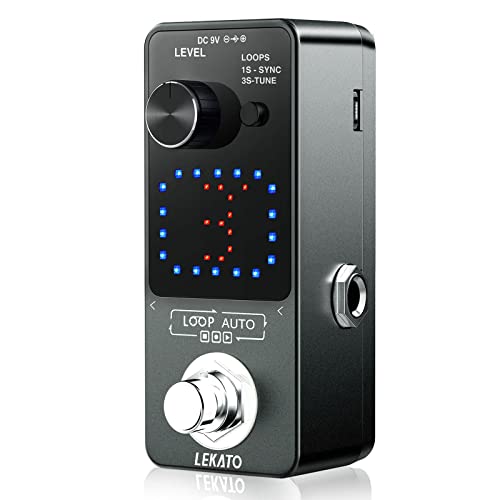
- Synchronized recording and built-in tuner
- Three loops with 18 minutes total recording
- USB file transfer and unlimited overdubs
Best For: Guitarists and bassists wanting compact, focused looping control
Professional Control – BOSS RC-5 Loop Station
The BOSS RC-5 is a compact choice for musicians who want advanced stereo looper pedals with high-quality processing, extensive phrase storage, and flexible performance control. It combines 13 hours of stereo recording, 99 phrase memories, onboard rhythms, MIDI, USB, and a multi-color display in a pedalboard-friendly design.
Best For: Performers and loopers who need professional features, long recording time, rhythm accompaniment, and expanded MIDI or footswitch control.
Pros:
- 32-bit AD/DA conversion and 32-bit floating-point processing support high-quality loop capture and playback.
- Stores up to 13 hours of stereo recording across 99 phrase memories.
- Includes 57 rhythms with A/B variations and seven drum kits.
- Offers MIDI I/O, USB, a multi-color LCD, reverse playback, and external control support.
Cons:
- Optional PSA power adapter is required for extended sessions if you do not use a 9V battery.
- Its broader control and connectivity options may be more than beginners need.
The RC-5 is a strong all-around pick when recording capacity and integration matter as much as basic looping. Its compact format makes it practical for a pedalboard, while the display, rhythms, and MIDI support leave room for more complex setups.
Stereo Groove Workstation – MOOER Groove Loop X2
The MOOER Groove Loop X2 pairs stereo looping with a built-in drum machine, making it a versatile option among stereo looper pedals. It provides 14 save slots, up to 140 minutes of total stereo recording, 121 drum grooves, tempo tools, and separate routing for loop and drum audio.
Best For: Guitarists and performers who want drum-backed practice or performances with substantial storage, stereo I/O, and computer-based track management.
Pros:
- Combines a stereo looper and drum machine in one pedal.
- Offers 14 slots with loops up to 10 minutes each, for 140 minutes total stereo recording.
- Includes 121 grooves across 11 genres, plus count-in, automatic, and normal recording modes.
- Supports time stretching, tap tempo, separate audio routing, and import/export through editor software.
Cons:
- Requires a 9V DC, 300mA center-negative adapter.
- Its larger 5.55-by-5-inch footprint may need more pedalboard space.
Choose the Groove Loop X2 if integrated rhythm accompaniment is central to your workflow. Its stereo connections and editing software add flexibility, while the separate outputs can help manage the loop and drum signals in a more developed setup.
Simple Stereo Looping – BOSS RC-1 Loop Station
The BOSS RC-1 is a straightforward entry point for musicians comparing stereo looper pedals. Its simple record, playback, overdub, undo, and redo controls are supported by stereo inputs and outputs, a 24-segment loop indicator, and 12 minutes of recording time.
Best For: Guitar, bass, and keyboard players who want an easy-to-use looper for layering phrases without advanced menus or complex setup.
Pros:
- Simple controls cover recording, playback, overdubbing, undo, and redo.
- Stereo inputs and outputs support stereo-compatible setups.
- Provides 12 minutes of stereo recording time.
- Includes a visual loop indicator and retains the recorded phrase when powered off.
Cons:
- It has less recording capacity and fewer specialized features than the RC-5 or combination looper-drum pedals.
- The PSA-series AC adapter is optional and sold separately.
The RC-1 is best suited to players who value immediate operation over extensive rhythm libraries, memory banks, or editing functions. Its clear indicator and familiar stompbox layout make it a practical first looper or uncomplicated performance tool.
High-Capacity Rhythm Looping – Donner Circle Looper
The Donner Circle Looper combines stereo looping and drum-machine functions for players seeking practical value in stereo looper pedals. It offers 40 memory slots, 160 minutes of total loop capacity, 110 drum grooves, a timing display, USB import/export, tap tempo, and fade-out control.
Best For: Practice and performance setups that need many saved loops, built-in rhythm patterns, and computer-based file transfer.
Pros:
- Provides 40 slots with four minutes per slot and 160 minutes of total recording capacity.
- Includes 110 drum grooves across 11 styles and 10 metronome settings.
- Bright screen shows loop mode, time progress, and timing information.
- Supports USB import/export, tap tempo, fade out, and an external footswitch.
Cons:
- Power supply is not included.
- The external footswitch is also sold separately.
- It requires a 9V DC center-negative adapter; the supplied notes reference a 500mA requirement.
The Circle Looper stands out for storage capacity and rhythm variety at the same time. It is a useful fit for players who want to keep numerous ideas available, though buyers should plan for the additional adapter and optional footswitch.
Best Long-Memory Value – LEKATO 9-Loop Guitar Looper
If you want a straightforward option among stereo looper pedals, the LEKATO emphasizes generous memory, uncomplicated foot control, and a built-in tuner. It records up to 10 minutes per loop, stores nine loops, and provides 40 minutes of total recording time with unlimited overdubs.
Best For: Guitarists and bassists who want long recording capacity, simple one-button looping, and an integrated tuner.
Pros:
- Stores nine loops with up to 40 minutes of total recording time.
- Supports 48 kHz/24-bit uncompressed audio with Analog-Dry-Through design.
- USB transfer supports importing and exporting WAV loop files.
- Built-in tuner switches continuously without interrupting the phrase.
Cons:
- Uses a single footswitch and one knob, so several functions rely on foot commands.
- Requires a 9-volt, 300 mA power source.
- The supplied connector is a mono 1/4-inch TS jack.
The LEKATO is a practical pick when recording time and ease of use matter more than extensive rhythm or MIDI features. Its visual time indicator, tuner, and USB file management add useful convenience for practice and basic performance setups.
Best With Drum Machine – FLAMMA FF03 Stereo Looper
The FLAMMA FF03 is a feature-rich choice among stereo looper pedals, combining stereo recording with a built-in drum machine. It offers 160 minutes of storage in 40 slots, dual-foot switch control, sync and quantization functions, and a headphone output for quieter practice.
Best For: Solo performers, practice sessions, and players who want synchronized loops and drum accompaniment.
Pros:
- Records 160 minutes of 44.1 kHz/16-bit stereo audio across 40 memory slots.
- Includes 121 drum grooves, with 11 styles and 11 patterns per style.
- Dual footswitches provide dedicated control for looping functions.
- USB-C WAV transfer and a headphone output support file management and silent practice.
Cons:
- Its extensive drum and synchronization features may be more than needed for basic looping.
- Stores audio at 44.1 kHz/16-bit rather than the higher rate and bit depth listed for the LEKATO.
- Requires a 9-volt, 200 mA power source.
Choose the FF03 if rhythm support and hands-on live control are central to your setup. Tap tempo, count-in, quantization, fade-out, and looper-drum sync make it particularly useful for structured practice and solo performance.
Best for Expanded Control – NUX Loop Core Stereo
The NUX Loop Core Stereo suits players seeking extended storage and deeper control in a stereo looper pedal. It provides six hours of recording, 99 memory slots, 50 rhythm patterns, an HD color LCD screen, and external MIDI control for parameters such as tap tempo and transport functions.
Best For: Guitarists who need substantial loop storage, visual editing feedback, rhythm patterns, and MIDI-based control.
Pros:
- Offers up to six hours of phrase recording and 99 memory slots.
- Includes 50 rhythm patterns for practice and performance.
- HD color LCD screen provides a clearer view of parameters.
- External MIDI control can operate tap tempo, stop, start, and record functions.
Cons:
- The larger feature set may require more setup than a basic looper.
- The listed connector is a 5-pin DIN, so MIDI integration may need compatible equipment or adapters.
- The supplied notes specify a 9-volt, 300 mA power requirement.
The Loop Core Stereo is a strong fit when memory capacity and external control are priorities. Its display, rhythm library, and MIDI support make it better suited to organized practice rigs and more involved performance setups than minimalist loopers.
Best for Visual Simplicity – Donner Triple Looper
For players comparing stereo looper pedals, the Donner Triple Looper emphasizes straightforward control, visible timing information, and generous recording capacity. Its screen shows loop status and progress, while three independent slots support separate song sections or ideas.
Best For: Beginners, buskers, solo performers, and players who want simple looping with clear visual feedback.
Pros:
- Three loop slots with up to 90 minutes of total recording time.
- Bright screen displays loop status, progress, and timing.
- Unlimited overdubs, auto-save, and true bypass operation.
- Single-footswitch control keeps recording and playback approachable.
Cons:
- Power supply is not included.
- Single-footswitch operation may be less convenient for complex live control.
The Donner is a practical choice when storage, easy operation, and visual monitoring matter more than advanced drum or file-management features. Confirm the required 9V center-negative power supply before buying.
Best Feature-Rich Station – FLAMMA FF20 Looper
Among stereo looper pedals, the FLAMMA FF20 stands out as a broader practice and performance station. It combines stereo looping with 100 memory slots, a built-in drum machine, time stretching, USB file transfer, and headphone output.
Best For: Guitarists and bassists who want loop storage, rhythm accompaniment, silent practice, and hands-on stage control.
Pros:
- Stores up to 300 minutes of stereo loops across 100 slots.
- Includes 220 drum grooves across 11 styles.
- Dual footswitches support more intuitive live operation.
- Full-color screen, USB-C transfer, and headphone output add flexibility.
Cons:
- Its larger feature set may require more setup than a basic looper.
- Power supply requirements should be checked before use.
The FF20 is the strongest fit here for musicians who want more than basic overdubbing. Drum patterns, time stretch, auto record, and file transfer make it useful for composing, rehearsing, and performing without a separate backing-track setup.
Best Compact Sync Option – LEKATO Triple Looper
For shoppers seeking compact stereo looper pedals with useful performance tools, the LEKATO Triple Looper offers synchronized recording, a built-in tuner, and three loop slots. Its lossless 48 kHz/24-bit audio design and analog dry-through support a clean signal path.
Best For: Guitarists and bassists who value compact size, tuner access, synchronized looping, and USB file management.
Pros:
- Sync mode lets recording begin during playback without missing a phrase.
- Three loops provide up to 18 minutes of total recording time.
- Built-in tuner, unlimited overdubs, and one-button foot commands.
- USB import/export and automatic saving support convenient file management.
Cons:
- Its 18-minute total capacity is lower than the other listed options.
- Power supply is not included.
The LEKATO is a focused, compact option for players who do not need a drum machine or extensive memory. Sync recording and the tuner make it especially practical for live looping and everyday guitar or bass practice.
How We Picked These Stereo Looper Pedals
We selected these models based on the features that matter most in real-world looping: recording capacity, loop-slot storage, overdub behavior, stereo operation, rhythm accompaniment, controls, display feedback, and suitability for guitar and bass. We also considered the needs of different players, from beginners who want one-button operation to performers who need undo/redo, synchronization, MIDI control, or extensive phrase storage.
Specifications can vary by version and seller, so confirm the current manual and included accessories before buying. A pedal with more memory is not automatically better if its controls are difficult to operate during a performance.
Quick Comparison
| Best For | Look For | Featured Options |
|---|---|---|
| Simple practice and first loops | Clear controls, reliable recording, compact design | BOSS RC-1, LEKATO single-loop models |
| Rhythm-backed solo playing | Built-in drum grooves, tap tempo, stored patterns | MOOER Groove Looper, Donner Circle, FLAMMA FF03 |
| Long arrangements and song ideas | Large recording time, multiple loop slots, overdubs | NUX Loop Core, FLAMMA FF20 |
| Hands-on performance control | Multiple loops, screens, undo/redo, dedicated functions | Donner Triple Looper, BOSS RC-5 |
Key Buying Factors for Stereo Looper Pedals
Recording Time and Loop Storage
Recording time determines how long a phrase can be, while loop slots determine how many ideas or songs you can keep available. For basic practice, a single loop may be enough. Performers and songwriters benefit from multiple slots and longer total memory.
Stereo I/O and Signal Routing
Stereo inputs and outputs are useful for stereo effects, dual-amp rigs, keyboards, and preserving spatial effects. If your setup is mono, stereo capability is still convenient for future expansion, but it should not outweigh essential control or sound-quality needs.
Drum Machines and Timing
Built-in rhythms can provide a practical foundation for solo playing. Check the number and style of grooves, tap-tempo behavior, count-in options, and whether the rhythm remains easy to control while recording and overdubbing.
Footswitches, Displays, and Synchronization
Simple pedals minimize setup, while extra footswitches and screens make complex arrangements easier to manage. Undo/redo, dedicated stop controls, MIDI, and sync functions become increasingly valuable for live use and multi-pedal rigs.
Who Should Buy Which Stereo Looper Pedals?
Beginners: Choose a straightforward single-loop pedal such as the BOSS RC-1 or a compact LEKATO model. Solo performers: Consider a drum-equipped Donner, MOOER, or FLAMMA pedal for rhythm support. Songwriters: Prioritize the NUX Loop Core or FLAMMA FF20 for longer recording time and larger storage. Live loopers: Look for the BOSS RC-5 or Donner Triple Looper, especially if you need faster access to multiple functions. Stereo-rig owners: Confirm the exact input and output routing before purchase, then select the model whose controls match your performance workflow.