The best portable podcast recorders make it easier to capture clean interviews, live conversations, and location-based shows without relying on a full studio setup. The right model depends on your microphone inputs, monitoring needs, portability, and tolerance for hands-on setup.
We’ve selected 10 recorders spanning podcast-specific mixers, handheld devices, USB microphone recorders, and professional field options so you can match your workflow and budget to the right equipment.
Best 10 Portable Podcast Recorders Picks for 2026
Best for Multi-Person Shows

- Four XLR inputs and four headphone outputs
- Mix-minus for phone and remote interviews
- Battery-powered multitrack podcast recording
Best For: Multi-person podcasts and remote interviews
Best for Clip-Free Flexibility

- 32-bit float recording for clip-free audio
- Built-in stereo mics and two XLR/TRS inputs
- USB-C recording or streaming with SD backup
Best For: Mixed podcasting, music, and video audio
Best for AI-Assisted Podcasting

- Four XLR inputs and four headphone outputs
- AI noise reduction and tone enhancement
- Direct phone connection for video audio
Best For: Group podcasts with streamlined audio processing
Best for Long Field Sessions

- Three mics with nine recording patterns
- 32-bit float/96kHz clip-free capture
- Up to 20 hours of battery life
Best For: Solo podcasts, interviews, and field recording
Best for Two-Person Podcasts

- Two USB mic inputs and two headphone outputs
- Mix-Minus for echo-free remote calls
- AI noise reduction and battery operation
Best For: Two-person podcasts and remote interviews
Best for Expandable Field Recording

- Six-track 32-bit float recording
- Four XLR/TRS inputs plus X/Y microphones
- USB interface with simultaneous SD backup
Best For: Multi-mic podcasts, music, and filmmaking
Best Compact Starter Kit
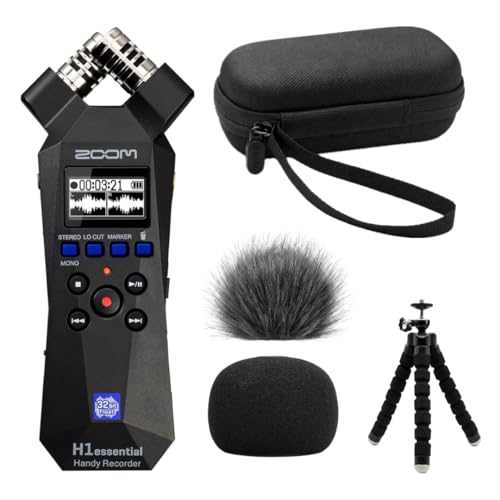
- 32-bit float stereo recording
- Includes case, windscreens, and flexible tripod
- USB microphone support for computers and mobile devices
Best For: Beginners, travel recording, and outdoor interviews
Best Professional Pick

- 32-bit float recording for changing levels
- Dual locking XLR/TRS inputs
- Low-noise preamps and flexible power
Best For: Professional field recording and XLR-based podcast setups
Best Simple Stereo Recorder

- Built-in X/Y stereo microphones
- 32-bit float recording
- USB-C microphone mode
Best For: Portable interviews, solo podcasts, and content creation
Best Two-Mic Setup

- Two XLR/TRS combo inputs
- 32-bit/96kHz WAV recording
- Waveform display for level checks
Best For: Two-microphone podcasts, interviews, and music recording
Best for Multi-Person Shows – Zoom PodTrak P4
The Zoom PodTrak P4 is a practical choice among portable podcast recorders for small shows that need several microphones, headphones, and remote-call support in one battery-powered unit. Its four XLR inputs, multitrack recording, and phone or USB connectivity make it suited to flexible podcast setups.
Best For: Multi-person podcasts, remote interviews, and creators who need four individual headphone outputs.
Pros:
- Four XLR microphone inputs with phantom power
- Four headphone outputs with individual volume controls
- Automatic mix-minus for phone and remote interviews
- Programmable sound pads and multitrack recording
Cons:
- Battery life is rated at up to 3.5 hours on two AA batteries
- Its feature set may be more than a solo podcaster needs
The P4 stands out when multiple participants need direct monitoring and separate microphone tracks. It is less focused on ultra-long battery sessions, but its podcast-specific connections make it a strong portable studio for group recording.
Best for Clip-Free Flexibility – Zoom H4 Essential
The Zoom H4 Essential is a versatile option among portable podcast recorders for users who also record music, video audio, interviews, or live performances. Its 32-bit float recording, built-in stereo microphones, and two XLR/TRS inputs support both quick recordings and more involved setups.
Best For: Podcasters, musicians, and filmmakers who want one handheld recorder for varied audio projects.
Pros:
- 32-bit float recording helps provide clip-free audio
- Built-in stereo microphones plus two XLR/TRS inputs
- Records to an SD card while connecting over USB-C
- Spoken menu guidance supports easier navigation
Cons:
- Only two external XLR/TRS inputs are provided
- It is less specialized for multi-person podcast monitoring than the PodTrak models
The H4 Essential is a strong all-purpose recorder when your podcasting needs overlap with music, filmmaking, or field work. Its clip-free recording approach can simplify unpredictable sessions, while the external inputs add room for dedicated microphones or instruments.
Best for AI-Assisted Podcasting – Zoom PodTrak P4next
The Zoom PodTrak P4next brings AI-assisted processing to the portable podcast recorder format. It combines four XLR inputs, four individually controlled headphone outputs, and multitrack support with AI noise reduction, tone enhancement, and compression for streamlined group recording.
Best For: Podcast teams that want four-mic recording and built-in tools to help create balanced audio with less manual mixing.
Pros:
- Four XLR inputs with up to +70 dB of gain
- Four headphone outputs with separate volume controls
- AI noise reduction, Tone Enhancement, and COMP tools
- Can connect to a phone for direct audio capture in video
Cons:
- Battery requirements and battery life are not specified in the supplied details
- Its AI processing may be unnecessary for users who prefer fully manual editing
The P4next is designed for convenience without giving up the flexibility of four microphone channels. It is particularly appealing for group podcasts and phone video workflows where reducing cleanup and syncing can save time.
Best for Long Field Sessions – Zoom H2 Essential
The Zoom H2 Essential is a compact choice among portable podcast recorders for solo creators, journalists, and field recordists who value flexible microphone coverage. Three built-in microphones, nine recording patterns, 32-bit float capture, and up to 20 hours of battery life support a wide range of portable sessions.
Best For: Solo podcasting, interviews, field recording, and situations where long battery life and adaptable pickup patterns matter.
Pros:
- Three built-in microphones with nine selectable recording patterns
- 32-bit float/96kHz recording for clip-free capture
- Works as a USB microphone while recording a backup to SD card
- Rated for up to 20 hours on two AA batteries
Cons:
- It does not offer XLR inputs for connecting external microphones
- Its single 3.5mm headphone output is less suited to group monitoring
The H2 Essential is best when portability, battery endurance, and adaptable built-in microphones are more important than multiple external mic connections. Its USB microphone mode and simultaneous SD recording also make it useful for straightforward home or mobile workflows.
Best for Two-Person Podcasts – Simple USB Podcasting
The Zoom PodTrak P2 is one of the most straightforward portable podcast recorders for two-person shows. Plug in two USB microphones, connect two pairs of headphones, and record individual tracks to an SD card while streaming or calling in a remote guest.
Best For: Two-person podcasts, remote interviews, and creators who want simple battery-powered recording with built-in processing.
Pros:
- Two USB mic inputs and two headphone outputs simplify setup.
- Mix-Minus helps prevent echo and feedback with remote guests.
- AI noise reduction, tone shaping, compression, and de-essing reduce the need for post-production.
- Runs on four AA batteries for up to four hours, with USB and AC power options.
Cons:
- Limited to two USB microphone inputs.
- Battery life is listed at up to four hours.
Choose the PodTrak P2 if your priority is a quick, portable two-person setup rather than a larger multi-input recorder. Its call-in support and onboard voice processing make it especially practical for interviews recorded away from a studio.
Best for Expandable Field Recording – Six-Track 32-Bit Float Audio
The Zoom H6 Essential is a versatile choice among portable podcast recorders when you need more inputs and flexible recording. It combines built-in X/Y microphones with four XLR/TRS inputs, six-track 32-bit float recording, and USB interface functionality for podcasting, music, or video work.
Best For: Podcasters, musicians, filmmakers, and field recordists who need multiple inputs and clip-resistant recording.
Pros:
- Six-track 32-bit float recording helps preserve distortion-free takes.
- Four XLR/TRS combo inputs accommodate microphones and instruments.
- Built-in X/Y microphones capture stereo sound up to 135 dB SPL.
- Works as a USB audio interface while recording to an SD card for backup.
Cons:
- Requires four AAA batteries.
- Its broader feature set may be more than a basic two-person podcast requires.
The H6 Essential is the stronger fit when your setup may expand beyond a couple of microphones. Interchangeable mic capsules, multiple inputs, and long listed battery life give it flexibility for interviews, live events, and production work.
Best Compact Starter Kit – H1essential Recorder Bundle
The Zoom H1essential bundle packages a compact recorder with accessories that make portable podcasting and field recording easier to start. Its 32-bit float capture, stereo X/Y microphones, protective case, two windscreens, and flexible tripod are useful for interviews, travel, and tabletop recording.
Best For: Beginners and mobile creators who want a small recorder with basic travel and outdoor accessories included.
Pros:
- 32-bit float recording helps avoid clipping and distortion.
- Built-in X/Y microphones record up to 120 dB SPL and 96 kHz.
- Includes a hard EVA case, furry and foam windscreens, and an octopus tripod.
- Can function as a USB microphone with computers and mobile devices.
Cons:
- It is a compact stereo recorder rather than a multi-input mixer.
- Requires two AAA batteries.
This bundle is a practical entry point for portable podcast recorders when you value portability and included accessories over multiple microphone connections. The windscreens and tripod are particularly helpful for outdoor interviews, travel recording, and hands-free placement.
Best Professional Pick – Zoom F3 Field Recorder
For portable podcast recorders used in demanding locations, the Zoom F3 prioritizes recording reliability and flexible workflows. Its 32-bit float recording, dual locking inputs, and low-noise preamps make it suited to interviews, film work, and other situations where levels can change quickly.
Best For: Run-and-gun filmmakers, field recordists, and podcasters using professional XLR microphones.
Pros:
- 32-bit float recording helps capture quiet dialogue and sudden peaks without constant level adjustments.
- Dual locking XLR/TRS inputs help secure microphone connections.
- Ultra-low-noise preamps support clean audio in unpredictable environments.
- Flexible battery, USB, standalone, and wireless-control workflows.
Cons:
- It does not include built-in stereo microphones, so an external microphone is needed.
- Its professional input setup may be more than casual users require.
The F3 is a strong choice when dependable clip-free recording and secure XLR connections matter more than an all-in-one microphone design.
Best Simple Stereo Recorder – Zoom H1 Essential
The Zoom H1 Essential is one of the more approachable portable podcast recorders for capturing conversations, interviews, and content on the move. Its built-in X/Y stereo microphones, 32-bit float recording, and USB-C microphone mode cover both standalone recording and computer or mobile workflows.
Best For: Podcasters, interviewers, students, and content creators who want a compact built-in microphone setup.
Pros:
- Built-in X/Y microphones capture stereo audio without requiring an external mic.
- 32-bit float recording helps reduce concerns about clipping.
- USB-C microphone mode works for livestreams, calls, voiceovers, and podcasts.
- Lightweight 92-gram design and 10-hour battery life support mobile use.
Cons:
- It does not provide XLR inputs for professional external microphones.
- Its 10-hour battery life is shorter than the F3’s stated recording time.
Choose the H1 Essential when simplicity and portability are priorities. It is especially practical for quick interviews, solo narration, and recording directly into a computer or mobile device.
Best Two-Mic Setup – Zoom H1 XLR Recorder
The Zoom H1 XLR is a flexible option among portable podcast recorders for users who want a compact two-input setup. It records in 32-bit/96kHz, accepts two XLR/TRS sources, and adds a waveform display for checking levels while recording interviews, podcasts, or music.
Best For: Podcasters, filmmakers, and musicians connecting two external microphones or instruments.
Pros:
- Two XLR/TRS combo inputs support microphones, instruments, and other sources.
- 32-bit/96kHz recording provides detailed WAV audio.
- OLED waveform display makes level monitoring easier.
- 3.5mm stereo input and headphone output add connection flexibility.
Cons:
- The supplied notes do not list built-in stereo microphones for standalone room recording.
- Its 0.96-inch screen is smaller than the H1 Essential’s listed display.
- It requires two AA batteries rather than a rechargeable internal battery.
The H1 XLR is a practical middle ground for creators who need two external inputs without moving to a larger field recorder. Its waveform display and SDXC support are useful for longer, higher-quality sessions.
How We Picked These Portable Podcast Recorders
We focused on recording flexibility, input options, monitoring, portability, power requirements, and features that matter during real podcast production. The selection includes dedicated podcast recorders with multiple headphone outputs, handheld recorders for interviews and field work, and models with USB connectivity or AI noise reduction.
We also considered how easily each type can fit different workflows. A recorder designed for several XLR microphones is useful for roundtable discussions, while a compact handheld model may be better for quick interviews, ambient sound, or solo recording. Product capabilities can vary by configuration, so check the manufacturer’s specifications before buying.
Quick Comparison
| Best For | Look For | Recommended Type |
|---|---|---|
| Multi-person podcasts | Several mic inputs and headphone outputs | Podcast recorder or mixer |
| Remote interviews | Phone or USB connectivity and flexible routing | Podcast-specific recorder |
| Solo creators | Simple controls and compact size | Handheld recorder |
| Outdoor recording | Low weight, battery operation, and wind protection | Portable handheld recorder |
| Professional field work | Reliable preamps, safety recording, and durable construction | Field recorder |
Key Buying Factors for Portable Podcast Recorders
Inputs and Microphone Compatibility
Count how many people you expect to record at once. XLR inputs support many professional microphones, while USB microphone inputs can simplify setup for compatible digital mics. If you plan to connect instruments, phones, or other sources, verify that the recorder provides the required connection and routing options.
Headphone Monitoring
Multiple independent headphone outputs are especially valuable for interviews and group podcasts. They allow each participant to monitor the conversation without relying on splitters or a separate headphone amplifier.
Portability and Power
Consider the recorder’s size, battery life, storage method, and included accessories. A compact recorder is easier to carry, but larger podcast-focused units may offer more controls and connections. Windscreens, cases, and tripods can also make a noticeable difference for location recording.
Noise Control and Recording Quality
AI noise reduction can help manage distracting background sound, but it should not replace good microphone placement. Look for features such as reliable preamps, high-resolution recording, limiting, and safety tracks when you need greater protection against clipping or unpredictable environments.
Who Should Buy Which Portable Podcast Recorders?
Choose a dedicated podcast recorder if you regularly host multiple guests, need several headphones, or want convenient controls for a repeatable show setup. These models are generally the most efficient choice for roundtables and remote interview workflows.
Choose a handheld recorder if you prioritize portability, quick setup, and flexible use beyond podcasting. Handheld options suit street interviews, travel content, filmmaking, music, and solo narration.
Choose a professional field recorder if dependable audio capture, advanced recording features, and demanding location work matter more than the simplest interface. Before purchasing, map your complete setup—including microphones, headphones, cables, memory cards, batteries, and mounts—to ensure the recorder fits your production needs.