The best parametric audio equalizers give you more control than basic tone knobs, helping shape bass, midrange, and treble to suit your speakers, cabin, and listening preferences.
This roundup compares 10 options ranging from compact 1/2-DIN units to app-controlled digital signal processors, with attention to tuning flexibility, connectivity, output capability, and installation needs.
Best 10 Parametric Audio Equalizers Picks for 2026
Most Flexible Pedal EQ
Source Audio EQ2 Programmable Equalizer

- 10 adjustable bands across 20 Hz–20 kHz
- Independent stereo EQ curves
- Presets, MIDI, tuner, gate, and limiter
Best For: Musicians needing advanced programmable pedalboard EQ
Best App-Controlled DSP
LOWDR LDX 2.4 Digital Signal Processor

- Bluetooth app-based DSP adjustment
- Four outputs with per-channel parametric EQ
- Crossover, delay, limiter, and calibration tools
Best For: Car-audio systems tuned from a smartphone
Best Analog-Style Car EQ
Stetsom EQX764-7 Band Equalizer

- Seven fixed bands from 50 Hz to 16 kHz
- Four inputs and six outputs
- Dedicated subwoofer level and frequency controls
Best For: Multi-amplifier car systems needing simple graphic EQ
Best Display-Controlled DSP
PRV AUDIO DSP 2.4X Digital Crossover

- LCD interface for real-time adjustments
- 15-band graphic EQ with 12 presets
- Dedicated parametric EQ with bandwidth control
Best For: Car-audio tuning with onboard controls and presets
Simple Analog Tuning
CT-7EQ 7-Band Parametric Equalizer
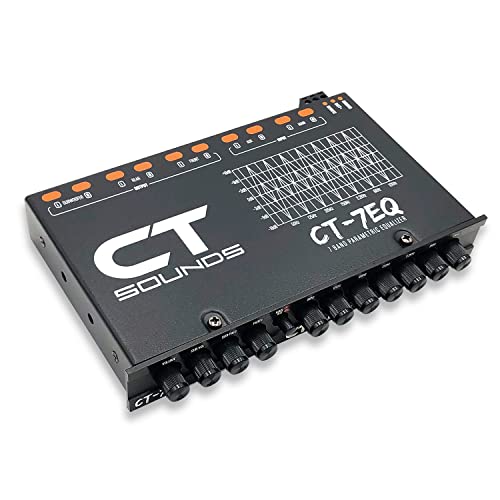
- Seven-band control across 20Hz–20kHz
- Separate bass, mid, treble, and sub-bass adjustment
- Compact 1/2-DIN design with installation hardware
Best For: Straightforward hands-on car audio tuning
Advanced Digital Routing
Taramps PRO 2.4S DSP Equalizer

- Four-channel DSP with two inputs and four outputs
- 15-band EQ with 12 presets and flexible routing
- Includes crossovers, time alignment, and output limiting
Best For: Complex multi-amplifier systems and OEM-radio upgrades
High-Output Control Center
SoundXtreme ST-EQ755 7-Band Equalizer

- Seven-band tuning with dedicated subwoofer controls
- Up to 8V RMS output and three stereo RCA outputs
- Independent input sensitivity controls for system matching
Best For: Multi-amplifier systems with front, rear, and sub outputs
Best Digital DSP Control
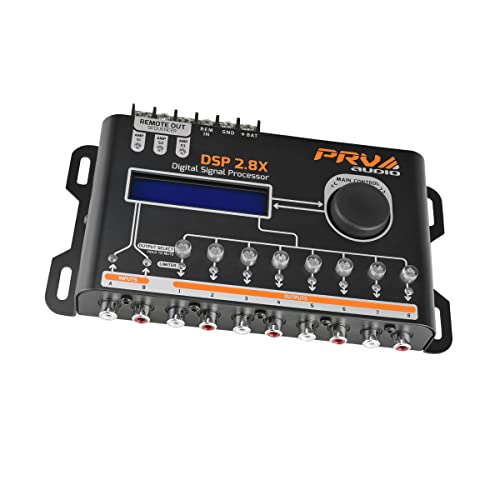
- Eight independent crossover outputs
- 15-band graphic EQ plus parametric control
- LCD interface with presets and sequencer
Best For: Advanced multi-channel car-audio installations
Best Parametric Bass Tuning

- Four parametric bands with ±12 dB adjustment
- Independent subwoofer level and frequency controls
- Up to 9V RMS master output
Best For: Hands-on bass and tone shaping in car-audio systems
Best Simple Graphic Equalizer
Clarion EQS755V 7-Band Equalizer

- Seven bands spanning 50 Hz to 16 kHz
- Six-channel, 8-volt RCA outputs
- Front AUX, rear RCA, and high-level inputs
Best For: Straightforward tonal adjustment and flexible connectivity
Most Flexible Pedal EQ – Source Audio EQ2 Programmable Equalizer
For musicians who need highly adaptable parametric audio equalizers in a pedalboard format, the Source Audio EQ2 combines deep band control with programmable recall. It covers the full 20 Hz–20 kHz spectrum and supports independent stereo EQ curves.
Best For: Guitarists and other performers who want extensive EQ shaping, stereo control, and preset-based operation.
Pros:
- Ten adjustable bands with up to ±18 dB of boost or cut, adjustable bandwidth, and Q control.
- True stereo signal path with two independent EQ curves.
- Onboard presets, MIDI support for up to 128 additional presets, and a built-in tuner.
- Includes noise gate, limiter, and a 12 dB clean boost.
Cons:
- Its extensive programming features may be more than casual users need.
- Requires 9-volt power with 180 mA consumption.
The EQ2 is a strong choice when precise, repeatable tone shaping matters more than simple plug-and-play adjustment. Its stereo architecture and preset ecosystem make it especially useful for complex live or studio setups.
Best App-Controlled DSP – LOWDR LDX 2.4 Digital Signal Processor
The LOWDR LDX 2.4 is a practical option for car-audio builders seeking parametric audio equalizers with wireless setup and system-management tools. Its four-output DSP combines parametric EQ, crossover control, delay, and limiting in a compact chassis.
Best For: Car-audio installations requiring smartphone tuning, flexible signal routing, and multi-channel processing.
Pros:
- Bluetooth app control provides wireless access to DSP parameters.
- Per-channel output parametric EQ and crossover filters including Butterworth, Linkwitz-Riley, and Bessel.
- Accepts RCA and high-level inputs with flexible input-to-output routing.
- Includes time alignment, adjustable limiter controls, calibration sweep, and password protection.
Cons:
- A smartphone is required for the Bluetooth app-based control experience.
- The four-output design may not suit systems needing more processed channels.
With its combination of wireless tuning and installation-focused features, the LDX 2.4 is aimed at users building a configurable car-audio system rather than a basic standalone EQ setup.
Best Analog-Style Car EQ – Stetsom EQX764-7 Band Equalizer
The Stetsom EQX764 offers straightforward graphic control for drivers upgrading a multi-amplifier car-audio system. While it is not a fully parametric processor, its seven fixed frequency bands, dedicated subwoofer controls, and line-driver output make it useful for practical system shaping.
Best For: Car-audio users who want accessible multi-channel graphic EQ and dedicated subwoofer adjustment.
Pros:
- Seven bands from 50 Hz to 16 kHz with ±12 dB adjustment range.
- Four inputs and six outputs support multiple sources and amplifiers.
- Dedicated subwoofer level and frequency controls complement front and rear outputs.
- Outputs can reach up to 10 VRMS to function as a line driver.
Cons:
- Fixed seven-band graphic EQ offers less frequency precision than parametric audio equalizers.
- Its feature set is focused on car-audio installation rather than general-purpose use.
The EQX764 is best viewed as a hands-on signal-shaping and distribution tool. It makes front, rear, and subwoofer adjustments accessible while providing multiple outputs for larger systems.
Best Display-Controlled DSP – PRV AUDIO DSP 2.4X Digital Crossover
The PRV AUDIO DSP 2.4X gives car-audio installers a front-panel interface for real-time adjustment, combining graphic EQ presets with a dedicated parametric EQ section. It also provides independently configurable outputs and a sequencer for connected equipment.
Best For: Car-audio users who want onboard display controls, preset-based tuning, and independent four-channel crossover outputs.
Pros:
- LCD display and intuitive interface support real-time adjustments.
- Two inputs can be routed as A, B, or A+B to four independent outputs.
- Includes a 15-band graphic EQ with manual tuning and 12 presets.
- Dedicated parametric EQ provides frequency, gain, and bandwidth adjustment.
Cons:
- The supplied notes specify one input and one output parametric EQ section, limiting its parametric scope.
- Its 16×2-character display may offer less visual detail than app-based control.
The DSP 2.4X suits installations where local controls and preset access are important. It combines broad graphic shaping with targeted parametric adjustment and flexible output routing.
Simple Analog Tuning – CT-7EQ 7-Band Parametric Equalizer
The CT Sounds CT-7EQ is a practical choice for drivers who want hands-on parametric audio equalizers controls in a compact 1/2-DIN format. Its seven bands divide the 20Hz–20kHz range for targeted adjustment, with separate bass, mid, and treble controls for everyday system tuning.
Best For: Car audio setups needing straightforward seven-band frequency shaping and a compact installation.
Pros:
- Seven bands cover frequencies from 20Hz to 20kHz.
- Includes bass, mid, treble, and sub-bass adjustments.
- Installation brackets and hardware are included.
Cons:
- Provides fewer advanced DSP features than a digital processor.
- The notes list six named parametric frequencies despite describing seven bands.
With a 25Hz–50kHz frequency response, +16dB output level, and greater than 60dB separation, the CT-7EQ offers useful analog control for a conventional aftermarket car audio system.
Advanced Digital Routing – Taramps PRO 2.4S DSP Equalizer
The Taramps PRO 2.4S is designed for more involved systems than basic parametric audio equalizers. This four-channel car audio DSP combines a 15-band graphic equalizer with flexible routing, crossover controls, time alignment, and compatibility with both factory and aftermarket stereos.
Best For: Multi-amplifier car audio builds that need digital signal processing and flexible input/output control.
Pros:
- Offers two inputs and four outputs with flexible routing.
- Includes a 15-band equalizer, 12 presets, and adjustable tuning.
- Provides HPF/LPF filters up to 48dB/octave, time alignment, and phase inversion.
- Works with RCA and high-level inputs, including OEM radios.
Cons:
- Its broader DSP feature set may require more setup than a basic analog equalizer.
- The notes identify it as a 15-band graphic equalizer with parametric EQ, rather than detailing specific parametric frequency bands.
Clip indicators, output limiting, and an anti-pop system add useful system-monitoring and startup-noise controls, making the PRO 2.4S a strong fit when signal management matters as much as tonal adjustment.
High-Output Control Center – SoundXtreme ST-EQ755 7-Band Equalizer
The SoundXtreme ST-EQ755 combines seven-band parametric audio equalizers control with a high-output preamp and dedicated signal routing. Its 1/2-DIN chassis provides front, rear, and subwoofer RCA outputs, while separate sensitivity controls help match source levels in multi-amplifier installations.
Best For: Expanded car audio systems using separate front, rear, and subwoofer amplifiers.
Pros:
- Seven adjustable bands span 50Hz to 16kHz, with up to ±12dB adjustment.
- Delivers up to 8V RMS output through the built-in active gain preamp.
- Provides dedicated front, rear, and subwoofer RCA outputs.
- Includes subwoofer level control and selectable 60Hz or 90Hz bass frequencies.
Cons:
- Its 1/2-DIN format may require a compatible custom dash or console installation.
- The feature set is focused on analog control rather than advanced digital DSP functions.
Independent left and right input sensitivity controls, an AUX/DVD input selector, and night illumination make the ST-EQ755 a flexible control point for systems that need strong output and convenient day-to-day adjustment.
Best Digital DSP Control – PRV Audio DSP 2.8X
For shoppers comparing parametric audio equalizers, the PRV Audio DSP 2.8X stands out as a full digital signal processor for complex car-audio systems. It combines two inputs, eight independent crossover outputs, a 15-band graphic equalizer, and a parametric equalizer with adjustable gain, frequency, and bandwidth.
Best For: Multi-channel car-audio installations that need detailed routing, crossover control, and flexible digital tuning.
Pros:
- Eight independent channel outputs support advanced system configuration.
- Includes a 15-band graphic equalizer and a parametric equalizer section.
- LCD interface, presets, and selectable A/B input sources simplify adjustments.
- Sequencer output can trigger other connected products.
Cons:
- Its many controls may be more than a basic audio system requires.
- The parametric equalizer is listed as one input and one output section.
The DSP 2.8X is the most feature-rich choice here for users building a highly configurable car-audio system. Choose it when independent outputs and digital signal management matter more than simple plug-and-play equalization.
Best Parametric Bass Tuning – Gravity GR-EQP11 Bass Machine
The Gravity GR-EQP11 is a focused option among parametric audio equalizers, offering four-band control for shaping low, midrange, and high-frequency response. Its dedicated subwoofer controls and adjustable master output make it useful for enthusiasts who want hands-on control over bass integration.
Best For: Car-audio systems where parametric tone shaping and independent subwoofer adjustment are priorities.
Pros:
- Four parametric bands provide up to ±12 dB of boost or cut.
- Dedicated subwoofer level and frequency controls help tailor bass response.
- Master volume provides up to 9V RMS output for compatible amplifiers.
- 30V bipolar switching power circuitry supports the equalization functions.
Cons:
- Four bands offer less overall adjustment than a larger graphic equalizer.
- It is designed as a signal-processing component and may require compatible installation hardware.
Choose the GR-EQP11 if you want straightforward parametric adjustment with especially accessible bass and subwoofer controls. It is a practical middle ground for tuning enthusiasts who do not need the PRV processor’s multi-output DSP architecture.
Best Simple Graphic Equalizer – Clarion EQS755V 7-Band Equalizer
The Clarion EQS755V offers an accessible alternative to more complex parametric audio equalizers. Its seven fixed graphic bands cover 50 Hz to 16 kHz, while front and rear auxiliary inputs, high-level speaker inputs, and multiple RCA outputs support flexible car-audio connections.
Best For: Drivers who want easy, broad tonal adjustments and convenient source connectivity in a 1/2-DIN-style chassis.
Pros:
- Seven graphic bands cover frequencies from 50 Hz through 16 kHz.
- Six-channel, 8-volt RCA outputs serve front, rear, and subwoofer channels.
- Includes front 3.5mm AUX, rear RCA AUX, and high-level speaker inputs.
- Independent master volume, subwoofer level, fader, and selectable low-pass filter controls.
Cons:
- Its graphic bands do not provide the frequency and bandwidth adjustment of a true parametric EQ.
- The low-pass filter offers only 60 Hz or 90 Hz selections.
The EQS755V is a sensible pick for users who prefer visible, quick frequency adjustments over detailed DSP programming. It also brings useful input and output flexibility for upgrading a conventional car-audio setup.
How We Picked These Parametric Audio Equalizers
We selected models across the main categories shoppers encounter in car audio: analog equalizers, compact preamp units, and full digital signal processors. We focused on practical specifications such as the number of bands or channels, input and output configuration, crossover controls, signal voltage, auxiliary connectivity, remote-control options, and installation format.
Because system requirements vary widely, no single model is ideal for every vehicle. A simple 1/2-DIN equalizer may be the better choice for an existing amplifier system, while a DSP can provide more precise control for multi-amplifier setups and factory-radio integration.
Quick Comparison
| Type | Best suited for | Main advantage | Potential limitation |
|---|---|---|---|
| Compact analog EQ | Simple aftermarket systems | Direct controls and straightforward installation | Less advanced routing and delay control |
| Digital EQ | Drivers seeking detailed tuning | Flexible crossover, channel, and parametric adjustments | More setup time and wiring complexity |
| DSP with app control | Custom multi-channel systems | Convenient, repeatable tuning from a phone or computer | Requires careful configuration and compatible installation |
| High-output preamp EQ | Systems needing stronger line-level output | Improved signal flexibility for multiple amplifiers | Output voltage alone does not guarantee better sound |
Key Buying Factors for Parametric Audio Equalizers
Parametric Control Versus Graphic Bands
Parametric controls let you adjust frequency, gain, and often bandwidth or Q, making them useful for correcting specific peaks and dips. Graphic equalizers are simpler because each slider controls a fixed frequency, but they can be faster to adjust by ear.
Inputs, Outputs, and Channel Count
Check whether the unit accepts RCA, speaker-level, auxiliary, or digital-style sources as required by your vehicle. Count the outputs needed for front, rear, and subwoofer amplifiers, then verify whether the processor supports independent channel routing and level control.
Crossover and Signal Voltage
Adjustable high-pass and low-pass filters help divide frequencies between speakers and subwoofers. A higher-rated line output can be useful when connecting several amplifiers, but clean installation, gain matching, and noise prevention matter just as much as the advertised voltage.
Installation and Tuning Workflow
Confirm the available dashboard space, wiring requirements, remote-control method, and power connections before buying. App-controlled DSPs offer deeper adjustment, but they demand more setup. If you prefer quick manual changes, physical knobs may be more practical.
Who Should Buy Which Parametric Audio Equalizers?
- Choose a compact analog equalizer if you want accessible controls, a simpler installation, and basic front/rear/subwoofer adjustment.
- Choose a digital DSP equalizer if your system has multiple amplifiers, separate speaker channels, or requires detailed crossover and routing control.
- Choose an app-controlled model if you want to save tuning profiles, make precise adjustments, or configure the system from a phone.
- Choose a high-output preamp model if your installation uses long RCA runs or several amplifiers and you need flexible line-level connections.
Before deciding, match the equalizer to your head unit, amplifier layout, speaker count, and tuning experience. The most capable processor is not automatically the best choice if its inputs, outputs, or installation demands exceed what your system requires.