Mini PCs with 128GB RAM deliver desktop-class memory capacity in compact systems designed for demanding workloads. This roundup focuses on current Ryzen AI Max+ 395 models with fast LPDDR5X memory, capable integrated graphics, and high-speed SSD storage.
Whether you need a compact AI workstation, a powerful development machine, or a quiet alternative to a full-size desktop, these systems offer substantial performance without taking up much desk space.
Best 10 Mini PCs with 128gb RAM Picks for 2026
Top AI Workstation Pick

- Ryzen AI Max+ 395 with 16 cores and 32 threads
- 128GB LPDDR5X memory and 2TB PCIe 4.0 SSD
- Wi-Fi 7, dual 2.5G LAN, and quad-display support
Best For: AI, video editing, rendering, and professional multitasking
Top Gaming and AI Performance

- Ryzen AI Max+ 395 with Radeon 8060S graphics
- 128GB LPDDR5X memory running up to 8000MT/s
- Wi-Fi 7, 2.5GbE, USB4, and quad-display output
Best For: Local AI, gaming, creative work, and multi-monitor setups
Best for Private Local AI

- Supports select local models up to 128B parameters
- 128GB LPDDR5X, 2TB SSD, and dual M.2 slots
- Dual 2.5GbE, Wi-Fi 7, and quad-display capability
Best For: Private AI deployment, creative studios, and professional workloads
Best Connected Compact Workstation

- Ryzen AI Max+ 395 with Radeon 8060S integrated graphics
- 128GB LPDDR5X, 2TB SSD, and expandable second M.2 slot
- Quad 8K display output, dual USB4, and 2.5GbE
Best For: Power users needing AI, creation, storage, and connectivity
Flagship AI Powerhouse
Ryzen AI Max+ 395 128GB Mini PC

- 16-core Ryzen AI Max+ 395 processor
- 128GB LPDDR5 at up to 8000MT/s
- Radeon 8060S integrated graphics and 1TB SSD
Best For: AI workloads, creative work, and high-performance compact computing
Expandable AI Workstation

- 128GB LPDDR5X and 2TB PCIe 4.0 SSD
- Radeon 8060S graphics for gaming and creation
- OCuLink Gen4 x4 enables external GPU expansion
Best For: AI professionals and creators planning demanding or expandable setups
Linux Developer Workstation
Ryzen AI Max+ 395 128GB Linux Mini PC
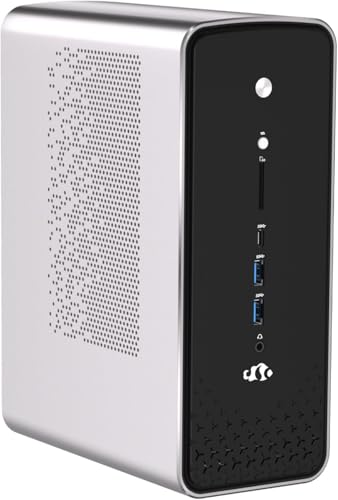
- Pre-installed Linux for development and testing
- 128GB LPDDR5X with a 256-bit memory bus
- Dual 2.5G LAN, USB4, and dual M.2 slots
Best For: Linux development, homelabs, local AI, and sustained workloads
Top AI Creator Pick
- 128GB LPDDR5X unified memory for AI and professional workloads
- Radeon 8060S graphics with up to four-display support
- 2TB SSD, dual M.2 slots, Wi-Fi 7, and 2.5GbE
Best For: Local AI, content creation, development, and demanding multitasking
Expansion-Focused Workstation
MINISFORUM MS-S1 MAX AI Workstation

- Ryzen AI Max+ 395 with 128GB unified LPDDR5X memory
- Full-length PCIe x16 slot and dual M.2 storage expansion
- Dual 10GbE, USB4 V2, Wi-Fi 7, and cluster support
Best For: AI development, studio workflows, business deployment, and expansion
Best eGPU-Ready Option

- 128GB LPDDR5X memory and a 2TB PCIe 4.0 SSD
- OCuLink interface for external GPU expansion
- Ryzen AI Max+ 395 with Radeon 8060S integrated graphics
Best For: AI development, gaming, video production, and future GPU expansion
Top AI Workstation Pick – ACEMAGIC M1A PRO+ AI Mini PC
For shoppers comparing mini pcs with 128gb ram, the ACEMAGIC M1A PRO+ stands out as a compact Windows 11 Pro workstation with a Ryzen AI Max+ 395 processor, fast unified memory, and generous storage. Its combination of AI-focused hardware, multiple expansion slots, and extensive display support suits demanding professional setups.
Best For: Local AI workloads, 8K video editing, 3D rendering, professional multitasking, and multi-monitor workstations.
Pros:
- Ryzen AI Max+ 395 offers 16 cores, 32 threads, and boost speeds up to 5.1GHz.
- 128GB LPDDR5X 8000MHz unified memory can allocate up to 96GB to integrated graphics.
- Includes a 2TB PCIe 4.0 SSD, three M.2 slots, Wi-Fi 7, dual 2.5G LAN, and quad-display support.
Cons:
- Memory is integrated and not presented as user-upgradable.
- Its high-end specifications may be more than needed for basic office or browsing tasks.
The M1A PRO+ is a strong choice when you want workstation-level memory capacity and connectivity in a small chassis. Windows 11 Pro and the included two-year warranty add practical value for business and professional users.
Top Gaming and AI Performance – GMKtec EVO-X2 AI Mini PC
The GMKtec EVO-X2 is one of the more performance-oriented mini pcs with 128gb ram, pairing the Ryzen AI Max+ 395 with a Radeon 8060S integrated GPU. It is designed for buyers who want local AI capability, high-end integrated graphics, fast networking, and support for demanding games and creative applications.
Best For: Local LLM use, FHD gaming, video editing, multi-display setups, and high-performance home workstations.
Pros:
- Ryzen AI Max+ 395 combines 16 Zen 5 cores, 32 threads, and up to 5.1GHz boost.
- Radeon 8060S graphics use the shared 128GB memory pool and support demanding gaming and AI workloads.
- Offers Wi-Fi 7, 2.5GbE, dual USB4, and up to four 4K/8K displays.
- Triple-fan cooling system includes a stated Quiet Mode noise level of 35dB.
Cons:
- The supplied notes do not specify included SSD capacity or a warranty term.
- Integrated memory and graphics share the system memory pool.
The EVO-X2 is especially compelling for users who prioritize graphics performance and local AI over basic compact-computer duties. Its cooling and connectivity features also make it suitable for sustained workloads, though buyers should confirm storage configuration before ordering.
Best for Private Local AI – GEEKOM A9 Mega AI Workstation
Among mini pcs with 128gb ram, the GEEKOM A9 Mega is aimed squarely at private AI and professional creative work. Its Ryzen AI Max+ 395 platform, 128GB unified memory, and 2TB PCIe Gen4 SSD provide room for large models, datasets, media projects, and demanding multitasking without relying entirely on cloud services.
Best For: Developers, creative studios, business users handling sensitive data, and offline AI experimentation.
Pros:
- Supports select 4-bit quantized models with up to 128 billion parameters using compatible software.
- 128GB LPDDR5X 8000MT/s memory allows up to 96GB allocation to the Radeon 8060S GPU.
- Includes a 2TB PCIe Gen4 NVMe SSD, dual M.2 slots, dual 2.5GbE, and Wi-Fi 7.
- IceBlast 5.0 cooling is designed for up to 120W sustained power.
Cons:
- Advanced local AI workflows require compatible drivers, software, and model downloads.
- Operating-system support is described broadly rather than as a specific Windows edition.
The A9 Mega makes the most sense when local processing, data privacy, and sustained creative workloads matter more than simple everyday computing. Its three-year limited warranty and B2B support are useful additions for professional buyers.
Best Connected Compact Workstation – BOSGAME M5 AI Mini PC
The BOSGAME M5 is a well-rounded option among mini pcs with 128gb ram, combining the Ryzen AI Max+ 395 with Radeon 8060S graphics, a 2TB SSD, and broad connectivity. It is built for users who want local AI, 8K creative work, gaming, fast networking, and several high-resolution displays in a compact system.
Best For: Power users, video editors, local AI enthusiasts, gamers, NAS users, and multi-display workspaces.
Pros:
- Ryzen AI Max+ 395 provides 16 cores, 32 threads, a 5.1GHz boost, and 126 TOPS total AI compute.
- 128GB LPDDR5X 8000MHz memory supports large AI workloads and integrated GPU allocation up to 96GB.
- Includes a 2TB PCIe 4.0 SSD and a second M.2 slot for expansion up to 8TB or RAID.
- Supports quad 8K displays, dual USB4, 2.5GbE, Wi-Fi 7, and Bluetooth 5.4.
Cons:
- Memory is onboard with a stated maximum of 128GB, limiting future RAM upgrades.
- The listed warranty coverage is split between one year for the full machine and three years for parts.
The M5 offers an unusually broad feature set for a compact workstation, particularly if networking, display output, and storage expansion are priorities. It is a practical fit for demanding users who want one system for AI, creation, gaming, and productivity.
Flagship AI Powerhouse – Ryzen AI Max+ 395 128GB Mini PC
For shoppers comparing mini pcs with 128gb ram, this NIMO model pairs the 16-core/32-thread Ryzen AI Max+ 395 with 128GB of fast LPDDR5 memory and a 1TB PCIe 4.0 SSD. Its Radeon 8060S integrated graphics and high-bandwidth memory make it suited to demanding desktop, creative, AI, and gaming workloads in a compact format.
Best For: AI users, creators, developers, and gamers who need substantial unified memory and strong integrated graphics.
Pros:
- Ryzen AI Max+ 395 offers 16 cores, 32 threads, and boost speeds up to 5.1GHz.
- 128GB LPDDR5 memory runs at up to 8000MT/s through an eight-channel design.
- Radeon 8060S graphics with 40 compute units support demanding gaming and creative workloads.
- Includes a 1TB PCIe 4.0 SSD for fast storage and ample everyday capacity.
Cons:
- Memory is an onboard LPDDR5 solution, so upgrade flexibility may be limited compared with standard SODIMM systems.
- Integrated graphics performance depends on shared system memory and may not replace a discrete desktop GPU for every workload.
This is a performance-first choice for buyers who want workstation-style memory capacity without moving to a full-size tower. Its combination of CPU, graphics, and bandwidth is particularly compelling for local AI and content creation.
Expandable AI Workstation – EVO-X3 Ryzen AI Max+ 395
The GMKtec EVO-X3 stands out among mini pcs with 128gb ram by combining 128GB LPDDR5X memory, a 2TB PCIe 4.0 SSD, and a Ryzen AI Max+ 395 processor. It also adds an OCuLink PCIe Gen4 x4 connection, giving demanding users a path to external GPU expansion.
Best For: Local AI deployment, professional creation, gaming, and users who may want external GPU capability later.
Pros:
- 16-core/32-thread Ryzen AI Max+ 395 processor reaches up to 5.1GHz.
- 128GB LPDDR5X memory runs at up to 8000MT/s and can share resources between CPU and GPU.
- Large 2TB PCIe 4.0 SSD provides more built-in storage for projects, models, and media.
- OCuLink PCIe Gen4 x4 supports external GPU docks for additional graphics performance.
Cons:
- OCuLink devices must be connected or disconnected while powered off; it does not support hot-plugging.
- LPDDR5X memory is installed onboard rather than using conventional removable memory modules.
The EVO-X3 is a strong fit when memory capacity alone is not enough and future graphics expansion matters. Its 2TB storage and external-GPU support make it one of the more flexible options for advanced desktop and AI workflows.
Linux Developer Workstation – Ryzen AI Max+ 395 128GB Linux Mini PC
For developers seeking mini pcs with 128gb ram, this NIMO system arrives with a pre-installed Linux OS and hardware aimed at local AI, compiling, virtualization, and networking. Its 128GB LPDDR5X memory uses a 256-bit bus, while dual 2.5G LAN ports and dual USB4 connections support more specialized setups.
Best For: Linux developers, engineers, homelab users, and professionals running local AI or sustained parallel workloads.
Pros:
- Pre-installed Linux provides a command-line-ready environment for development and testing.
- Ryzen AI Max+ 395 delivers 16 Zen 5 cores, 32 threads, and up to 5.1GHz boost.
- 128GB LPDDR5X on a 256-bit bus is designed for high-bandwidth CPU and graphics workloads.
- Dual 2.5G LAN, dual USB4, dual PCIe 4.0 M.2 slots, and up to four-display support suit advanced workspaces.
Cons:
- Linux may require additional software configuration for users accustomed to Windows.
- The memory is an onboard LPDDR5X configuration, limiting conventional RAM-upgrade options.
- Specialized networking and expansion features may be unnecessary for basic home or office use.
This model is tailored less to casual desktop buyers and more to users building a Linux development station, homelab, or private AI system. Its connectivity, storage expansion, and cooling-focused design support sustained technical workloads.
Top AI Creator Pick – BOSGAME M5 Ryzen AI Max+ 395
For shoppers comparing mini pcs with 128gb ram, the BOSGAME M5 stands out as a compact Windows 11 Pro workstation with Ryzen AI Max+ 395 processing, 128GB of unified memory, and a 2TB PCIe 4.0 SSD. Its shared memory architecture is suited to local AI, demanding creative applications, multitasking, and virtual machines.
Best For: Local AI users, creators, developers, and professionals who need strong integrated graphics and extensive memory in a compact desktop.
Pros:
- Ryzen AI Max+ 395 provides 16 cores, 32 threads, and up to 126 TOPS total AI performance.
- 128GB LPDDR5X-8000 unified memory supports large models, complex projects, and multiple virtual machines.
- Radeon 8060S graphics, dual M.2 slots, SD 4.0, and support for up to four displays add flexibility.
- Wi-Fi 7, Bluetooth 5.4, 2.5GbE, USB4, HDMI 2.1, and DisplayPort 1.4 provide modern connectivity.
Cons:
- Memory is integrated LPDDR5X, so it is not presented as user-upgradable.
- The 240-watt power consumption is higher than that of basic office mini PCs.
The M5 is a particularly well-rounded choice when 128GB of memory, local AI capability, integrated graphics, and multi-display support matter more than the smallest possible footprint.
Expansion-Focused Workstation – MINISFORUM MS-S1 MAX AI Workstation
The MINISFORUM MS-S1 MAX is one of the more expandable mini pcs with 128gb ram, combining the Ryzen AI Max+ 395 APU with 128GB LPDDR5X-8000 unified memory. It is designed for local AI workloads and can also serve as a studio, business, rack-mount, or cluster-oriented system.
Best For: AI developers, studios, businesses, and advanced users who value expansion, high-speed networking, and multi-system deployment.
Pros:
- Ryzen AI Max+ 395 offers 16 cores, 32 threads, RDNA 3.5 graphics, and 126 TOPS total system AI output.
- 128GB unified memory helps reduce traditional CPU/GPU memory bottlenecks for AI, 3D, and video workflows.
- Full-length PCIe x16 expansion, dual M.2 slots, USB4 V2, and dual 10GbE provide unusual flexibility.
- Cooling uses six heat pipes, dual turbine fans, and a built-in 320-watt power supply.
Cons:
- Its larger chassis is less compact than many conventional mini PCs.
- The supplied listing information is inconsistent about storage, citing both a 2TB capacity and a 4TB PCIe SSD.
- Its advanced cluster and rack features may be unnecessary for ordinary home-office use.
The MS-S1 MAX makes the strongest case for buyers who want 128GB memory without giving up workstation-style expansion or the option to build a larger local AI setup.
Best eGPU-Ready Option – GMKtec X3 AI Mini PC
The GMKtec X3 is a flexible pick among mini pcs with 128gb ram, pairing the Ryzen AI Max+ 395 with 128GB LPDDR5X memory and a 2TB PCIe 4.0 SSD. Its OCuLink interface makes it especially appealing to users who want a compact system now but may add an external GPU later.
Best For: Gamers, AI developers, video editors, and creators who want substantial memory with a path to dedicated external graphics.
Pros:
- Ryzen AI Max+ 395 delivers 16 cores, 32 threads, a 50+ TOPS NPU, and up to 126 TOPS total AI performance.
- 128GB LPDDR5X-8000 unified memory can support large local models and demanding creative workloads.
- OCuLink PCIe 4.0 x4 enables external GPU expansion for gaming, rendering, and AI acceleration.
- Includes Radeon 8060S integrated graphics, a 2TB PCIe 4.0 SSD, 2.5GbE, Wi-Fi 7, and Bluetooth 5.4.
Cons:
- Memory is onboard LPDDR5X and is not described as upgradeable.
- An external GPU setup requires additional hardware and expense.
- The supplied notes mention both “Radeon 8090S” and Radeon 8060S; buyers should verify the exact configuration.
The X3 is a strong choice for buyers who want the convenience of integrated graphics today while preserving a clearly defined upgrade route for more demanding GPU workloads.
How We Picked the Best Mini PCs with 128gb RAM
We focused on compact PCs that provide 128GB of memory alongside AMD Ryzen AI Max+ 395 processors, fast LPDDR5 or LPDDR5X RAM, and practical storage configurations. We also considered SSD capacity, integrated graphics potential, networking, port selection, operating system support, cooling design, and the intended workload.
Because many of these models share the same processor platform, differences in memory speed, chassis design, firmware, connectivity, upgrade options, and manufacturer support can matter as much as headline specifications. Product listings should be checked carefully for exact port layouts, power adapters, storage configurations, and operating-system details.
Quick Comparison
| Best For | What to Prioritize | Why It Matters |
|---|---|---|
| AI and local development | Ryzen AI Max+ 395, 128GB RAM, fast SSD | Supports large workloads, virtual machines, and local models |
| Creative production | Strong integrated graphics and sustained cooling | Improves performance in editing, rendering, and content creation |
| Gaming | Fast memory, RDNA graphics, dual-channel bandwidth | Integrated GPU performance depends heavily on memory bandwidth |
| Business multitasking | Reliable networking, ports, and warranty support | Makes the system easier to deploy and maintain |
| Linux workstation use | Linux compatibility and driver support | Reduces setup issues with graphics, Wi-Fi, and peripherals |
Key Buying Factors for Mini PCs with 128gb RAM
Processor and Sustained Performance
The Ryzen AI Max+ 395 is a high-end mobile-class processor with substantial CPU and integrated GPU capability. For long renders, compilations, or AI workloads, check reviews for thermal behavior and sustained performance rather than relying only on boost-clock claims.
Memory Speed and Availability
128GB is useful for local AI tools, large creative projects, multiple virtual machines, and heavy multitasking. LPDDR5X memory is usually soldered, so confirm that the installed capacity meets your needs because future upgrades may not be possible. Faster memory can also benefit integrated graphics.
Storage and Expansion
A 2TB PCIe 4.0 SSD is a strong starting point for applications, games, and project files. If you work with large media libraries or datasets, look for a second M.2 slot, accessible internals, or support for external high-speed storage.
Connectivity and Display Support
Dual 2.5Gb Ethernet, Wi-Fi 7, USB4, HDMI, DisplayPort, and multiple USB ports can significantly affect workstation flexibility. Verify which ports support charging, high-resolution displays, or full-speed data before buying.
Cooling, Noise, and Support
A compact chassis must remove heat efficiently. Look for independent testing that reports fan noise and temperatures under load. Warranty terms, BIOS updates, driver availability, and customer support are especially important for lesser-known mini-PC brands.
Who Should Buy Which Mini PCs with 128gb RAM?
Choose a performance-focused model with 2TB storage and strong cooling for AI experimentation, software development, rendering, and demanding multitasking. A system with multiple high-speed networking and display outputs is better suited to a desk-based workstation or compact server.
For gaming and graphics-heavy work, prioritize models with effective cooling and high-speed LPDDR5X memory, since integrated graphics share system memory. Linux users should select a configuration explicitly sold with Linux or verify community driver support before purchase. If you only need office work, streaming, and light browsing, 128GB is more capacity than necessary; a lower-memory mini PC may offer better value.