The best field recorders make it easier to capture clean, detailed audio away from a studio. This roundup compares compact handheld recorders, professional 32-bit-float models, and voice recorders designed for lectures and notes.
Whether you need reliable sound for filmmaking, music production, podcasting, interviews, or personal dictation, the right choice depends on microphone quality, recording format, storage, battery life, and workflow features.
Best 10 Field Recorders Picks for 2026
Professional Pick

- 32-bit float capture helps prevent clipping
- Two locking XLR/TRS inputs
- Low-noise preamps for location work
Best For: Run-and-gun filmmakers and serious location recordists
High-Capacity Value

- Up to 68 hours of recording per charge
- 136GB total listed storage
- One-click and voice-activated recording
Best For: Lectures, meetings, interviews, and extended voice recording
Versatile Multitrack Choice

- Four-track simultaneous recording
- Interchangeable input capsules
- Two XLR/TRS inputs with phantom power
Best For: Filmmakers and musicians needing flexible portable inputs
Simple Voice Capture
- One-button recording and playback
- Voice activation and noise reduction
- Up to 30 hours of recording
Best For: Lectures, meetings, interviews, and everyday voice notes
Best Versatile Field Recorder

- 32-bit float recording for clip-free audio
- Stereo mics and two XLR/TRS inputs
- USB-C recording with SD-card backup
Best For: Musicians, podcasters, filmmakers, and interviewers needing flexible inputs
Best Smart Note-Taking Field Recorder

- AI transcription and summaries in 113 languages
- 128GB storage with up to 33 hours of recording
- OTG transfers, VOR, and privacy lock
Best For: Students and professionals recording meetings, lectures, and interviews
Best Professional Field Recorder

- Large 19.4mm X/Y stereo microphones
- 32-bit float and up to 192kHz WAV recording
- Dedicated gain knobs for hands-on control
Best For: Filmmakers and musicians recording detailed audio on location
Versatile Portable Pick

- 32-bit float stereo recording with X/Y microphones
- WAV and AAC formats with up to 96 kHz recording
- USB microphone mode and up to 12 hours of battery life
Best For: Creators needing flexible recording and USB connectivity
Most Flexible Microphone Array

- Three microphones with nine selectable recording patterns
- 32-bit float/96 kHz recording without manual gain setting
- USB microphone use with simultaneous SD-card backup
Best For: Users recording varied sources and multi-recorder sessions
Lightest Simple Stereo Option

- 3.2-ounce design with stereo X/Y microphones
- 32-bit float recording at up to 96 kHz
- USB microphone mode and audio guidance for accessibility
Best For: Lightweight everyday stereo recording
Professional Pick – Zoom F3 Field Recorder
For filmmakers and musicians who need dependable field recorders, the Zoom F3 prioritizes clean, clip-free capture in unpredictable conditions. Its 32-bit float workflow reduces the need to stop and adjust levels, while dual locking inputs suit more demanding recording rigs.
Best For: Run-and-gun filmmakers, location recordists, and musicians using XLR microphones.
Pros:
- 32-bit float recording with dual A/D converters helps protect against clipping.
- Two locking XLR/TRS inputs keep cable connections secure.
- Ultra-low-noise preamps support clean recordings in uncontrolled environments.
- Runs on two AA batteries and supports standalone or USB workflows.
Cons:
- It requires external microphones for most recording applications.
- The compact 2-inch screen may be less convenient for detailed menu navigation.
The F3 is a focused choice when recording reliability matters more than built-in microphone convenience. Its small size, flexible power options, and 32-bit float recording make it particularly practical for location work.
High-Capacity Value – Tonfarb 136GB Voice Recorder
The Tonfarb A20 is a practical option among field recorders for lectures, meetings, interviews, and everyday voice capture. It combines one-click recording with noise reduction, voice activation, generous storage, and a rechargeable battery designed for extended sessions.
Best For: Students, journalists, meeting attendees, and users who want long recording capacity.
Pros:
- Includes 8GB of built-in storage and a complimentary 128GB TF card.
- Offers up to 68 hours of continuous recording on a charge.
- One-click recording can be started even while the device is powered off.
- Voice activation, A-B repeat, password protection, and USB-C file transfer add convenience.
Cons:
- Its built-in microphones and noise-cancellation focus it more on voice than multitrack production.
- The 1.44-inch screen is relatively small.
With its compact metal casing and unusually large storage capacity, the A20 is well suited to people who record frequently and want minimal file management. It is less appropriate for users seeking professional XLR inputs or multitrack control.
Versatile Multitrack Choice – Zoom H5 Handheld Recorder
The Zoom H5 is one of the more adaptable field recorders for filmmakers and musicians who need built-in stereo capture plus external input flexibility. Its interchangeable capsule system, four-track recording, and combo inputs support a range of production setups.
Best For: Audio-for-video users, musicians, and recordists building flexible portable rigs.
Pros:
- Interchangeable input capsules allow the recording setup to be adapted to different needs.
- Records up to four tracks simultaneously.
- Two XLR/TRS combo inputs include selectable phantom power and a -20dB pad.
- Functions as a multichannel stereo USB audio interface for PC, Mac, and iPad.
Cons:
- Records directly to SD/SDHC cards up to 32GB, limiting capacity compared with newer high-storage devices.
- It uses two batteries and has a listed digital recording time of 10 hours.
The H5 remains a strong middle ground for creators who want more input control than a basic voice recorder without moving to a larger studio-style unit. Its capsule compatibility is especially useful for expanding a portable setup over time.
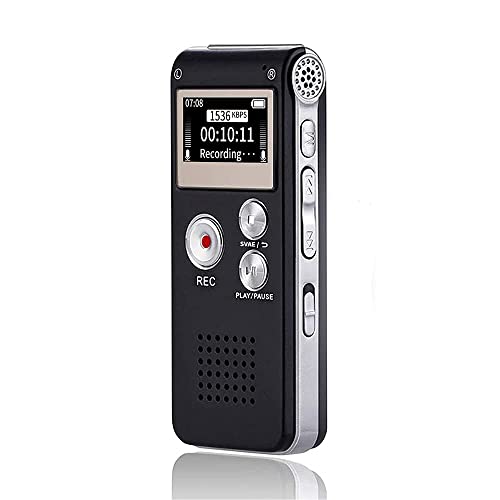
Simple Voice Capture – Sunlan 16GB Voice Recorder
The Sunlan 16GB is a straightforward choice among field recorders for lectures, meetings, and interviews. Its one-button operation, built-in speaker, voice activation, and noise-reduction processing keep everyday recording simple.
Best For: Students and casual users who want compact, easy-to-operate voice recording.
Pros:
- Dedicated record, stop, and play controls make operation uncomplicated.
- Voice activation can conserve storage and battery power.
- DSP noise reduction and 1536kbps recording support clearer voice capture.
- Offers up to 30 hours of continuous recording and works as a USB storage device.
Cons:
- The 16GB capacity is modest compared with higher-capacity recorders.
- Its mono, built-in microphone design is aimed at voice rather than professional stereo production.
For users who value simplicity over advanced connections, the Sunlan provides the essential recording and playback functions in a lightweight 35-gram body. It is best viewed as a personal voice recorder rather than a filmmaker’s multitrack tool.
Best Versatile Field Recorder – Zoom H4 Essential
The Zoom H4 Essential is a flexible choice among field recorders for musicians, podcasters, filmmakers, and interviewers. Its built-in stereo microphones, two XLR/TRS inputs, four-track recording, and 32-bit float capture make it well suited to varied recording environments.
Best For: Creators who need one portable recorder for music, interviews, podcasts, video audio, and live performances.
Pros:
- 32-bit float recording helps produce clip-free audio across changing volume levels.
- Built-in stereo microphones plus two XLR/TRS inputs support multiple recording setups.
- Can record to a phone, tablet, or computer over USB-C while saving a backup to an SD card.
- Spoken menu guidance can make operation easier for visually impaired users.
Cons:
- Requires two AA batteries.
- Its four-track design may be more capability than needed for simple voice notes.
The H4 Essential stands out as an adaptable field recorder for projects that may shift from quiet dialogue to loud performances. Choose it when input flexibility and backup recording matter more than an ultra-minimal voice-recorder design.
Best Smart Note-Taking Field Recorder – EVISTR L359 AI Voice Recorder
The EVISTR L359 is a compact field recorder focused on meetings, lectures, interviews, and everyday voice notes. Along with 128GB of storage, it adds AI transcription, summaries, speaker identification, and wired OTG transfers through its companion app.
Best For: Students and professionals who want recordings converted into searchable, organized notes.
Pros:
- AI features support transcription in 113 languages, summaries, mind maps, speaker identification, and Ask AI insights.
- 128GB of storage can hold up to 9,216 hours at 32kbps.
- Up to 33 hours of continuous recording and a lightweight 65g design suit portable use.
- One-touch recording, VOR, password encryption, and a HOLD switch support convenient operation and file privacy.
Cons:
- Its built-in microphone is designed for mono and speech-recognition operation rather than stereo music capture.
- AI processing uses the AI DVR Link app and a wired OTG connection.
The L359 is best viewed as a voice-recorder and note-taking system rather than a traditional music-focused field recorder. Its strongest advantages are high storage capacity, long battery life, and an integrated transcription workflow.
Best Professional Field Recorder – Zoom H5 Studio
The Zoom H5 Studio is a strong option for demanding field recording, filmmaking, and music work. Its large 19.4mm X/Y microphone capsule, 32-bit float recording, dedicated gain knobs, and support for up to four simultaneous tracks prioritize detailed, controllable audio on location.
Best For: Filmmakers and musicians who want high-resolution portable recording with hands-on level control.
Pros:
- Large stereo microphones are designed to deliver detailed sound with a wide dynamic range.
- 32-bit float recording helps protect takes from clipping in changing environments.
- Dedicated gain knobs provide quick, precise level adjustments.
- Records up to four tracks simultaneously at up to 192kHz in WAV format.
Cons:
- Requires four AA batteries, more than the H4 Essential.
- Its professional recording features may be unnecessary for basic spoken notes.
For serious location work, the H5 Studio offers a more hands-on approach than a simple voice recorder. It is a particularly suitable field recorder when microphone quality, physical gain control, and high-resolution WAV capture are priorities.
Versatile Portable Pick – Xvive XV1-R
The Xvive XV1-R is a flexible choice among field recorders for musicians, podcasters, filmmakers, and everyday voice recording. Its 32-bit float capture helps reduce clipping concerns, while the compact design and USB microphone mode make it useful both on location and at a desk.
Best For: Creators who want stereo recording, long battery life, and USB connectivity in one portable recorder.
Pros:
- 32-bit float recording supports high-dynamic-range sources without constant gain adjustments.
- X/Y microphones capture audio up to 130 dB SPL, suitable for concerts and other loud environments.
- Supports WAV and space-saving AAC recording, plus USB microphone operation with computers and mobile devices.
- Offers auto-record, pre-record, noise reduction, and up to 12 hours of battery life.
Cons:
- No headphone jack is listed in the supplied specifications.
- The maximum individual file size is 4GB, with longer recordings automatically split.
The XV1-R stands out as an adaptable field recorder for users who value multiple file formats and straightforward USB use. It is especially practical when portability and flexible storage matter.
Most Flexible Microphone Array – Zoom H2 Essential
The Zoom H2 Essential is one of the most versatile field recorders in this group, combining three built-in microphones with nine selectable recording patterns. Its 32-bit float recording, long battery life, and simultaneous USB microphone and SD recording make it well suited to varied production setups.
Best For: Musicians, journalists, podcasters, and filmmakers who need multiple pickup patterns and clip-free recording.
Pros:
- Three microphones and nine patterns support mono, stereo, and surround recording applications.
- 32-bit float recording helps capture different volume levels without manually setting gain.
- Can function as a USB microphone while recording a backup to an SD card.
- Includes Bluetooth timecode synchronization for compatible multi-recorder setups and audible menu guidance in seven languages.
Cons:
- Its 1.3-inch screen is smaller than a typical smartphone display.
- It requires two AA batteries, despite offering an average battery life of up to 20 hours.
The H2 Essential is the strongest choice here for recording flexibility. Its microphone-pattern options and backup recording capability give field users more ways to adapt to changing sources and locations.
Lightest Simple Stereo Option – Zoom H1essential
The Zoom H1essential is a compact entry point for field recorders, offering stereo 32-bit float recording through an X/Y microphone design. It records to an SD card, works as a USB microphone, and adds audio guidance for visually impaired users.
Best For: Travelers, students, musicians, and creators who want a lightweight stereo recorder with simple operation.
Pros:
- Weighs just 3.2 ounces, making it easy to carry for mobile recording.
- 32-bit float recording minimizes the need to set gain before recording.
- X/Y microphones support clean capture up to 120 dB SPL and recording rates up to 96 kHz.
- USB-C connectivity supports use as a microphone with PCs, Macs, iOS devices, and Android devices.
Cons:
- No headphones jack is listed in the supplied specifications.
- The listed digital recording time is 120 minutes.
- The supplied warranty is a 90-day limited warranty.
The H1essential favors portability and straightforward stereo recording over extensive pattern selection. It is a sensible pick when low weight and accessible controls are more important than advanced routing options.
How We Picked These Field Recorders
We selected these Field Recorders to cover a broad range of recording needs and budgets. The lineup includes professional handheld units with X/Y microphones, multitrack models for musicians, 32-bit-float recorders that simplify level management, and voice recorders with large storage or transcription features.
We focused on practical specifications: microphone configuration, supported recording formats, input and output options, storage, power, portability, and ease of transferring files. Because a recorder suited to filmmaking may be excessive for lectures, the recommendations are organized around real-world use rather than price alone.
Quick Comparison
- For professional location audio: Look at the Zoom F3 or another model with 32-bit-float recording and dependable external microphone support.
- For music and multitrack work: The Zoom H5, H4 Essential, or similar flexible handheld recorder offers useful inputs and musician-friendly controls.
- For simple stereo recording: The Zoom H1essential, Zoom H2 Essential, and Xvive XV1-R are compact options for rehearsals, interviews, ambience, and content creation.
- For lectures and voice notes: High-capacity digital voice recorders from Tonfarb, EVISTR, and other compact models prioritize long recording times and straightforward playback.
Key Buying Factors for Field Recorders
Microphones and Input Options
Built-in X/Y microphones are convenient for stereo recordings, while adjustable microphone arrays can provide wider or more focused pickup. If you plan to use lavaliers, shotgun microphones, instruments, or mixers, check for compatible inputs, phantom power, and suitable connectors.
Recording Format and Headroom
WAV files preserve more editing flexibility than compressed formats. 32-bit-float recording is especially helpful for unpredictable sources because it provides substantial headroom and can reduce the need to constantly adjust gain. It does not replace good microphone placement, but it can make location work more forgiving.
Storage, Battery, and Connectivity
Confirm whether the recorder uses microSD or another removable card, how files transfer to a computer, and whether it can function as a USB microphone. Consider battery type, expected runtime, charging convenience, and whether a power bank can keep it running during long sessions.
Size and Controls
A compact recorder is easier to carry, but larger models may provide better displays, physical controls, input access, and mounting options. For filmmaking or field interviews, quick access to monitoring and recording controls can matter as much as audio specifications.
Who Should Buy Which Field Recorders?
Choose a professional 32-bit-float recorder if you record film sets, live events, nature, or other unpredictable sources and want strong protection against poorly set levels.
Choose a multitrack handheld model if you record musicians, rehearsals, podcasts, or small productions that benefit from multiple inputs and more hands-on control.
Choose a compact stereo recorder for travel, ambient sound, interviews, classroom projects, and quick content where portability matters most.
Choose a dedicated voice recorder for lectures, meetings, dictation, or note-taking. Large internal storage, simple playback, long battery life, and transcription tools may be more valuable than advanced music-recording features.