The best dual-track looper pedals make it easier to build layered performances without stopping between parts. They can capture separate phrases, add rhythm support, and give guitarists, vocalists, keyboard players, and solo performers more control on stage.
This roundup compares 10 options across recording time, track flexibility, effects, drum patterns, storage, connectivity, and ease of use so you can choose a looper that fits your workflow.
Best 10 Dual Track Looper Pedals Picks for 2026
Best All-Around Choice

- 13 hours of stereo recording
- Onboard rhythms and color LCD
- XLR, 1/4-inch, and USB connectivity
Best For: Feature-rich live looping and extended recording
Best for Rhythmic Looping

- 140 minutes across 14 save slots
- 121 grooves in 11 genres
- Stereo looping with time stretch
Best For: Looping with built-in drum accompaniment
Best for Deep Control

- 99 phrase memories and 13-hour recording
- 16 drum kits and 57 preset rhythms
- Loop FX, MIDI, and USB management
Best For: Complex live performances and detailed loop control
Best for Performers
Sheeran Looper + Dual-Track Pedal

- Four looping modes and color display
- 128 loops with over three hours of storage
- USB interface and battery operation
Best For: Portable vocal, instrument, and live performance setups
Feature-Rich Pick

- 300 minutes of stereo recording in 100 slots
- 220 drum grooves across 11 styles
- Color screen, time stretch, and headphone out
Best For: Players wanting extensive storage and built-in rhythms
Advanced Performance Pick
Aeros Loop Studio Gold Edition
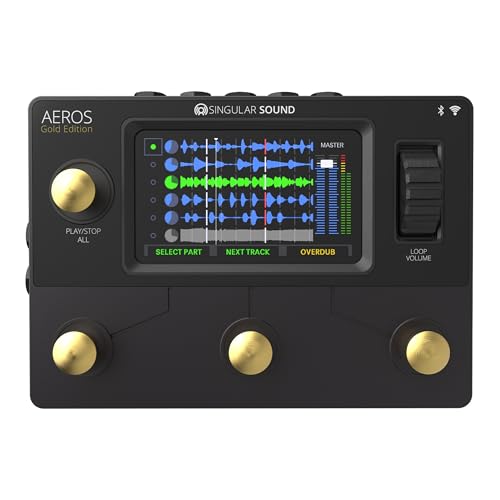
- Six song parts and six stereo tracks per song
- Up to 10 hours per song and 48+ hours stored
- Touchscreen mixer with MIDI and wireless connectivity
Best For: Complex live looping and layered song arrangements
Timing-Focused Value Pick

- 160 minutes of stereo recording in 40 slots
- 121 grooves with sync, count-in, and quantization
- Dual footswitches, USB-C, and headphone out
Best For: Practice and performances centered on tight drum synchronization
Compact Effects Looper

- Dedicated start/stop button
- Loop import, export, and backing tracks
- Stop, Reverse, and Half Speed effects
Best For: Simple looping with essential playback effects
Feature-Rich Stereo Looper
VALETON VLP-200 Dual Track Looper

- Serial and parallel two-loop modes
- 100 stereo drum rhythms
- 99 project spaces with MIDI I/O
Best For: Stereo performances with drums and synchronization
Advanced Dual-Track Looper

- Two loop tracks for layered compositions
- Seven loop effects and loop decay
- MIDI sync with true bypass
Best For: Live dual-track arrangements and synchronized looping
Best All-Around Choice – BOSS RC-500 Dual-Track Looper
The BOSS RC-500 is a practical choice for players seeking dual track looper pedals with extended stereo recording, onboard rhythms, and flexible connections. Its color LCD, USB support, and XLR input make it well suited to detailed live setups.
Best For: Performers who want a feature-rich dual-track looper with long recording capacity and microphone-ready connectivity.
Pros:
- Offers up to 13 hours of stereo recording time.
- Includes onboard rhythm tracks and a color LCD.
- Provides XLR and 1/4-inch inputs plus USB import/export.
- Includes a two-year warranty.
Cons:
- Requires a 9V, 500mA AC adapter.
- At 950 g, it is less lightweight than some compact pedals.
The RC-500 balances substantial storage and connectivity with performance-focused controls. It is a strong fit when you want one dual-track pedal to handle looping, rhythms, and audio transfers.
Best for Rhythmic Looping – MOOER Groove Loop X2
The MOOER Groove Loop X2 combines looping and drum-machine functions in one compact pedal, making it an appealing option among dual track looper pedals for players who want built-in rhythmic accompaniment. It provides stereo recording, save slots, and flexible tempo features.
Best For: Guitarists and other instrumentalists who want extensive drum patterns and substantial loop storage in a stereo pedal.
Pros:
- Stores up to 140 minutes of stereo loops across 14 save slots.
- Includes 121 drum grooves across 11 genres.
- Supports count-in, automatic, and normal recording modes.
- Offers time stretching, tempo detection, and separate audio routing.
Cons:
- Requires separate editor software for file management and firmware updates.
- Uses a 9V DC, 300mA adapter rather than battery power.
With its large groove library and generous storage, the Groove Loop X2 is particularly useful for practice and performance arrangements that depend on drum accompaniment. Its stereo I/O and external-control connection add setup flexibility.
Best for Deep Control – BOSS RC-500 Advanced Looper
The BOSS RC-500 gives dual track looper pedals a performance-oriented feature set, including 32-bit processing, onboard rhythms, phrase memories, and loop effects. Its display and MIDI support are useful for players who want more control over complex looping setups.
Best For: Experienced performers who need detailed loop management, rhythm options, and external control support.
Pros:
- Provides 13 hours of stereo recording time.
- Stores loops in 99 phrase memories.
- Includes 16 drum kits, 57 preset rhythms, and A/B variations.
- Offers reverse and Loop FX, USB file management, and MIDI I/O.
Cons:
- MIDI connectivity uses mini TRS jacks and may require an adapter cable.
- Its extensive controls may be more than a basic looper user needs.
- The supplied notes list a one-year warranty.
The RC-500 is aimed at players who want to build repeatable, layered performances rather than simply capture short phrases. Its storage, effects, rhythms, and connectivity make it a capable centerpiece for a pedalboard.
Best for Performers – Sheeran Looper + Dual-Track Pedal
The Sheeran Looper + is a performance-focused option among dual track looper pedals, with a full-color display, RGB loop-status ring, and four looping modes. It also supports microphones, stereo instruments, USB audio, and battery-powered use for mobile setups.
Best For: Gigging musicians, vocalists, and street performers who want portable looping with audio-interface functionality.
Pros:
- Offers single, multi, sync, and song looping modes.
- Stores up to 128 loops and more than three hours of total audio.
- Functions as a 2-in/2-out USB audio interface.
- Runs for over six hours on four AA batteries under typical use.
Cons:
- At 1.7 kg, it is relatively heavy for a portable pedal.
- The supplied notes list a one-year manufacturer warranty.
- Its broad connectivity may be unnecessary for simple looping needs.
The LOOPER + stands out for musicians who move between stage, studio, and mobile performance. Its storage, display, battery operation, and USB features make it versatile, especially for vocal-and-instrument setups.
Feature-Rich Pick – FLAMMA FF20 Looper Pedal
For players comparing dual track looper pedals, the FLAMMA FF20 adds generous stereo recording capacity and a built-in drum machine in a compact format. Its screen, auto-record function, time stretching, and headphone output make it suitable for both performance and focused practice.
Best For: Guitarists and bassists who want extensive loop storage, onboard rhythms, and silent-practice options.
Pros:
- Stores up to 300 minutes of stereo loops across 100 memory slots.
- Includes 220 drum grooves across 11 styles for solo playing and practice.
- Full-color screen displays loop status, BPM, drum patterns, and settings.
- Supports time stretching, auto record, USB-C WAV transfer, and headphone monitoring.
Cons:
- Its 5.22-by-4.34-inch footprint may be larger than a basic looper pedal.
- Requires a 9-volt, 300-milliamp power source.
The FF20 is a strong all-around choice when storage, rhythm accompaniment, and clear visual feedback matter more than keeping the pedal minimal.
Advanced Performance Pick – Aeros Loop Studio Gold Edition
Among dual track looper pedals, the Aeros Loop Studio Gold Edition is aimed at musicians who need a more expansive arrangement workflow. It supports six song parts and six stereo tracks per song, with touchscreen mixing, MIDI compatibility, and substantial recording capacity.
Best For: Live loopers, songwriters, vocalists, and multi-instrumentalists building layered performances.
Pros:
- Provides up to six song parts and six stereo tracks per song with unlimited overdubs.
- Records up to 10 hours per song and stores more than 48 hours with a 32GB SD card.
- Offers 32-bit floating-point audio plus reverse, fade, and loop-decay effects.
- Includes touchscreen mixing and USB, Wi-Fi, Bluetooth, and MIDI connectivity.
Cons:
- The 32GB SD card is not included.
- Its 8.5-by-6.25-inch size and 2.3-pound weight make it less compact than simpler pedals.
- Uses a Micro USB Type-B hardware interface.
The Aeros is the most capable option here for complex, track-based looping, though its larger format and broader feature set may be unnecessary for straightforward overdubbing.
Timing-Focused Value Pick – FLAMMA FF03 Looper Pedal
The FLAMMA FF03 gives dual track looper pedals shoppers a practical stereo looper with dual-footswitch control, drum synchronization, and timing tools. Its 160-minute capacity, LED indicators, and headphone output cover core performance and practice needs without the FF20’s larger storage allowance.
Best For: Players who prioritize synced drums, quantization, and straightforward loop control.
Pros:
- Offers 160 minutes of stereo recording across 40 memory slots.
- Includes 121 drum grooves, metronome rhythms, tap tempo, count-in, and quantization.
- Supports looper-drum sync, undo/redo, fade-out, and multi-color status indicators.
- Provides USB-C WAV transfer and a headphone output for quiet practice.
Cons:
- Has less recording time and fewer memory slots than the FF20.
- Uses 44.1kHz/16-bit stereo recording rather than the Aeros’ stated 32-bit floating-point audio.
- Requires a 9-volt, 200-milliamp power source.
The FF03 is a sensible fit for musicians who want dependable loop-and-drum coordination, especially when timing aids are more important than maximum storage or advanced track management.
Compact Effects Looper – TC Electronic DITTO X2
The TC Electronic DITTO X2 is a straightforward option for guitarists comparing dual track looper pedals and wanting dedicated stop control, loop transfer, and a few creative playback effects. Its compact design keeps the focus on essential looping functions.
Best For: Players who want simple looping with dedicated stop control and basic loop effects.
Pros:
- Dedicated start/stop button for more direct control.
- Supports loop import, export, and backing tracks through USB.
- Includes Stop, Reverse, and Half Speed loop effects.
Cons:
- Offers fewer advanced dual-track features than the DITTO X4 or VLP-200.
- Does not list built-in drum rhythms or MIDI connectivity in the supplied specifications.
The DITTO X2 is a practical pick when ease of use matters more than extensive sequencing features. Choose it for focused looping and effects rather than a full song-arrangement workstation.
Feature-Rich Stereo Looper – VALETON VLP-200 Dual Track Looper
The VALETON VLP-200 stands out among dual track looper pedals with stereo operation, two collaboration modes, drum rhythms, and MIDI interfaces. It is designed for players who want loops, rhythm backing, and more flexible song-section control in one pedal.
Best For: Guitarists, bassists, keyboardists, vocalists, and performers who need stereo looping with drums and MIDI synchronization.
Pros:
- Two looper modes support serial playback or parallel loop operation.
- Provides 99 project storage spaces and software support.
- Includes 100 stereo drum rhythms across 16 drum-kit styles.
- Offers CTRL and MIDI IN/OUT interfaces for control and synchronization.
Cons:
- Its broader feature set may require more setup than a basic looper.
- At 0.7 kg, it is heavier than the compact DITTO X2.
With high-resolution 24-bit, 48 kHz operation and extensive rhythm and storage options, the VLP-200 is well suited to fuller solo performances. It is the strongest choice here for users who value connectivity and built-in accompaniment.
Advanced Dual-Track Looper – TC Electronic DITTO X4
The TC Electronic DITTO X4 is a dedicated dual-track looper pedal for players building evolving arrangements or complete song sections. It combines two loop tracks with loop effects, MIDI sync, and a design focused on live performance control.
Best For: Guitarists who want dual-track composition, live loop transitions, and synchronized performance control.
Pros:
- Two independent loop tracks support evolving multi-track compositions.
- Includes seven loop effects for expanded creative control.
- MIDI sync helps keep live loops precisely timed.
- True bypass and analog dry through preserve the dry signal path.
Cons:
- Its 1.1 kg weight makes it less lightweight than the DITTO X2.
- It has fewer supplied drum and project-storage features than the VALETON VLP-200.
The DITTO X4 is the better fit when two-track performance and MIDI timing are priorities. Its loop decay and seven effects add flexibility for developing arrangements without moving to a larger setup.
How We Picked the Best Dual Track Looper Pedals
We focused on loopers that provide two-track or closely related multitrack workflows, rather than basic one-button phrase samplers alone. The comparison considers independent track control, looping time, overdub behavior, stop functions, rhythm features, onboard effects, memory capacity, stereo operation, and support for different instruments.
We also considered practical usability. Clear displays or indicators, dedicated controls, reliable footswitches, project storage, and straightforward operation matter just as much as headline recording time when a pedal is used during rehearsal or live performance.
Quick Comparison
| Priority | What to look for | Best suited to |
|---|---|---|
| Simple layered practice | Easy recording, overdub, undo, and stop controls | Beginners and home musicians |
| Live two-part performance | Independent track control and predictable footswitch operation | Solo performers and accompanists |
| Rhythm-backed looping | Drum patterns, tap tempo, and pattern variation | Songwriters and groove-based players |
| Large song libraries | Project storage, long recording time, and software support | Gigging musicians |
| Expanded arrangements | More than two tracks, stereo routing, and advanced effects | Performers needing multitrack control |
Key Buying Factors for Dual-Track Looper Pedals
Track Control and Looping Workflow
Check whether the two tracks can be started, stopped, overdubbed, and cleared independently. This determines whether you can keep a rhythm part running while replacing or extending a lead, vocal, or chord layer.
Recording Time and Memory
Short loop times may be sufficient for practice, but songwriters and performers often benefit from longer recording capacity and multiple saved projects. Storage is especially important if you want to prepare several sets in advance.
Drums, Tempo, and Synchronization
Built-in drum machines can provide a complete practice foundation, but pattern count and tempo control vary widely. Look for tap tempo, time-signature support, count-ins, and easy rhythm adjustment if the pedal will replace a backing track.
Connections and Sound Quality
Stereo inputs and outputs are useful for keyboards, stereo effects chains, and wider live mixes. Also check instrument compatibility, auxiliary or microphone inputs, USB or software support, and whether the pedal preserves a clean signal through repeated overdubs.
Footswitches and Stage Operation
Dedicated stop, undo, redo, and track controls reduce mistakes during performance. Displays and color indicators can make project status easier to read, especially under changing stage lights.
Who Should Buy Which Dual Track Looper Pedals?
Choose a straightforward dual-track looper if your priority is fast practice, basic layering, and minimal setup. A model with built-in drums is a better fit for players who want rhythm accompaniment without carrying separate gear. If you perform regularly, prioritize dependable footswitches, saved project memory, clear visual feedback, and independent track management.
Musicians who need more arrangement freedom should consider a pedal with extra tracks, stereo routing, or advanced loop effects. Conversely, if you mainly record short guitar ideas, a compact and intuitive unit may be more useful than a feature-heavy pedal. Match the pedal’s workflow to the way you actually create and perform rather than choosing solely by maximum recording time.