The best digital synthesizers can do far more than reproduce classic keyboard sounds. Today’s options range from compact grooveboxes and pocket instruments to versatile production keyboards with deep sequencing, synthesis, and performance controls.
We selected 10 digital synthesizers for different budgets, workflows, and experience levels, so you can find the right balance of sound design, portability, playability, and connectivity.
Best 10 Digital Synthesizers Picks for 2026
Most Experimental
Arturia MicroFreak Synthesizer Keyboard
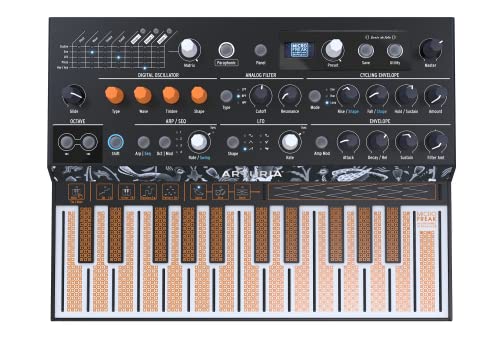
- Hybrid digital oscillator and analog-filter design
- 25-key touch keyboard with poly-aftertouch
- CV, USB, MIDI, and advanced modulation controls
Best For: Experimental sound design and compact modular-friendly setups
Best for Deep Sequencing
Elektron Digitone II Digital Synthesizer

- Four engines with 16-voice polyphony across 16 tracks
- Parameter locks, trig conditions, and Song Mode
- Effects, balanced I/O, MIDI, USB audio, and Overbridge
Best For: Detailed electronic arrangements and external gear control
Best for Beginners
Roland GO:KEYS 3 Music Creation Keyboard

- Touch-sensitive 61-note keyboard
- Over 1,000 Roland ZEN-Core sounds
- Accompaniment styles and chord-sequencer presets
Best For: Accessible keyboard-based music creation
Best Compact Drum Synth
Korg Volca Drum Digital Percussion Synthesizer

- Six-part DSP percussion engine with waveguide resonator
- 16-step sequencer with Active Step and Slice
- Portable design with built-in speaker
Best For: Portable electronic percussion and live pattern creation
Portable Beatmaking Pick

- 25-key velocity-sensitive keybed with eight MPC pads
- Over 100 built-in drum and instrument sounds
- Battery operation, speaker, USB MIDI, and included software
Best For: Mobile beatmaking, songwriting, and compact MIDI production
Workstation-Style Choice

- 49-key design with Motif Sound Engine
- 128-note polyphony for live or sequenced playing
- USB carries stereo audio and 16 MIDI channels
Best For: Live performance and computer-based music production
Hybrid Sound Design Pick

- 37-key six-voice polyphonic synthesizer
- Hybrid digital-and-analog sound profile
- Includes a MiniFreak VST counterpart
Best For: Electronic sound design and hands-on hybrid synthesis
Best DIY Digital Synth

- Build-your-own kit with customization potential
- 18-key multitouch keyboard and 8-step sequencer
- Multimode filter, EG, and three LFOs
Best For: DIY-minded musicians and portable sound-design setups
Best Portable FM Digital Synth
M-VAVE Wireless FM Synthesizer

- Six operators and 32 FM algorithms
- 128 presets, effects, arpeggiator, and sequencer
- Battery-powered with speaker and wireless MIDI
Best For: Mobile music-making and accessible FM synthesis
Best Retro Pocket Synth

- Stylus-controlled touch-sensitive playing surface
- Warm vintage sound with three octaves
- Battery-powered with speaker and headphone socket
Best For: Beginners, collectors, and portable retro sound experiments
Most Experimental – Arturia MicroFreak Synthesizer Keyboard
The Arturia MicroFreak is a strong choice for digital synthesizers shoppers who want unusual sounds in a compact instrument. Its hybrid design combines multiple digital oscillator modes with a resonant analog filter, while the touch-sensitive keybed and modulation matrix encourage expressive sound design.
Best For: Advanced users seeking experimental tones, compact size, and flexible hardware connectivity.
Pros:
- Offers numerous oscillator modes, including wavetable, physical modeling, vocoder, and FM-style options.
- 25-key touch-plate keyboard supports individual pressure or poly-aftertouch control.
- Includes CV outputs, USB, MIDI adapters, sequencer functions, and a 5×7 modulation matrix.
Cons:
- The 25-key keyboard may feel limiting for players who need a larger range.
- Its advanced modulation and sequencing features may require a learning curve.
Choose the MicroFreak if hands-on experimentation matters more than a traditional keyboard experience. It is especially appealing for producers who want distinctive textures and the ability to connect with modular or MIDI-based setups.
Best for Deep Sequencing – Elektron Digitone II Digital Synthesizer
The Elektron Digitone II is built for musicians who want a deep sequencing environment alongside modern digital synthesis. Four synth engines, 16 voices, extensive per-voice shaping, and Elektron-style pattern tools make it suited to complete arrangements as well as individual sounds.
Best For: Experienced producers building detailed electronic arrangements and controlling external gear.
Pros:
- Four synth engines cover pads, leads, bass, drums, and other digital textures.
- Its 16-track sequencer includes parameter locks, trig conditions, polymetric lengths, and Song Mode.
- Provides onboard delay, reverb, chorus, compression, balanced audio I/O, MIDI, and USB audio.
Cons:
- The extensive sequencing and sound-shaping system may be demanding for beginners.
- Its desktop format does not provide a traditional piano-style keyboard.
The Digitone II is a compelling pick when sequencing depth and integrated production tools are priorities. It can serve as a central digital synthesizer and MIDI controller for a broader hardware or DAW-based setup.
Best for Beginners – Roland GO:KEYS 3 Music Creation Keyboard
The Roland GO:KEYS 3 offers an approachable route into digital synthesizers and music creation. Its touch-sensitive 61-note keyboard, large selection of Roland sounds, automatic accompaniment, and chord sequencer are designed to help players start making music without extensive prior experience.
Best For: Beginners and casual creators who want an easy keyboard-based way to explore sounds and arrangements.
Pros:
- Touch-sensitive 61-note keyboard provides a familiar playing format with expressive control.
- Includes over 1,000 sounds through Roland’s ZEN-Core sound engine.
- More than 200 accompaniment styles and over 300 chord-sequencer presets support quick ideas.
Cons:
- Its emphasis is on accessible music creation rather than advanced modular-style synthesis.
- The supplied notes do not specify detailed connectivity or onboard sequencing beyond the chord sequencer.
GO:KEYS 3 is a practical choice for new players who want immediate results from a full-size keyboard. It favors guided creativity and broad preset access over the deeper sound-design workflow found on more specialized synthesizers.
Best Compact Drum Synth – Korg Volca Drum Digital Percussion Synthesizer
Korg Volca Drum Digital Percussion Synthesizer w/ 16-step Sequencer and Active Step
Check Price On AmazonThe Korg Volca Drum is a compact digital percussion synthesizer for rhythm-focused setups. Its six-part DSP engine, waveguide resonator, 16-step sequencer, and pattern variation tools provide hands-on ways to build and manipulate drum sounds in the studio or on the go.
Best For: Producers and performers who want portable electronic percussion with immediate step sequencing.
Pros:
- Six-part DSP synthesis and a waveguide resonator support varied, resonant drum sounds.
- 16-step sequencing includes Active Step, Slice, accent, choke, and randomization functions.
- Compact design includes a built-in speaker for portable music creation.
Cons:
- It is focused on percussion rather than melodic, polyphonic synthesis.
- The 16-step sequencer is more limited than the longer sequencing systems on larger instruments.
The Volca Drum makes sense when size, immediacy, and rhythmic experimentation are more important than a full keyboard or broad melodic engine. It can add distinctive electronic percussion to a hardware rig or live performance setup.
Portable Beatmaking Pick – Akai MPK Mini Play MK3
The Akai MPK Mini Play MK3 is a compact option for exploring digital synthesizers without committing to a full-size setup. Its 25-key velocity-sensitive keybed, built-in sounds, speaker, pads, and battery operation make it useful for mobile beatmaking and quick musical sketches.
Best For: Beat makers, songwriters, and musicians who want a portable keyboard with built-in sounds and USB MIDI control.
Pros:
- Includes over 100 internal drum and instrument sounds, including synth leads and pads.
- Combines 25 dynamic keys, eight MPC drum pads, an arpeggiator, note repeat, and four encoder knobs.
- Built-in speaker, battery operation, OLED display, and included software support portable workflows.
Cons:
- The 25-key format is compact but offers less playing range than larger keyboards.
- Batteries are not included.
The MPK Mini Play MK3 stands out as a flexible entry point for digital synthesizers and MIDI production, especially when portability and immediate hands-on control matter more than a larger keyboard range.
Workstation-Style Choice – Yamaha MX49
The Yamaha MX49 is a 49-key music production synthesizer suited to players who need broader keyboard coverage and production-focused connectivity. Its Motif sound engine, 128-note polyphony, and USB audio/MIDI connection make it a practical choice for live playing and computer-based arrangements.
Best For: Musicians and producers who want a 49-key synthesizer for live performance, layered sounds, and 16-track production workflows.
Pros:
- 49 keys provide more playing range than compact mini-key controllers.
- Motif Sound Engine supports layering, zoning, switching, cycling, and randomizing up to eight elements within a voice.
- Offers 128-note polyphony plus stereo audio and 16 channels of MIDI over one USB cable.
Cons:
- The supplied notes do not indicate built-in speakers or battery operation.
- Its 12.5-pound weight makes it less travel-oriented than compact controllers.
For shoppers comparing digital synthesizers for a more substantial studio or stage setup, the MX49 emphasizes sound layering, polyphony, and straightforward USB integration rather than ultra-portable operation.
Hybrid Sound Design Pick – Arturia MiniFreak
Arturia MiniFreak 37 Key Polyphonic 6-Voice Hybrid Synthesizer Keyboard (Standard, 37 Key)
Check Price On AmazonThe Arturia MiniFreak is a 37-key, six-voice polyphonic hybrid synthesizer for players who want to move between digital and analog-inspired sound worlds. Its portable format and included VST counterpart make it suitable for hands-on experimentation alongside computer-based production.
Best For: Beginners and electronic musicians seeking an expressive hybrid synthesizer with a mid-sized keyboard and software counterpart.
Pros:
- Hybrid sound profile combines digital and analog characteristics.
- Six-voice polyphony supports chords and layered musical parts.
- 37-key format balances portability with more range than a mini 25-key controller.
Cons:
- The supplied notes do not specify built-in speakers or battery operation.
- It uses corded electric power, so mobile use requires access to power.
The MiniFreak is an appealing choice among digital synthesizers for users who prioritize sonic exploration and a blend of hardware and software workflows in a portable 37-key instrument.
Best DIY Digital Synth – Korg Nu:Tekt NTS-1 MKII
The Korg Nu:Tekt NTS-1 MKII is a compact digital synthesizer kit for hands-on musicians who want to assemble and customize their instrument. Its multitouch keyboard, arpeggiator, sequencer, multimode filter, envelope generator, and three LFOs provide substantial sound-shaping flexibility in a highly portable format.
Best For: DIY-minded musicians, portable setups, and users who want deep sound design in a small instrument.
Pros:
- Easy-to-assemble kit with customization potential.
- Compact aluminum design weighs just 0.19 kg.
- Includes an 18-key multitouch keyboard, arpeggiator, and 8-step sequencer.
- Offers a multimode filter, EG, and three LFOs for versatile sound shaping.
Cons:
- Assembly is required before playing.
- The 18-key layout and 8-step sequencer may feel limited for larger arrangements.
The NTS-1 MKII stands out among digital synthesizers for combining a build-it-yourself experience with serious synthesis controls. Choose it if portability and experimentation matter more than a full-size keyboard.
Best Portable FM Digital Synth – M-VAVE Wireless FM Synthesizer
The M-VAVE Wireless Portable FM Synthesizer is a battery-powered digital synthesizer with a built-in speaker, 27 silicone keys, and a six-operator FM engine. With 128 presets, 32 algorithms, effects, an arpeggiator, a sequencer, and multiple MIDI options, it is designed for immediate, flexible music-making away from a studio.
Best For: Mobile musicians, FM-synthesis learners, and creators who want an all-in-one portable instrument.
Pros:
- Battery operation, built-in speaker, and compact design support play anywhere.
- Six operators and 32 algorithms provide classic FM sound-shaping options.
- Includes 128 presets, six built-in effects, a 16-step sequencer, and arpeggiator.
- Supports USB MIDI, Bluetooth MIDI, and 3.5mm MIDI IN simultaneously.
Cons:
- The silicone keys may offer a different feel from conventional piano keys.
- Its plastic body may be less substantial than an aluminum instrument.
- FM programming can take time to master beyond the included presets.
This M-VAVE model is a strong choice when portability and connectivity are priorities. Its presets make it approachable, while the six-operator architecture and 32 algorithms leave room for deeper FM exploration.
Best Retro Pocket Synth – Stylophone Original
The Stylophone Original is a pocket-sized electronic synthesizer built around a touch-sensitive metal playing surface and connected stylus. Its warm, vintage sound, three-octave range, built-in speaker, headphone socket, and battery operation make it an approachable option for casual practice, creative sketches, and retro-inspired sounds.
Best For: Beginners, gift buyers, collectors, and musicians seeking an extremely portable retro instrument.
Pros:
- Simple stylus-based interface is easy for beginners to explore.
- Produces an iconic analog sound with three octaves and optional vibrato.
- Fits in a coat pocket and runs on three AA batteries.
- Includes a built-in speaker, headphone socket, and 3.5mm computer connectivity.
Cons:
- The touch-surface layout is less conventional than a standard keyboard.
- Its feature set is more limited than larger digital synthesizers.
- Recording connectivity requires a 3.5mm stereo cable.
The Stylophone is less suited to elaborate sequencing than the other digital synthesizers here, but its distinctive interface and retro tone are the appeal. It is an inexpensive, portable way to experiment with electronic music.
How We Picked These Digital Synthesizers
We evaluated each instrument according to its synthesis capabilities, sound library, keyboard or pad layout, sequencing features, connectivity, portability, and overall usefulness for its intended audience. Because Digital Synthesizers vary widely, we considered both dedicated sound-design instruments and keyboards that combine synthesis with production or performance tools.
We also looked for meaningful differences between products. Some prioritize experimental sound creation, while others are better suited to songwriting, live performance, beat making, education, or compact travel setups.
Quick Comparison
| Best For | Recommended Type | What to Prioritize |
|---|---|---|
| Beginners | Accessible keyboard synth | Presets, built-in sounds, simple controls |
| Sound designers | Desktop or compact synthesizer | Oscillator flexibility, modulation, effects |
| Producers | Groovebox or production keyboard | Sequencing, multitrack control, DAW connectivity |
| Performers | Playable keyboard synthesizer | Key feel, patch changes, outputs, controls |
| Travel and casual use | Portable mini synthesizer | Battery life, built-in speaker, compact design |
Key Buying Factors for Digital Synthesizers
Keyboard, Pads, or No Keys
A full-size or 37-key layout is more comfortable for melodies and chords, while mini keys save space. Desktop units and grooveboxes may omit a traditional keyboard but offer pads, step buttons, or sequencing controls instead.
Synthesis and Sound Creation
Consider whether you want subtractive, FM, wavetable, physical-modeling, or hybrid synthesis. Preset-focused instruments are quicker to use, while deeper modulation systems reward experimentation but require more learning.
Sequencing and Workflow
A built-in sequencer is valuable for creating complete patterns without a computer. Check track count, polyphony, pattern length, motion sequencing, step editing, and whether the workflow suits loops, songs, or live improvisation.
Connectivity and Expansion
USB MIDI is useful for computer production, while standard MIDI and audio outputs make hardware integration easier. Also check whether the instrument supports pedals, headphones, external audio, firmware updates, or downloadable sounds.
Portability and Power
For mobile use, examine size, weight, battery operation, speaker quality, and durability. A compact instrument is not automatically convenient if it requires several adapters or lacks practical monitoring options.
Who Should Buy Which Digital Synthesizers?
Beginners should choose an instrument with approachable presets, clear controls, and enough built-in sounds to start playing immediately. Compact keyboards and entry-level music-creation models are usually the easiest starting points.
Electronic producers should focus on sequencing depth, pattern management, polyphony, and hands-on parameter control. A groovebox-style synthesizer can provide a more self-contained workflow than a basic MIDI controller.
Sound designers will get the most from instruments with flexible oscillators, modulation routing, effects, and unusual synthesis engines. These models take longer to learn but offer more room for original patches.
Live performers should prioritize reliable patch changes, playable keys or pads, visible controls, strong audio outputs, and a workflow that minimizes menu diving. Travelers and casual players should favor lightweight battery-powered instruments with built-in monitoring and quick startup.