Bi-wiring uses separate cable paths from one amplifier channel to a speaker’s high- and low-frequency terminals. The right cable makes that connection tidy and secure, but it cannot fix a mismatched system or guarantee better sound.
These 10 options cover short and long runs, banana-plug splitters, and heavier-gauge cables. Start by checking your speaker terminals, amplifier connections, and the distance to each speaker.
Best 10 Bi Wire Speaker Cables Picks for 2026
Compact Pair

- Two 1.5 m cables
- Two-to-four banana plugs per cable
- OFC, hand-assembled construction
Best For: Short runs to a stereo speaker pair
Welded Terminations
Blue Jeans Cable Canare 4S11 Bi-Wire

- One 6-foot cable
- Ultrasonically welded connectors
- Locking banana plugs
Best For: Single-speaker runs prioritizing connector construction
Flexible Splitter Pair

- Two 6-foot cables
- Two 12 AWG to four 14 AWG leads
- Soft silicone jacket
Best For: Stereo bi-wire setups needing flexible 6-foot cables
Long-Run Pair
- Two 5 m cables
- 12 banana plugs total
- OFC, hand-assembled construction
Best For: Wider stereo layouts requiring longer cable runs
Long-Run Splitter
CNCESS 10-Foot Bi-Wire Banana Cables

- Pair of 10-foot cables
- Two-to-four banana-plug layout
- 12-gauge tinned copper
Best For: Speakers needing 10-foot banana-plug bi-wire runs
Long-Reach OFC Pair
WBC-GOLD 15-Foot Bi-Wire Cables
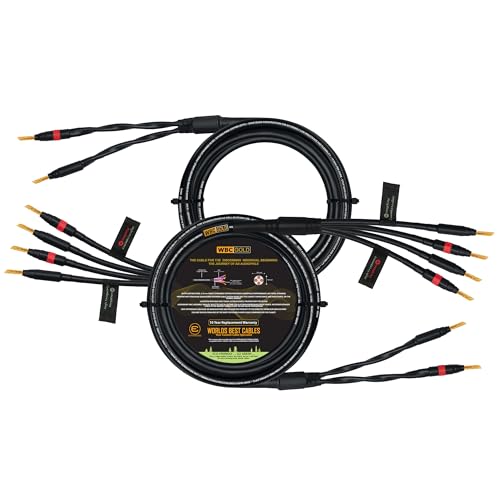
- Pair of 15-foot cables
- 12-AWG, four-core OFC design
- Insulated gold-plated banana plugs
Best For: Indoor stereo setups needing 15-foot finished bi-wire runs
Compact-Run Splitter
CNCESS 3-Foot Bi-Wire Banana Cables

- Pair of 3-foot cables
- Two-to-four banana-plug layout
- 12-AWG to 14-AWG split
Best For: Short runs to nearby bi-wire speakers
Best for Long Runs
WBC-GOLD 25-Foot Bi-Wire Cable Pair

- Two 25-foot cables for left and right speakers
- 12 AWG, four-core oxygen-free copper construction
- Insulated gold-plated banana plugs
Best For: Indoor bi-wire setups with long speaker runs
Best for a Single Speaker Run
SVS SoundPath Ultra 10-Foot Cable

- One 10-foot cable per purchase
- Four braided, 14 AWG copper conductors
- Gold-plated banana connectors and cotton jacket
Best For: Replacing or adding one 10-foot bi-wire cable
Best for Short Premium Setups
WBC Ultimate 6-Foot Cable Pair

- Two 6-foot bi-wire speaker cables
- Heavy 7 AWG oxygen-free copper construction
- Carbon tweed jacket and gold-plated banana plugs
Best For: Compact stereo setups that favor premium finishes
Compact Pair – k4B-2B 1.5 m Bi-Wire Cables
For a nearby amplifier and speaker pair, these bi wire speaker cables provide two banana plugs at the amplifier end and four at the speaker end of each 1.5 m cable. The set includes two cables.
Best For: Short home-audio runs where both speakers need bi-wire connections.
Pros:
- Pair includes 12 banana plugs in total.
- OFC cable with hand-assembled construction.
- Either speaker input can be used for the high or low connection.
Cons:
- At 1.5 m per cable, the pair may be too short for wider speaker placement.
Choose this length if you can route both cables comfortably without stretching them; the included pair covers two speakers without a separate cable purchase.
Welded Terminations – Blue Jeans Cable Canare 4S11 Bi-Wire
Among bi wire speaker cables, this 6-foot Canare 4S11 option stands out for its ultrasonically welded terminations and locking banana plugs. It has two connectors at the amplifier end and four at the speaker end.
Best For: A single-speaker run where welded connections and locking plugs are priorities.
Pros:
- Ultrasonic welding joins the copper wire directly to the brass connectors without compression sleeves or setscrews.
- Locking collars tighten the banana plugs inside binding posts.
- Star-quad construction is designed to reduce the cable’s EM field and interaction with nearby cabling.
- Assembled in Seattle, Washington.
Cons:
- Sold as one cable, so a stereo pair requires two.
- The listed 6-foot length may not suit longer routes.
This is a practical pick when connector construction matters, provided you account for the single-cable package before ordering.
Flexible Splitter Pair – CNCESS 6-Foot Bi-Wire Cables
These bi wire speaker cables come as a two-pack of 6-foot banana-plug splitters, with two plugs at the amplifier end and four at the speaker end of each cable. Their soft silicone jackets suit buyers who prefer a flexible cable.
Best For: Connecting a stereo speaker pair with 6-foot bi-wire runs.
Pros:
- Two cables and 12 banana plugs are included.
- Each cable splits from two 12 AWG leads to four 14 AWG leads.
- Tinned copper conductors and soft silicone jacketing are specified.
Cons:
- The fixed 6-foot length limits placement if the speakers are farther from the amplifier.
Check your routing distance first; if 6 feet reaches both speakers, this package supplies the pair and the required banana-plug split.
Long-Run Pair – k4B-2B 5 m Bi-Wire Cables
If the speakers sit farther from the amplifier, these bi wire speaker cables provide 5 m (16.4 ft) per cable. The pair uses a two-banana-to-four-banana layout, with 12 plugs across the set.
Best For: Wider stereo layouts that need longer bi-wire cable runs.
Pros:
- Two 5 m cables are included.
- OFC cable and hand-assembled construction are specified.
- Both cables arrive with banana plugs fitted.
Cons:
- Extra cable length may be cumbersome in a compact setup.
Measure the actual cable path before buying: this version offers substantially more reach than the 1.5 m k4B-2B pair, but only if that length is useful in your room.
Long-Run Splitter – CNCESS 10-Foot Bi-Wire Banana Cables
For speakers farther from your amplifier, these 10-foot bi wire speaker cables provide a ready-made banana-plug connection. The pair uses a two-plug-to-four-plug layout at each cable’s amplifier-to-speaker connection.
Best For: A left/right speaker setup that needs 10-foot runs and banana-plug bi-wire connections.
Pros:
- Two cables are included for left and right speakers.
- 12-gauge, 680-strand tinned-copper cable has a soft silicone jacket.
- Preinstalled banana plugs avoid cutting and terminating wire.
Cons:
- The fixed 10-foot length may leave excess cable in a compact setup.
- Banana-plug ends require compatible binding posts.
This is the straightforward choice of the two CNCESS lengths when the amplifier-to-speaker distance calls for more reach. Check your binding posts and measure the route before ordering.
Long-Reach OFC Pair – WBC-GOLD 15-Foot Bi-Wire Cables
These 15-foot bi wire speaker cables suit a home-audio layout that needs longer runs and a four-core cable. Each cable uses fine-strand, 99.99% oxygen-free copper in a star-quad design, with Eminence gold-plated banana plugs.
Best For: Indoor stereo setups needing a 15-foot bi-wire cable pair with preinstalled banana plugs.
Pros:
- Includes one 15-foot cable for each stereo channel.
- Four-core, 12-AWG star-quad cable has a flexible PVC-blend jacket.
- Insulated banana-plug bodies help prevent accidental shorts.
Cons:
- Listed for indoor use.
- The fixed 15-foot length may be cumbersome for speakers close to the amplifier.
Its specified materials and assembled connectors make this a practical option if you want a finished long-run pair. The notes describe low-capacitance and low-inductance construction, but they do not provide measurements to compare against other cables.
Compact-Run Splitter – CNCESS 3-Foot Bi-Wire Banana Cables
When your amplifier and speakers are close together, these 3-foot bi wire speaker cables offer a preterminated option without a long coil of spare wire. Each cable splits from two banana plugs to four, and the package includes two cables.
Best For: Short amplifier-to-speaker runs with banana-plug-compatible bi-wire binding posts.
Pros:
- Short 3-foot length suits nearby equipment.
- Two-to-four banana-plug configuration comes ready to connect.
- Uses tinned-copper conductors and a soft silicone rubber cable.
Cons:
- Three feet may not reach speakers placed beyond the equipment rack.
- Fixed banana-plug ends need compatible binding posts.
Choose this pair if you have measured a short route and want the splitter connections already fitted. Its listed construction is 2 x 12 AWG to 4 x 14 AWG per cable, so check that layout against your terminals.
Best for Long Runs – WBC-GOLD 25-Foot Bi-Wire Cable Pair
For speakers farther from your amplifier, these 25-foot bi wire speaker cables provide a ready-made left-and-right pair. Each cable uses a four-core starquad design with 12 AWG, 99.99% oxygen-free copper conductors and banana plugs.
Best For: Indoor bi-wire setups that need a 25-foot cable run to each speaker.
Pros:
- Includes two 25-foot cables, one for each channel.
- Four-core starquad construction uses fine-strand oxygen-free copper.
- Insulated, gold-plated banana plugs and a flexible PVC-blend jacket.
Cons:
- Banana plugs may not suit equipment that requires another connector type.
- Extra cable length may be cumbersome in a compact setup.
Choose this pair when reach is the priority; check that your amplifier and speakers accept its banana-plug bi-wire connections before ordering.
Best for a Single Speaker Run – SVS SoundPath Ultra 10-Foot Cable
SVS SoundPath Ultra Bi-Wire Speaker Cable with Banana Connectors – Each (10 ft.)
Check Price On AmazonThe SVS SoundPath Ultra is a 10-foot option for shoppers comparing bi wire speaker cables who need one cable rather than a stereo pair. It combines four braided conductors of 99.99% pure stranded copper with banana connectors and a braided cotton jacket.
Best For: Adding or replacing a single 10-foot bi-wire speaker cable.
Pros:
- Four braided copper conductors in a 14 AWG cable.
- Hand-soldered, gold-plated banana connectors.
- Three-layer shielding and a wear-resistant braided cotton jacket.
Cons:
- Sold individually; a two-speaker setup requires two cables.
- The 10-foot length may not reach more distant speakers.
Its single-cable packaging is useful when you need an exact replacement, but budget for a second unit if you are wiring both speakers.
Best for Short Premium Setups – WBC Ultimate 6-Foot Cable Pair
These 6-foot bi wire speaker cables suit a compact setup where heavy-gauge construction and a finished look matter. The pair uses 7 AWG, fine-strand 99.99% oxygen-free copper, with a hand-applied carbon tweed jacket and gold-plated banana plugs.
Best For: Short left-and-right speaker runs where premium materials and presentation are priorities.
Pros:
- Includes a 6-foot cable for each speaker channel.
- Heavy 7 AWG construction with fine-strand oxygen-free copper.
- Hand-applied tweed jacket, embroidered labels and a gift box.
Cons:
- Six feet may be too short for widely spaced equipment.
- Heavy-gauge construction may be less convenient to route in tight spaces.
Consider this pair if your speakers are close enough for a 6-foot run and you want the substantial cable and decorative finish; confirm banana-plug compatibility first.
How We Picked the Best Bi Wire Speaker Cables
We focused on practical differences shoppers can verify: cable length, whether the listing supplies one cable or a stereo pair, connector layout, conductor information, and the space the cable needs behind equipment. The selection includes compact splitters, ready-terminated pairs, and longer runs. We did not treat claims about superior sound as proof of an audible improvement; installation and compatibility are more useful starting points.
Quick Comparison
For a short, simple setup, the 3- or 6-foot CNCESS two-packs and the 1.5-meter k4B-2B pair are convenient places to start. The 10-foot CNCESS set, 10-foot SVS cable, and 5-meter k4B-2B suit more distant speakers, though the SVS listing is for each cable rather than a pair. WORLDS BEST CABLES offers 6-, 15-, and 25-foot options for shoppers seeking different lengths and heavier or specified conductor designs. Blue Jeans Cable’s Canare 4S11 option is listed as one cable with bi-wire terminations, so budget for two if you need a stereo pair.
Key Buying Factors for Bi-Wire Speaker Cables
Check the Connection Layout First
Most bi-wire speaker cables connect to one amplifier channel at one end and to four speaker terminals—two positive and two negative—at the other. Confirm the connector count and polarity before ordering. Your speakers need separate high- and low-frequency terminal pairs; remove the factory jumper plates or links only when making a proper bi-wire connection. If you use a conventional single-wire connection instead, leave those links in place.
Measure Length and Confirm Quantity
Measure the actual route around furniture and allow enough slack to avoid pulling on the plugs. Avoid paying for substantially more cable than you need. Product listings may say each, one cable, pair, or two-pack; these distinctions matter when wiring two speakers.
Consider Gauge, Connectors, and Fit
Longer runs and low-impedance speakers can benefit from thicker, lower-resistance conductors, but gauge alone does not establish sound quality. Check the stated wire gauge and material rather than relying on marketing labels. Banana plugs make frequent changes easier, provided your binding posts accept them. Also check plug clearance: a thick cable or closely spaced four-plug fan-out may be awkward behind a speaker placed near a wall.
Who Should Buy Which Bi Wire Speaker Cables?
Choose a short two-pack or pair when both speakers sit near the amplifier and you want a straightforward installation. Choose a longer matched pair when cable routing demands it, after measuring each side separately. Consider the Canare-based Blue Jeans option if you prefer its documented termination approach, but account for its single-cable listing. Pick premium, heavy-gauge options for a specific length, construction, or handling preference—not an assumed sonic upgrade. If your speakers have only one pair of terminals, buy standard speaker cable instead.