Choosing an audio interface with MIDI ports gives your studio more flexibility than a basic recording interface. You can connect microphones and instruments while controlling hardware synthesizers, drum machines, and other MIDI gear from the same setup.
We compare 10 options across entry-level recording, mobile production, multitrack sessions, and expandable studio systems so you can match features, connectivity, and budget to the way you work.
Best 10 Audio Interface with Midi Ports Picks for 2026
High-Channel Hub

- 18 inputs and 20 outputs
- Eight MIDAS mic preamps
- ADAT I/O and MIDI connectivity
Best For: Larger home studios and multi-source recording
Modern Studio Hub
Focusrite Scarlett 4i4 4th Gen

- Four-in/four-out connectivity with MIDI I/O
- Two mic preamps and two Hi-Z inputs
- Auto Gain, Clip Safe, and Air mode
Best For: Flexible desktop music production
Compact Creator Pick

- 5-pin MIDI input and output
- Compact two-input recording setup
- Includes loopback and creative software
Best For: Beginners, mobile creators, and small studios
Monitoring-Focused Choice

- 4x4 USB-C connectivity with MIDI I/O
- LCD screen and low-latency monitoring
- Loopback for recording and podcasting
Best For: Desktop recording, mixing, and podcasting
Best All-Around Choice
Focusrite Scarlett 2i2 4th Gen

- Two mic/instrument inputs
- Auto Gain, Clip Safe, and Air modes
- Includes a broad recording software bundle
Best For: Solo musicians and compact home studios
Best MIDI Connectivity

- 4x4 USB audio/MIDI interface
- Four mic preamps with phantom power
- Four inputs and four outputs
Best For: MIDI-equipped home recording setups
Best for Hardware Monitoring

- 2-in/2-out USB-C design
- Hardware monitoring included
- 24-bit/192kHz support with two preamps
Best For: Solo creators wanting compact direct monitoring
Studio-Ready Solo

- 120dB dynamic range and 24-bit/192kHz audio
- XLR mic preamp plus Hi-Z instrument input
- No MIDI ports listed; includes recording software
Best For: Solo vocalists, guitarists, and songwriters
MIDI-Friendly Compact Pick
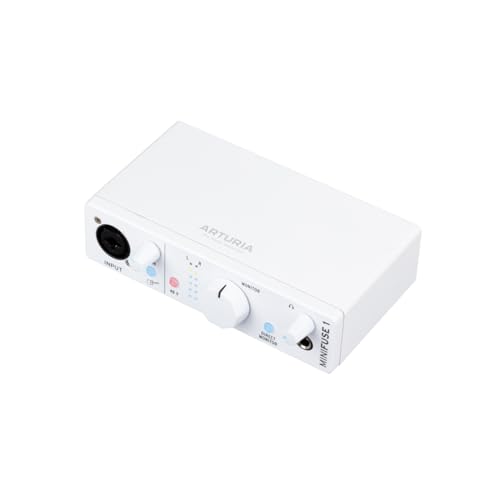
- Five-pin MIDI input and output
- Combo input with 48V phantom power
- Includes loopback, USB hub, and creative software
Best For: Beginners using synths, controllers, or drum machines
Proven Budget Classic

- 24-bit/192kHz recording with Air mode
- One XLR mic and one Hi-Z instrument input
- No MIDI ports listed; software bundle included
Best For: Beginners recording vocals, guitar, bass, or podcasts
High-Channel Hub – Behringer UMC1820
If you need an audio interface with MIDI ports and substantial I/O for a larger recording setup, the Behringer UMC1820 offers 18 inputs and 20 outputs over USB 2.0. Its eight MIDAS-designed mic preamps, ADAT I/O, phantom power, and 24-bit/96 kHz support suit multi-microphone and instrument recording.
Best For: Home studios and musicians who need many simultaneous inputs, outputs, and expansion through ADAT.
Pros:
- Provides 18 inputs and 20 outputs for complex recording setups.
- Includes eight mic preamps with +48V phantom power.
- Supports ADAT I/O and up to 24-bit/96 kHz resolution.
- Works with popular software such as Pro Tools, Ableton Live, and Cubase.
Cons:
- Its larger channel count and 24.35-inch width may be more than a small setup needs.
- USB 2.0 connectivity is less current than USB-C interfaces.
The UMC1820 is a practical choice when expansion and channel capacity matter more than compact size. It is especially well suited to recording multiple microphones, instruments, or external hardware at once.
Modern Studio Hub – Focusrite Scarlett 4i4 4th Gen
The Focusrite Scarlett 4i4 4th Gen is a compact audio interface with MIDI ports for connecting microphones, guitars, synths, drum machines, and controllers. It combines two mic preamps, two Hi-Z inputs, four line inputs, four outputs, and USB-C connectivity with 24-bit/192 kHz recording.
Best For: Producers and musicians building a flexible desktop studio around microphones, instruments, line-level gear, and MIDI hardware.
Pros:
- Offers MIDI input and output alongside four inputs and four outputs.
- Includes two mic preamps and two Hi-Z instrument inputs.
- Air mode, Auto Gain, and Clip Safe support easier recording workflows.
- Includes a software bundle with Ableton Live Lite, Cubase LE, and other tools.
Cons:
- It has fewer total channels than larger multi-input interfaces.
- The listed frequency response is 20 kHz, despite its 192 kHz maximum sample rate.
With current USB-C connectivity and helpful level-management features, the Scarlett 4i4 is a balanced option for a growing personal studio. Its MIDI I/O also makes it useful for integrating synths and drum machines without needing a separate MIDI interface.
Compact Creator Pick – Arturia MiniFuse 2
For a portable audio interface with MIDI ports, the Arturia MiniFuse 2 keeps the setup compact while covering microphones, guitars, synths, and other instruments. It provides two combo inputs, balanced outputs, headphone monitoring, 5-pin MIDI input and output, and up to 192 kHz operation.
Best For: Beginners, mobile creators, and small home studios that want straightforward recording plus MIDI hardware integration.
Pros:
- Includes dedicated 5-pin MIDI input and output connections.
- Combines two combo mic/instrument/line inputs with phantom power and two additional instrument/line inputs.
- Offers loopback for capturing voiceovers alongside in-app or in-game audio.
- Includes extensive creative software and a five-year warranty.
Cons:
- Its compact design provides less I/O than larger interfaces.
- The supplied notes list one headphone output, which may limit shared monitoring.
The MiniFuse 2 is an approachable choice when ease of use, portability, and included software are priorities. Its MIDI connections make it more versatile than a basic two-input interface for synths, controllers, and drum machines.
Monitoring-Focused Choice – MOTU M4
The MOTU M4 is a 4×4 USB-C audio interface with MIDI I/O for musicians, producers, and podcasters who want a compact desktop unit. It includes two microphone preamps, low-latency hardware monitoring, an LCD screen, loopback, and support for Mac, PC, and iOS.
Best For: Desktop recording, mixing, and podcasting setups that benefit from clear level monitoring and MIDI connectivity.
Pros:
- Provides 4×4 USB-C connectivity with MIDI I/O.
- Includes two microphone preamps for vocal and instrument recording.
- Offers an LCD monitoring screen and low-latency hardware monitoring.
- Supports loopback and connection to Mac, PC, and iOS devices.
Cons:
- Its four-in/four-out layout is less suitable for large ensembles or extensive hardware rigs.
- The supplied notes specify a two-year warranty, shorter than some competing options listed here.
The M4 stands out for users who value practical monitoring and flexible computer or mobile connectivity. It offers a focused feature set for recording, mixing, streaming, and podcasting without the footprint of a high-channel interface.
Best All-Around Choice – Focusrite Scarlett 2i2 4th Gen
The Focusrite Scarlett 2i2 4th Gen is a streamlined audio interface with MIDI ports searchers may consider when they want strong recording essentials in a compact USB-C unit. It provides two microphone/instrument inputs, 24-bit/192kHz conversion, Auto Gain, Clip Safe, and Air modes for shaping recordings.
Best For: Solo musicians, vocalists, guitarists, and home studios needing two inputs and easy level control.
Pros:
- Two mic preamps and two Hi-Z instrument inputs
- 120dB dynamic range with up to 192kHz sample rate
- Auto Gain, Clip Safe, and Air modes simplify recording
- Includes Pro Tools Intro+, Ableton Live Lite, Cubase LE, and Hitmaker Expansion
Cons:
- Provides two audio inputs and does not list a MIDI I/O connection in the supplied specifications
- USB-C connectivity requires a compatible computer, tablet, or adapter setup
The Scarlett 2i2 is a capable two-channel choice with useful recording safeguards and a generous software bundle. If MIDI hardware connectivity is essential, verify the port requirements before buying.
Best MIDI Connectivity – Behringer UMC404HD
The Behringer U-PHORIA UMC404HD is a practical audio interface with MIDI ports, offering 4×4 USB audio/MIDI connectivity for recording microphones and instruments. Its four MIDAS-designed mic preamps, 24-bit/192kHz support, and four-input/four-output layout suit more involved home recording setups.
Best For: Musicians who need four audio inputs, multiple outputs, and dedicated MIDI I/O in one interface.
Pros:
- Four inputs and four outputs for flexible routing
- Dedicated MIDI I/O for compatible keyboards and controllers
- Four MIDAS-designed mic preamps with +48V phantom power
- Impact-resistant metal chassis and support for popular recording software
Cons:
- Its 2.7-pound, 11.5-inch-deep chassis is less compact than two-channel alternatives
- The supplied details list Windows operating-system support rather than a broad current-platform list
The UMC404HD is the clearest fit here for buyers prioritizing MIDI ports and expanded I/O. Its durable enclosure and four preamps add flexibility, though its larger footprint may matter on a crowded desk.
Best for Hardware Monitoring – MOTU M2 USB-C Interface
The MOTU M2 is a compact 2-in/2-out USB-C audio interface for musicians who value straightforward recording and hardware monitoring. It includes two preamps, 24-bit/192kHz capability, and compatibility with macOS, Windows, and iOS, although the supplied details do not specify a MIDI I/O port.
Best For: Solo creators who want two inputs, hardware monitoring, and a small desktop interface.
Pros:
- Two preamps in a compact 2-in/2-out design
- Supports 24-bit/192kHz recording
- Includes hardware monitoring for direct listening
- Works with macOS, Windows, and iOS according to the supplied notes
Cons:
- The supplied specifications do not list MIDI input or output ports
- Only two audio inputs and two outputs are provided
The M2 is a sensible compact interface when monitoring and basic two-channel recording are the priorities. Buyers specifically seeking an audio interface with MIDI ports should confirm external MIDI connectivity before choosing it.
Studio-Ready Solo – Scarlett Solo 4th Gen
If you need an audio interface with MIDI ports, note that the Scarlett Solo 4th Gen focuses on microphone and instrument recording rather than MIDI connectivity. It is a compact USB-C interface with a mic preamp, Hi-Z instrument input, 24-bit/192kHz recording, and a 120dB dynamic range.
Best For: Songwriters and solo creators recording vocals, guitar, and other single-source performances.
Pros:
- 120dB dynamic range and 24-bit/192kHz conversion
- One XLR mic preamp and one Hi-Z instrument input
- Air modes add presence and harmonic drive to vocals and guitars
- Includes Pro Tools Intro+, Ableton Live Lite, Cubase LE, and Hitmaker Expansion
Cons:
- No MIDI input or output is listed in the supplied specifications
- Designed around one microphone and one instrument input
The Solo 4th Gen is a strong choice for straightforward vocal-and-instrument recording, but it is not the right match if MIDI ports are essential to your setup. Its updated conversion, Air modes, and bundled software make it appealing for a compact home studio.
MIDI-Friendly Compact Pick – Arturia MiniFuse 1
For shoppers specifically seeking an audio interface with MIDI ports, the Arturia MiniFuse 1 is the clearest fit in this group. It combines a compact USB recording interface with five-pin MIDI input and output, a combo mic/instrument/line input, balanced outputs, headphone monitoring, and a USB hub.
Best For: Beginners and mobile producers connecting a microphone, instrument, synth, controller, or drum machine.
Pros:
- Includes five-pin MIDI input and output connections
- Combo XLR input supports mic, instrument, and line sources with 48V phantom power
- Offers loopback, balanced line outputs, and headphone volume control
- Includes Ableton Live Lite, Analog Lab Intro, effects, guitar software, and other creative tools
Cons:
- Only one main combo input is specified
- Its compact feature set may be limiting for larger multi-mic sessions
The MiniFuse 1 stands out when MIDI integration matters, while still covering common vocal, guitar, synth, and content-creation tasks. Its five-year warranty and beginner-oriented software bundle add practical value for a first interface.
Proven Budget Classic – Scarlett Solo 3rd Gen
The Scarlett Solo 3rd Gen is a compact USB interface for recording vocals and instruments, but it is not an audio interface with MIDI ports based on the supplied specifications. It provides one XLR mic preamp, one Hi-Z instrument input, Air mode, and recording up to 24-bit/192kHz.
Best For: Home-recording beginners who need a simple interface for guitar, bass, vocals, or podcasts.
Pros:
- High-performance mic preamp with switchable Air mode
- 24-bit/192kHz converters and Gain Halos for managing input levels
- Two low-noise balanced outputs for studio monitors
- Includes Pro Tools Intro+, Ableton Live Lite, Cubase LE, and Hitmaker Expansion
Cons:
- No MIDI input or output is listed in the supplied specifications
- Limited to one mic preamp and one instrument input
This 3rd-generation Solo remains a practical entry-level choice for direct vocal-and-instrument recording. Choose it for a simple workflow and established feature set, not for connecting external MIDI hardware.
How We Picked the Best Audio Interface with Midi Ports
We focused on interfaces that combine dependable audio recording with practical MIDI connectivity. The selection covers compact one- and two-input models, flexible four-input interfaces, and higher-channel-count hardware for larger sessions. We also considered preamp quality, conversion specifications, driver and USB connectivity, monitoring features, portability, and expansion options such as ADAT.
Because MIDI implementation varies, check the exact port type and routing features before buying. A traditional five-pin MIDI I/O connection is useful for hardware instruments, while USB MIDI may be sufficient if your controllers and instruments connect directly to your computer.
Quick Comparison
| Best For | Recommended Options | Why |
|---|---|---|
| Solo recording | Focusrite Scarlett Solo 4th Gen, MOTU M2 | Compact designs with quality inputs and direct monitoring |
| Two-person recording | Scarlett 2i2 4th Gen, Arturia MiniFuse 2 | Two microphone or instrument inputs for vocals, instruments, or stereo sources |
| More inputs and MIDI control | Scarlett 4i4, MOTU M4, UMC404HD | Additional routing flexibility for keyboards, synths, and multiple sources |
| Larger studio setups | Behringer UMC1820 | High input and output count with ADAT expansion |
| Smallest footprint | Arturia MiniFuse 1, Scarlett Solo 3rd Gen | Simple, portable interfaces for basic recording rigs |
Key Buying Factors for an Audio Interface with Midi Ports
Input and Output Count
Count how many microphones, instruments, and stereo devices you need to connect at once. Two inputs suit many singer-songwriter setups, while four or more inputs are better for drum machines, stereo keyboards, multiple performers, or external hardware routing.
MIDI Connections and Routing
Look for dedicated MIDI In and Out ports if you use older or hardware-based instruments. Consider whether the interface supports convenient MIDI routing, synchronization, and low-latency monitoring. If you only use a USB controller, dedicated five-pin ports may be less important.
Latency, Drivers, and Monitoring
Low latency matters for software instruments and live monitoring. Direct monitoring can reduce perceived delay when recording vocals or guitar, while dependable drivers and current operating-system support help prevent interruptions.
Expansion and Recording Quality
Higher sample rates and bit depth are useful, but input quality, gain range, noise performance, and stable conversion matter more in everyday work. ADAT support is especially valuable if you may add an external preamp or additional channels later.
Who Should Buy Which Audio Interface with Midi Ports?
Choose the Scarlett Solo 4th Gen, MiniFuse 1, or Scarlett Solo 3rd Gen for a compact single-performer setup. The MOTU M2 and Scarlett 2i2 4th Gen are stronger fits when you want two inputs and detailed monitoring for vocals, guitar, or stereo instruments.
For producers working with several hardware devices, the Scarlett 4i4, MOTU M4, or UMC404HD provide more practical I/O and routing flexibility. Choose the MiniFuse 2 when portability and bundled creative software are priorities. For a growing studio with multiple microphones and expansion plans, the UMC1820 offers the broadest channel count in this group.