Choosing the right encoder can make the difference between a smooth live stream and a problem-filled broadcast. For creators, churches, schools, and pro AV teams, the best 4K streaming encoders balance resolution, reliability, and protocol support.
Below, we focus on options that handle real-world streaming workflows well, from simple HDMI setups to advanced SDI and multi-input production needs.
Best 10 4K Streaming Encoders Picks for 2026
Multi-Protocol HDMI Encoder

- 4K UHD HDMI input up to 30fps
- Streams to RTMP, SRT, HLS, and more
- Up to 4 simultaneous outputs
Best For: Creators needing flexible HDMI live streaming to multiple platforms
Professional 4K Encoder
Blackmagic Streaming Encoder 4K

- DCI 4K streaming up to 60fps
- H.264/H.265 to SRT or RTMP
- Front-panel controls and monitor outputs
Best For: Professional live production with simple hands-on control
Flexible IP Encoder
URayCoder 4K HDMI to Ethernet Streamer
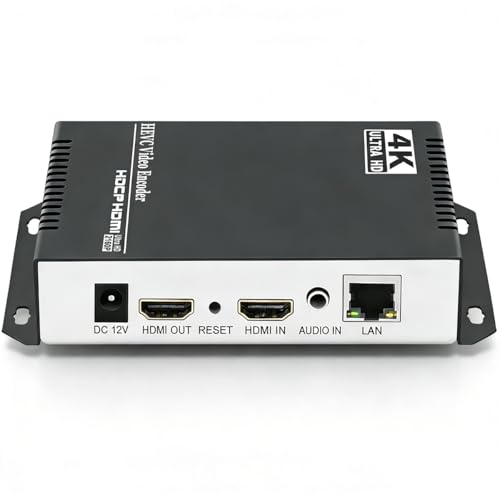
- 4K HDMI input up to 30fps
- Supports RTSP, RTMP(S), SRT, HLS, and more
- Can send 4 streams simultaneously
Best For: HDMI-to-IP live streaming with broad protocol support
Pro SDI Encoder
Magewell Ultra Encode SDI Plus

- SDI encoding up to 4096x2160p30
- Streams and records at the same time
- Supports NDI|HX, PoE, and Wi‑Fi
Best For: Professional SDI production, contribution, and hybrid IP workflows
Compact NDI 4K Streaming Box
ZowieBox 4K HDMI NDI Encoder/Decoder

- HDMI capture up to 4K with zero-lag passthrough
- Supports NDI|HX3/HX2/HX, SRT, RTMP(S), RTSP, and HLS
- Compact body with LCD, tally light, PoE, and web control
Best For: Compact standalone streaming and IP video workflows
Broadcast-Ready SDI 4K Encoder
Blackmagic Streaming Encoder 4K
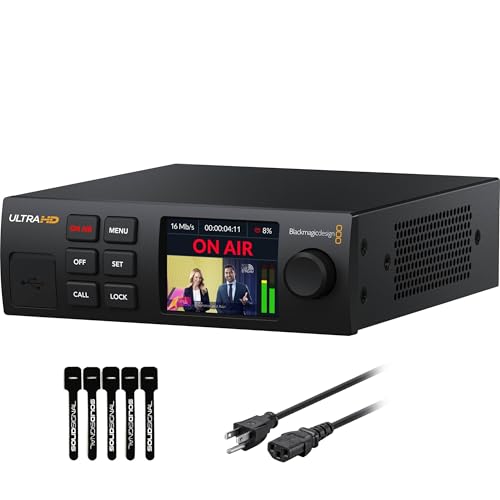
- H.264/H.265 streaming up to 2160p60 via SRT or RTMP
- 12G-SDI input, loop out, and standards conversion
- Ethernet plus mobile failover for backup connectivity
Best For: Broadcast teams needing SDI, redundancy, and direct streaming
Multi-Protocol HDMI Network Encoder
URayCoder 4K HDMI to IP Encoder

- 4K UHD HDMI input with H.265/H.264 dual encoding
- Supports RTSP, RTMP(S), SRT, HLS, WebRTC, ONVIF, and more
- Can send up to 4 simultaneous streams with custom overlays
Best For: Multi-platform streaming and IPTV workflows
Dual-Input Pro Encoder
Magewell Ultra Encode AIO 4K HDMI/SDI Encoder

- HDMI and SDI inputs in one rack-mount unit
- Streams to up to six destinations at once
- Records while streaming with overlays and processing
Best For: Multi-source live production and broadcast-style workflows
Flexible Multi-Output Encoder
ORIVISION 4K HDMI Encoder with OLED Display

- Choose 1×4K30 or 4×1080P30 stream mode
- OLED display shows status and IP details
- Supports RTMP, SRT, RTSP, HTTP, UDP, and ONVIF
Best For: IPTV, signage, and simple multi-stream deployments
Compact HDMI Workhorse
Magewell Ultra Encode HDMI Plus 4K Encoder

- HDMI 4K encoding with loop-through monitoring
- Records to internal, USB, or network storage
- Supports PoE, Wi‑Fi, and NDI|HX
Best For: HDMI-centric live streaming and remote production
Multi-Protocol HDMI Encoder – URayCoder 4K HDMI Streamer
If you need a practical 4k streaming encoder for HDMI sources, this URayCoder unit is built around broad protocol support and flexible output options. It handles 4K UHD input up to 30fps, supports H.265/H.264 encoding, and can push multiple streams to different destinations at once.
Best For: Multi-platform live streaming from HDMI cameras, switchers, or other HDMI-compatible sources.
Pros:
- Supports 4K UHD input up to 3840×2160 at 30fps.
- Multi-protocol support includes RTSP, RTMP(S), SRT, HLS, UDP, and WebRTC.
- Can output up to 4 video streams with different protocols simultaneously.
- Offers overlays, cropping, rotation, flipping, and mirroring for customized streams.
Cons:
- 4K tops out at 30fps rather than higher broadcast-style frame rates.
- Designed around HDMI input only, so it is not for SDI workflows.
Overall, this is a feature-heavy encoder if your priority is flexible distribution rather than a simple single-output box. Its customization options and lifetime warranty support make it appealing for recurring live-stream setups.
Professional 4K Encoder – Blackmagic Streaming Encoder 4K
The Blackmagic Design Streaming Encoder 4K is a straightforward choice for buyers who want a dedicated 4k streaming encoder with a more professional hardware feel. It supports H.264 and H.265 streaming to SRT or RTMP, handles DCI 4K up to 60fps, and includes SDI and HDMI monitor outputs for local confidence viewing.
Best For: Professional users who want a compact encoder with simple front-panel control and 4K60 support.
Pros:
- Supports DCI 4K streaming up to 60fps.
- Uses H.264 and H.265 with SRT or RTMP output.
- Includes SDI and HDMI monitor outputs.
- Front-panel buttons and spin knob make on-device operation easier.
Cons:
- Specific streaming protocol support is narrower than some multi-protocol alternatives.
- The supplied details do not highlight built-in recording or extensive overlay tools.
This model makes sense when you want a compact, self-contained encoder rather than a feature-packed general-purpose box. Its 4K60 capability and direct controls should suit live production environments that value speed and reliability.
Flexible IP Encoder – URayCoder 4K HDMI to Ethernet Streamer
For users looking for 4k streaming encoders that can push HDMI video onto an IP workflow, this URayCoder model is built for broad compatibility. It supports 4K UHD input up to 30fps, H.265/H.264 encoding, and an extensive list of network protocols for sending live video to streaming services or private servers.
Best For: HDMI-to-network streaming setups that need broad protocol compatibility and simple web-based management.
Pros:
- Supports 4K UHD HDMI input up to 3840×2160 at 30fps.
- Wide protocol list includes RTSP, RTMP(S), SRT, HLS, UDP, FLV, WebRTC, and more.
- Can output up to 4 streams with different protocols at the same time.
- Includes customization options like text, logos, timestamps, cropping, and rotation.
Cons:
- 4K performance is limited to 30fps.
- HDMI-only input means it is not suited to SDI-based rigs.
This is a strong fit if your workflow depends on flexible network delivery rather than one platform or one protocol. The combination of multi-stream output and browser-friendly status monitoring makes it useful for practical live streaming deployments.
Pro SDI Encoder – Magewell Ultra Encode SDI Plus
The Magewell Ultra Encode SDI Plus is a higher-end 4k streaming encoder for production teams that need SDI input, multi-destination delivery, and recording in one compact unit. It encodes SDI up to 4096x2160p30, supports H.264/H.265, and adds NDI|HX alongside RTMP, RTMPS, SRT, HLS, and TS over UDP/RTP.
Best For: Professional SDI workflows that need streaming, recording, and NDI|HX integration.
Pros:
- Encodes SDI video up to 4096x2160p30.
- Supports multiple delivery protocols, including RTMP, RTMPS, SRT, NDI|HX, and HLS.
- Can stream and record simultaneously, with internal and external storage options.
- Includes PoE, Wi-Fi, and support for 4G/5G USB modems for flexible deployment.
Cons:
- Built for SDI sources, so it is not the best pick for HDMI-only setups.
- More complex than a basic encoder if you only need a single output path.
This model stands out when your work involves broadcast-style contribution, remote production, or hybrid IP workflows. The mix of NDI|HX, recording, and connectivity choices makes it especially versatile for demanding professional environments.
Compact NDI 4K Streaming Box – ZowieBox 4K HDMI NDI Encoder/Decoder
If you want a flexible 4k streaming encoder for live gaming or compact IP workflows, the ZowieBox is built to do a lot from a small footprint. It handles HDMI capture up to 4K, offers zero-lag HDMI passthrough, and can also decode IP streams back to 4K HDMI, making it a practical pick when you need encoding and decoding in one box.
Best For: Streamers and AV users who want a compact, standalone HDMI-to-NDI/RTMP/SRT workflow with passthrough.
Pros:
- Supports native NDI|HX3/HX2/HX, plus SRT, RTMP(S), RTSP, and HLS workflows.
- Captures up to 4K with zero-lag HDMI passthrough for gaming and live production.
- Web UI control from PC, phone, or tablet with PTZ, tally, audio, and network settings.
- Compact design includes tally light, LCD status screen, PoE, USB-C power, and tripod mount.
Cons:
- Encoder and decoder modes cannot run at the same time.
- Full NDI signals are not supported.
- USB capture card functionality is not currently supported.
This is a strong choice if you value versatility and a small form factor more than a simple single-purpose encoder. It fits best in setups where NDI HX, RTMP, SRT, and hardware control matter more than raw feature simplicity.
Broadcast-Ready SDI 4K Encoder – Blackmagic Streaming Encoder 4K
For buyers looking for a serious 4k streaming encoder in an SDI-based production setup, the Blackmagic Design Streaming Encoder 4K is designed to stream directly without a dedicated encoding PC. It supports H.264 and H.265 up to 2160p60, adds standards conversion, and includes Ethernet plus mobile failover so it can stay online in demanding live workflows.
Best For: Broadcast and production teams that need SDI input, direct-to-platform streaming, and backup connectivity.
Pros:
- Streams in H.264 or H.265 up to 4K60 via SRT or RTMP.
- 12G-SDI input with SDI loop out and automatic standards conversion.
- Ethernet plus 5G/4G mobile support with auto-failover for backup internet.
- Includes closed captions, timecode passthrough, REST API control, tally, and talkback support.
Cons:
- Built around SDI devices, so it is less relevant for HDMI-only setups.
- More of a broadcast tool than a simple plug-and-play streaming box.
- At 1/3 RU form factor, it is not the most portable option.
This encoder stands out when reliability and workflow integration matter more than minimal setup. If your production needs SDI routing, remote control features, and failover networking, it offers a well-rounded professional package.
Multi-Protocol HDMI Network Encoder – URayCoder 4K HDMI to IP Encoder
This 4k streaming encoder is built for users who want broad protocol support and flexible output options from a single HDMI source. It accepts up to 4K UHD input at 30fps, supports H.265/H.264 encoding, and can push multiple streams using protocols like RTSP, RTMP(S), SRT, HLS, WebRTC, and more.
Best For: Multi-platform live streaming, IPTV, and network video setups that need protocol flexibility.
Pros:
- Supports 4K UHD HDMI input with H.265/H.264 dual encoding.
- Wide protocol support including RTSP, RTMP(S), SRT, HLS, WebRTC, and ONVIF.
- Can output up to 4 streams with different protocols at the same time.
- Allows text, captions, logos, timestamps, cropping, rotation, flipping, and mirroring.
Cons:
- 4K input is limited to 30fps.
- Feature set is broad, so setup may be more involved than a basic encoder.
- Best suited to users who need network streaming flexibility more than a simple one-button workflow.
If your priority is compatibility across platforms and distribution methods, this model is a strong fit. It offers plenty of control over stream layout and delivery while staying focused on HDMI-to-network encoding.
Dual-Input Pro Encoder – Magewell Ultra Encode AIO 4K HDMI/SDI Encoder
If you need one of the more flexible 4k streaming encoders for live production, the Magewell Ultra Encode AIO stands out for its HDMI and SDI inputs, multi-destination streaming, and built-in recording. It can handle either input separately or combine both with picture-in-picture or side-by-side layouts, making it useful when a single box has to support different sources and workflows.
Best For: Live production teams, educators, and AV users who want dual-input flexibility plus stream-and-record capability.
Pros:
- Supports HDMI up to 4096×2160p60 and SDI up to 4096×2160p30.
- Streams to up to six destinations with RTMP, RTMPS, SRT, NDI|HX2/HX3, HLS, and more.
- Includes recording to SD card, USB storage, or network drives while streaming.
- Offers onboard processing and up to eight text/image/clock overlays.
Cons:
- Rack-mount design may be more than casual users need.
- Dual-input and multi-protocol flexibility may be overkill for simple single-stream setups.
Overall, this is a strong pick if you want a feature-rich encoder that can adapt to demanding production environments without adding extra boxes.
Flexible Multi-Output Encoder – ORIVISION 4K HDMI Encoder with OLED Display
Among practical 4k streaming encoders, this ORIVISION unit is built for users who need selectable output modes and broad protocol support rather than a complex production feature set. It can deliver either one 4K30 stream or four 1080P30 streams, and the OLED display makes it easier to confirm IP address, resolution, and encoding status at a glance.
Best For: IPTV, live event, digital signage, and education setups that need simple multi-stream output.
Pros:
- Selectable 1×4K30 or 4×1080P30 output modes.
- Supports RTMP, RTMPS, SRT, RTSP, HTTP, UDP, and ONVIF.
- Built-in OLED screen shows IP address, resolution, and status.
- Includes HDMI loop-out for local monitoring.
Cons:
- Factory default EDID is 1080P, so 4K input needs a web-interface change.
- Single HDMI input keeps it focused on simpler workflows.
This is a sensible choice if your priority is flexible stream output and straightforward monitoring without paying for advanced production extras.
Compact HDMI Workhorse – Magewell Ultra Encode HDMI Plus 4K Encoder
The Magewell Ultra Encode HDMI Plus is a compact option in the world of 4k streaming encoders, especially if you want HDMI encoding, loop-through monitoring, and the ability to stream and record at the same time. It supports modern protocols like RTMP, RTMPS, SRT, NDI|HX, HLS, and TS over UDP/RTP, while also giving you a built-in 128 GB storage base for local recording.
Best For: HDMI-based streaming setups that need recording, PoE, and NDI|HX support in a small unit.
Pros:
- Encodes HDMI up to 4096×2160p30 with loop-through output.
- Streams via RTMP, RTMPS, SRT, NDI|HX, HLS, and TS over UDP/RTP.
- Records to internal 128 GB storage, USB, or network locations.
- Includes Gigabit Ethernet with PoE plus Wi‑Fi and 4G/5G USB modem support.
Cons:
- HDMI-only input means it is less flexible than dual-input models.
- 4K input tops out at 30p, not 60p.
For users centered on HDMI sources, this model balances portability, networking options, and recording features in a very practical package.
How We Picked These 4K Streaming Encoders
Our selection focused on features that matter in live production: stable 4K encoding, broad protocol compatibility, input options, recording support, and practical deployment features like PoE, loop-through, or standalone operation. We also favored models that fit different use cases, from straightforward one-camera streaming to more advanced multi-source workflows.
Quick Comparison: What Sets Them Apart
In this group of 4K Streaming Encoders, the biggest differences come down to source type and workflow. HDMI-only models are usually simpler and more affordable, while SDI-capable and dual-input units are better for professional cameras and switching setups. NDI|HX support is especially useful for IP-based production environments, and multi-protocol support helps you stream to platforms or servers with different requirements.
Key Buying Factors for 4K Streaming Encoders
Input Type and Signal Path
Start with your source. HDMI encoders are common for cameras, laptops, and mixers, while SDI models are a better fit for longer cable runs and professional gear. If you plan to move between setups, an encoder with both HDMI and SDI can offer more flexibility.
Streaming Protocols
Look for support that matches your workflow. RTMP and RTMPS remain essential for common platforms, while SRT is valuable for more reliable contribution over unstable networks. HLS, RTSP, UDP, and WebRTC can matter for IPTV, internal distribution, or low-latency applications.
Resolution, Bitrate, and Latency
Not every 4K encoder performs the same under load. Check whether it supports true 4K streaming at your target frame rate and bitrate. If your priority is live interaction, low latency matters as much as image quality.
Recording, Mixing, and Network Features
Some 4K Streaming Encoders include local recording, dual-input mixing, loop-through outputs, or NDI|HX support. These features can simplify production by reducing the number of separate devices you need.
Who Should Buy Which 4K Streaming Encoders?
If you want the simplest setup for a single camera or HDMI source, a basic standalone HDMI encoder is usually enough. If you need broadcast-style connectivity, choose an SDI model. For multi-camera or IP-centric productions, look for NDI|HX and dual-input options. And if your streams must stay stable across changing network conditions, prioritize SRT support and a unit with proven hardware reliability.
For most buyers, the best choice is the encoder that matches both the source format and the delivery platform. That keeps the setup easier to manage and helps ensure dependable results from the first stream onward.