Choosing the right capture card can make the difference between a clean, reliable stream and a frustrating setup. Whether you need high-refresh gameplay passthrough, simple plug-and-play recording, or a card for console streaming, the best option depends on your gear and resolution targets.
This roundup of 10 4K capture cards focuses on real-world performance, compatibility, and value so you can narrow down the right pick faster.
Best 10 4K Capture Cards Picks for 2026
Flagship HDMI 2.1 Pick

- Captures up to 4K144 and 1080p240
- HDMI 2.1 with VRR passthrough
- Works with OBS, Streamlabs, Twitch Studio, and more
Best For: Streamers who want premium passthrough and very high frame-rate capture
Easy External Streaming Pick
AVerMedia Live Gamer Extreme 3

- Records 4K30 with up to 1080p240 capture
- VRR passthrough at 1440p120 or 1080p120
- Plug and play with included cables
Best For: Streamers who want a simple external card with good console support
Budget Flexible Option
XIIXMASK 4K60 USB Capture Card

- 4K60 capture/passthrough with 1080p120 support
- 3.5mm audio in and mic out included
- Wide OS and device compatibility
Best For: Budget buyers who want flexible connectivity and broad device support
Internal PCIe Premium Pick
Elgato 4K Pro for 8K60 Passthrough

- 8K60 passthrough with 4K60 HDR10 capture
- HDMI 2.1 and up to 1080p240 recording
- Built for Windows 10 PCIe desktop setups
Best For: Desktop streamers who want a high-end internal PCIe capture card
Rybozen Value Pick
Budget-Friendly 4K Input Capture Card

- 4K input up to 4K30/60Hz
- 1080p capture with USB 3.0 plug-and-play
- HDMI loop-out plus mic-in support
Best For: Streamers and gamers who want easy 1080p capture with low latency
Acer Everyday Streamer
4K Input, 1080P Output Capture Card

- 4K input with 1080p@60Hz output
- Mic-in and low-latency streaming support
- Works with Windows, macOS, Linux, and Android
Best For: Creators and educators who want broad compatibility in a compact capture card
Portable Creator Choice
Compact 4K HDMI to USB-C Capture Card

- Up to 4K@30Hz HDMI input
- Records at 2K@30Hz or 1080p@60Hz
- USB-C, USB 3.0, and wide OS support
Best For: Mobile creators who need a compact, easy-to-use capture card
Budget-Friendly 4K HDMI Capture
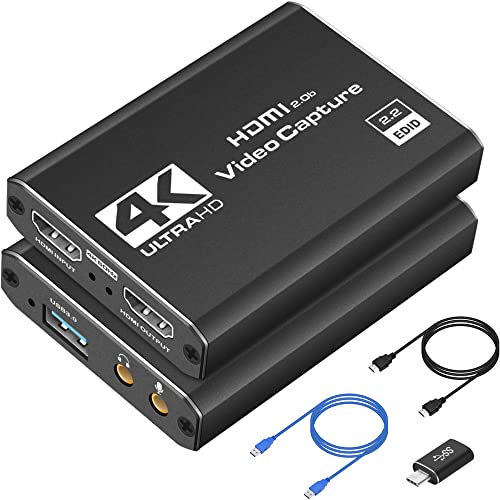
- 4K HDMI input with 1080p 60FPS recording
- Plug-and-play USB 3.0 setup
- Works with OBS, Streamlabs, and XSplit
Best For: Creators who want easy, low-latency capture from consoles, cameras, or a PC
Desk-Ready 4K Capture Hub
4K30 Loop-Out with Power Delivery

- 4K@30Hz capture with low-latency loop-out
- Single 4K@144Hz HDR display support
- 100W power delivery helps simplify setups
Best For: Streamers and remote workers who want capture, display output, and charging in one device
Simple 1080P Capture Card

- 1080p capture with 4K HDMI input support
- Plug-and-play USB 3.0 setup
- Includes HDMI loop-out and mic-in
Best For: Streamers who want basic capture plus commentary support without extra hardware
Flagship HDMI 2.1 Pick – Elgato 4K X for 4K144 and VRR
If you want one of the most capable 4k capture cards for modern consoles and PCs, the Elgato 4K X is built for high-end passthrough and fast capture. It supports 4K144 recording, HDMI 2.1 in/out, and VRR passthrough, while staying compatible with OBS, Streamlabs, Twitch Studio, Restream, Zoom, Teams, and more.
Best For: Streamers and gamers who want HDMI 2.1 support, VRR passthrough, and very high frame-rate capture.
Pros:
- Captures up to 4K144 and supports up to 1080p240 recording.
- HDMI 2.1 in/out with VRR passthrough for smoother gameplay.
- USB 3.2 Gen 2 connection is designed for ultra-low latency.
- Works with a wide range of apps and platforms, including OBS and Twitch.
Cons:
- Requires a capable system and USB 3.2 Gen 2 port for best results.
- Its advanced feature set is more than casual users may need.
Overall, the 4K X is the strongest fit if you want a forward-looking capture card with broad software support and top-tier passthrough features. It is especially compelling for gamers who care about frame rate, VRR, and smooth broadcast performance.
Easy External Streaming Pick – AVerMedia Live Gamer Extreme 3
The AVerMedia Live Gamer Extreme 3 is a practical choice if you want a straightforward option among 4k capture cards. It records 4K30, supports up to 1080p240, and offers VRR passthrough at 1440p120 or 1080p120, making it a solid fit for everyday streaming setups on Windows or Mac.
Best For: Users who want an easy external capture card with strong console compatibility and simple setup.
Pros:
- Records 4K30 and supports up to 1080p240 capture.
- VRR passthrough at 1440p120 or 1080p120 helps keep gameplay smooth.
- Plug and play design makes setup simple.
- Includes USB-C to USB-A cable, HDMI cable, and quick start guide.
Cons:
- Capture tops out at 4K30 rather than higher 4K frame rates.
- Requires a computer with a USB 3.2 Gen 1 Type-C port.
This model is a good middle-ground pick for streamers who value ease of use over cutting-edge specs. It covers the essentials well, especially if you want reliable external capture for PS5, Xbox, Nintendo Switch, or PC.
Budget Flexible Option – XIIXMASK 4K60 USB Capture Card
If you need an affordable entry in 4k capture cards without giving up useful features, the XIIXMASK USB 3.0 capture card is worth a look. It supports up to 4K60 passthrough and 1080p120 capture, adds 3.5mm audio input and mic out, and works across a wide range of devices and operating systems.
Best For: Budget-conscious users who want broad compatibility, audio inputs, and 4K60 passthrough.
Pros:
- Supports 4K60 capture/passthrough and 1080p120 recording.
- Includes 3.5mm audio in and mic out for commentary or ambient audio.
- Plug and play setup with USB A/C connection and no external power required.
- Compatible with Windows, macOS, Linux, Android, iPadOS, and many devices.
Cons:
- Only uses USB 3.0, which may limit performance compared with higher-end models.
- The feature set is broad, but it lacks the premium passthrough specs of top-tier cards.
For the price-focused buyer, this card stands out by balancing 4K60 support with useful audio connectivity and wide compatibility. It is a sensible choice for streaming, mirroring, and general capture tasks.
Internal PCIe Premium Pick – Elgato 4K Pro for 8K60 Passthrough
For a desktop build, the Elgato 4K Pro is a premium internal choice in the world of 4k capture cards. It offers 8K60 passthrough, 4K60 HDR10 capture, HDMI 2.1 in/out, and up to 1080p240 recording, making it a strong fit for serious Windows 10 streaming rigs and dual-PC setups.
Best For: Desktop streamers and dual-PC users who want an internal PCIe card with HDMI 2.1 and 8K60 passthrough.
Pros:
- Supports 8K60 passthrough and 4K60 HDR10 capture.
- HDMI 2.1 in/out with up to 1080p240 recording.
- VRR support and ultra-low latency help maintain smooth gameplay.
- Compatible with OBS, Streamlabs, Twitch Studio, Restream, Zoom, Teams, and more.
Cons:
- Requires a Windows 10 PC with a PCIe slot.
- Internal installation makes it less portable than external capture cards.
The 4K Pro is the most desktop-focused option here, and it is clearly aimed at users who want maximum passthrough capability and deep integration into a permanent setup. If your goal is a high-end streaming tower rather than a travel-friendly card, it makes a lot of sense.
Rybozen Value Pick – Budget-Friendly 4K Input Capture Card
If you want a practical option among 4k capture cards, this model focuses on the basics that matter: HDMI input up to 4K30/60Hz, 1080p capture, and plug-and-play setup over USB 3.0. It’s a straightforward choice for streaming from consoles, cameras, or other HDMI sources without adding a complicated setup.
Best For: Streamers and gamers who want an easy, low-latency capture card with mic input and HDMI loop-out.
Pros:
- Supports HDMI input up to 4K30/60Hz with 1080p capture output
- Plug-and-play design with no driver or external power required
- HDMI loop-out helps avoid delay while gaming
- Includes mic-in support for external commentary
Cons:
- Does not support 4K120Hz or 144Hz input
- Output tops out at 2K30Hz
- Listed capture resolution is 1080p rather than true 4K recording
This is a simple, low-friction capture solution for Windows and Mac users who mainly need reliable 1080p streaming with 4K input compatibility. It’s best viewed as a value-focused tool rather than a high-end 4K recorder.
Acer Everyday Streamer – 4K Input, 1080P Output Capture Card
This Acer option is aimed at buyers comparing 4k capture cards who want strong compatibility and smooth 1080p performance rather than a complicated pro workflow. It accepts 4K input, outputs at 1080p@60Hz, and uses YUY2 video for richer color than MJPEG, making it a sensible pick for streaming, recording, and online teaching.
Best For: Creators, gamers, and educators who want a compact USB capture card with mic-in and broad device support.
Pros:
- 4K input with smooth 1080p@60Hz output
- YUY2 technology for richer color than MJPEG
- Mic-in support for commentary without extra adapters
- Works with Windows, macOS, Linux, Android, and many devices
Cons:
- Records at 1080p rather than capturing 4K video output
- Needs a USB 3.0 port to run at full speed
- May be more basic than cards aimed at advanced production workflows
Overall, this is a well-rounded everyday capture card for users who need easy setup, low latency, and broad compatibility. It is especially appealing if you want a portable unit that works across consoles, PCs, and classroom or meeting software.
Portable Creator Choice – Compact 4K HDMI to USB-C Capture Card
For shoppers looking at 4k capture cards that can travel easily, this compact USB3.0 unit is built around 4K@30Hz HDMI input, 2K@30Hz recording, and 1080p@60Hz capture. Its aluminum shell and plug-and-play USB-C support make it a practical fit for mobile streaming, screen sharing, and general video recording.
Best For: Mobile creators and multi-platform users who want a compact capture card for streaming, meetings, and gameplay.
Pros:
- Supports up to 4K@30Hz HDMI input
- Records at 2K@30Hz or 1080p@60Hz
- USB 3.0 and USB-C connection options with no driver required
- Compatible with Windows, macOS, Linux, and Android
Cons:
- Not designed for 4K recording output
- Requires enough system power for 1080p capture
- Tablet use depends on OTG being enabled
This is a strong pick if you want portability and easy setup more than advanced recording specs. It covers a lot of devices and software, making it useful for streamers, presenters, and gamers who move between setups.
Budget-Friendly 4K HDMI Capture – 1080P60 USB Streaming
If you want one of the more affordable 4k capture cards for streaming and recording, this USB 3.0 model focuses on dependable 1080p 60FPS capture with 4K HDMI input support. It’s a practical pick for creators who need plug-and-play setup, broad device compatibility, and low-latency performance without adding complexity.
Best For: Gamers, beginners, and creators who want simple 1080p60 capture from PS5, Xbox, Switch, cameras, or a PC.
Pros:
- Captures smooth 1080p 60FPS video with 4K HDMI input support
- Plug-and-play USB setup with no drivers needed
- Compatible with OBS Studio, Streamlabs, and XSplit
- Supports passthrough for PS5, Xbox Series X, Switch, DSLR cameras, and PCs
Cons:
- Recording output is 1080p rather than full 4K capture
- Requires a USB 3.0 port for proper use
- May be less feature-rich than higher-end capture solutions
This is a solid choice if you care more about easy setup and reliable streaming than advanced capture specs. For straightforward gameplay recording and live content, it covers the essentials well.
Desk-Ready 4K Capture Hub – 4K30 Loop-Out with Power Delivery
Among 4k capture cards, this WAVLINK model stands out for creators who want capture, monitoring, and charging in one device. It delivers 4K@30Hz capture with low-latency loop-out, supports a single 4K@144Hz display, and adds 100W power delivery to help keep a laptop setup cleaner and more efficient.
Best For: Gamers and multitaskers who want 4K capture plus display output and laptop charging in one compact hub.
Pros:
- 4K@30Hz capture with low-latency HDMI loop-out
- Single 4K@144Hz HDR display support
- 100W power delivery for laptop charging and tidier setups
- Compatible with PS5, Xbox, Switch, OBS, Windows, and Mac
Cons:
- Capture tops out at 4K@30Hz, not 4K60
- USB-C and HDMI IN cannot be used simultaneously
- Mac OS support has some display limitations noted by the manufacturer
This is a smart pick if your priority is a streamlined desktop setup with strong capture and monitor features. It’s especially useful when you want fewer cables and better charging support alongside streaming.
Simple 1080P Capture Card – HDMI Loop-Out with Mic Input
This is one of the more practical 4k capture cards for buyers who really need clean 1080p streaming rather than full 4K recording. It uses USB 3.0 for low-latency capture, supports plug-and-play setup, and adds HDMI loop-out plus mic-in, which makes it useful for gameplay commentary and basic live production.
Best For: Streamers who want easy 1080p capture with passthrough and the option to add live voice commentary.
Pros:
- 1080p capture with 4K HDMI input support
- Plug-and-play operation with no external power required
- HDMI loop-out for delay-free gameplay monitoring
- Mic-in support for commentary during streams
Cons:
- Recorded output is 1080p, not native 4K
- Mic input only accepts 3.5mm TRS standard microphone headset
- Best results depend on correct USB 3.0 and system setup
If you want a straightforward capture device with useful extras, this one covers the basics well. The mic input and loop-out make it a good fit for simple gaming streams without unnecessary setup overhead.
How We Picked These 4K Capture Cards
We focused on the features that matter most for streaming and recording: capture resolution and frame rate, passthrough support, latency, connection type, software compatibility, and whether the card fits a console, PC, or hybrid setup. We also considered how future-proof each option is for newer HDMI standards and higher-refresh displays.
Quick Comparison
Before buying, match the card to your target use case. Some 4K Capture Cards prioritize true 4K capture, while others are better for 1080p60 recording with 4K passthrough. Internal PCIe models are usually better for desktop creators who want lower latency and stronger performance, while USB models are more portable and easier to move between systems.
Key Buying Factors for 4K Capture Cards
Capture Resolution Vs Passthrough
Do not assume 4K passthrough means 4K capture. Many cards let you play in 4K while recording at 1080p or 1440p. If you plan to edit high-resolution footage later, prioritize true 4K capture support rather than passthrough alone.
Frame Rate Matters
For fast-paced games, 60 fps is the baseline to look for. If you use a high-refresh monitor or console setup, features like 4K60, 1440p120, or even higher passthrough can make gameplay feel much smoother.
USB Vs Internal
USB capture cards are easier to set up, more portable, and usually best for beginners. Internal cards are a stronger choice for dedicated desktop streaming rigs, especially if you want the most stable connection and lower overhead.
Compatibility and Software
Check support for your console, PC, OBS, streaming apps, and operating system before buying. Some devices are broadly compatible, while others work best only in certain workflows or rely on specific drivers and companion software.
Audio and Power Features
Some cards offer audio pass-through, mic monitoring, or power delivery through USB-C. Those extras can simplify cable management and reduce the number of accessories you need on your desk.
Who Should Buy Which 4K Capture Cards?
If you want the best overall performance and own a strong desktop PC, an internal PCIe card is often the smartest choice. If you need easy setup for a console, laptop, or travel kit, a USB model is usually better. Budget buyers can get solid 1080p60 recording from simpler cards, while creators who want more future-proofing should look for HDMI 2.1 support, higher passthrough refresh rates, and stronger software compatibility.