Ultrawide monitors can replace a two-screen setup with one continuous workspace, making them useful for spreadsheets, editing timelines, gaming, and everyday multitasking.
This roundup compares ten standout models across screen size, resolution, refresh rate, connectivity, smart features, and price-oriented use cases so you can choose the right fit.
Best 10 Ultrawide Computer Monitors Picks for 2026
Best All-Around Workstation
LG 34WR55QK-B UltraWide WQHD Monitor

- 3440 x 1440 curved VA display with 100Hz refresh rate
- USB-C connectivity with up to 65W power delivery
- Height-adjustable stand and Picture-by-Picture support
Best For: Home offices and multitasking
Best for Smooth Office and Media Use

- 3440 x 1440 VA panel with a 120Hz refresh rate
- USB-C connectivity with up to 65W power delivery
- Built-in speakers and ComfortView Plus eye-care technology
Best For: Comfortable work and entertainment
Best Value IPS Ultrawide
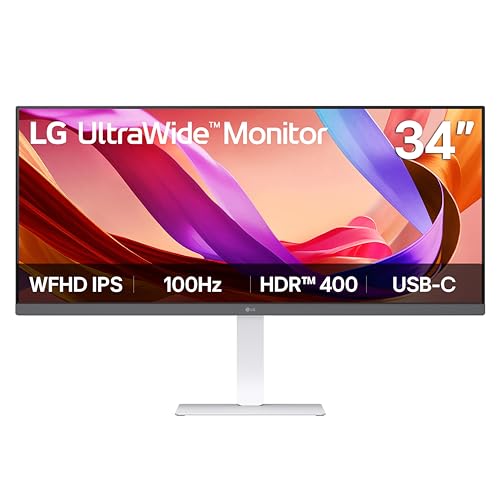
- 34-inch IPS display with a spacious 21:9 layout
- 100Hz refresh rate and VESA DisplayHDR 400
- USB-C, DisplayPort, HDMI, and built-in speakers
Best For: Everyday multitasking on a budget
Best for High-Refresh QHD

- 3440 x 1440 curved VA display with HDR10
- High-refresh-rate design with FreeSync Premium Pro
- Eye Saver Mode and flicker reduction for viewing comfort
Best For: QHD productivity and smooth media use
High-Refresh Gaming Pick
Sceptre 34-Inch 240Hz Ultrawide

- 3440 x 1440 resolution with a 240Hz refresh rate
- 1ms response time and 1500R curved design
- Two HDMI and two DisplayPort inputs
Best For: Gamers and creators prioritizing speed and color coverage
Smart Entertainment Pick

- Built-in webOS for streaming and LG Channels
- 3440 x 1440 curved 21:9 display at 100Hz
- AirPlay 2, HDR10, USB, and HDMI connectivity
Best For: Home offices and entertainment-focused setups
Value Gaming Pick
Sceptre 30-Inch 200Hz Ultrawide

- 30-inch curved 21:9 display at 2560 x 1080
- Up to 200Hz through DisplayPort with AMD FreeSync
- Built-in speakers and VESA mounting support
Best For: Compact gaming setups seeking high refresh rates
Best Balanced Ultrawide
Samsung ViewFinity S50GC 34-Inch

- 34-inch Ultra-WQHD workspace
- 100Hz refresh with FreeSync
- PIP/PBP and eye-care features
Best For: Productivity, multitasking, editing, and casual gaming
Best Value Gaming Ultrawide
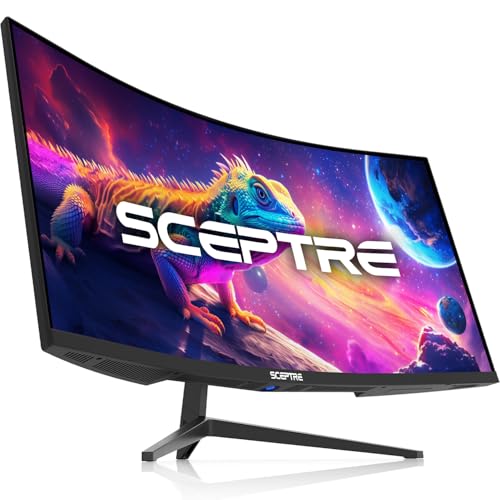
- Up to 180Hz refresh rate
- 1ms MPRT and FreeSync Premium
- Curved 3440 x 1440 display
Best For: Fast-paced gaming and immersive entertainment
Best Super Ultrawide
Samsung Odyssey G9 G91F 49-Inch

- 49-inch 32:9 dual-monitor-style layout
- 5120 x 1440 with 144Hz refresh
- 1000R curve and DisplayHDR 600
Best For: Immersive gaming and expansive multitasking
Best All-Around Workstation – LG 34WR55QK-B UltraWide WQHD Monitor
The LG 34WR55QK-B is a versatile choice among ultrawide computer monitors, pairing a sharp 3440 x 1440 curved VA display with 100Hz motion and a broad set of connectivity options. Its 21:9 layout is well suited to side-by-side windows, while USB-C with up to 65W power delivery can help simplify a laptop-based desk.
Best For: Home offices and multitaskers who want high-resolution workspace flexibility.
Pros:
- WQHD resolution provides ample room for multiple windows.
- USB-C supports display, data, and up to 65W power delivery.
- Height- and tilt-adjustable stand plus PbP support improve workspace flexibility.
- HDR10 and up to 99% sRGB coverage support colorful multimedia use.
Cons:
- Its 100Hz refresh rate is less gaming-focused than faster ultrawide options.
- Built-in speakers are not listed among the supplied features.
Choose this LG when desk organization and productivity features matter as much as image quality. The combination of WQHD detail, USB-C convenience, and ergonomic adjustment makes it a balanced everyday monitor.
Best for Smooth Office and Media Use – Dell S3425DW 34-inch Monitor
The Dell S3425DW stands out among ultrawide computer monitors for its smooth 120Hz refresh rate, strong color coverage, and built-in audio. Its 3440 x 1440 VA panel combines a 3000:1 contrast ratio with eye-comfort features, making it a practical fit for long workdays and casual entertainment.
Best For: Office users who want comfortable all-day viewing with smoother motion and integrated speakers.
Pros:
- 120Hz refresh rate and FreeSync Premium support smooth motion.
- 99% sRGB and 95% DCI-P3 coverage support vivid color.
- USB-C offers a single-cable connection with up to 65W power delivery.
- Built-in speakers and ComfortView Plus add convenience for daily use.
Cons:
- The supplied specifications list two HDMI ports but do not identify a DisplayPort connection.
- The 34-inch display weighs 20.7 pounds, which may make repositioning less convenient.
This Dell is a strong everyday option for buyers who value a polished office setup without giving up fluid scrolling or entertainment features. Its eye-comfort technology, USB-C connectivity, and integrated speakers reduce the need for extra desk accessories.
Best Value IPS Ultrawide – LG 34U530A-W Wide Monitor
The LG 34U530A-W offers a spacious 21:9 format at a lower 2560 x 1080 resolution, making it one of the more approachable ultrawide computer monitors for everyday multitasking. Its IPS panel, 100Hz refresh rate, HDR400 support, built-in speakers, and adjustable stand create a well-rounded setup for work and general media use.
Best For: Everyday productivity users who want an affordable, feature-rich 34-inch ultrawide.
Pros:
- IPS panel provides wide 178-degree viewing angles.
- 100Hz refresh rate supports smoother calls, streaming, and general use.
- USB-C, DisplayPort, and HDMI provide flexible connectivity.
- Built-in Waves MaxxAudio speakers and a height-, tilt-, and swivel-adjustable stand add convenience.
Cons:
- 2560 x 1080 resolution is less detailed than QHD ultrawide models.
- The 1000:1 contrast ratio is lower than the VA alternatives in this roundup.
This LG makes the most sense when horizontal workspace and practical extras matter more than maximum pixel density. It is a capable choice for documents, browser tabs, video calls, and casual entertainment, especially if you appreciate built-in audio and flexible positioning.
Best for High-Refresh QHD – Samsung ViewFinity S5 S55GH
The Samsung ViewFinity S5 S55GH combines a 34-inch 1800R curved VA panel with 3440 x 1440 resolution and a high-refresh-rate specification. For shoppers comparing ultrawide computer monitors, its HDR10 support, FreeSync Premium Pro, and Eye Saver Mode make it appealing for both productive creative work and smoother recreational use.
Best For: Creative and office users who want QHD detail, strong contrast, and fluid motion.
Pros:
- QHD ultrawide resolution delivers detailed workspace and panoramic viewing.
- High refresh rate specification and FreeSync Premium Pro support smooth motion.
- HDR10 supports darker blacks, brighter highlights, and broad color expression.
- Eye Saver Mode and flicker reduction are designed to improve viewing comfort.
Cons:
- Connectivity is limited to one HDMI and one DisplayPort in the supplied details.
- The stand’s adjustment features are not specified in the supplied notes.
This Samsung is a compelling pick if you want a high-resolution ultrawide with a stronger emphasis on smooth motion and contrast-rich visuals. Its straightforward HDMI and DisplayPort setup may be best for buyers who do not need USB-C laptop docking.
High-Refresh Gaming Pick – Sceptre 34-Inch 240Hz Ultrawide
For shoppers comparing ultrawide computer monitors for fast-paced gaming and immersive multitasking, this 34-inch Sceptre combines a 3440 x 1440 resolution with a 240Hz refresh rate. Its curved 1500R design, 1ms response time, 100% sRGB coverage, and broad port selection make it a performance-focused option.
Best For: Gamers and creators who want high refresh rates, sharp ultrawide resolution, and accurate sRGB color.
Pros:
- 240Hz refresh rate and 1ms response time support responsive gaming.
- 3440 x 1440 resolution provides a spacious 21:9 workspace.
- Two HDMI ports and two DisplayPort connections offer flexible device support.
- Built-in speakers, Blue-Light Shift, and 100% sRGB coverage add everyday convenience.
Cons:
- The feature set is centered on gaming, which may be more than needed for basic office use.
- The curved 34-inch format requires substantial desk space.
This is the strongest performance-oriented choice in the group, especially if smooth motion and gaming responsiveness matter more than smart-TV features.
Smart Entertainment Pick – LG 34-Inch QHD Smart Monitor
This LG is one of the more versatile ultrawide computer monitors for work, streaming, and casual gaming. The 34-inch 3440 x 1440 curved screen offers a broad 21:9 workspace, while webOS, HDR10, AirPlay 2, and built-in speakers let it function as an entertainment display without requiring a separate streaming device.
Best For: Home offices and entertainment setups that need streaming, screen sharing, and a wide multitasking display.
Pros:
- Built-in webOS provides access to streaming apps and more than 300 free LG Channels.
- 3440 x 1440 resolution and a 21:9 aspect ratio suit multitasking and panoramic viewing.
- AirPlay 2, HomeKit compatibility, and screen-sharing features support Apple devices.
- HDR10, up to 99% sRGB coverage, two HDMI ports, and three USB ports improve versatility.
Cons:
- The 100Hz refresh rate is lower than the gaming-focused Sceptre option.
- Its listed 5ms response time is less suited to competitive gaming than a 1ms display.
- Streaming and smart features may be unnecessary if you only need a basic monitor.
Choose this LG when your monitor needs to double as a streaming screen and connected home-office display; it emphasizes convenience and versatility over maximum gaming speed.
Value Gaming Pick – Sceptre 30-Inch 200Hz Ultrawide
For a more compact and value-oriented entry among ultrawide computer monitors, this 30-inch Sceptre delivers a 21:9 curved screen with 2560 x 1080 resolution and up to 200Hz over DisplayPort. AMD FreeSync, gaming presets, built-in speakers, and blue-light reduction round out its practical gaming feature set.
Best For: Gamers who want an affordable-feeling ultrawide format with a high refresh rate and compact footprint.
Pros:
- DisplayPort supports refresh rates up to 200Hz for smoother gameplay.
- AMD FreeSync helps reduce tearing and stuttering.
- Curved 21:9 design provides an expansive view while using less space than a 34-inch monitor.
- Built-in speakers, Blue Light Shift, flicker reduction, and VESA mounting add convenience.
Cons:
- 2560 x 1080 resolution is less detailed than the 3440 x 1440 models.
- The listed 5ms response time is slower than the 1ms Sceptre gaming model.
- HDMI supports up to 120Hz, so the full 200Hz rate requires DisplayPort.
This model makes sense when you want ultrawide gaming benefits without moving to a larger 34-inch display, provided 1080p-class vertical resolution meets your needs.
Best Balanced Ultrawide – Samsung ViewFinity S50GC 34-Inch
The Samsung ViewFinity S50GC is a practical choice for shoppers seeking ultrawide computer monitors for office work, creative projects, and occasional gaming. Its 34-inch Ultra-WQHD resolution gives you broad workspace, while 100Hz refresh, HDR10, and eye-care features make extended use more comfortable.
Best For: Productivity, multitasking, photo and video editing, and casual gaming.
Pros:
- 34-inch 3440 x 1440 display provides generous 21:9 workspace.
- 100Hz refresh rate and AMD FreeSync help reduce motion blur and tearing.
- PIP and PBP support two simultaneous sources for flexible multitasking.
- Ambient brightness adjustment, Eye Saver Mode, and Flicker Free are useful for long sessions.
Cons:
- 5ms response time is less gaming-focused than faster 1ms alternatives.
- Its flat panel may feel less immersive than curved ultrawide designs.
- Brightness is rated at 300 cd/m², which is modest for HDR viewing.
Choose this Samsung when a clean, flat display and productivity features matter more than maximum gaming speed or dramatic HDR brightness. The dual-input functions are especially useful for replacing two smaller monitors.
Best Value Gaming Ultrawide – Sceptre 34-Inch Curved WQHD
The Sceptre C345B-QUT168 is one of the more gaming-oriented ultrawide computer monitors in this group. It combines a curved 34-inch 3440 x 1440 panel with refresh rates up to 180Hz, a 1ms MPRT response time, FreeSync Premium, and built-in speakers.
Best For: Fast-paced gaming, immersive entertainment, and buyers wanting strong gaming specifications at a practical size.
Pros:
- Up to 180Hz refresh rate supports smooth, responsive gameplay.
- 1ms MPRT response time helps reduce ghosting during action scenes.
- Curved 21:9 WQHD display offers an immersive view with 3440 x 1440 detail.
- Includes FreeSync Premium, PIP/PBP, built-in speakers, and a blue-light filter.
Cons:
- Its 1000:1 to 3000:1 contrast specification is less consistent than a fixed rating.
- Built-in speakers may not replace dedicated desktop audio.
- The feature set is gaming-focused, with fewer workstation-oriented conveniences than some productivity models.
This Sceptre is a strong fit if refresh rate and response time are priorities. It delivers a higher-speed gaming profile than the Samsung ViewFinity, while retaining enough resolution and screen space for everyday multitasking.
Best Super Ultrawide – Samsung Odyssey G9 G91F 49-Inch
The Samsung Odyssey G9 G91F is built for shoppers who want the maximum workspace from ultrawide computer monitors. Its 49-inch 32:9 screen matches the width of two 16:9 monitors, while the 1000R curve, 5120 x 1440 resolution, 144Hz refresh rate, and DisplayHDR 600 target immersive gaming and demanding multitasking.
Best For: Immersive gaming, side-by-side workflows, and replacing a dual-monitor setup.
Pros:
- 49-inch 32:9 display provides exceptionally wide workspace.
- 5120 x 1440 resolution delivers dual-monitor-style detail on one screen.
- 144Hz refresh, 1ms response time, and FreeSync Premium Pro support smooth gaming.
- 1000R curvature, HDR 600, PIP, and split-screen features enhance immersion and multitasking.
Cons:
- Its 45.18-inch width and 34.4-pound weight require substantial desk space and support.
- The 280 cd/m² brightness rating is modest despite the DisplayHDR 600 specification.
- This large format may be excessive for users who need only a conventional 34-inch ultrawide.
The Odyssey G9 makes the most sense when one expansive panel is preferable to two monitors. It is the strongest option here for panoramic gaming and side-by-side work, but plan carefully for desk depth, width, and mounting.
How We Picked These Ultrawide Computer Monitors
We focused on the specifications that most affect daily use: aspect ratio, resolution, refresh rate, panel technology, curve, connectivity, adaptive sync, HDR support, ergonomics, and built-in features. The selection spans practical 30- and 34-inch displays, high-refresh gaming monitors, smart monitors, and the extra-wide 49-inch Samsung Odyssey G9.
Resolution was considered in relation to screen size. A 3440 x 1440 display generally provides sharper text and more workspace than a 2560 x 1080 model, while a 5120 x 1440 super-ultrawide is designed to replace two 16:9 QHD monitors.
Quick Comparison
- Best all-around resolution: Choose a 34-inch 3440 x 1440 monitor for a balanced mix of workspace, clarity, and immersion.
- Best for fast gaming: Prioritize the Sceptre models or Samsung Odyssey G9 when high refresh rates and adaptive sync matter most.
- Best for office work: Look for USB-C, picture-by-picture support, eye-comfort modes, and an adjustable stand.
- Best for streaming: The LG smart monitor adds webOS and built-in speakers for use without a separate computer or streaming device.
- Best for limited budgets: A 2560 x 1080 ultrawide can provide the wide format at a lower cost, though text and image detail are less crisp.
Key Buying Factors for Ultrawide Computer Monitors
Size, Resolution, and Aspect Ratio
A 34-inch 21:9 screen is the most versatile format for most buyers. WQHD resolution, commonly listed as 3440 x 1440, is preferable for sharp text and detailed images. A 30- or 34-inch 2560 x 1080 monitor costs less but has a lower pixel density. A 49-inch 32:9 model offers exceptional multitasking space but requires a wide desk and strong graphics hardware.
Refresh Rate and Adaptive Sync
For office use, 100Hz or 120Hz makes scrolling and cursor movement feel smoother than 60Hz. Gamers should compare refresh rate with their computer’s graphics performance. FreeSync or another adaptive-sync technology helps reduce tearing when frame rates fluctuate.
Ports, Ergonomics, and Extra Features
Check whether the monitor includes HDMI, DisplayPort, and USB-C. USB-C is especially useful for laptops, but verify whether it supports video, charging, or only data. Also examine stand adjustment, VESA compatibility, built-in speakers, HDR claims, and picture-by-picture modes. HDR is most convincing when paired with strong brightness and contrast, not just an HDR label.
Who Should Buy Which Ultrawide Computer Monitors?
Choose a 34-inch 3440 x 1440 model if you want the best general-purpose balance for work, media, and gaming. Choose a 2560 x 1080 option if price is the priority or your computer is not powerful enough for higher resolutions. Choose a high-refresh Sceptre display for competitive gaming on a budget. Choose the LG smart monitor for streaming and simple living-room-style use. Choose the Samsung Odyssey G9 if you need maximum horizontal workspace and have the desk space and GPU to support it.