The best polyphonic synthesizers make it easier to build chords, pads, basses, leads, and evolving textures without limiting you to monophonic lines. This roundup compares 10 standout options across analog, hybrid, wavetable, and multi-engine designs.
Whether you need an affordable first synth, a flexible desktop module, or a premium performance instrument, the right choice depends on voice count, synthesis architecture, keyboard format, sequencing, and hands-on control.
Best 10 Polyphonic Synthesizers Picks for 2026
Accessible Analog Favorite

- Warm four-voice analog sound
- 200 presets and hands-on editing
- Polyphonic step and motion sequencer
Best For: Beginners and budget-conscious analog synth players
Deep Desktop Powerhouse

- Eight-voice polyphonic architecture
- Wavetables, analog-style oscillators, and analog filter
- Extensive modulation and onboard effects
Best For: Advanced studio sound design and modular setups
Experimental Modeling Playground

- 60 voices and four stacked oscillators
- Flexible sync and cross-modulation routing
- Built-in KAOSS Pad and motion sequencing
Best For: Evolving textures and expressive live sound design
Portable Hybrid Performer

- Six-voice hybrid synthesis
- Compact 37-key portable design
- Includes MiniFreak VST counterpart
Best For: Portable hybrid performance and beginner-friendly setups
Advanced Digital Choice

- Two wavetable oscillators
- High polyphony with polyphonic aftertouch
- USB and five-pin DIN MIDI
Best For: Advanced desktop sound designers
Analog Performance Pick

- Four VCO analog design
- 37 velocity-sensitive full-size keys
- Sequencer and arpeggiator included
Best For: Players wanting hands-on analog performance
Pad-Driven Creative Pick
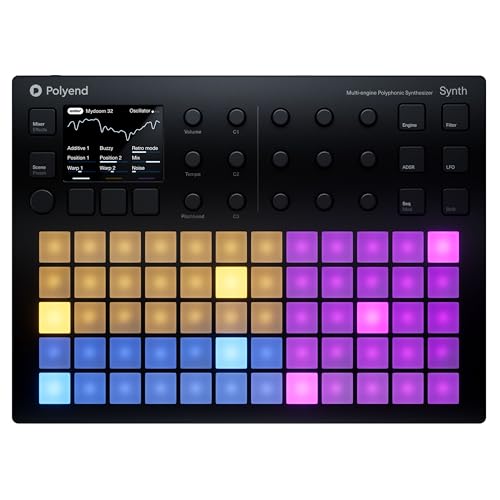
- Eight-voice polyphony
- Eight synth engines
- 60 RGB pads with polyphonic aftertouch
Best For: Pad-based performers and electronic creators
Wide-Range Analog Power
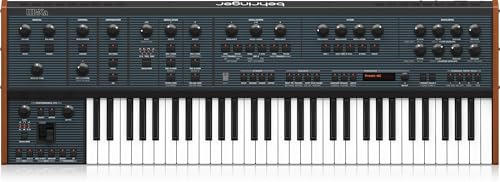
- 16 analog voices and 32 oscillators
- Bi-timbral design for layered or split sounds
- 5-pin DIN MIDI plus three foot-switch jacks
Best For: High-polyphony analog performance and studio setups
Expressive Flagship Workflow
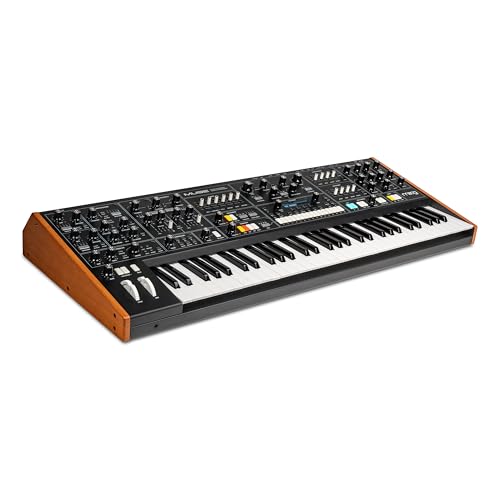
- Eight analog voices with dual VCOs
- 61 keys and bi-timbral operation
- Sequencer, chord memory, arpeggiator, and diffusion delay
Best For: Studio or stage centerpiece duties
Compact Classic-Inspired Value

- Eight voices with two VCOs per voice
- Arpeggiator, sequencer, and 400 memories
- Unison mode delivers 16-oscillator sounds
Best For: Classic analog tones in a Eurorack-format setup
Accessible Analog Favorite – Korg Minilogue
The Korg Minilogue is a practical entry point into polyphonic synthesizers, combining warm analog sound with a compact 37-key format. Its four-voice polyphony, 200 presets, and built-in sequencing make it suitable for both hands-on sound design and quick arrangement ideas.
Best For: Beginners, live performers, and musicians seeking affordable analog polyphonic synthesis.
Pros:
- Warm, punchy analog sound with four-voice polyphony
- Includes 200 presets plus extensive editing controls
- Built-in polyphonic step and motion sequencer
- Compact slim-key design with onboard tape-style delay
Cons:
- Four voices provide less polyphony than the other options here
- 37 slim keys may not suit players who prefer full-size keys
The Minilogue balances approachable controls and useful performance features with genuine analog character, making it a versatile choice for studio and stage setups.
Deep Desktop Powerhouse – Novation Peak
The Novation Peak is a powerful desktop option among polyphonic synthesizers, offering eight-voice polyphony, Oxford oscillators, an analog filter, and extensive modulation. Its combination of digital wavetables, analog-style tones, and onboard effects supports detailed sound design without requiring a keyboard chassis.
Best For: Experienced sound designers, studio producers, and modular users wanting extensive synthesis control.
Pros:
- Eight-voice polyphony with analog-style and wavetable oscillators
- 16-slot modulation matrix with multiple envelopes and LFOs
- Three distortion stages per voice plus reverb, delay, and chorus
- CV modulation input for modular integration
Cons:
- Desktop format requires a separate keyboard for traditional playing
- Its extensive architecture may be demanding for beginners
Peak is a strong choice when modulation depth and tonal flexibility matter more than an all-in-one keyboard layout.
Experimental Modeling Playground – Korg MultiPoly
Korg multipoly Analog Modeling Synthesizer w/Four Oscillators, 60 Voices and built-in KAOSS Pad
Check Price On AmazonThe Korg MultiPoly brings an expansive approach to polyphonic synthesizers with four stacked oscillators, 60 voices, flexible routing, and a built-in KAOSS Pad. Its modeling engine and performance-oriented modulation tools are designed for layered, evolving, and interactive sounds.
Best For: Sound designers and performers who want rich layers, experimental routing, and expressive motion control.
Pros:
- 60-voice polyphony with four stacked oscillators
- Supports cross modulation and oscillator sync routing
- Includes dual filters, insert effects, four envelopes, and five LFOs
- Built-in KAOSS Pad with Kaoss Physics and motion sequencing
Cons:
- Plastic body may feel less substantial than metal desktop instruments
- Warranty information requires contacting the seller or manufacturer
MultiPoly stands out for players who value abundant polyphony and unconventional performance control over a traditional analog-synth workflow.
Portable Hybrid Performer – Arturia MiniFreak
Arturia MiniFreak 37 Key Polyphonic 6-Voice Hybrid Synthesizer Keyboard (Standard, 37 Key)
Check Price On AmazonThe Arturia MiniFreak is a compact six-voice hybrid choice among polyphonic synthesizers, pairing a 37-key keyboard with a digital-and-analog sound profile. Its portable design and included VST counterpart make it appealing for musicians who want a flexible instrument that can move between hardware and software workflows.
Best For: Beginners and portable performers seeking a compact hybrid keyboard synthesizer.
Pros:
- Six-voice polyphony in a compact 37-key format
- Hybrid digital-and-analog sound profile
- Portable design with USB connectivity
- Includes a MiniFreak VST counterpart
Cons:
- Its compact keyboard may not satisfy players needing a larger range
- Supplied notes provide limited detail about onboard synthesis controls
MiniFreak is a sensible fit for mobile setups and players who want hardware playability alongside a software counterpart without choosing a large instrument.
Advanced Digital Choice – Korg modwave Module
The Korg modwave Module is a desktop-focused option for advanced users comparing polyphonic synthesizers with wavetable capability. Its two wavetable oscillators, high polyphony, extensive program memory, and broad effects section make it suited to detailed digital sound design.
Best For: Advanced producers who want wavetable synthesis, deep modulation, and a compact desktop or rackmount format.
Pros:
- Two wavetable oscillators support complex digital tones.
- High polyphony and polyphonic aftertouch support expressive playing.
- Includes advanced LFO options, multiple effects, and MIDI 2.0 support.
- Desktop/rackmount design with USB and five-pin DIN MIDI connectivity.
Cons:
- Its advanced feature set may be more than beginners need.
- It is a module rather than a keyboard instrument.
- The supplied dimensions list a relatively deep desktop footprint.
Choose the modwave Module if flexible digital synthesis and extensive programming matter more than built-in keys. It is a strong fit for a studio setup built around external MIDI controllers.
Analog Performance Pick – Behringer POLY D
The Behringer POLY D brings a hands-on analog approach to polyphonic synthesizers, combining four VCOs with a classic ladder filter and a 37-key layout. Its four-voice design supports mono, unison, and polyphonic modes, while the sequencer and arpeggiator add performance flexibility.
Best For: Keyboard players and producers seeking warm, bass-heavy analog tones with full-size keys and onboard sequencing.
Pros:
- Four VCOs provide a substantial analog sound foundation.
- Four-voice mono, unison, and polyphonic/paraphonic modes offer flexibility.
- 37 semi-weighted full-size keys include velocity functionality.
- Includes a 32-step sequencer, arpeggiator, stereo chorus, and distortion.
Cons:
- At 26.1 pounds, it is notably heavy for a synthesizer.
- The 31.4-inch-wide body requires substantial desk or stand space.
- Its analog, bass-heavy sound profile may not suit every style.
The POLY D is the practical choice when tactile keyboard control and classic analog character are priorities. Its limited four-voice design is balanced by useful performance modes and onboard sequencing tools.
Pad-Driven Creative Pick – Polyend Synth
The Polyend Synth is a compact desktop choice among polyphonic synthesizers, pairing eight-voice polyphony with eight synth engines and 60 RGB-backlit performance pads. Polyphonic aftertouch, customizable combo knobs, and a built-in step sequencer make it geared toward interactive composition and performance.
Best For: Performers and creators who prefer pad-based control, multiple synthesis engines, and a portable desktop workflow.
Pros:
- Eight-voice polyphony supports layered and chord-based parts.
- Eight synth engines provide varied sound-generation options.
- 60 RGB-backlit performance pads support hands-on control.
- Polyphonic aftertouch, customizable knobs, and a step sequencer expand performance options.
Cons:
- It is a desktop synthesizer without supplied piano-style keys.
- The control layout may favor pad workflows over traditional keyboard playing.
- Connectivity details supplied for the product list USB only.
The Polyend Synth stands out for users who want a compact, performance-oriented instrument rather than a conventional keyboard synth. Its eight engines and pad interface make it especially appealing for experimental sequencing and live control.
Wide-Range Analog Power – UB-Xa 16-Voice Synthesizer
The Behringer UB-Xa is a strong choice for musicians seeking versatile polyphonic synthesizers with substantial analog voice capacity. Its 16 voices, 32 oscillators, and bi-timbral design support layered or split performances, while traditional MIDI connectivity and foot-switch inputs suit studio and stage setups.
Best For: Players and producers who need high polyphony, bi-timbral operation, and hands-on analog sound.
Pros:
- 16-voice polyphonic analog architecture with 32 oscillators
- Bi-timbral operation supports layered or split sounds
- Includes 5-pin DIN MIDI In, Out, and Thru
- Three 1/4-inch TRS foot-switch jacks add performance flexibility
Cons:
- Large, heavy format may require substantial workspace
- Product details list a plastic body despite stainless-steel material information
Choose the UB-Xa when maximum analog polyphony and flexible MIDI integration matter more than a compact footprint. Its 45.9-inch width and 14 kg weight make it better suited to a dedicated studio or performance rig.
Expressive Flagship Workflow – MOOG Muse Polyphonic Synth
The MOOG Muse is aimed at players who want premium, performance-focused polyphonic synthesizers with deep analog architecture. Its eight voices combine dual VCOs, a modulation VCO, dual filters, and stereo VCAs, while the sequencer, arpeggiator, chord memory, and diffusion delay expand its sound-design and performance range.
Best For: Keyboardists, producers, and sound designers seeking an expressive centerpiece for stage or studio work.
Pros:
- Eight analog voices with two VCOs per voice
- 61-key, bi-timbral format supports substantial performance control
- Includes arpeggiator, chord memory, and a 64-step sequencer
- Stereo diffusion delay adds multi-tap, filtering, and spatial effects
Cons:
- Only eight voices, which is less polyphony than some larger instruments
- At 32 pounds, it is not especially portable
- Ships with 224 of 256 patch locations preloaded, leaving two banks for users
The Muse stands out when hands-on control, sequencing, and evolving analog textures are central to the purchase. Its 61-key layout and broad performance features make it a particularly compelling studio centerpiece or live keyboard.
Compact Classic-Inspired Value – PRO-800 Analog Synthesizer
The Behringer PRO-800 offers a more focused route into classic analog polyphonic synthesizers. This Eurorack-format instrument provides eight voices, two VCOs per voice, a classic VCF, unison mode, arpeggiator, sequencer, and 400 program memories for flexible patch-based work.
Best For: Producers and synthesizer enthusiasts who want classic-style analog polyphony in a rack-friendly format.
Pros:
- Eight-voice polyphonic analog design
- Two VCOs per voice support fat and detuned sounds
- Offers arpeggiator, sequencer, and 400 program memories
- Unison mode provides 16-oscillator lead and bass sounds
Cons:
- Eurorack format may require compatible integration or workspace planning
- Uses USB Type B connectivity rather than the listed 5-pin DIN MIDI connections of some alternatives
- The supplied details do not specify a keyboard
The PRO-800 is a practical pick for buyers prioritizing analog fundamentals, classic voice architecture, and extensive preset storage. Its feature set is broad for the format, but confirm your intended mounting and control setup before buying.
How We Picked These Polyphonic Synthesizers
We selected these instruments to cover the main needs of modern players, producers, and sound designers. The lineup includes compact keyboards, desktop modules, analog and digital architectures, and instruments ranging from four voices to high-count or multitimbral designs.
We prioritized useful sound-shaping controls, practical workflow features, connectivity, portability, and the type of value each synthesizer offers. Voice count matters, but it is only one part of the decision: oscillator design, filter character, modulation, effects, sequencing, and patch memory can have an equally large impact on daily use.
Quick Comparison
- Best compact analog keyboard: Korg minilogue
- Best premium desktop hybrid: Novation Peak
- Best feature-rich performance synth: Korg multipoly
- Best hybrid keyboard: Arturia MiniFreak
- Best wavetable desktop module: Korg modwave Module
- Best classic-style four-voice keyboard: Behringer POLY D
- Best multi-engine option: Polyend Synth
- Best high-voice-count analog keyboard: Behringer UB-Xa
- Best premium analog instrument: Moog Muse
- Best affordable eight-voice analog module: Behringer PRO-800
Key Buying Factors for Polyphonic Synthesizers
Voice Count and Voice Allocation
More voices help you play wider chords, sustain layered parts, and use longer releases without notes being cut off. Four voices can work well for simple chords and vintage-style playing, while eight or more voices provide greater freedom for pads and complex arrangements. Check whether voice count changes when using unison, splits, layers, or onboard effects.
Synthesis Architecture
Analog synthesizers are often chosen for their direct controls and familiar oscillator-filter behavior. Digital, wavetable, and hybrid instruments generally offer more precise modulation, broader timbral variety, and deeper effects. Choose based on the sounds you need rather than assuming one architecture is universally better.
Keyboard, Module, and Control Layout
A keyboard version is convenient for playing and composing, while a desktop module can save space and integrate neatly with a MIDI controller or sequencer. Look for velocity and aftertouch support if expressive playing matters. Hands-on knobs and dedicated modulation controls are especially useful for live performance.
Sequencing, Effects, and Connectivity
An onboard sequencer, arpeggiator, motion recording, or chord function can make a synth more self-contained. Built-in effects reduce the need for external processing. Also check MIDI, USB, CV or gate connections, audio outputs, and whether the instrument supports the studio or hardware workflow you already use.
Who Should Buy Which Polyphonic Synthesizers?
Choose the Korg minilogue or Behringer POLY D if you want a relatively approachable keyboard with classic analog character and immediate controls. These are sensible starting points for players who prefer a hands-on workflow.
Choose the Arturia MiniFreak, Korg modwave Module, or Polyend Synth if versatility and modern sound design are the priority. Their hybrid or digital approaches are well suited to evolving textures, experimental patches, and electronic production.
Choose the Novation Peak or Korg multipoly if you want a powerful desktop centerpiece with broad synthesis capabilities, substantial polyphony, and performance-oriented features.
Choose the Behringer UB-Xa, Moog Muse, or Behringer PRO-800 if you specifically want an analog polyphonic instrument with a larger playing range or classic-inspired tone. Before buying, confirm the available space, budget, keyboard requirements, and whether you need multitimbral operation or only a single synth voice architecture.