A wireless in-ear monitor system with multiple receivers can give an entire band, worship team, or production crew a consistent monitor mix without running headphone cables across the stage.
These 10 systems vary in receiver count, transmission technology, channel capacity, range, battery life, and stereo support. The right choice depends on how many performers need monitoring and how much control your setup requires.
Best 10 Wireless in Ear Monitor System with Multiple Receivers Picks for 2026
Best Team Pick
Xvive U4R4 Four-Receiver IEM System

- Four receivers share one transmitter
- Under-5ms latency and six channels
- Up to five hours of rechargeable use
Best For: Small groups needing four wireless monitor feeds
Best for Large Groups
IME-6000 Six-Bodypack UHF IEM System

- Six bodypacks and earphones included
- 330-foot open-space range claim
- IR sync, limiter, and preset frequencies
Best For: Bands and production teams monitoring six performers
Best Single-User Starter
- One transmitter and one receiver
- Under-5ms latency with six channels
- Up to five hours of rechargeable battery life
Best For: Solo performers starting a wireless monitoring setup
Best Eight-Pack Value
JM20508 Eight-Bodypack UHF IEM System

- Eight bodypacks for large groups
- 40 preset frequencies across two channels
- Dual-antenna reception and 300-foot-plus range claim
Best For: Schools, churches, bands, and large stage teams
Best for Flexible Stage Integration

- 24-bit/48 kHz audio with under 5 ms latency
- 5.8 GHz True Diversity reception
- Supports up to six channels
Best For: Performers needing expandable, mixer-friendly wireless monitoring
Best Multi-Performer UHF Package

- Four bodypack receivers included
- Up to four standalone mono mixes
- Rackmountable UHF transmitter station
Best For: Four-member bands and worship teams needing separate mixes
Best Portable Multi-Receiver Value

- Includes two receivers with one transmitter
- Supports up to 10 receiver pairs
- Up to 30 hours with charging case
Best For: Portable rehearsals and simple one-to-many monitoring
Best for Crowded Venues
- 50 channels with one-to-unlimited receiver support
- Less than 5ms latency and claimed 300-foot range
- Auto-scan, one-touch sync, and rugged hard case
Best For: Bands needing scalable mono monitoring in busy venues
Best Stereo Control

- Stereo/mono modes with EQ and balance controls
- 89 frequencies and up to five systems simultaneously
- Rackmountable metal transmitter with carrying case
Best For: Stage and studio users wanting stereo flexibility and detailed controls
Best Compact Multi-User Pick

- One transmitter supports up to four receiver pairs
- Under 4.5ms mono latency and 24-bit/48kHz audio
- Compact design with 6–8-hour claimed battery life
Best For: Small bands and rehearsal groups wanting simple multi-user monitoring
Best Team Pick – Xvive U4R4 Four-Receiver IEM System
The Xvive U4R4 is a practical wireless in ear monitor system with multiple receivers for small bands, production teams, and group stage monitoring. Its 2.4GHz connection, six selectable channels, under-5ms latency, and claimed 90-plus-foot range support straightforward setup and movement onstage.
Best For: Small live groups that need one transmitter for four performers.
Pros:
- Includes four receivers and one transmitter.
- Under-5ms latency helps keep monitoring responsive.
- Rechargeable units offer up to five hours of battery life.
- Includes a 1/4-inch-to-XLR adapter, bag, and charging cables.
Cons:
- Five-hour battery life may require recharging for longer events.
- Its stated 90-plus-foot range is better suited to small venues than large spaces.
- No water resistance is specified.
Choose this package when you want a compact, plug-and-play multi-performer setup without moving to a larger UHF rack system.
Best for Large Groups – IME-6000 Six-Bodypack UHF IEM System
For larger ensembles, this wireless in ear monitor system with multiple receivers combines one UHF transmitter with six bodypacks. It offers preset frequency options, IR syncing, a claimed 330-foot open-space range, and limiter circuitry intended to help control distortion during live monitoring.
Best For: Bands, church groups, stage crews, and other teams needing six bodypacks.
Pros:
- Includes six receivers and six in-ear earphones.
- UHF operation provides a claimed range of up to 330 feet in open spaces.
- IR sync and 2×40 preset frequencies simplify multi-receiver setup.
- Receiver battery and RF indicators aid status checks.
Cons:
- Mono monitoring may be limiting for users who want stereo mixes.
- Walls, glass, and metal obstacles can reduce the stated range.
- The system operates within the listed 520–580MHz frequency range.
This is the stronger fit when receiver count and coverage matter more than the compact simplicity of a small 2.4GHz kit.
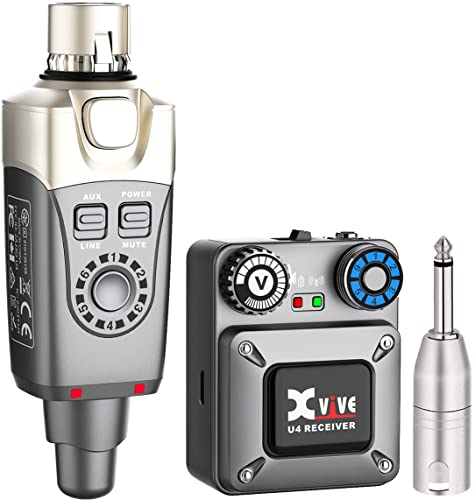
Best Single-User Starter – Xvive U4 Single-Receiver IEM
The Xvive U4 is a straightforward wireless in ear monitor system with multiple receivers when expanded with additional compatible receivers, while this package itself supplies one transmitter and one receiver. Its 2.4GHz link, six-channel operation, under-5ms latency, and 90-plus-foot range make it a simple starting point for personal monitoring.
Best For: Individual performers or teams beginning with one wireless monitoring path.
Pros:
- Compact transmitter-and-receiver package is easy to deploy.
- Under-5ms latency supports distraction-free monitoring.
- Up to five hours of rechargeable battery life.
- Includes a 1/4-inch-to-XLR adapter and storage bag.
Cons:
- This package includes only one receiver.
- Its 90-plus-foot range is aimed at smaller venues.
- No water resistance is specified.
It is a sensible entry point for a solo performer, with the same core U4 features that make the platform suitable for later multi-receiver expansion.
Best Eight-Pack Value – JM20508 Eight-Bodypack UHF IEM System
This wireless in ear monitor system with multiple receivers is built for larger stage, church, school, and recording applications, pairing a UHF transmitter with eight bodypack receivers. It provides two-channel operation, 40 preset frequencies, dual-antenna reception, a claimed range above 300 feet, and mono monitoring.
Best For: Larger groups that need up to eight bodypacks for stage or studio monitoring.
Pros:
- Eight bodypacks support broad group coverage.
- Two channels and 40 preset frequencies offer setup flexibility.
- Dual antennas and digital signal processing are designed to reduce reception blind spots.
- Metal transmitter includes an LCD display, controls, and a front 1/4-inch headphone jack.
Cons:
- Each receiver requires two AA batteries, which are not included.
- Mono monitoring may not suit stereo monitoring needs.
- Range can vary with obstacles and venue conditions.
Consider this model when receiver capacity is the priority and you are prepared to manage disposable or rechargeable AA batteries for the bodypacks.
Best for Flexible Stage Integration – Xvive U45C Wireless IEM
The Xvive U45C is a practical choice for musicians comparing a wireless in ear monitor system with multiple receivers or expandable channel options. Its 5.8 GHz True Diversity design, channel scanning, and support for up to six channels make it well suited to organized stage setups.
Best For: Performers and bands that need low-latency monitoring with flexible mixer connectivity and room to expand.
Pros:
- 24-bit/48 kHz audio with less than 5 ms latency
- True Diversity reception and dual antennas help support a stable RF connection
- Channel scan mode helps identify a suitable local frequency
- Accepts balanced XLR or 1/4-inch TS mixer outputs
Cons:
- Includes one transmitter and one bodypack receiver
- Battery life is listed at approximately five hours
- Earphones are not indicated as included in the supplied package details
The U45C stands out when audio responsiveness and straightforward integration matter more than an all-in-one multi-receiver bundle. Its six-channel capability can support additional systems, but extra receiver units may be needed for larger groups.
Best Multi-Performer UHF Package – Phenyx Pro PTM-33-4B
For bands specifically seeking a wireless in ear monitor system with multiple receivers, the Phenyx Pro PTM-33-4B is built around four bodypacks and four separate monitoring channels. Its integrated transmitter station provides four left/right input groups and loop outputs for creating individual mixes.
Best For: Four-member bands, worship teams, stage productions, and live events requiring separate mono mixes.
Pros:
- Includes four UHF bodypack receivers and four in-ear earphones
- Provides up to four standalone mixes with no stated audio delay
- Offers 4 x 25 UHF frequencies and IR sync for linking receivers
- Includes rackmount hardware and supports daisy-chained audio signals
Cons:
- Mono monitoring only
- Operating range is affected by walls, glass, and metal obstructions
- Requires four auxiliary mixer outputs for the full four-channel setup
This is the most complete multi-receiver package of the three products. It favors dedicated, rack-friendly UHF deployment and separate personal mixes, making it particularly suitable when several performers need monitoring simultaneously.
Best Portable Multi-Receiver Value – LEKATO MS-20 Wireless IEM
The LEKATO MS-20 offers a compact wireless in ear monitor system with multiple receivers for rehearsals, studio work, and smaller live setups. One transmitter can send to two included receivers and can support up to 10 device pairs, while the charging case provides up to 30 hours of stated total use.
Best For: Portable band rehearsals, singers, instrumentalists, and users who want simple one-to-many monitoring with rechargeable hardware.
Pros:
- Includes one transmitter and two wireless receivers
- Supports one transmitter to multiple receivers, up to 10 pairs
- Charging case provides up to 30 hours of usage time
- Offers auto-pairing, OTG input support, and mono/stereo switching
Cons:
- Earphones are not included
- 2.4 GHz operation may be less specialized for complex RF stage environments than the supplied UHF or True Diversity alternatives
- Specified 150-foot range is for open areas
The MS-20 is appealing when portability and receiver quantity are priorities. Its charging case, auto-pairing, and OTG support simplify setup, although larger professional stage systems may benefit from more dedicated frequency-management features.
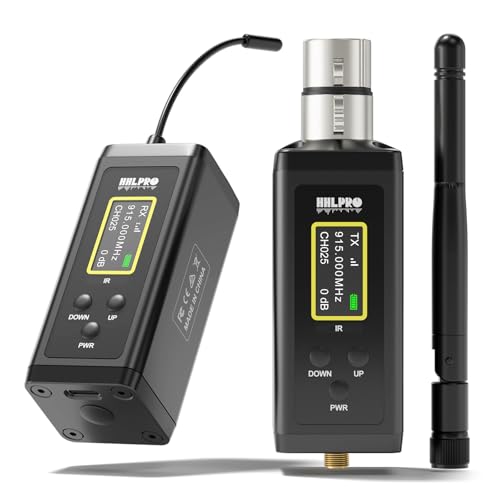
Best for Crowded Venues – 50-Channel UHF IEM
If you need a wireless in ear monitor system with multiple receivers for band rehearsals, worship, or live gigs, this HHLPRO F10P emphasizes range, channel flexibility, and quick setup. Its 902–927MHz UHF operation, 50 channels, claimed 300-foot range, and one-transmitter-to-unlimited-receivers design make it suited to larger group monitoring setups.
Best For: Bands and performers working in busy venues that want low-latency mono monitoring and flexible receiver expansion.
Pros:
- 50 selectable channels and one transmitter can support unlimited receivers.
- Claims less than 5ms latency and up to 300 feet of range.
- Auto-scan, one-touch syncing, dual volume controls, and a rugged metal build simplify gig use.
- Includes an XLR adapter, silicone covers, and hard case.
Cons:
- The listed set includes one transmitter and one receiver, so additional receivers are needed for a full band.
- Battery life is specified at about 5–8 hours, depending on use.
- Its mono design may not suit performers who require stereo monitoring.
The F10P is a practical choice when stable UHF operation and receiver scalability matter more than stereo sound. Confirm the included accessories and add compatible receivers for your intended performer count.
Best Stereo Control – Phenyx Pro PTM-10 IEM
The Phenyx Pro PTM-10 is a strong option if your wireless in ear monitor system with multiple receivers needs stereo flexibility and detailed controls. It operates in the 900MHz UHF band, offers 89 tunable frequencies, and supports up to five systems simultaneously for stage, studio, speech, and event applications.
Best For: Performers and production setups that prioritize stereo monitoring, adjustable sound controls, and multiset UHF operation.
Pros:
- Stereo/mono selection provides either spatial detail or focused monitoring.
- 89 tunable frequencies and support for up to five systems help with multiset use.
- EQ, balance, limiter, PAD, and lock functions offer useful signal and control management.
- Metal transmitter, rackmount hardware, carrying case, and hybrid XLR/6.3mm inputs suit professional setups.
Cons:
- The stated operating range is 160 feet, shorter than some competing systems.
- The listed box includes one bodypack receiver, so extra receivers or systems may be required for multiple performers.
- Its feature-rich controls may take longer to configure than simpler plug-and-play systems.
Choose the PTM-10 when stereo monitoring and control over tone, balance, and overload protection are central to your setup. Its rack-friendly design is especially useful for installed or repeat-performance systems.
Best Compact Multi-User Pick – LEKATO MS-02 2.4GHz IEM
For a compact wireless in ear monitor system with multiple receivers, the LEKATO MS-02 offers a straightforward 2.4GHz approach. One transmitter can send to up to four receiver pairs, with mono latency under 4.5ms, automatic pairing, and up to 100 feet of open-area range.
Best For: Small or medium bands, church teams, and rehearsal groups that need simple multi-performer monitoring in a compact package.
Pros:
- One transmitter supports up to four receiver pairs.
- Mono mode claims less than 4.5ms latency, with 24-bit/48kHz audio.
- Up to 6–8 hours of operation, battery and volume LEDs, and five-level receiver volume adjustment.
- Supports mono/stereo modes, one-key mute, and USB-C charging.
Cons:
- The wireless range is listed as 100 feet in an open area.
- Earbuds are not included and must be purchased separately.
- Its 2.4GHz design may be less suitable for environments with heavy wireless congestion than a selectable UHF system.
The MS-02 is appealing for portable rehearsals and smaller multi-performer setups where simple pairing and low latency matter. Budget separately for earbuds and keep the four-pair receiver limit in mind.
How We Picked the Best Wireless in Ear Monitor System with Multiple Receivers
We focused on systems designed for shared live monitoring, prioritizing the number of included receivers, channel flexibility, operating range, latency, battery performance, and setup simplicity. We also considered whether each option supports mono or stereo monitoring, rack mounting, charging cases, and expandable configurations.
Because wireless performance depends on venue conditions, these systems should be evaluated by their frequency band and real-world workflow—not receiver count alone. A larger package is useful only when it matches your channel plan, stage size, and monitoring needs.
Quick Comparison
- Best for four performers: A dedicated four-receiver package such as the Xvive U4R4 keeps setup straightforward.
- Best for larger groups: Six- and eight-bodypack UHF systems suit bands, churches, and productions with many performers.
- Best for expandable control: Four-channel systems provide more independent mixes or frequency options.
- Best for portability: Compact 2.4GHz systems with charging cases are convenient for rehearsals and small stages.
- Best for stereo monitoring: Choose a system specifically identified as stereo rather than assuming every IEM kit supports it.
Key Buying Factors for a Wireless In-Ear Monitor System with Multiple Receivers
Receiver Count and Channel Design
Count the performers who need wireless monitoring, then add at least one spare receiver if your budget allows. Confirm whether all receivers share one mix or whether the transmitter provides multiple independent channels. A two-channel system may offer more flexibility than a larger single-channel package.
Frequency Band and Interference
UHF systems can offer useful range and dependable stage coverage, but frequency coordination matters in crowded venues. 2.4GHz systems are often easy to deploy, though Wi-Fi and other devices may compete for spectrum. Systems with selectable frequencies or multiple channels are easier to adapt.
Mono Versus Stereo
Mono monitoring is usually adequate for vocals, cues, and basic band mixes. Stereo is preferable when performers need spatial separation, detailed playback, or a more natural music mix. Check the transmitter inputs and receiver outputs before buying, since “IEM” does not automatically mean stereo.
Range, Latency, and Battery Life
Compare the advertised range with your actual venue, allowing margin for walls, people, and interference. Low latency helps vocals and instruments feel natural. For long services or shows, prioritize receivers with enough battery life for the full performance and a practical charging solution.
Inputs, Outputs, and Stage Integration
Verify connector types, rack-mount compatibility, antenna requirements, and whether the transmitter accepts the outputs from your mixer. A system that fits directly into your existing monitor console will save adapters and setup time.
Who Should Buy Which Wireless in Ear Monitor System with Multiple Receivers?
Small bands and solo performers should choose a compact kit with one or two receivers, especially if portability matters. Churches and medium-sized bands will generally benefit from four- to six-receiver packages with selectable channels and dependable UHF coverage. Large ensembles and production teams should consider eight-bodypack systems or multi-channel rack units, provided they can coordinate frequencies and create suitable monitor mixes.
Before ordering, confirm the exact receiver quantity, frequency range, included accessories, and whether additional bodypacks are compatible. Those details determine whether a wireless in-ear monitor system with multiple receivers will scale with your setup or require replacement later.