The best stereo wireless in-ear monitor systems help musicians hear a consistent mix while reducing stage volume, cable clutter, and feedback risk. The right system depends on more than wireless range: channel capacity, monitoring modes, latency, battery life, and setup flexibility all matter.
We selected 10 systems spanning UHF and 2.4GHz or 5.8GHz designs, from compact single-user kits to multi-bodypack solutions. Use the guide below to narrow your options by performance needs, venue size, and budget.
Best 10 Stereo Wireless in Ear Monitor Systems Picks for 2026
Best RF Flexibility

- Auto-scans across 63 selectable UHF frequencies.
- Offers stereo/mono modes and three RF power levels.
- Includes limiter, EQ, balance, rack kit, and carrying case.
Best For: Single-performer and stage setups needing adjustable UHF control
Best Low-Latency Stereo Simplicity

- Provides stereo, L, R, and Mix monitoring modes.
- Uses dual XLR inputs with less-than-5ms latency.
- Supports shared mixes, six channels, and five-hour battery life.
Best For: Small-to-medium bands and worship teams wanting quick setup
Best Complete Band Kit

- Includes one transmitter and four receivers.
- Offers up to 230 feet of stated range and 200 tunable channels.
- Adds stereo/mono modes and Bluetooth 5.3 streaming.
Best For: Bands needing multiple bodypacks in one package
Best Compact 5.8GHz System

- Uses 5.8GHz wireless with auto or manual pairing.
- Offers one-touch frequency hopping and 10 manual channels.
- Displays channel, battery, pairing, EQ, and system status.
Best For: Buskers and mobile performers prioritizing portability
Best Value Stereo IEM
Phenyx Pro PTM-10 Single-Receiver System

- Stereo/mono modes with EQ, limiter, balance, and PAD controls
- 89 tunable 900MHz frequencies and up to 160ft range
- Includes earbuds, case, and rack-mount kit
Best For: Solo performers, speakers, and compact monitoring setups
Best Long-Range Stereo IEM
Dual-Transmitter System with Mix Control

- True stereo or adjustable dual-channel mix mode
- 5ms latency and 500ft open-field range
- Rechargeable batteries, auto-scan, and one-key sync
Best For: Advanced live monitoring and custom performer mixes
Best for Groups
Phenyx Pro PTM-10 Four-Bodypack Kit
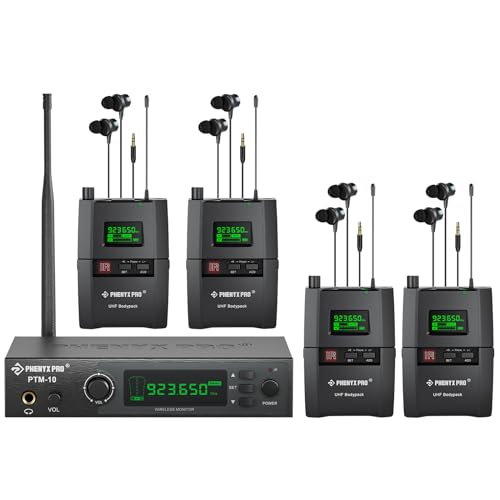
- One transmitter paired with four bodypack receivers
- 89 selectable 900MHz frequencies and up to 160ft range
- Includes four earbuds, rack kit, batteries, and case
Best For: Small bands, worship teams, and multi-performer setups
Best Compact 2.4GHz Pick

- Automatic pairing and mono/stereo switching
- Up to six receivers per transmitter
- Includes in-ear headphones and rechargeable batteries
Best For: Solo performers and small monitoring setups
Best Multi-Performer UHF Kit

- Includes four receiver bodypacks and earphones
- 60 selectable frequencies in the 560–590MHz band
- Advertised range up to 80 meters
Best For: Bands and stage groups needing four monitoring receivers
Best Low-Latency Value

- Under 4.5ms mono-mode latency
- One transmitter supports up to four receivers
- Earbuds sold separately; 6–8 hour battery life
Best For: Small bands and performers who already own earbuds
Best RF Flexibility – Phenyx Pro PTM-10 GEN2
If you need stereo wireless in ear monitor systems for a busy stage, the Phenyx Pro PTM-10 GEN2 emphasizes frequency control and adaptable monitoring. Its auto-scan function, 63 selectable UHF frequencies, three RF power levels, and stated 164-foot range support flexible setups for bands, singers, churches, and live-stage crews.
Best For: Performers and stage teams that want adjustable UHF coverage, stereo/mono operation, and hands-on bodypack controls.
Pros:
- Auto Scan and 63 selectable frequencies help simplify frequency selection in crowded RF environments.
- Switchable stereo and mono monitoring, with more than 40 dB of stereo separation, supports different stage workflows.
- Bodypack includes a limiter, PAD attenuation, balance control, EQ, and lock function.
- Combo XLR/6.35 mm inputs and the included half-rack kit suit fixed or mobile installations.
Cons:
- The system includes only one bodypack receiver, so additional performers require more receivers.
- Its UHF setup and rack-oriented connections may be more involved than compact plug-and-play systems.
The PTM-10 GEN2 is a practical choice when RF flexibility and receiver-side controls matter more than having several bodypacks in the box. The carrying case, earphones, batteries, and rack hardware make it a well-rounded single-performer kit.
Best Low-Latency Stereo Simplicity – Xvive U45D
The Xvive U45D is a straightforward option among stereo wireless in ear monitor systems, using 5.8GHz wireless transmission and dual XLR inputs. Its four monitoring modes, less-than-5ms latency, six channels, and channel scan make it useful for performers who want quick setup without rack gear.
Best For: Musicians, bands, and worship teams sharing a stereo or mono monitor mix with minimal setup.
Pros:
- True stereo mode preserves left/right imaging through separate XLR inputs.
- Four modes provide stereo, left, right, or combined Mix monitoring.
- Less-than-5ms latency helps vocals, instrument attacks, grooves, and click tracks feel immediate.
- Receivers can share the same channel and offer up to five hours of rechargeable battery life.
Cons:
- Its stated wireless range is up to 100 feet, shorter than some UHF alternatives.
- The system provides six channels, which may be limiting for larger or more frequency-dense productions.
Choose the U45D when fast operation and flexible mix routing are priorities. It is especially appealing for small-to-medium performance setups where low latency and shared mixes are more important than extensive RF tuning.
Best Complete Band Kit – XTUGA SEM200
For groups needing multiple listeners, the XTUGA SEM200 stands out among stereo wireless in ear monitor systems by including four bodypacks. Its UHF design offers up to 230 feet of stated range and 200 tunable channels, while stereo/mono modes and Bluetooth 5.3 streaming add flexibility for rehearsals and performances.
Best For: Bands and larger rehearsal or stage setups that need four receivers from one boxed system.
Pros:
- Four receivers are included, allowing multiple performers to monitor without immediate add-ons.
- Up to 230 feet of stated UHF range and 200 tunable channels support larger stage layouts.
- Stereo and mono modes accommodate spatial monitoring or a focused centered feed.
- Bluetooth 5.3 can stream backing tracks, click tracks, or intermission music from compatible devices.
Cons:
- The supplied notes do not specify latency, so timing-sensitive users may want to verify that detail before buying.
- Bluetooth streaming is an added convenience but may not replace a professional mixer connection for every workflow.
- The kit is less suited to buyers who need only one receiver.
The SEM200 offers strong value for a full band because it combines four bodypacks, UHF operation, stereo/mono switching, and preset modes in one package. It is a sensible choice when receiver count and operating range are central requirements.
Best Compact 5.8GHz System – NUX C-7
The NUX C-7 is a compact 5.8GHz choice for shoppers comparing stereo wireless in ear monitor systems for busking and mobile performance. It supports automatic or manual pairing, one-touch frequency hopping, and a mini display that shows channel, battery, pairing, EQ, and system information.
Best For: Buskers and mobile performers who want a simple wireless stereo link for compatible in-ear earphones.
Pros:
- 5.8GHz transmission is designed for stable, low-interference wireless monitoring.
- Auto pairing enables quick one-to-one connections, while manual mode supports one transmitter with multiple receivers across 10 channels.
- One-touch frequency hopping and channel scanning help respond to interference.
- The 0.87-inch display provides visible status information, including battery and channel details.
Cons:
- The supplied specifications list a 33-foot Bluetooth range, so it is not the best fit for long-distance stages.
- Its stated use is busking, which may make it less appropriate for complex professional touring systems.
- The notes specify a six-hour battery life but do not identify the included receiver count.
The C-7 is attractive for performers who value portability, quick pairing, and clear on-device status feedback. Its manual multi-receiver capability adds flexibility, while the relatively short listed range favors compact performance spaces.
Best Value Stereo IEM – Phenyx Pro PTM-10 Single-Receiver System
For shoppers comparing stereo wireless in ear monitor systems, the Phenyx Pro PTM-10 combines selectable 900MHz UHF operation with stereo/mono modes, useful controls, and rack-mount hardware. Its 160-foot stated operating range and 89 tunable frequencies make it a practical option for stage, studio, speech, and presentation use.
Best For: Solo performers, speakers, rehearsals, and compact monitoring setups needing one bodypack receiver.
Pros:
- Switchable stereo and mono monitoring with balance, EQ, limiter, PAD, and lock functions.
- 89 selectable frequencies support operation of up to five systems simultaneously.
- Includes earbuds, carrying case, rack-mount kit, and hybrid XLR/6.3mm inputs.
Cons:
- Includes only one bodypack receiver, so additional performers require extra systems.
- Its stated range is shorter than some long-range alternatives.
This is a well-equipped single-user system with professional-friendly controls and mounting accessories. Choose it when straightforward stereo monitoring and 900MHz reliability matter more than supporting a larger group from one transmitter.
Best Long-Range Stereo IEM – Dual-Transmitter System with Mix Control
This stereo wireless in ear monitor system is designed for advanced monitoring workflows, using dual transmitters and a dual-channel beltpack receiver for independent left and right audio. Mix mode, auto-scan, one-key sync, 5ms latency, and a stated 500-foot open-field range give it a feature-rich profile for demanding live and studio applications.
Best For: Performers and engineers who need true stereo separation, custom channel blends, or extended open-field range.
Pros:
- Supports true stereo operation as well as mix mode with adjustable channel blending.
- Dual transmitters help provide independent left and right channels with reduced crosstalk.
- Offers 5ms latency, auto-scan, one-key sync, rechargeable batteries, and a 500-foot stated range.
Cons:
- The dual-transmitter setup is more involved than a conventional single-transmitter system.
- Battery runtime is listed at 5–8 hours, so extended events may require charging or swapping.
With its unusual common-plus-private mixing concept and dual-channel architecture, this system stands out for customized monitoring rather than basic plug-and-play use. It is especially compelling when spatial separation, cue control, and mobility are central requirements.
Best for Groups – Phenyx Pro PTM-10 Four-Bodypack Kit
For bands and production teams comparing stereo wireless in ear monitor systems, this Phenyx Pro package pairs one 900MHz UHF transmitter with four bodypack receivers. It offers stereo/mono selection, 89 tunable frequencies, rack-mount support, and a stated range of up to 160 feet for coordinated stage or studio monitoring.
Best For: Small bands, worship teams, rehearsals, and productions where four performers need monitoring from one transmitter.
Pros:
- Supplies four bodypacks and four sets of earbuds in one ready-to-use package.
- 89 tunable frequencies support multiset operation with up to five systems.
- Includes stereo/mono modes, EQ, balance, limiter, PAD, lock, rack kit, and carrying case.
Cons:
- The stated operating range is about 160 feet, which may not suit very large venues.
- One transmitter sends the same configured source to the included receivers rather than providing separate transmitter mixes.
This kit is a practical way to equip several performers without buying separate receiver packages individually. Its shared-transmitter design keeps the setup relatively straightforward while providing the controls and accessories expected for recurring stage or studio use.
Best Compact 2.4GHz Pick – Voxfull M6S Stereo IEM System
For shoppers comparing stereo wireless in ear monitor systems, the Voxfull M6S is a compact option with automatic pairing, selectable mono/stereo input, and a supplied pair of in-ear headphones. Its 24-bit/48kHz processing and 2.4GHz wireless link are suited to straightforward monitoring for performances, rehearsals, and church use.
Best For: Solo performers, church musicians, and small setups that want an easy-to-use kit with headphones included.
Pros:
- Automatic transmitter-to-receiver pairing simplifies setup.
- Supports mono/stereo switching and 24-bit/48kHz audio processing.
- One transmitter can pair with up to six units simultaneously.
- Rechargeable batteries provide up to about 10 hours of use after charging.
Cons:
- The 2.4GHz system may be less suitable for environments crowded with wireless devices.
- The supplied receiver and transmitter require approximately three hours to charge.
The M6S stands out as an accessible all-in-one solution: it includes the headphones, offers useful multi-receiver capability, and avoids manual channel selection. It is a practical choice when convenience matters more than advanced frequency-management features.
Best Multi-Performer UHF Kit – D Debra Audio PRO ST-202
Among stereo wireless in ear monitor systems, the D Debra Audio PRO ST-202 is designed for teams: its package includes one transmitter and four bodypack receivers with earphones. The UHF system provides 60 selectable preset frequencies and an advertised range of up to 80 meters, or up to 300 meters in open environments.
Best For: Bands, stage groups, and other multi-performer setups that need four receiver packs from one package.
Pros:
- Includes four receivers and four earphones for shared monitoring.
- Offers 60 switchable frequencies in the 560–590MHz band.
- Advertises up to 80 meters of range, with longer open-area range noted by the manufacturer.
- Includes antennas, audio cables, mounting accessories, and a power plug.
Cons:
- The larger multi-piece setup requires more installation and cable management.
- The product is listed as not water resistant.
- The supplied notes contain mixed wireless-technology labeling, so buyers should verify the exact configuration before purchase.
The ST-202 makes the most sense when several performers need monitoring at once. Its frequency selection and four-bodypack bundle offer more scale than a basic single-receiver system, though the expanded hardware kit is less portable and simple than compact 2.4GHz alternatives.
Best Low-Latency Value – LEKATO MS-02 Wireless IEM
The LEKATO MS-02 is a flexible choice for shoppers seeking stereo wireless in ear monitor systems with low latency and a compact beltpack design. It supports mono or stereo input, offers latency below 4.5ms in mono mode, and can send one transmitter to as many as four receivers.
Best For: Singers, trainees, and small or medium bands that already have earbuds and want a portable wireless monitoring link.
Pros:
- Mono-mode latency is rated below 4.5ms, with 24-bit/48kHz audio processing.
- One transmitter can connect with up to four receiver units.
- Provides mono/stereo switching, one-key mute, and five-level receiver volume control.
- Offers approximately 6–8 hours of operation and a 100-foot open-area range.
Cons:
- Earbuds are not included and must be purchased separately.
- The 2.4GHz open-area range is listed at 100 feet, so real-world range may vary by surroundings.
- Pairing multiple receivers involves repeating the pairing procedure for each unit.
The MS-02 is appealing for users who already own preferred in-ear headphones and want modern convenience features without a bulky rack-style system. Its low latency, mute control, and one-to-four support make it particularly useful for rehearsals and smaller live-performance teams.
How We Picked the Best Stereo Wireless in Ear Monitor Systems
We focused on systems designed for live monitoring rather than casual listening. Our selection includes products with stereo transmission, practical bodypack receivers, and features relevant to musicians, presenters, worship teams, and small production crews. We also considered operating band, claimed range, monitoring flexibility, frequency selection, pairing, rack-mount options, and the number of included receivers.
Because wireless performance varies with venue construction, interference, antenna placement, and local regulations, published range figures should be treated as ideal-condition estimates. Always confirm regional frequency requirements before purchasing.
Quick Comparison
| Best For | What to Look For | Most Relevant Options |
|---|---|---|
| Small bands and solo performers | Simple pairing, low latency, compact hardware | 2.4GHz and 5.8GHz systems |
| Worship teams and ensembles | Multiple bodypacks, stereo or mix modes | Xvive U45D and XTUGA SEM200 |
| Installed or larger stage setups | Rack mounting, selectable frequencies, longer range | Phenyx Pro UHF models |
| Flexible monitoring | Dual-mono, stereo, left/right, or mix control | Xvive U45D and dual-channel systems |
Key Buying Factors for Stereo Wireless In-Ear Monitor Systems
Wireless Band and Interference
UHF systems can offer useful range and dependable coverage, especially when frequency selection is available, but they require more careful coordination. 2.4GHz and 5.8GHz systems are often easier to deploy, though Wi-Fi and other nearby devices may affect performance. For busy venues, selectable channels and a clear frequency plan are valuable.
Stereo, Mono, and Mix Controls
Stereo monitoring preserves left-right placement, while mono or mix modes can help performers hear a balanced signal from a single receiver. If different musicians need different listening arrangements, choose a system with independent monitoring controls rather than a basic stereo-only design.
Receiver Count and Expansion
Check how many bodypacks are included and whether additional receivers can use the same transmitter. A multi-pack may be more economical for a band, but a single-receiver system can be the better choice for a solo performer or presenter.
Latency, Range, and Battery Life
Low latency is important for singers and players who rely on timing. Consider the real distance between transmitter and performers, line-of-sight limitations, battery type, charging convenience, and whether spare batteries can be carried during a long show.
Connections and Stage Integration
Confirm the transmitter’s input type, output routing, antenna arrangement, and compatibility with your mixer or interface. Rack-mount hardware is useful for permanent installations, while clip-on transmitters may suit mobile performers.
Who Should Buy Which Stereo Wireless in Ear Monitor Systems?
Choose a compact 2.4GHz or 5.8GHz system if you want quick setup for rehearsals, small stages, or mobile performances. Choose a multi-bodypack kit if several performers need the same monitor feed. Choose a selectable-frequency UHF system for larger venues or more demanding wireless coordination. Choose a system with multiple monitoring modes if performers need stereo, mono, left/right, or custom mix flexibility.
Before ordering, count your performers, identify the mixer outputs you will use, and check local wireless rules. A system that matches your channel plan and monitoring workflow will usually be more useful than one chosen solely for maximum advertised range.