The right adapter can make a favorite manual or legacy lens useful on a newer mirrorless body, but compatibility goes far beyond the mount name. Aperture control, infinity focus, electronic communication, and lens clearance can all affect whether an adapter fits your shooting style.
This roundup compares 10 camera lens adapters with aperture control across Nikon F, Pentax K, Leica M, Deckel Bayonet, and other systems. Use the guide below to narrow your options by camera mount, lens type, automation needs, and budget.
Best 10 Camera Lens Adapters with Aperture Control Picks for 2026
Electronic AF Pick
VILTROX NF-E1 Nikon F to Sony E Adapter

- Phase-detection autofocus on listed Sony cameras
- EXIF transmission and aperture control
- Supports VR and USB firmware updates
Best For: Sony E users seeking electronic Nikon F lens support
Manual RF Value
PHOLSY Nikon F/G to Canon RF Adapter

- Manual aperture ring for Nikon G lenses
- Glass-free design with infinity focus
- Fits Nikon F types and Canon RF cameras
Best For: Canon RF photographers using manual Nikon lenses
Built-In Dial Pick
Fotodiox Pentax K AF to Sony E Adapter

- Mechanical aperture dial
- Supports infinity focus or beyond
- Anodized aluminum construction with two-year warranty
Best For: Sony E users adapting Pentax K AF lenses manually
Wide Compatibility Pick
PHOLSY Nikon F/G to Sony E Adapter

- Damped manual aperture ring
- Supports many Sony E and NEX bodies
- Glass-free Nikon F/G adaptation with infinity focus
Best For: Sony E users building a broad manual Nikon lens setup
Best L-Mount Aperture Adapter

- Manual aperture ring for Nikon F lenses
- Infinity focus guaranteed
- No autofocus or electronic communication
Best For: Manual Nikon lens use on Leica L-mount cameras
Best Macro Reverse Adapter

- Enables extreme macro photography
- Mechanical aperture control
- Includes UV filter and lens cap
Best For: Nikon users exploring inexpensive reverse-lens macro
Best Sony E-Mount Nikon Adapter
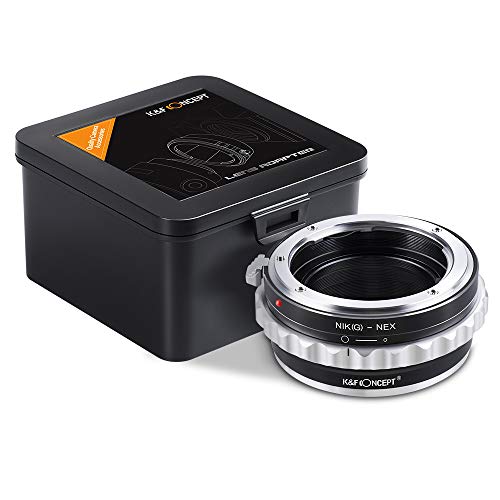
- Aperture ring for Nikon G lenses
- Supports infinity focus and stop-down metering
- Check camera and AI-lens limitations
Best For: Manual Nikon lens use on compatible Sony E-mount cameras
Vintage Nikon Versatility
Fotodiox Nikon F to Canon EF Adapter
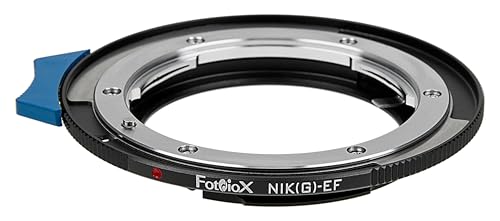
- Built-in dial for G-type lens aperture control
- All-metal build with infinity focus
- Compatible with Canon EF and EF-S cameras
Best For: Canon users adapting Nikon F-mount G lenses
Leica M Manual Control
K&F Concept IV PRO L/M-E Adapter

- Aperture ring and manual focus operation
- Matte interior helps limit reflections
- Designed for Leica M lenses and Sony E bodies
Best For: Sony E users shooting Leica M lenses manually
Solid DKL-to-Sony Fit
Fotodiox Pro DKL-NEX-P Adapter

- Integrated dial for lens aperture adjustment
- Supports infinity focus or beyond
- All-metal construction with a precise fit
Best For: Sony E users adapting Deckel bayonet lenses
Electronic AF Pick – VILTROX NF-E1 Nikon F to Sony E Adapter
The VILTROX NF-E1 is a strong choice among camera lens adapters with aperture control if you want to use Nikon F lenses on compatible Sony E-mount cameras while retaining selected electronic features. It supports autofocus through phase detection on listed Sony models, transmits EXIF data, and works with VR and non-VR lenses.
Best For: Sony E-mount users who want electronic Nikon F lens compatibility, manual aperture control, EXIF transmission, and supported stabilization features.
Pros:
- Supports Nikon F lenses on compatible Sony E-mount cameras.
- Provides autofocus through phase detection on listed camera models.
- Transmits aperture, shutter speed, and exposure information through EXIF.
- Supports VR lenses and firmware updates through USB.
Cons:
- Autofocus support is limited to specific cameras and phase-detection mode.
- Compatibility and electronic performance depend on the lens and camera combination.
With its compact aluminum construction, tripod screw, stabilization support, and upgradeable firmware, the NF-E1 offers more functionality than a basic mechanical adapter. Check the supported-camera list carefully before buying.
Manual RF Value – PHOLSY Nikon F/G to Canon RF Adapter
The PHOLSY Nikon F/G-to-Canon RF adapter is a practical option among camera lens adapters with aperture control for photographers adapting Nikkor lenses to Canon RF bodies. Its built-in ring gives G-type lenses manual aperture adjustment, while the glass-free design preserves the lens’s optical characteristics.
Best For: Canon RF users adapting Nikon G, F, AI, AIS, D, or AF-S lenses for manual-focus photography.
Pros:
- Compatible with a broad range of Nikon F-mount lens types and Canon RF cameras.
- Progressive-damping aperture ring offers controlled manual adjustment.
- No glass or electronic contacts, so there is no stated loss of brightness, contrast, or speed.
- Allows infinity focus and uses lightweight aviation-grade aluminum and magnesium alloy.
Cons:
- All settings must be adjusted manually; autofocus is not available.
- Electronic communication and EXIF transmission are not provided.
This adapter is best viewed as a durable mechanical bridge for users comfortable with manual exposure and focus. It expands Canon RF lens options without adding optical elements that could affect image quality.
Built-In Dial Pick – Fotodiox Pentax K AF to Sony E Adapter
The Fotodiox PKAF adapter is a straightforward choice among camera lens adapters with aperture control for mounting Pentax K AF lenses on Sony E-mount cameras. Its built-in aperture dial provides mechanical control, while the anodized aluminum body is designed for everyday durability.
Best For: Sony E-mount photographers who want to use Pentax K AF lenses with mechanical aperture adjustment and infinity focus.
Pros:
- Designed for Pentax K AF lenses on Sony E-mount cameras.
- Built-in dial provides mechanical aperture control.
- Allows infinity focus or beyond.
- Anodized aluminum construction and a two-year limited manufacturer warranty.
Cons:
- Mechanical aperture control does not provide electronic communication.
- The supplied notes do not indicate autofocus, EXIF transmission, or stabilization support.
For adapting Pentax K AF glass without adding optics, the PKAF keeps the setup simple and gives you direct aperture control. It is a sensible fit for manual shooting, provided you do not need modern electronic lens functions.
Wide Compatibility Pick – PHOLSY Nikon F/G to Sony E Adapter
The PHOLSY Nikon F/G-to-Sony E adapter suits photographers looking for camera lens adapters with aperture control and broad body compatibility. It uses a damped manual aperture ring for Nikkor G lenses, supports many Nikon F-mount variants, and adds no glass or electronic contacts.
Best For: Sony E and NEX users who want to adapt Nikon G, F, AI, AIS, D, or AF-S lenses for manual shooting.
Pros:
- Compatible with an extensive list of Sony E-mount and NEX cameras.
- Manual aperture ring is designed for controlled, progressive adjustment of Nikon G lenses.
- Supports Nikon G, F, AI, AIS, D, and AF-S lens types.
- Glass-free construction preserves stated brightness, contrast, and speed while allowing infinity focus.
Cons:
- No autofocus or electronic contacts are included.
- Sony cameras must be set to “shoot with no lens attached.”
- Focus, exposure, and other settings require manual operation.
This is a useful, lightweight mechanical adapter for building a flexible manual-lens kit around Sony E bodies. Its broad compatibility is appealing, but users should be comfortable changing camera settings and working without electronic lens data.
Best L-Mount Aperture Adapter – Fotasy Nikon F to Leica L
For photographers comparing camera lens adapters with aperture control, this Fotasy adapter provides a manual way to mount Nikon F-mount lenses on Leica L-mount mirrorless cameras. Its aperture ring supports manual F-stop adjustment, while focusing and exposure remain fully manual.
Best For: Panasonic, Leica, and Sigma L-mount users adapting Nikon G or F lenses for manual-focus photography.
Pros:
- Supports Nikon F-mount lenses on compatible Leica L-mount cameras.
- Built-in aperture control ring allows manual F-stop adjustment.
- Infinity focus is guaranteed.
- Compatible with select Panasonic, Leica, and Sigma cameras.
Cons:
- No electrical contacts.
- Autofocus, automatic diaphragm, and other electronic functions do not operate.
- Focus and exposure must be adjusted manually.
This is a straightforward choice for adapting Nikon lenses to an L-mount body when manual operation is acceptable. It is less suitable for photographers who need autofocus or electronic lens communication.
Best Macro Reverse Adapter – Fotodiox 52mm Nikon Kit
This Fotodiox kit takes a different approach to camera lens adapters with aperture control: it reverse-mounts a compatible lens for extreme macro photography. The mechanical adapter provides manual aperture control and includes a 52mm UV filter and lens cap.
Best For: Nikon camera users seeking an inexpensive, manual setup for experimenting with extreme macro photography.
Pros:
- Designed for lenses with a 52mm filter thread.
- Provides mechanical aperture control for Nikon G and DX-type lenses.
- Reverse mounting enables extreme macro photography.
- Includes a 52mm UV filter and cap.
Cons:
- Limited to lenses with a 52mm filter thread.
- Manual-focus operation with no image stabilization.
- Reverse mounting is specialized for macro rather than general-purpose shooting.
Choose this kit if close-up experimentation is the priority. Its low-cost, manual design makes it practical for macro projects, but the filter-thread requirement limits compatibility.
Best Sony E-Mount Nikon Adapter – K&F Concept G/F Adapter
The K&F Concept adapter is a useful option for camera lens adapters with aperture control when pairing Nikon G, F, AI, or AIS lenses with Sony E-mount bodies. Its aperture ring supports stop-down control, and the adapter allows infinity focusing with manual exposure modes.
Best For: Sony Alpha and NEX users adapting Nikon lenses for manual shooting with AE priority or manual stop-down metering.
Pros:
- Compatible with Nikon G, F, AI, and AIS lenses in the supported setup.
- Includes an aperture control ring for Nikon G lenses.
- Supports infinity focus and manual stop-down metering.
- Designed for a broad range of Sony E-mount and NEX cameras.
Cons:
- Does not provide autofocus or electronic lens communication.
- The aperture ring cannot be used with Nikon AI lenses because of the pin arrangement.
- Listed compatibility excludes several Sony models, including the a7S, a7 II, a7S II, and a7R II.
This adapter suits Sony users building a manual Nikon-lens setup, especially with G-type lenses. Verify the camera model and lens type before buying, since compatibility and aperture control vary by combination.
Vintage Nikon Versatility – Fotodiox Nikon F to Canon EF Adapter
For photographers seeking camera lens adapters with aperture control, this Fotodiox model connects Nikon F-mount G-type lenses to Canon EF and EF-S cameras. Its built-in dial provides manual aperture adjustment while the all-metal construction supports a secure, solid fit.
Best For: Canon EOS users adapting Nikon G-type lenses for manual-focus vintage shooting.
Pros:
- Built-in aperture dial controls G-type lenses.
- Supports infinity focus.
- All-metal construction with a secure fit.
- Includes a limited two-year manufacturer warranty.
Cons:
- Manual focus and manual exposure control are required.
- Designed specifically for Nikon F lenses on Canon EF or EF-S cameras.
This is a practical choice for Canon owners who want to reuse Nikon F-mount G lenses while retaining mechanical aperture control. Confirm both mount types before ordering.
Leica M Manual Control – K&F Concept IV PRO L/M-E Adapter
This K&F Concept adapter is a strong option among camera lens adapters with aperture control for pairing Leica M lenses with Sony E-mount bodies. It provides mechanical aperture and focus adjustment, with a matte interior designed to help avoid unwanted light reflection.
Best For: Sony E-mount photographers using Leica M lenses in a fully manual setup.
Pros:
- Includes an aperture control ring for manual adjustment.
- Supports manual focusing without electronic contacts.
- Copper and aluminum alloy construction is designed for durability.
- Matting varnish inside helps reduce light reflection.
Cons:
- No electronic contacts or autofocus support are provided.
- The camera must be set to allow release without a lens.
- Mount compatibility should be verified before purchase.
Its knurled, non-slip design and broad Sony compatibility make it convenient for deliberate, manual shooting. Because camera settings and lens compatibility matter, check your specific Sony body and Leica M lens first.
Solid DKL-to-Sony Fit – Fotodiox Pro DKL-NEX-P Adapter
For photographers looking for camera lens adapters with aperture control, the Fotodiox Pro DKL-NEX-P mounts Deckel bayonet lenses on Sony E-mount mirrorless cameras. An integrated dial adjusts lens aperture, while the precision all-metal construction is designed for a stable connection.
Best For: Sony E-mount users adapting Deckel bayonet lenses for manual aperture control.
Pros:
- Integrated aperture control dial.
- Supports infinity focus or beyond.
- Chrome-plated brass mounts provide a solid fit.
- Designed to avoid play, gaps, or wiggling when mounted.
Cons:
- Compatible with Deckel bayonet lenses and Sony E-mount cameras only.
- Manual exposure control is specified.
- Autofocus capability is not guaranteed by the adapter.
This Pro-series adapter suits Sony users with compatible DKL lenses who prioritize a precise mechanical fit. Verify the lens and camera mounts before purchase, especially when adapting less-common vintage lenses.
How We Picked These Camera Lens Adapters with Aperture Control
We focused on adapters that provide a practical way to control the aperture of compatible lenses, especially lenses with electronic or mechanical aperture limitations. The selection covers both simple manual adapters and more advanced electronic models, including options for Sony E, Canon RF, Canon EF, Leica L, and other camera systems.
We also considered mount compatibility, stated support for G-type or other lens variants, potential EXIF or autofocus communication, construction features, and the needs of photographers using vintage, DSLR, macro, or cinema-style lenses. Because adapter fit is system-specific, always confirm both sides of the mount before ordering.
Quick Comparison
| Best For | Adapter Types to Consider | What to Check First |
|---|---|---|
| Autofocus and electronic communication | VILTROX NF-E1 | Supported Nikon lenses, camera firmware, AF and VR compatibility |
| Nikon G lenses on Sony E | PHOLSY, K&F Concept, or Fotodiox options | G-type aperture lever range and desired build quality |
| Budget manual adaptation | PHOLSY or Fotasy models | Camera mount, infinity focus, and lens clearance |
| Macro experimentation | Fotodiox reverse ring kit | Filter-thread size, lens type, and working distance |
| Specialty vintage lenses | Leica M or Deckel Bayonet adapters | Exact legacy mount and correct flange distance |
Key Buying Factors for Camera Lens Adapters with Aperture Control
Confirm Both Mount Names
An adapter must match the lens mount on one side and the camera mount on the other. “Nikon F,” “Nikon G,” “Sony E,” “Canon RF,” and “Leica L” are not interchangeable labels. Check the exact camera model and whether the lens is G-type, AF-S, AI, AIS, or another variation.
Understand Aperture Operation
Built-in aperture control usually means the adapter moves a lens lever or provides a manual control ring; it does not necessarily provide automatic exposure. Markings may be approximate, and some adapters offer no electronic link to the camera. Electronic adapters can add communication or autofocus, but performance depends on the lens and body combination.
Check Focus and Clearance
Correct flange distance is essential for infinity focus. Also verify that the adapter does not interfere with a protruding rear element, mirror, shutter, or internal camera mechanism. Thin manual adapters are often simpler, while electronic models may be larger and more complex.
Decide Whether Automation Matters
For deliberate manual focus, a basic adapter may offer the best value and reliability. If you need autofocus, lens data, vibration reduction, or EXIF transmission, choose an electronic model and review its supported features rather than assuming every function will work.
Who Should Buy Which Camera Lens Adapters with Aperture Control?
Choose the VILTROX option if electronic communication and possible autofocus are more important than the lowest price. Nikon G-to-Sony E shoppers have several manual choices from PHOLSY, K&F Concept, and Fotodiox, with build quality and control feel helping distinguish them. Pentax K users should look for the dedicated PK-to-Sony E model, while Canon RF, Canon EF, and Leica L owners should select an adapter made specifically for those camera mounts.
For close-up experimentation, the reverse ring kit is the specialist choice rather than a general lens adapter. Buyers adapting rare Deckel Bayonet or Leica M lenses should prioritize precise mount fit and careful handling over broad compatibility claims. In every case, treat adapter aperture markings as a starting point and test exposure and focus with your specific lens and camera.